Dominoes: From Childhood Memories to Modern Gameplay

An ancient game still popular today

August 9

From the time I was a wee tyke, this game was part and parcel of my life. There was something fascinating about these little black tiles with white dots on them. No doubt they helped me learn to count and add.
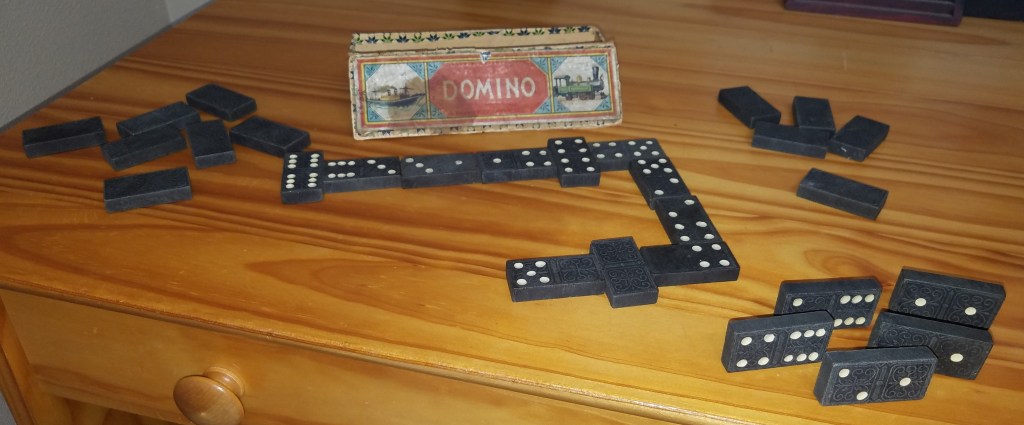
A typical set up for a game of traditional dominoes.

Additionally, they were often employed as bricks for tiny doll houses and set up in rows only to be knocked down.

The domino was first mentioned over 700 years ago. It is, no doubt, one of the oldest games known to man.

Yes, the Infallible Wikipedia has a page devoted to it:
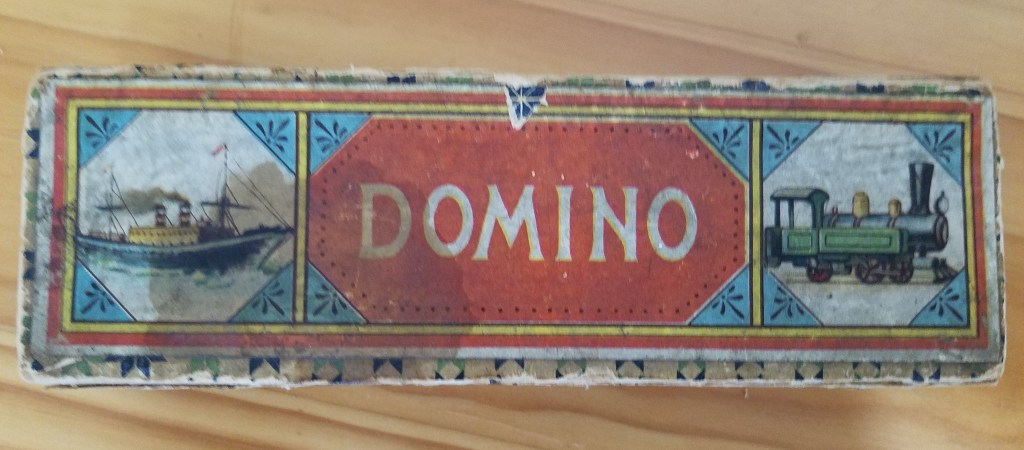
The cover of a domino box which we discovered among my parents’ things. The inside box cover (below) is signed and has a date of 1910 in it.

“The earliest mention of dominoes is from Song dynasty China found in the text Former Events in Wulin by Zhou Mi (1232–1298). Modern dominoes first appeared in Italy during the 18th century, but they differ from Chinese dominoes in a number of respects, and there is no confirmed link between the two. European dominoes may have developed independently, or Italian missionaries in China may have brought the game to Europe.

The name ‘domino’ is probably derived from the resemblance to a kind of carnival costume worn during the Venetian Carnival, often consisting of a black-hooded robe and a white mask. Despite the coinage of the word ‘polyomino’ as a generalization, there is no connection between the word ‘domino’ and the number 2 in any language. The most commonly played domino games are Domino Whist, Matador, and Muggins (All Fives). Other popular forms include Texas 42, Chicken Foot, Concentration, Double Fives, and Mexican Train.”

Now, on the minute chance there are readers who are not familiar with dominos, the most common configuration features a set of 28 tiles. Each tile has two faces featuring from zero to six ‘spots’ on either face. The lowest denomination is double zero (blank on both faces), while the greatest is a double six (a six at either end). In between is every single combination of numbers such as one-five, three-four, two-six, etc.

The traditional game I learned was that each participant drew seven tiles and the one with the highest double would start the game by laying down their tile face up. The person to their left would either play a domino which matched their number (For example, if they played a double five, then the second player had to also play a tile with a five at one end) or draw if they did not have a play.

The game continued until one person was able to play all of their tiles before anyone else.

I have a distinct childhood memory of playing dominoes with my mother and grandmother at the family cabin. My grandmother was a keen game player and, it seemed to me, that she always won. But I’m certain my mother won her fair share also. As a kid, I never stood a chance against them!

After my mother’s dementia had taken over her brain, dominoes was the last game she was capable of playing and my sister would often get out the dominoes set which had been acquired just for Mom and engage her in the activity.
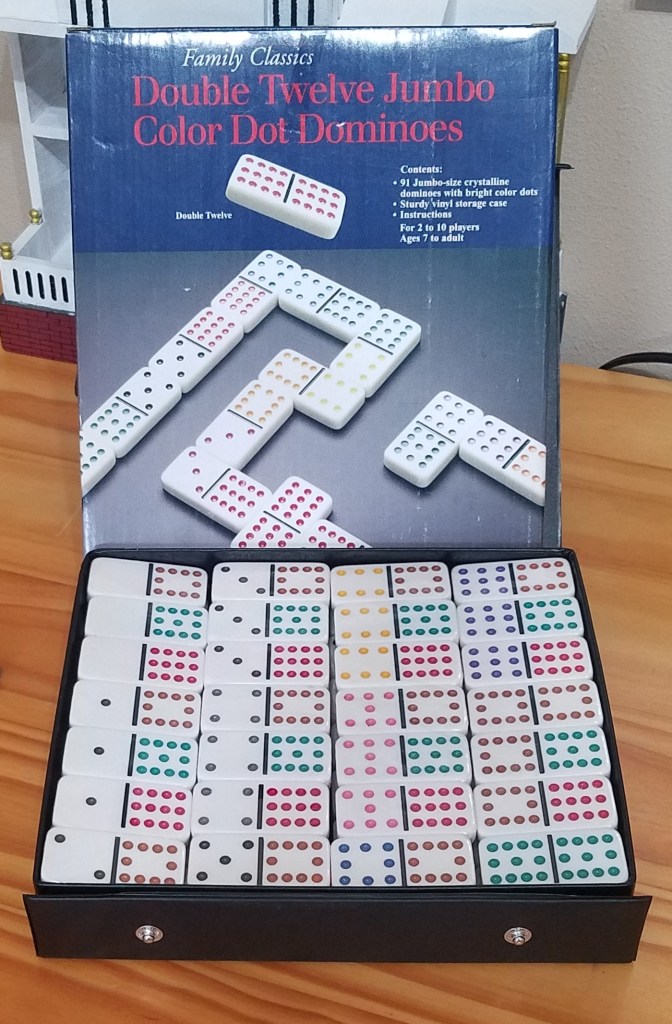
The set of dominoes acquired for Mom after her dementia diagnosis.

More recently, my sister, niece, and my niece’s hubby, introduced me to a domino game which I would describe as being on steroids. The game: Mexican Train.

Mexican Train, however, uses dominoes with zero up to twelve dots on each face, so there are 91 tiles. We turn to the Infallible Wikipedia once again to learn how the game is played:

“With a standard double-twelve set the double twelve is placed in the station. In each successive round the next lower double is used until all doubles are used. The double-blank is the final round.

Play continues to the left. Each person lays one legally placed domino per turn, or two if the player’s first domino is a double. If they are unable to, they must draw a domino from the boneyard. If they are able to lay that domino, they must do so immediately. Otherwise, their turn is over and play continues to the left, each player trying to place all their dominoes by playing matching dominoes one at a time, end to end.

A train can be as long as the players can make it; it ends only when all dominoes that could match its endpoint have already been played. As a result, trains can become quite long, especially with an extended domino set. It is acceptable to ‘bend’ the train 90° or 180° to keep the train on the playing surface, as long as it does not interfere with the endpoints of other trains.

All trains begin the game as ‘public’, and all players may play on them. When a player plays a domino on their train it then becomes ‘private.’ When a player draws a domino and is unable to play it, they must mark their train as ‘public’ by placing a marker on their train.

The Mexican train is an additional train that anyone may play on during their turn. They can start the train by playing a domino matching the engine (i.e. the double played at the beginning of the round) or add to the train.”

I must admit I was curious about how it became known as Mexican train. One last blurb from the Infallible Wikipedia:

The new Mexican Train dominos set up and ready for customers

“‘Mexican Train’ is a name typically used only in the United States. It is believed Mexican Train Dominoes is a variation on a Chinese game called Pai gow, which means ‘make nine’. Chinese laborers brought the game to Latin America once they began working in sugar fields in the mid to late 1800s. Cubans and other Latin American players adopted the game to use dominoes and called it ‘Domino Cubano’. It later arrived in the United States around the 1860s once Cuban laborers began working on U.S. railroads. Americans began referring to the game as ‘Mexican Train Dominoes’ because of its growing popularity among Cuban, Mexican, and other Latin American laborers brought to the United States.”

Playing the game with my sister and her gang has become one of my favorite things to do when we get together. This is in spite of the fact that the final score of the first round of 13 I ever played resulted in me taking high score honors. Oh, did I mention that you are trying to earn the ‘least’ amount of points? Exactly.  

My high score – which was somewhere in the high 600’s – has not, to my knowledge, been eclipsed by anyone else in our quartet. My niece tried hard to get there last week when the four of us spent a few days at the beach. I have yet to check with her to see if, from the past score sheets which are kept, if she is the new high score champ.

In years past, she has brought the Mexican train set she owns with her on the annual trip. But this year it was accidentally left behind. As fate would have it, the first day we were there was my birthday and, after a stop at Fred Meyer, there appeared a shiny new metal tin full of dominos as a gift.

Now one might think that since it was my birthday week, they would at least let me win the game. One would be wrong. Despite my best efforts, it was my sister who came out on top for this two day round of Mexican Train, followed by her son-in-law, then me, and then my niece.

Since I started playing with them, however, I would say each one of us has been the victor at least once.

Ultimately, however, I always come away from the game feeling as though I’m the winner, regardless of the score. For me being able to experience the joy of simply playing games with family and friends is the real win.

As for the new set of tiles, I opted to leave them in the owner’s closet at the family condo for all to enjoy when at the beach.

The links:

https://en.wikipedia.org/wiki/Dominoes

https://en.wikipedia.org/wiki/Mexican_Train

If you have a few minutes take a look at this YouTube video of dominoes set up and then getting knocked down. I don’t possess the patience to do something like this.

Alone Again (Naturally)

Reflections on Life

August 2, 2022

Over the course of the past several years, I’ve developed a list of potential topics for Tuesday Newsday. If something occurred on a certain date, I will sometimes pencil it in ahead of time.

This particular song, which reached the top of the Billboard charts for six weeks starting on July 29, 1972, has been on that list since the beginning. But each year at this time, there were other topics which resonated more.

I can’t explain why, exactly, except to say that while I liked this song as an angsty 15 year old, there wasn’t any particular tie in for me. Until now.

First, about the song.

Alone Again (Naturally) was written and sung by a young artist by name of Gilbert O’Sullivan. From the Infallible Wikipedia:

“The single spent six non-consecutive weeks at no. 1 on the United States Billboard Hot 100 singles chart, which ranked it as the No. 2 song for 1972. In Casey Kasem’s American Top 40 of the 1970s, ‘Alone Again (Naturally)’ ranked as the fifth most-popular song of the decade (Debby Boone’s ‘You Light Up My Life’ was no. 1). It also spent six weeks at no. 1 on the easy listening chart, and reached no. 3 on the UK Singles Chart. (snip)

‘Alone Again (Naturally)’ is a melancholy, introspective ballad. In the first verse, the singer contemplates suicide after having been left ‘in the lurch at a church’; in the second, he wonders if there is a God; finally, he laments the death of his parents. O’Sullivan has said the song is not autobiographical: for example, his mother was alive during its composition, and he was not close to his father, who was cruel to his mother and died when the singer was 11 years old.

The song received extensive radio airplay in the months after its release, and was critically praised. O’Sullivan commented that ‘Neil Diamond covered ‘Alone Again (Naturally)’ and said he couldn’t believe a 21-year-old wrote it, but for me it was just one song I had written.’ Neil Sedaka stating when he covered the song in 2020 that he wished that he himself had written the song, because its complexity was more typical of someone much older than 21.”

The complex lyrics tugged at the heartstrings of anyone who had ever suffered through a break up or questioned their faith or lost a parent. When I was 15 I had not experienced enough life to truly appreciate how profound the song is. What I do know is that I loved the song as somehow it spoke to something deeper.

And yet, when it came to including in my blog, I never did and was not going to again this week. Then, on July 29, something changed.

That something was the dreaded phone call, this time from the hubby’s younger sister, to let us know that my 96 year old father-in-law had passed a short time earlier.

To be clear, it was not unexpected. He had been struggling with ill health for quite some time. But dying, for those who have not been through it with an elderly loved one, is often a multi-week, if not months, long process. The steps are incremental.

For the family, however, his was above all else, a love story.

At the ripe old age of 20 in the autumn of 1945, he was on a Navy ship. Yes, he saw battle in WWII. But the particular day we always heard about was the day his ship was stationed in Seattle and, with a bit of shore leave, had disembarked.

In the crowds there to greet the young men, was an 18 year old girl from West Seattle. At the time, that’s what the young women would often do, go down to meet and greet the sailors who came to port.

It was a rainy day (of course it was, it was Seattle in October). My mother-in-law has always told the story that she saw him through the crowd and knew she wanted to meet him. He had ‘earrings’ on his ear lobes. Not real earrings, but droplets of water which clung to the bottom of his lobes just like the real thing.

Plus, I’ve seen the pictures of them from that time and they were both ‘lookers.’

I have no idea how long he was in port, but it was long enough for them to fall in love. They were married only five months later on March 20, 1946.

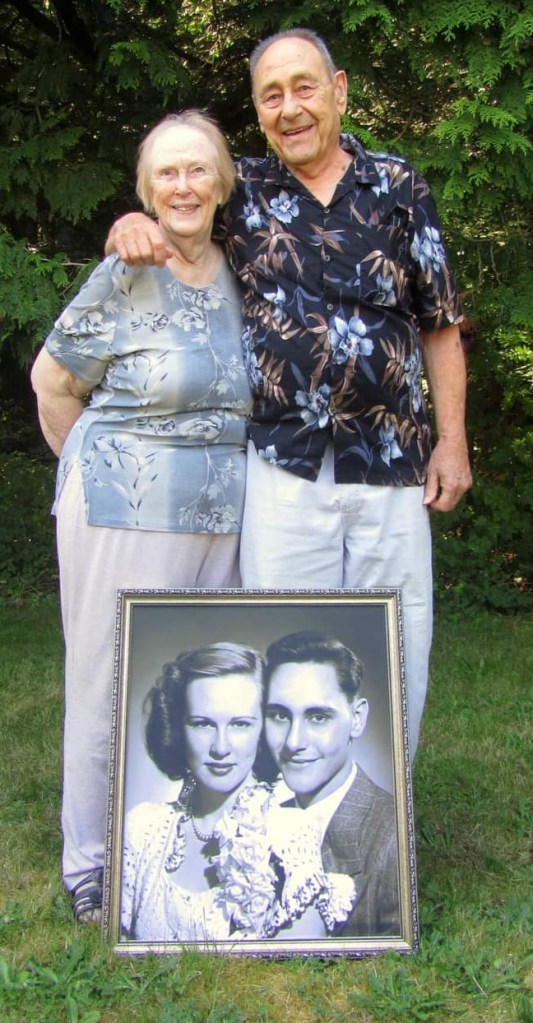
Photo taken a couple years ago with their wedding photo from 1946

This past March they celebrated their 76th wedding anniversary!

Through the years there were, no doubt, disagreements and times of challenge. But truly, theirs was a testament to the enduring power of love and commitment. Four children, six grandchildren, one great grandchild. Daughter and Son-in-laws. Heartache and joy. And being each other’s best friend for 76 years.

RIP my beloved father-in-law.

Ancestor Hunting: DNA

Who Am I? Where Did I Come From?

July 26, 2022

My page from Ancestry which displays my heritage groups. The two additional groups not shown are Sweden/Denmark and Scotland. When all the Scandahoovian pieces are added together, they represent the majority of my DNA

Between the internet and advances in DNA testing, tracking your ancestors has become infinitely easier. With these technologies, however, are risks. And sometimes people don’t want to hear what the facts reveal.

Of the two it is DNA testing which has unlocked more closets full of skeletons. But first a bit about the technology.

For anyone who knows me, they understand that while I love learning about the general science behind things, my eyes pretty much roll back in my head when the specifics are touted. In reading about DNA on the Infallible Wikipedia, my eyes were doing some pretty serious rolling back. As a writer I try to distill things down to their most basic as a service to all others who don’t want the Deoxyribonucleic acid, double stranded helix of polynucleotide chains explanation.

Deoxyribonucleic acid, double stranded helix of polynucleotide chains

Thankfully, there was a second Infallible Wikipedia article helpfully titled Introduction to Genetics. Here’s more of a layman’s explanation:

“Genes are made from a long molecule called DNA, which is copied and inherited across generations. DNA is made of simple units that line up in a particular order within this large molecule. The order of these units carries genetic information, similar to how the order of letters on a page carries information. The language used by DNA is called the genetic code, which lets organisms read the information in the genes. This information is the instructions for constructing and operating a living organism.

The information within a particular gene is not always exactly the same between one organism and another, so different copies of a gene do not always give exactly the same instructions. Each unique form of a single gene is called an allele. As an example, one allele for the gene for hair color could instruct the body to produce much pigment, producing black hair, while a different allele of the same gene might give garbled instructions that fail to produce any pigment, giving white hair. Mutations are random changes in genes and can create new alleles. Mutations can also produce new traits, such as when mutations to an allele for black hair produce a new allele for white hair. This appearance of new traits is important in evolution.”

Okay, okay, even THAT required we go wandering out in the weeds a bit. I recall first learning about genetics and found the concept of one’s chances of having blue or brown eyes fascinating. In my nuclear family there wasn’t a brown eye to be found; we ALL had blue eyes – well, except for my sister who ended up with green eyes which are kinda like blue eyes on steroids. It was only when I was older did I come to understand that some 8 percent of the world population has blue eyes and only 2 percent have green eyes! And, those who have either blue or green eyes are most likely to be able to trace their roots to northwestern Europe.

A helpful chart which sums up WHY there were no brown eyes from my parents all blue ones. My sister is truly rare!

Which brings us round to what is known as Genetic Genealogy. The Infallible Wikipedia describes it as:

“…the use of genealogical DNA tests, i.e., DNA profiling and DNA testing, in combination with traditional genealogical methods, to infer genetic relationships between individuals. This application of genetics came to be used by family historians in the 21st century, as DNA tests became affordable. The tests have been promoted by amateur groups, such as surname study groups or regional genealogical groups, as well as research projects such as the Genographic Project.

As of 2019, about 30 million people had been tested. As the field developed, the aims of practitioners broadened, with many seeking knowledge of their ancestry beyond the recent centuries, for which traditional pedigrees can be constructed.”

I am a big fan of DNA testing in the search of ancestors and have more than a few good stories about this pursuit. One of the early tests involved my Dad to have him test for what’s known as “y-DNA” or, more commonly, to trace the male line only. For years I had been frustrated with the DeVore family line as, apparently, my great-great Grandfather Hartley had been dropped into Wisconsin in 1848 from outer space.

A 23andMe kit

Thanks to my dad’s test, however, I connected with a close genetic ‘cousin’ who shared the name and lived in Georgia! In fact all of the folks who closely matched him have that common trait: a last name of DeVore. So far so good.

Then, in early 2019, I took the Ancestry.com test, and was very interested to see where that would lead. And my sister took it and, thankfully, we were still sisters. And then the Hubby took a test and, thankfully, our cousin-ness stayed firmly at multiple generations. In fact our genetics are so far removed, the DNA matching doesn’t go back that far.

Then in summer 2019 I purchased kits for our kids. And then we waited. Finally the first results came back for our son. Our daughter got hers the next day… and then the hubby and I checked our Ancestry accounts which helpfully tells you ‘who’ you are related to and how and I blasted out the message to the three of them something along the lines of “Good News! Your father is, er, your father.”

Which brought us, as parents, all sorts of amusement since we were both 100 percent certain that would be the result.

But it also highlights one of the issues with DNA testing. Sometimes people discover things they’d rather not know. On my sister’s husbands side of the family a ‘cousin’ popped up who no one had ever heard of or met. The wife of the ‘cousin’ contacted my niece and told her they had decided the testing must be flawed. Considering the fact that both Ancestry AND 23andMe connected him not only to my niece but also one of my niece’s first cousin and, eventually, her Dad when he took the test… well, it would seem that the mystery cousin’s heritage is not what he was raised to believe about his family.

My niece and I discussed it several times and she and I concluded that it was best to drop the whole thing as the possibility of an unhappy ending was great.

Recently I had a similar mystery reveal itself in my family. There is intrigue as to why one of the DNA ‘matches’ I have seems to suggest a further apart relationship than what we’ve always believed. It’s not something I plan to pursue unless the person involved also happens to notice.

From my perspective as a historian and genealogist, however, the facts are the facts. And I always want to learn the whole story in all its messy human details. It’s in my DNA.

So many links:

https://en.wikipedia.org/wiki/Genetic_genealogy

https://en.wikipedia.org/wiki/DNA

https://en.wikipedia.org/wiki/Eye_color#Green

https://www.ancestry.com/

https://www.23andme.com/

https://www.familytreedna.com/public/DeVoreDNA/default.aspx?section=ycolorized (This is the link to the paternal line DNA test my father took and shows all the other DeVore’s who are closely related)

https://www.familytreedna.com/

And a reward for all of you who read to the very end… this trailer from a 1964 Elvis movie: Kissin’ Cousins. Until a few minutes ago I never knew this movie existed. Not sure my life has been enhanced because of this new knowledge!

Ancestor Hunting

Did I really marry my cousin?

July 19, 2022

Who am I? Where did I come from?

These two age old questions are ones which humans often start asking at a young age.

In the home where I grew up, I became aware – at about age 10 – of an old photo album. Inside the very heavy, olive green velvet book were fragile pages of black and white photos of people who, my mother told me, were my ancestors.

The first family photo album I ever saw. It was full of photos of my great grandmother’s family. Sadly, she did not label many photos so it was up to me to try and figure out who the people were.

It was an odd thought to think that these people – dressed in old fashioned clothes and hairstyles– were related; people of a different place and time.

Thus was born, for me, a lifelong interest in genealogy and a quest to answer those two questions: Who am I? Where did I come from?

When at college at the University of Puget Sound, I took a month long intense study class (the session was called Winterim) in January of 1979 where the focus was only genealogy. With that excellent professor to guide us, class participants traveled to the National Archives at Sand Point in Seattle and pored over microfiche census records, perused the available book collections at the Seattle Public Library, and learned to craft letters to governmental agencies for information. And, of course, got a master’s class as to how to research and document one’s genealogy.

At that time there was no way to access digital databases because they did not exist. All research took excessive amounts of time and travel, often with limited results, and meticulous hand written records.

Then, in 1996, two Provo, Utah, residents changed the world for genealogists everywhere. The Infallible Wikipedia tells us:

“Paul Brent Allen and Dan Taggart, two Brigham Young University graduates, founded Infobases and began offering Latter-day Saints (LDS) publications on floppy disks. In 1988, Allen had worked at Folio Corporation, founded by his brother Curt and his brother-in-law Brad Pelo.

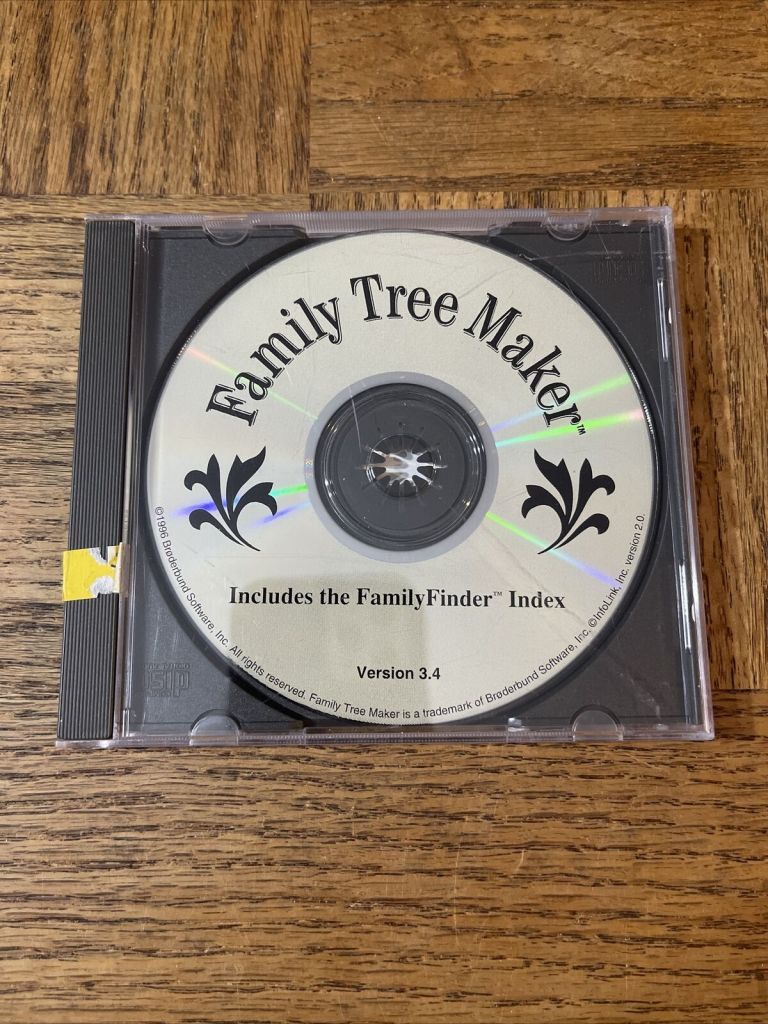
The genealogy program my mother in law purchased.

Infobases’ first products were floppy disks and compact disks sold from the back seat of the founders’ car. In 1994, Infobases was named among Inc. magazine’s 500 fastest-growing companies. Their first offering on CD was the LDS Collectors Edition, released in April 1995, selling for $299.95, which was offered in an online version in August 1995. Ancestry officially went online with the launch of Ancestry.com in 1996.” (The Paul Allen named is not the same one who co-founded Microsoft)

Over the years, there have been numerous entertaining – at least to me – events which have occurred. Which is why this is likely to be a multi-week series of articles.

My mother-in-law spent decades researching her family lines and she, and my father in law, literally travelled in a Fifth wheel travel trailer for ten years all across the United States sightseeing and researching. She had purchased Allen and Taggart’s $300 product and used it daily.

Photo of my great grandmother Rosanna Bell King DeVore and her three sisters, about 1886, taken in Fairmont, Minnesota. The photo is in the album which I still have.

The topic of genealogy has always been one which she and I have enjoyed discussing, ad naseum. Her impressive collection easily involves 50 large notebooks filled with carefully researched documents found throughout the United States as well as many garnered from other researchers who had made the leap ‘across the pond’, so to speak.

One thing she has always been quite proud about is her connection to one family on the first sailing of the Mayflower and the many ancestors who settled in the northeast.

Back in 1996, when she was heavily into the research, I had discovered some of the early ‘on line data bases’ and would frequently go out to Rootsweb to see if any potential relatives had posted something new.

Although I cannot recall the specifics of the event, one day I happened upon a distant relative’s family tree and started clicking backwards. Doing this often provided names and dates for previously unknown ancestors, thus enabling me to expand my family tree.

I was in my father’s line which had me back in Massachusetts. Not quite Mayflower connections, but darn close. It was a day when I ‘jumped the pond’ to England with my ancestor Elizabeth House… whose mother was one Elizabeth Hammond.

An ambitious King relative collected and compiled the family history back in the 1950’s. His work was essential to getting me started in my research.

Hammond? Where had I seen that name recently? Then it hit me. Hammond was one of the names from my mother-in-law’s family which I had seen earlier that day when discussing genealogy with her! Hmmm… I wondered.

As I had her paper ancestry trees on the desk next to me, I only had to turn a few pages and there was THE  connection. The one which proved that not only were my mother-in-law and I blood related but I had, in fact, married a cousin!

I think I let out a ‘whoop’ of some sort and then turned around to where my Mother-in-law happened to be sitting as she and my father-in-law were visiting, and announced that I’d found the holy grail of connections to prove, once and for all, that we were related.

Which meant, of course, that I had married my cousin (all legal since it was 10 generations back).

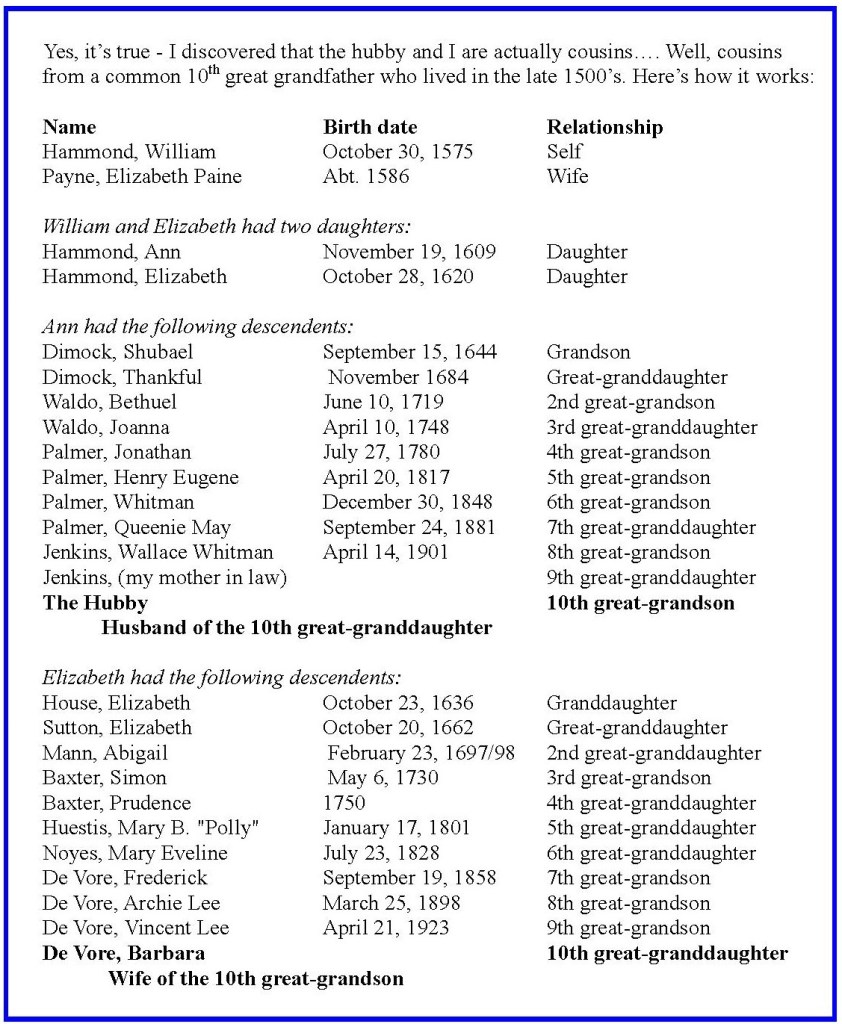
The chart I created in 1996 to document how the hubby and I were cousins

My poor daughter – only six that year – got the most confused look on her face when she learned that her Mom and Dad were related to each other which meant, and I quote, “Wait? How can I be related to myself?”

This caused all sorts of amusement for the family and I love to tell people that I’m married to my cousin if only to see the reaction I get.

As for my daughter’s question, the answer is that all of us are likely related to ourselves at some point. It kinda blows the mind, doesn’t it?

I must end, however, with the caveat all genealogists give. It is possible, that somewhere along the way there is an attribution for a person which will turn out to be wrong. Alas, none of us can go talk to the people involved to verify the information. All we can do is look for connections and, nowadays, to see if we have shared DNA to others claiming the same ancestors. But that IS a story for another week.

A link to https://www.ancestry.com/

https://en.wikipedia.org/wiki/Ancestry.com

Family Feud

A TV staple since 1976

July 12, 2022

The concept of this game show is fairly simple: two groups of five people – families – compete to see which group can successfully guess the top answers to questions answered by a studio audience.

The Family Feud premiered on July 12, 1976. It has been one of the longest running and most popular game shows on American television.

When it first went on the air, it was hosted by Richard Dawson, a British actor made famous as Lieutenant Newkirk on the 1960s sitcom, Hogan’s Heros. When that series ended, Dawson became a regular on The Match Game and was then made the first host of Family Feud.

Dawson was known for his kissing of the female contestants; a practice which drew criticism during the show’s first iteration. For Dawson, however, it seemed to have worked out well. From an article in Good Housekeeping, we learn:

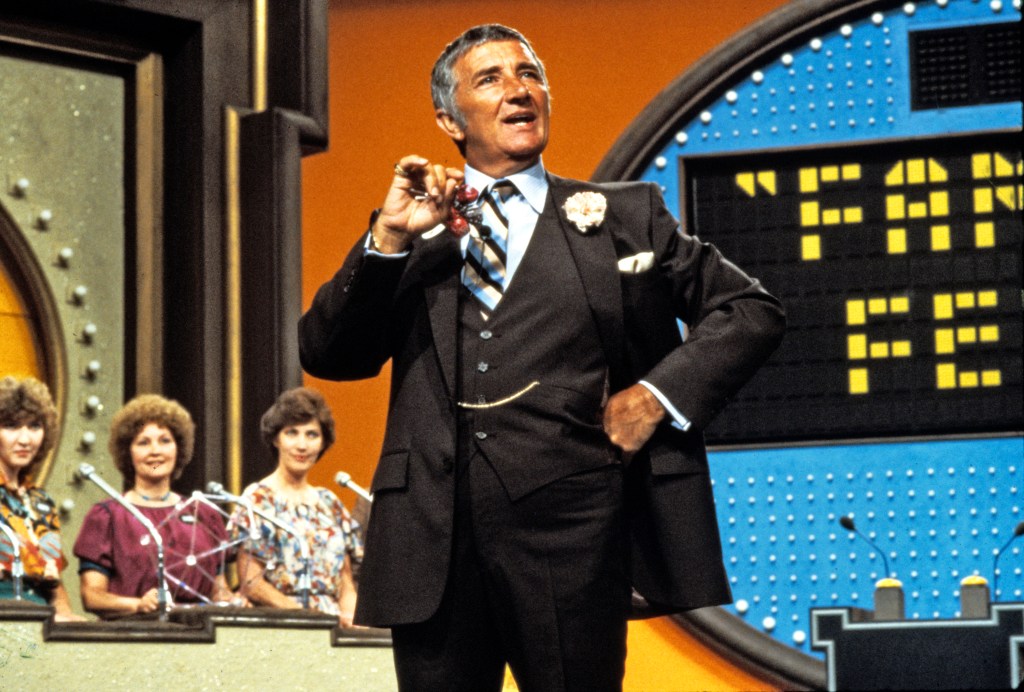
UNITED STATES – APRIL 16: FAMILY FEUD – 4/16/81, Show coverage. Pictured: host Richard Dawson, (Photo by ABC Photo Archives/ABC via Getty Images)

“He allegedly asked viewers to vote on whether or not they would like him to stop. The votes came in 14,600 to 704 in favor of kissing, according to Hogan’s Heroes: The Unofficial Company. The book also reveals that contestants filled out a questionnaire before each game including, “Do you mind if Richard Dawson greets you with a kiss?” Apparently, not many declined.

As controversial as the kissing was, in 1981, Dawson planted a peck on a woman who would eventually become his second wife. Forty-nine-year-old Dawson met 24-year-old Gretchen Johnson when she was a contestant on the show.”

Dawson continued as host for the next nine years but the kissing stopped after he and Gretchen were married.

The show had two subsequent hosts after Dawson but the show – and game shows in particular – had lost popularity with the viewing public.

Dawson with future wife Heather when she was a contestant on the show.

That all changed when, in 2010, they hit upon Steve Harvey, a host who was so relatable that it’s ratings skyrocketed back to the top. The infallible Wikipedia shares:

“The show’s Nielsen ratings were at 1.5, putting it in danger of cancellation once again (as countless affiliates that carried the show from 1999 to 2010 aired it in daytime, graveyard or other low-rated time slots). Since Steve Harvey took over the show, ratings increased by as much as 40%, and within two short years, the show was rated at 4.0, and had become the fifth-most-popular syndicated program. Fox News’ Paulette Cohn argued that Harvey’s ‘relatability,’ or ‘understanding of what the people at home want to know,’ was what saved the show from cancellation; Harvey himself debated, ‘If someone said an answer that was so ridiculous, I knew that the people at home behind the camera had to be going, ‘What did they just say?’ … They gave this answer that doesn’t have a shot in hell of being up there. The fact that I recognize that, that’s comedic genius to me. I think that’s [what made] the difference.’

One of the things which has endeared Steve Harvey to Family Feud fans is his expressive face.

Steve Harvey’s Family Feud has regularly ranked among the top 10 highest-rated programs in all of daytime television programming and third among game shows (behind Wheel of Fortune and Jeopardy!); in February 2014, the show achieved a 6.0 share in the Nielsen ratings, with approximately 8.8 million viewers. In June 2015, Family Feud eclipsed Wheel of Fortune, which had been on top for over 30 years, as the most-watched syndicated game show on television, and consistently began ranking among the top three shows in all of syndication.”

Unlike Dawson, Harvey does not kiss the female contestants. I think the thing which makes him so endearing is that he clearly is having fun as he hosts. You see him laughing along with the contestants and the audience at the ridiculous answers often given.

I had not watched Family Feud since the 1970’s when Dawson was the host. But in early 2012 when my mother landed in one particular care facility, their version of getting the residents up and interactive was to move them to a half circle of recliners set up to watch TV each morning and afternoon.

In my mother’s ‘house’ there were six residents plus one particular twice a day visitor and fixture, also known as my Dad. When I would visit Mom at the facility, Family Feud was often playing on the big TV.

For me, I always enjoyed the show but my dad, well, not so much. Every day there seemed to be a battle over ‘what’ would be watched on the living area TV. Dad consistently angled to get control of the remote and soon Family Feud was gone and Gunsmoke or Gilligan’s Island reruns would be playing.

Sometimes the residents – who seemed to like Family Feud – would complain and one of the staff would switch the TV back to the game show.

That sometimes would prompt Dad to get Mom up and we’d return to her small room to visit there.

After leaving that facility, Mom had a TV in her room at the new Adult Family Home and Dad always had control of the remote when he was there. I can’t say I’ve ever seen Family Feud on TV again.

But there is, of course, the internet. YouTube has, literally, hundreds of clips which provide endless hours to waste, er, research for this topic.

For a more exhaustive look at Family Feud, here are a few links:

https://en.wikipedia.org/wiki/Family_Feud

https://www.goodhousekeeping.com/life/a46188/richard-dawson-kssing-family-feud/

A Crow Named Bob

Considered one of the most intelligent species

July 5, 2022

The species Corvus – commonly known as a crows, ravens, and jackdaws – are considered some of the most intelligent creatures on earth. They have been documented to construct ‘tools’ from materials, can recognize specific people and animals of other species, and work cooperatively together to achieve goals.

Crows were frequent visitors to our backyard in Kirkland, often challenging the squirrels for a food source.

For purposes of today’s Tuesday Newsday, we shall refer to this bird simply as ‘crows.’ I chose the first week in July to highlight crows as I propose that the national symbol of the United States could just as easily been a crow rather than an eagle.

Legend has it that Benjamin Franklin suggested the turkey as the national bird but others thought the eagle to be more majestic. In terms of sheer intelligence, cleverness, and persistence, however, it is the crow which dominates. These attributes, to me, more closely encapsulate the nature of Americans.

The Infallible Wikipedia shares the following:

“As a group, crows show remarkable examples of intelligence. Natural history books from the 18th century recount an often-repeated, but unproven anecdote of ‘counting crows’ — specifically a crow whose ability to count to five (or four in some versions) is established through a logic trap set by a farmer. Crows and ravens often score very highly on intelligence tests. Certain species top the avian IQ scale. Wild hooded crows in Israel have learned to use bread crumbs for bait-fishing. Crows engage in a kind of mid-air jousting, or air-“chicken” to establish pecking order. They have been found to engage in activities such as sports, tool use, the ability to hide and store food across seasons, episodic-like memory, and the ability to use individual experience in predicting the behavior of proximal conspecifics. (snip)

A crow seems to find these baby toys irresistible. AvesNoir.com

The western jackdaw and the Eurasian magpie have been found to have a nidopallium about the same relative size as the functionally equivalent neocortex in chimpanzees and humans, and significantly larger than is found in the gibbons.

Crows have demonstrated the ability to distinguish individual humans by recognizing facial features. Evidence also suggests they are one of the few nonhuman animals, along with insects like bees or ants, capable of displacement (communication about things that are not immediately present, spatially or temporally). (snip)

In the past there have been plenty of studies conducted on how ravens and corvids in general learn. Some of these studies have concluded that the brains of ravens and crows compare in relative size to great apes. The encephalization quotient (EQ), helps to expose the similarities between a great ape brain and a crow/raven brain. This includes cognitive ability. Even though the brain differs significantly between mammals and birds we can see larger forebrains in corvids than other birds (except some parrots), especially in areas associated with social learning, planning, decision making in humans and complex cognition in apes. Along with tool use, ravens can recognize themselves in a mirror.”

Here in the Pacific Northwest, crows are everywhere. But that was not always the case. They were rare at the beginning of the 20th century.

Recently, the hubby and I had a crow encounter which we are unable to explain. While strolling down a sidewalk in the Fairhaven neighborhood of Bellingham, a crow swooped low over the hubby’s head, causing both of us to duck. When the crow repeated the action less than a minute later – this time making contact with the hubby’s hair – we knew it was not a random event. We wonder if the hubby’s head, slightly sunburned and shiny on a small spot at the crown, attracted its attention. Regardless, we did not wish to tempt the bird a third time and crossed the street to safety.

Their reputation for collecting shiny objects is based on this behavior. https://kids.britannica.com/

It was another crow encounter, in July of 2005, which became the reason I think the crow should have been our national bird.

I was, along with hundreds of others, at the Sundome in Yakima, Washington, for the Washington/Idaho Rainbow Girls annual convention.

Somehow, a crow had gotten into the building but, apparently, had no way to get out. No worries for the crow, as it swooped and flew around the large space, entertaining the girls, their families, and advisors.

The young woman who was leading the group that year dubbed the crow “Bob” in honor of a group of adult volunteers who had formed a vocal quartet named “The Bob’s” as all the men were named Bob.

For three days Bob flew around the building and was seen alighting on chairs and backdrops – pretty much anywhere. I imagine finding food was not an issue as, no doubt, more than a few snacks were likely consumed – and morsels dropped – by the attendees.

It was on the last day, July 10, when a scenario so perfect occurred that a Hollywood screen writer could not have scripted it better.

The moment had arrived for the Stars and Stripes to be returned from its place of honor on the main stage to the back of the room. This job fell to one of the young women present who – with great reverence – arrived at the flag, bowed to it, and then hoisted it aloft to carry it down a ramp and across the large convention center floor.

Lee Greenwood’s God Bless The USA played over the loud speaker as all eyes watched her procession. Then Bob stole the show.

The crow soared high across the arena, landing on the top of the loudspeaker system just below the ceiling, at the center of the dome. He paused for a moment and then, when the flag bearer was directly underneath him, he flapped his wings and flew in the same direction as she was walking, disturbing confetti which had likely settled on the loudspeaker a week earlier during Fourth of July celebrations.

Tiny red, white, and blue tissue paper glittered in the lights as it filled the air and swirled to the floor.

It was the most awe inspiring patriotic moment I’ve ever experienced.

I was able to confirm that Bob – like the rest of us – departed the Sundome later that evening to go back to his regular life. From the writeup in the Rainbow Girls newsletter:

“Of course, this article would not be complete without mention of Bob the bird. He appeared during set-up and stayed throughout all of the sessions, often coming to visit in the East, taking a bath in the decorations or sitting in the middle of the floor. He enjoyed the sessions and no one will soon forget our special visitor. And for those who may be wondering, Bob did leave the Sundome as the clean up process was coming to an end on Sunday night.”

Well done, Bob, well done. You are a credit to your species and an inspiration to us all.

The Links:

https://en.wikipedia.org/wiki/Corvus

https://en.wikipedia.org/wiki/International_Order_of_the_Rainbow_for_Girls

Washington/Idaho Rainbow Girls webpage: https://www.nwrainbow.org/

Summer Solstice

The Best Day of the Year

June 21, 2022

On June 21 at 2:13 a.m. Pacific Daylight Time, the sun (which will be seen elsewhere around the globe, but not in our time zone) will stand still for a moment, thus marking its northern hemisphere zenith.

A mid-July ‘sunset’ over Bergen, Norway, harbor. The sun never completely sets during the summer months that far north. This photo was taken by the author in 1980 around midnight.

From then on it is, as one might say, all downhill from there.

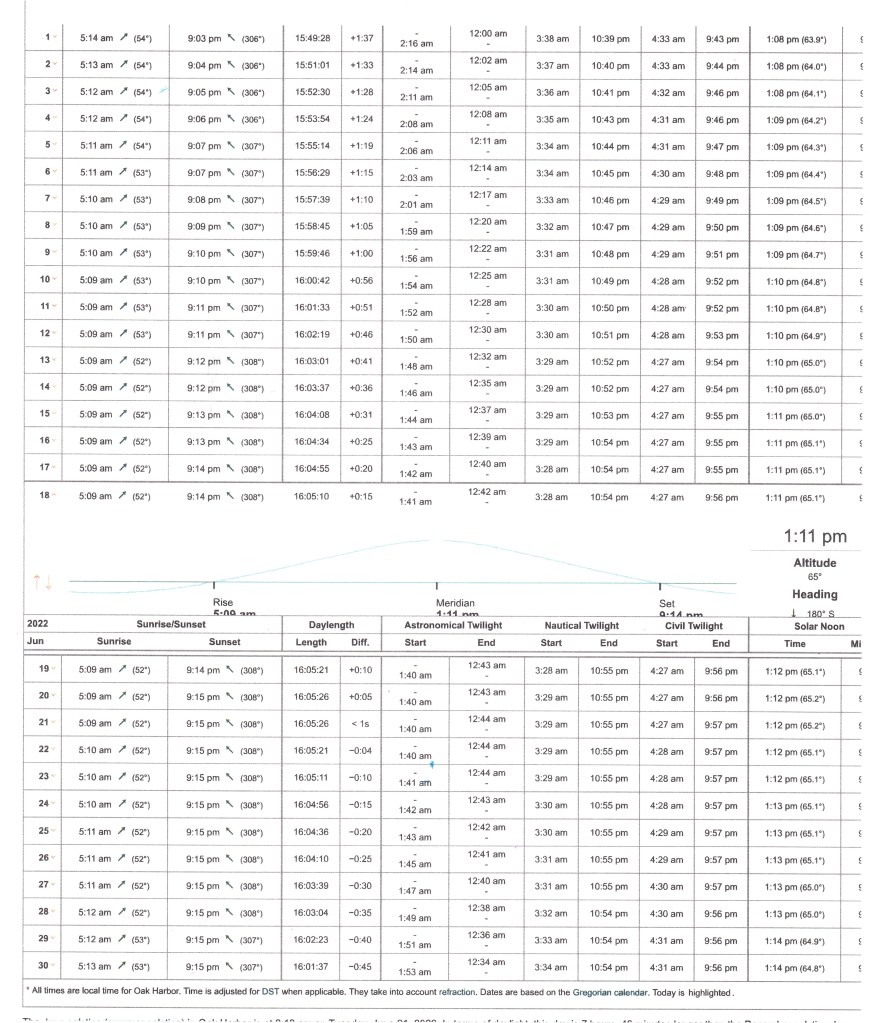
The summer solstice is the longest number of daylight hours for us. In fact the sun will not set until 9:15 p.m. with civil twilight extending until just before 10 p.m. and not fully dark until 12:45 a.m.

While many think of the solstice as being the longest day, the change is imperceptible. In fact, the sun will set at 9:15 p.m. for the remainder of June and then, on July 1st, it will set one minute earlier.

Where the real change occurs is in the morning. Sunrise is at 5:09 a.m. on both June 20 and 21 but is one minute later on the 22nd. By that same July 1st date it will be a whole 5 minutes later. Now, for most of us, it will be unnoticeable since we are likely to be asleep.

While the Infallible Wikipedia does provide all sorts of technical information about the solstice, I like the website timeanddate.com which shows in very understandable graph form all the geeky minutiae I crave. As seen here:

The June sunrise/sunset times for the Pacific Northwest

Of course, all this is very interesting, but it does not explain what it is about the months of May, June, and July which speak to my soul. I don’t love fall and I don’t love winter. By spring it’s getting closer to my favorite season. June is, by far, my favorite month of the year.

I would venture to guess that I, like many in the PNW, suffer with some degree of Seasonal Affected Disorder (SAD). All the hours of light (I hesitate to call it sunlight during a year such as this one where it’s been cloudy, cool, and rainy so many days) help to buoy my spirits.

It’s as if we need the extra light to carry us through the dark months of the year.

By the time I was 18 I was, intellectually, aware of the fact that the length of days varied depending on where you were. But it wasn’t until a trip with my parents and my sister to England, Scotland, and Norway in July 1980, when I personally experienced even longer days than what we have here.

We flew into Bergen, Norway in the early part of July, arriving late morning. I didn’t think much about it until that evening, after having dinner, we walked around the town… but it never got dark. I snapped a photo of my sister sleeping at 11 pm with sunlight still streaming through the window.

My sister asleep at 11 p.m. in Bergen.

It was a bit surreal. Back to Timeanddate.com. A search for Bergen reveals that the sunset in mid-July is nearly 11 p.m. and that it never gets completely dark at night. As it says on timeanddate.com ‘nautical twilight’ continues the rest of the night!

As tourists, we loved it, able to explore the country all times of the day… or night. We took a ride up a vernicular and visited the harbor late in the evening which provided the closest thing to a sunset they had.

The natives, also, adjusted their habits. In the early afternoon, all the shops would close up and the locals would go enjoy the extra sunshine too! And who can blame them? Come December, they pay for the extra light with extra dark.

As for me, I try not to think of fall or winter, but just enjoy the long light and count my blessings that I live in a place where I can enjoy the beauty of a light filled summer’s evening.

https://en.wikipedia.org/wiki/Summer_solstice

Sister Golden Hair

America’s 1975 #1 Hit

June 15, 2022

For those who were teenagers and in their early 20’s in the 1970’s, those words are instantly recognizable as belonging to the song Sister Golden Hair – one of the musical group America’s two songs to hit the top of the Billboard charts.

The song was released on March 19 and took the number one spot on June 14, 1975.

Written by Gerry Beckley – one of the three original members of America – it was a song which seemed to find him. From the Infallible Wikipedia:

Dan Peek, Gerry Beckley, and Dewey Bunnell. The trio made up the group America for several years until Peek departed the band in May 1977.

“Beckley says ‘There was no actual Sister Gold Hair.’ The lyrics were largely inspired by the works of Jackson Browne. Beckley commented, ‘[Jackson Browne] has a knack, an ability to put words to music, that is much more like the L.A. approach to just genuine observation as opposed to simplifying it down to its bare essentials… I find Jackson can depress me a little bit, but only through his honesty; and it was that style of his which led to a song of mine, Sister Golden Hair, which is probably the more L.A. of my lyrics.’ Beckley adds that Sister Golden Hair ‘was one of the first times I used ‘ain’t’ in a song, but I wasn’t making an effort to. I was just putting myself in that frame of mind and I got those kind of lyrics out of it.’”

Beckley succeeded in creating a song which was a bit depressing. And yet it resonated because of its naked truth. He conveys to the nameless ‘sister golden hair’ that he likes her; heck, he might even love her. But commitment is not in the cards and, what he seems to hope is that she will be willing to accept his terms.

Not exactly a recipe for a successful relationship.

In my journey as a novelist, this song – perhaps more than any other – has provided perspective into the emotions of the male protagonists and antagonists of my stories. But also the psyche of the heroines.

It encapsulates the journey we humans are on. Women and men frequently find themselves at odds with each other because one or the other is not in an emotional place where they are ready for a lifetime commitment… and, yet, the yearning to be loved and cherished persists.

This particular song came out the spring before my 18th birthday. I had recently become involved with a young man in what was my first serious relationship. At the time we thought of ourselves as being so mature, certain we knew everything we needed to know.

But there was Sister Golden Hair to suggest, perhaps, that we had not experienced enough of life to qualify us to be making life altering decisions. We simply did not know what we did not know.

I was Sister Golden Hair in more than one relationship, its lyrics returning to my head when things didn’t work out:

Unless you married your high school sweetheart, the chances are you’ve either been in the position of the singer or a Sister Golden Hair at least once in your life. This song continues to resonate some 47 years later precisely because it captures what it means to be human.

https://en.wikipedia.org/wiki/Sister_Golden_Hair

https://en.wikipedia.org/wiki/America_(band)

High School Graduation

Endings and Beginnings

June 7, 2022

For any individual over the age of 18 this event is, perhaps, one of the most seminal and memorable of their life.

Photo from the author’s Senior year annual, the Reveille

The High School Graduation represents so very much. For most it marks the official change from child to adult. It is also a sobering reminder that it is time to either get a job or go on to college. Whichever is the case, it truly represents the end of a phase of life.

The ceremony, known as Commencement, can trace its origins back some 800 years to Europe. At that time, of course, it was a rarefied event and confined to those few scholars who studied at universities AND only in Latin. The awarding of a degree was for the purpose of conferring recognition upon those few who were to be the teachers.

The Infallible Wikipedia tells us:

“Ceremonies for graduating students date from the first universities in Europe in the twelfth century. At that time Latin was the language of scholars. A universitas was a guild of masters (such as MAs) with license to teach. ‘Degree’ and ‘graduate’ come from gradus, meaning ‘step’. The first step was admission to a bachelor’s degree. The second step was the masters step, giving the graduate admission to the universitas and license to teach. Typical dress for graduation is gown and hood, or hats adapted from the daily dress of university staff in the Middle Ages, which was in turn based on the attire worn by medieval clergy.

Graduation Announcement

The tradition of wearing graduation hats in Sweden has been in place since the mid-eighteenth century. The cap is typically a white sailor hat with a black or dark blue band around it, a crown motif, and a black peak at the front. The graduation hat tradition was initially adopted by students at Uppsala University. The headgear then became popular across several other European nations as well.”

In the United States, graduation ceremonies became popular for high schools but, alas, the Infallible Wikipedia tells us nothing as to when that tradition began. In recent years ‘graduations’ have been adopted by Junior High, Middle, and elementary schools. When my children were little, even their ‘pre-schools’ held ‘graduation’ with the tots donning mortar board hats and sharing what they liked best about pre-school.

The months of May and June are prime commencement season. My own high school graduation, from Dwight D. Eisenhower HS, took place on June 6.

What is interesting is how much of that night I remember. My high school had a tradition of the Seniors having an ‘all night’ party following the ceremony. At the time I didn’t recognize the purpose of the party. It was not so the young adults could go crazy… it was to keep them from going crazy and, it was hoped, to keep them safe.

In many ways, my High School graduation encapsulated all of the joys and sorrows of life in a single moment.

It was a typical June day in Yakima. The high was 77 degrees but by graduation time it was in the mid 60’s. There was a steady 16 mph wind blowing with some higher gusts.

The author the afternoon before her graduation

My class of 365 graduates assembled just outside the doors at the north end of the gymnasium and awaited the moment we were to walk in. Our parents and families occupied the bleachers, no doubt fanning themselves with the programs, constantly rearranging themselves on the hard wooden benches.

In our line, there was whispering as thoughts and gossip were exchanged. Someone mentioned that a pair of our classmates had recently gotten married due to her getting pregnant. The young woman of the couple had been a good friend in junior high and, although we had drifted apart, the news rattled me.

But it was the information I heard next which, just as the line started to move, literally shook me to my core.

To this day, I cannot recall who told me. Yet the moment is firmly etched in my mind. The older brother of a good friend had been killed in an automobile accident in the early hours of June 6. Although he had been living with his father (their parents were divorced) in Western Washington, he had a good relationship with his siblings and his mother who did live in Yakima. He was only 20 years old.

That sobering moment likely affected the perception of my graduation. Yes, we still cheered and threw our mortar boards in the air; Yes, we had our all night –and alcohol free – party; yes, all our graduates survived the night – even those who skipped the school approved event.

And sometime in the next few days I went to see my friend and her mother, both of them deep in the grief of losing a brother and a son.

That summer I turned 18 and began to prepare for the next phase of my life: college. The month of June, it turned out, was a time of endings but also beginnings, of learning in classes and out of classes, of sorrow but also joy.

All the years of school leading up to graduation had not quite prepared me for the most important lesson I’ve ever learned: embrace each moment and never, ever take for granted a single day.

The links:

https://en.wikipedia.org/wiki/Graduation

The Paper Clip

A Gem of a Great Idea

May 31, 2022

Chances are you have at least one of these objects within 20 feet of where you are currently located. I would also venture to guess that there is 99.9 percent chance (nothing’s ever quite 100, right?) that if you are in your abode, you could put your hands on one of these in less than two minutes.

The author’s colorful clip collection

It’s an object we take for granted, as they are as ubiquitous as a rock on the ground or a leaf on a plant.

The object: a paper clip.

Now, we haven’t always had paper clips. Someone did have to conceive of the concept and invent them. Like many innovations, it seems as if the idea was floating around in the cosmos waiting for the right person to wonder:

 “Hmmm… I wonder if I twist this little piece of metal wire into a couple of bends, will it hold together pieces of paper?”

The first to patent the most popular paper clip was Cushman & Denison

The concept is rather ludicrous, but that is precisely what happened.

But unbeknownst to the early paper clip inventor… or I should say inventors… the idea sprang forth in different places with a few years of each other.

Those crazy Norwegians – with little else to do in the winter – had one of their own create a ‘paper clip.’ He has been widely touted as the inventor of the device and even today you can find a paper clip monument to him. The Infallible Wikipedia tells us:

“Norwegian Johan Vaaler (1866–1910) has erroneously been identified as the inventor of the paper clip. He was granted patents in Germany and in the United States (1901) for a paper clip of similar design, but less functional and practical, because it lacked the last turn of the wire. Vaaler probably did not know that a better product was already on the market, although not yet in Norway. His version was never manufactured and never marketed, because the superior Gem was already available.

Long after Vaaler’s death his countrymen created a national myth based on the false assumption that the paper clip was invented by an unrecognised Norwegian genius. Norwegian dictionaries since the 1950s have mentioned Vaaler as the inventor of the paper clip, and that myth later found its way into international dictionaries and much of the international literature on paper clips.”

Johan Vaaler and his paper clip design… missing the last turn

The real inventor of the most used paper clip design in the world was – well, unknown. What we do know via the Infallible Wikipedia is this:

“The most common type of wire paper clip still in use, the Gem paper clip, was never patented, but it was most likely in production in Britain in the early 1870s by ‘The Gem Manufacturing Company’, according to the American expert on technological innovations, Professor Henry J. Petroski. He refers to an 1883 article about ‘Gem Paper-Fasteners’, praising them for being ‘better than ordinary pins’ for ‘binding together papers on the same subject, a bundle of letters, or pages of a manuscript’. Since the 1883 article had no illustration of this early ‘Gem’, it may have been different from modern paper clips of that name.

The earliest illustration of its current form is in an 1893 advertisement for the ‘Gem Paper Clip’. In 1904 Cushman & Denison registered a trademark for the ‘Gem’ name in connection with paper clips. The announcement stated that it had been used since March 1, 1892, which may have been the time of its introduction in the United States. Paper clips are still sometimes called ‘Gem clips’, and in Swedish the word for any paper clip is ‘gem’.

(snip)…the original Gem type has for more than a hundred years proved to be the most practical, and consequently by far the most popular. Its qualities—ease of use, gripping without tearing, and storing without tangling—have been difficult to improve upon. National Paper clip Day is May 29.”

Now, I love paper clips so much, that instead of celebrating them on only one day, for me this is National Paper clip WEEK.

I’m not exactly sure WHEN I became obsessed with paper clips, but I think it started back in 2004 when I took a novel writing course. Every week, we aspiring authors could bring six or so pages of our current work-in-progress (WIP). But the rule was that you must bring enough copies to share with everyone in the class. And, it was strongly suggested, that the pages be paper clipped together.

Who knows what got into my brain, but this gave me an excuse to purchase the colorful paper clips I coveted. You know the ones: red, pink, white, green, yellow, blue, and purple… no boring silver metal for me. Oh, no, I wanted the coated kind.

What’s still left of the original sets from Michaels

Soon, when taking something to share, my WIP was clipped together all in the same color paper clips.

Then one day it happened. I was at Michael’s in Kirkland pawing through the sales bins and I found a card with six beautiful hot pink paper clips. At the top of each clip was a rosette of pink netting and a trio of tiny seed beads – in sea green, sky blue, and pearl white, sewn in the center. I was smitten. Further sifting through the bin produced a second set, identical to the first, but with light pink netting instead.

Both sets found their way home and the next week, my pages at the writer’s group were passed out with my beautiful new paper clips brightening up the room.

Needless to say, they were noticed and the pressure was on. What paper clips would she bring next?

Soon, I was perusing office supply stores for new and exciting paper clips. For a while, Staples had this large tubular structure filled with paper clips in all sorts of wonderful shapes and colors: music notes, stars, hearts, triangles, kittens, butterflies, and suns, to name several.

Many of these were added to my growing collection. And then one day I had an idea. Perhaps there was a way I could create my own specialty paper clips? I experimented with making small embroidered hearts. I cut out flowers from material I had and glued them to the clips. I added small craft gemstones.

My legendary paper clip collection grew.

With Pinterest providing inspiration, I taught myself how to tie on ribbons and attach buttons and all sorts of baubles. I started giving away my specialty paper clips as gifts.

Some of the hundreds of snowflake paper clips I’ve made

The paper clip obsession continues to this day. The hubby just shakes his head and shrugs when the ‘bin’ of supplies comes out.

These past couple of years with my involvement in Eastern Star, I’ve specialized. The theme has been snowflakes. I’ve literally made a couple hundred snow themed paper clips which, as far as I can tell, have been well received. Either that or people are gracious enough to accept them while secretly worrying about the mental health of the ‘crazy paper clip lady.’

But no matter. A portion of my paper clip collection sits in a ‘lazy susan’ style pen holder at the back of my desk (I’m looking at it as I type!) and I find that, at least once a day, I spin the holder around to decide ‘which’ paper clip I want for some set of pages. The ‘ice cream cones’ with the white, purple, and blue striped ribbon? The wooden Valentine ’s Day buttons with the various shades of pink polka dotted ribbons? Or perhaps the flower buttons, adorable with the tiny flowered bedecked ribbons?

A portion of my paper clip collection including the first set found at Michael’s (on the far right in the lazy Susan holder)

The possibilities are, as they say, endless. Well, at least for the crazy paper clip lady.

https://en.wikipedia.org/wiki/Paper_clip