The Ice Cream Sundae

I Miss the Iconic Farrell’s

July 25, 2023

A Tuesday Newsday Classic Updated

No doubt July 25th is an extremely important day for ice cream lovers everywhere. Yes, it’s the ‘official’ National Hot Fudge Sundae Day!

A hot fudge sundae

You might think something like this would be controversy free. You would be wrong.

According to the Infallible Wikipedia the invention of the Ice Cream Sundae is disputed. The town of Two Rivers, Wisconsin asserted the concoction was created as follows:

“Two Rivers’ claim is based on the story of George Hallauer asking Edward C. Berners, the owner of Berners’ Soda Fountain, to drizzle chocolate syrup over ice cream in 1881. Berners eventually did and wound up selling the treat for a nickel, originally only on Sundays, but later every day. According to this story, the spelling changed when a glass salesman ordered canoe-shaped dishes. When Berners died in 1939, the Chicago Tribune headlined his obituary ‘Man Who Made First Ice Cream Sundae Is Dead’. Two Ithaca High School students, however, claim that Berners would have only been 16 or 17 in 1881, so it is therefore ‘improbable’ that he would have owned an ice cream shop in that year. They also state that the obituary dates Berners’ first sundae to 1899 rather than 1881.

Residents of Two Rivers have contested the claims of other cities to the right to claim the title ‘birthplace of the ice cream sundae’. When Ithaca, New York, mayor Carolyn K. Peterson proclaimed a day to celebrate her city as the birthplace of the sundae, she received postcards from Two Rivers’ citizens reiterating that town’s claim.”

The rival towns who also claim they were first are Buffalo and Ithaca, New York and Evanston and Plainfield, Illinois.

So how did it come to be called an Ice Cream Sundae? Mostly it can be traced back to the “Blue Laws” which were in place in the 1800’s. Carbonated Soda water – like alcohol – was considered inappropriate for consumption on the Sabbath. Because Ice Cream Sodas could not be sold on Sunday in, particularly, Evanston and Plainfield Illinois, the inventive soda fountain owners began selling ice cream with the chocolate syrup poured over it – sans the soda – and thus created the first ice cream sundaes in that state. Rather than call it a ‘Sunday’ which was considered shocking, the spelling was changed to the now instantly recognizable ‘Sundae.’

1970’s era Farrell’s restaurant

I’m not sure who decided to pour hot chocolate over ice cream and create the hot fudge sundae, but it’s a good thing they did. Nothing quite says summer like a couple scoops of ice cream, hot fudge, and whipping cream with a cherry on top!
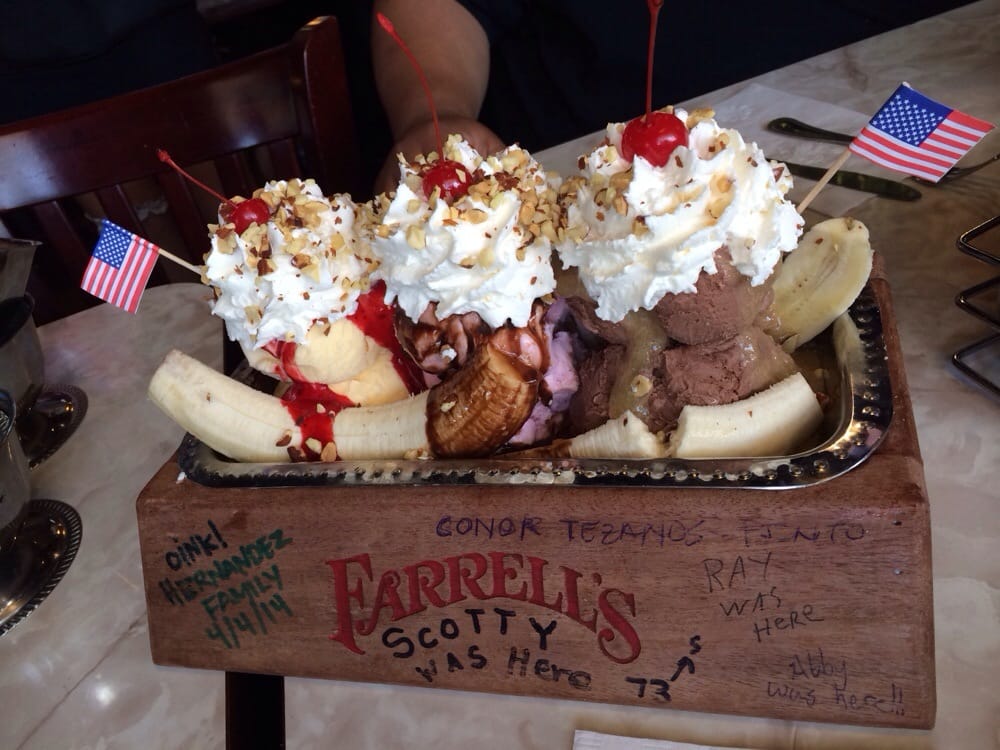
Farrell’s infamous ‘Pig Trough.’

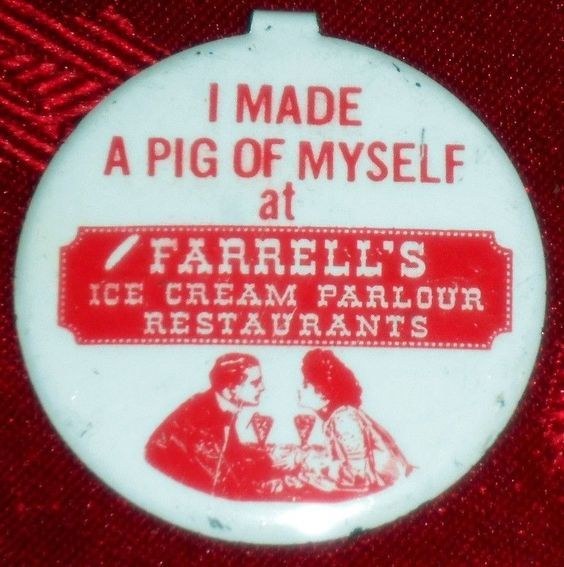
Back in my teen years a real treat was to go to Farrell’s – an ice cream and burgers restaurant which hearkened back to the days of the Soda Fountain. This was a special event for this kid from Yakima. We did not have anything nearly as cool as a Farrell’s. I looked forward to the rare expeditions to Seattle because it often meant gorging on ice cream at Farrell’s. A trip to Farrell’s was more about the experience than the food. The staff would sing happy birthday if you were so lucky to be there on your big day. Heaven help you if you ordered the ‘Pig Trough’. It featured a dozen scoops of ice cream and the rule was that YOU had to eat it all by yourself! Finish it and you were awarded a badge which said “I made of Pig of myself at Farrell’s.” The staff would parade through the restaurant with great fanfare, kazoos playing and drums pounding, to bring the trough to the person who ordered it and then do the repeat parade if that customer was able to finish it.

Mrs. H shows off her fork balancing skills

Going to Farrell’s capped off, a number of times, the annual summer convention where a few thousand Washington and Idaho Rainbow Girls and their chaperones would gather each year. On the last night of the event, literally, hundreds of us would descend upon the Farrell’s in Tukwila Tacoma or Spokane. (I cannot recall the exact locations any longer!) and take over the restaurant. Truly, the staff did not know what hit them.

One of my favorite memories was in 1977 when one of my adult advisors taught us all how to balance a fork on our noses. That was the sort of silliness we enjoyed whether at Farrell’s or, as I think was the case based on the artwork behind her, at Sambo’s in Spokane.

Sadly, the last Farrell’s location closed a number of years ago. I rather doubt any one would open a restaurant like Farrell’s in today’s world. It was sure a lot of fun and I imagine the kids of today would love it as much as we did.

For more information about ice cream Sundaes and their many variations and history click here: https://en.wikipedia.org/wiki/Sundae

Or for a brief history of Farrell’s click here: http://oldlarestaurants.com/Farrell’s/
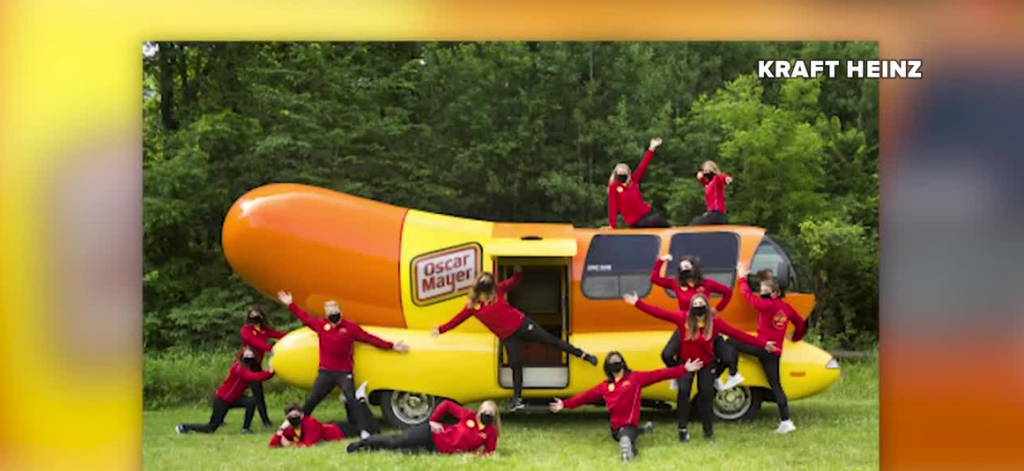
Wienermobile!

HotDogging since 1936

July 18, 2023

A 2017 Tuesday Newsday Classic updated

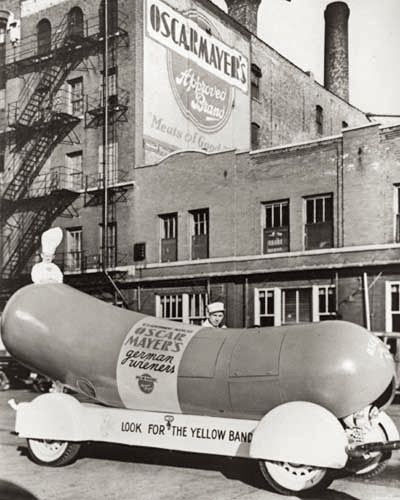
1936 Wienermobile in front of Oscar Mayer building

There cannot be found a more momentous day in history than July 18, 1936. It was on that day when a universally recognized symbol of American marketing debuted.

Yes, we are talking about the day the Wienermobile first rolled out onto the streets of America.

Truly it was a stroke of marketing genius to create a car which looks like a giant hot dog. And no doubt the Oscar Mayer people relish this day in their history.

Of course the Wienermobile has evolved over the years. Today, there are eight Wienermobiles and they are assigned regionally throughout the United States. The drivers are known as ‘Hotdoggers’ and to apply to be a Hotdogger you must be a College Senior about to graduate and then commit to one year as a driver. On average some 2000 people a year apply for the job but in the end only 12 are chosen. So it is quite the honor to be a Wienermobile driver.

From the Infallible Wikipedia:

The 1969 version of the Wienermobile.

“The Oscar Mayer Wienermobile has evolved from Carl Mayer’s original 1936 vehicle to the vehicles seen on the road today. Although fuel rationing kept the Wienermobile off the road during World War II, in the 1950s Oscar Mayer and the Gerstenslager Company created several new vehicles using a Dodge chassis or a Willys Jeep chassis. One of these models is on display at the Henry Ford Museum in Dearborn, Michigan. These Wienermobiles were piloted by ‘Little Oscar’ (portrayed by George Molchan) who would visit stores, schools, orphanages, and children’s hospitals and participate in parades and festivals.

In 1969, new Wienermobiles were built on a Chevrolet motor home chassis and featured Ford Thunderbird taillights. The 1969 vehicle was the first Wienermobile to travel outside the United States. In 1976 Plastic Products, Inc., built a fiberglass and styrofoam model, again on a Chevrolet motor home chassis.

Pandemic Era Hotdoggers all masked up and ready to roll

In 1988, Oscar Mayer launched its Hotdogger program, where recent college graduates were hired to drive the Wienermobile through various parts of the nation and abroad. Using a converted Chevrolet van chassis, Stevens Automotive Corporation and noted industrial designer Brooks Stevens built a fleet of six Wienermobiles for the new team of Hotdoggers.”

Introduced in 2017 was the Wienerdrone which can carry one hotdog!

In 1995 the Wienermobile got plumped up as it grew to 27 feet long and 11 feet tall! It was amazing! New versions are not as long but they are taller at 14 feet in height.

Then, on June 26 of 2017, the latest innovations for hot dog delivery were introduced. Yes, it’s true, there is now a Weinerdrone!

Update: July 18, 2023

When the Covid pandemic hit in the spring of 2020, the iconic Wienermobile got parked for a short time but that didn’t stop one Hotdogger whose handle is “Zach N’Cheese” from hatching a grand, memorable, plan that involved the iconic vehicle. On August 26, 2020, he pulled into a parking lot at Yellowstone National Park and there, with the Wienermobile prominently featured, dropped down on one knee and popped the question: ‘Do you prefer beef or turkey franks?’ Just kidding, he asked her to marry him and she said yes.

Hotdogger ‘Zach N’Cheese’ with his very unique proposal

But ‘Zach N’Cheese’s’ story gets even better; turns out that his great grandfather ALSO was a Hotdogger. WBTV out of Charlotte, NC, shared the following:

“Chatham credits his dad, 44-year-old Josh Chatham of Indian Land, with spotting the Wienermobile job application on Facebook. His mom is 44-year-old Mandy Chatham, and his sister is 26-year-old Bethany Singler, both also of Indian Land.

Only when his dad mentioned the job application did it click with Zach Chatham: His great-grandfather, Lon Baisden, now in his 80s and living in Monroe, Ga., had driven the Wienermobile in the 1970s.

‘I said, ‘That’s funny, that’s what Gige (pronounced GEE GEE with a hard ‘g’) did,’‘ he told his dad, referring to his great-grandfather by his nickname.

As a boy, Zach Chatham knew his great-grandfather worked for Oscar Mayer. He’d bring home Oscar Meyer brand toys for him to play with, but Zach Chatham said he didn’t know at the time that Baisden drove the Wienermobile.

Only as Zach Chatham grew older did he learn that, he said, and only when his dad mentioned the job application did it come to mind again.

‘This is a really, really good job,’ Zach Chatham said his dad told him.”

For those who think Zach’s proposal is a good idea, Oscar Mayer does make the Wienermobile available for special occasions. Frankly, it’s a great marketing ploy if a bit cheesy.

I’m sure that after reading this you all will want a hot dog. In the wurst way.

For more information about the iconic Wienermobile, click here:

https://en.wikipedia.org/wiki/Wienermobile

Charlotte’s Web

E.B. White’s Magnus Opus

July 11, 2023

An update to a Tuesday Newsday Classic from 2017

“You have been my friend,” replied Charlotte, “That in itself is a tremendous thing.” 

The cover of my 1959 copy of Charlotte’s Web – complete with crayon marks and tears.

It is rare to find a writer whose impact on both children and adults is so impactful, but E.B. White – who was born on July 11, 1899 – was such a writer.

For a writer there is no more monumental handbook than “Elements of Style.” Its dog-eared pages a testament to any author’s quest to use punctuation and grammar correctly. The book was first published in 1918 by William Strunk, Jr. It was in 1959 when it was revised and enlarged by White and now bore both contributors’ names. When a question arises as to ‘how’ to write something correctly, most writer’s will say, colloquially, ‘what does Strunk and White say?’

White spent his life as a writer, the bulk of that on staff with “The New Yorker” magazine. It was when he turned to the writing of children’s literature and, especially, with the publication of Charlotte’s Web, that he became a household name.

My collection of E.B. White books. Doesn’t every writer have not one, but at least two copies, of ‘Elements’?

According to the Infallible Wikipedia:

“White’s editor Ursula Nordstrom said that one day, in 1952, E. B. White handed her a new manuscript, the only version of Charlotte’s Web then in existence, which she read soon after and enjoyed. Charlotte’s Web was published three years after White began writing it. (snip)

Written in White’s dry, low-key manner, Charlotte’s Web is considered a classic of children’s literature, enjoyable to adults as well as children. The description of the experience of swinging on a rope swing at the farm is an often cited example of rhythm in writing, as the pace of the sentences reflects the motion of the swing. In 2000, Publishers Weekly listed the book as the best-selling children’s paperback of all time.”

Author E.B. White at work. One of the many dachshunds he had as pets over the years provides editorial supervision.

The book, at one time, was one of the most widely read books by elementary aged children. Somewhere in a dusty box in my parent’s basement is a copy of this wonderful book. A book which I read over and over again, falling in love with a pig named Wilbur and his friend, the spider Charlotte.

The above paragraph is what I wrote when this article was posted on my Blog on July 11, 2017. Two years later, in August of 2019, I did find that copy of Charlotte’s Web and brought it to my house. When I pulled it from the shelf to update this article, I was struck by its appearance. The paper cover was far more dog-eared than I recalled and also bore a couple of crayon marks courtesy of me, no doubt.

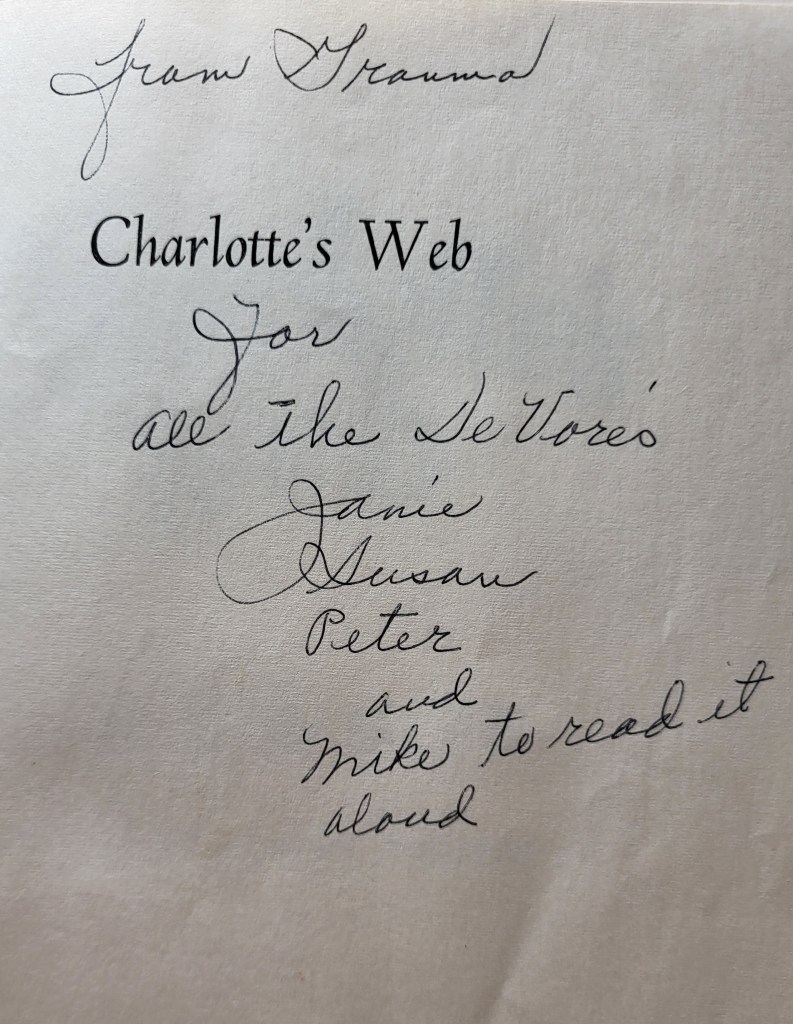
But then I opened the book and there on the first page I was treated to this gem of an inscription: ‘From Gramma For All the DeVore’s’ and our names are listed: ‘Janie, Susan, Peter, and Mike to read it aloud.’

Based on that information I know that the book arrived in my family’s home during the years our family lived in Clarkston, Washington. We were there from late 1958 until the summer of 1961. I was called Janie – my middle name being Jane – during those years as there was an older girl in the neighborhood named Barbara. I’m guessing I was about two at the time which made my siblings four, six, and eleven.

The inscription in the late 1950’s Charlotte’s Web given to me and my siblings from our Grandmother.

But the real story of “Charlotte’s Web” is that it addresses the topic of life and death in a way that made it personal and real for children. We experience grief right along with Wilbur as he learns that his beloved Charlotte is nearing the end. White summed it up in this moving paragraph following Charlotte’s demise:

“Wilbur thought often of Charlotte. A few strands of her old web still hung in the doorway. Every day Wilbur would stand and look at the torn, empty web, and a lump would come to his throat. No one had ever had such a friend – so affectionate, so loyal, and so skillful.”

White handled the topic with gentleness for his young readers, giving us all a great lesson: to love and appreciate those we call family and friends for every day we have with them. And when the day arrives when we have to say goodbye we know that their impact on us and on others was real and meaningful.

In a five day span the last week of June/first week of July I lost not one, but two, such friends. The grief is still raw and palpable. So give out hugs freely, always speak words of kindness, and remember, to love one another.

The links:

https://www.goodreads.com/work/quotes/987048-charlotte-s-web

https://en.wikipedia.org/wiki/E._B._White

Fireworks!

A 4th of July tradition since 1777

July 4, 2023

By the time darkness descends on July 4th, the skies of communities across the country will be filled with brilliant bursts of red, white, blue, purple, orange, and green fireworks, a visual feast to behold. Truly, fireworks are the symbol of Independence Day.

The first recorded mention of fireworks for a July 4th celebration was in 1777 to mark the one year anniversary of the signing of the Declaration of Independence.

The Infallible Wikipedia shares this:

“America’s earliest settlers brought their enthusiasm for fireworks to the United States. Fireworks and black ash were used to celebrate important events long before the American Revolutionary War. The very first celebration of Independence Day was in 1777, six years before Americans knew whether or not the new nation would survive the war; fireworks were a part of all festivities.

Fireworks photos from 2018 show in Puyallup

In 1789, George Washington’s inauguration was accompanied by a fireworks display. George Marshall was an American naval hero during the War of 1812 and other campaigns. He was a Master Gunner and pyrotechnics specialist who wrote Marshall’s Practical Marine Gunnery in 1822. The book outlines chemical formulas for the composition of fireworks. This early fascination with fireworks’ noise and color continues today with fireworks displays commonly included in Independence Day celebrations.”

My earliest memories of 4th of July fireworks are from when I was four years old. Actually, it’s my earliest memory of ANYTHING in life. My family lived in Clarkston, Washington, that summer. I can see in my mind’s eye the fireworks exploding overhead as we sit on a picnic blanket in a park, little bits of debris raining down on us. That night I found a star shaped piece of cardboard lying on the ground after the show. Of course I carried it home as a treasure which, undoubtedly, my mother disposed of a short time later after it was forgotten.

Wayne’s rules for safe fireworks

Most years did not involve going to a professional display, but I always went with my Dad to a stand and help pick out those fireworks which our family would set off. My favorites were always the sparklers. There was something exciting and dangerous about holding a metal stick in one’s hand while Dad lit the end and it erupted into tiny exploding sparks. My sister and I would dance around using the sparkler as if it were a colorful pen writing letters across the night sky.

It was in the 1980’s, however, when I was introduced to a completely different level of fireworks mania. My hubby, and his brother Wayne – as kids – were enamored with fireworks, riding their bikes out to the Native American reservations where they would purchase firecrackers and other contraband, often returning with enough to supply every explosion loving kid in their neighborhood.

For Wayne it was a passion he has embraced throughout his life. When I asked him how he got started in the business he did not hesitate: “It would have to be so I could legally play with bigger and better pyrotechnics.”

To do that required him to have pyrotechnics training and certification. The first show he ever helped with, once that certification was obtained, was Salty Sea Days in Everett in 1980.

Organizing the chaos. Puyallup 2018

Wayne has produced 4th of July fireworks shows all over Washington State. He did the City of Yakima show for 15 years in a row; the hubby and son were able to be on site there one year in the late 1990’s for the up close experience, while I stayed with our young daughter and we watched it from a bluff in Selah. Wayne’s shows have taken him all over the state including Blaine, Pasco, Renton, Everett, Omak, and Puyallup.

Wayne and his daughter review the roadmap, aka the schematic, of what shell belongs in which tube.

While most people love seeing the fireworks, few truly understand the time, training, and effort it takes. In 2018, I witnessed what goes in to the set up while the hubby helped Wayne prep the show. The half dozen members of the crew spent hours stringing wires between the tubes where the fireworks were staged; packed sand around the tubes; and had to carefully follow the schematic of what goes where. For my untrained eyes, it all seemed very chaotic for a very meticulous job which requires extreme care so that one does not blow themselves and others up.

Wayne is, perhaps, the most proud of his safety record. In the 44 years in a row doing a 4th of July show, no one on his crew has ever had a fireworks related injury or burn. In fact he made me promise to highlight the dangers of, literally, playing with fire. In the box on the side are his reminders, a defacto Public Service Announcement to all.

It was my understanding that 2023 was the year Wayne was going to retire but when I reached him for this story, he was headed to Yakima with his daughter, my niece. She too has the pyrotechnic bug and had lamented his impending retirement more than once the past few years. But it’s more like a partial retirement. This year he’s going to be on a crew run by one of the women who worked with him on the shows for many years; he’s going as a consultant to, as he said, ‘make sure no one does anything stupid.”

The reward of all the hours setting things up… getting to run the electronic ignition board.

And while there have been some scary moments when something didn’t happen as it should, he waxed poetic about the last year he did the Everett fireworks show in 2017. Everything was set up on a large barge just offshore and the crew, as always, had spent all day getting it organized, making sure all was safe and ready.

Wayne with his daughter at one of the shows. “Generational pyromania’ was the title on this Facebook photo.

That night, when the first ball rocketed into the air, exploding in a shower of sparks, it was the beginning of something special. “The show itself was the most perfect show we’ve ever done,” Wayne said, “Three hundred to four hundred shots and only two shells which did not fire. That’s very rare. It’s not uncommon to have half a dozen or more shells which never fire.” It was also the first show which his daughter, who turned 18 that year, could help with.

So while he’s given up being the guy in charge, he’ll be with a crew all day on the Fourth, embracing his lifelong passion for fireworks and the thrill of getting to play with the bigger and better pyrotechnics. Way cooler than sparklers.

https://en.wikipedia.org/wiki/Fireworks

The Pyromeister in Yakima 2023

Dark Shadows

My Generation’s version of Twilight

June 27, 2023

  • A Tuesday Newsday Classic – updated
Romantic hero of Dark Shadows, Barnabas Collins

Ask any person of my generation if they know who Barnabas Collins is and you are likely to get an enthusiastic response something to the effect of:

“I made sure I was home by 4 o’clock every day so I wouldn’t miss an episode.”

The aforementioned Barnabas was, by any definition, the romantic hero of the always melodramatic Dark Shadows. One look at his face and you might ask yourself “Really?”

Hold that thought. We’ll get back to his appeal in a bit.

June 27, 1966 marked the date when Dark Shadows premiered on ABC. The show, originally cast in black and white, captured the imaginations of millions of teens and pre-teens and became ‘must watch’ TV. In the course of its five year run, 1,225 episodes were aired. Like other daytime soap operas it featured storylines which took months to resolve and characters that became household names. But unlike any other shows at that time it was centered on vampires and werewolves, time travel and alternate existences.

From the Infallible Wikipedia:

The opening screen of the TV series

“Perhaps one of ABC’s first truly popular daytime series, along with the game show Let’s Make a DealDark Shadows found its demographic niche in teenagers coming home from school in time to watch the show at 4 p.m. Eastern / 3 p.m. Central, where it aired for almost all of its network run, the exception being a 15-month stretch between April 1967 and July 1968, when it aired a half-hour earlier. Originally, it was aired in black-and-white, but the show went into color starting with the August 11, 1967 installment transmission. It became one of ABC’s first daytime shows to actually win its timeslot, leading to the demise of NBC’s original Match Game and Art Linkletter’s long-running House Party on CBS, both in 1969.”
Dark Shadows reached its peak in March 1969. It was in those episodes when Barnabas figured prominently and was romantically involved with Angelique Bouchard. One particular episode stands out.

Barnabas and Angelique… a volatile relationship at work

Barnabas was in love with the blonde beauty and he takes her to his room. Ahem. Barnabas is conflicted as he wants to be with her but is concerned his passion will carry him away and he will ‘bite’ Angelique’s neck, thus killing her and she, too, will become a vampire. An outcome he does not want. I cannot recall if he did or did not bite her but I do recall that the show implied that the two of them engaged sexually. Powerful stuff for a kid of 12.

Barnabas did not have to be young or classically handsome as he was a compelling character and we Dark Shadow’s fans were completely enthralled.

I know that Dark Shadows influenced me as a writer. The power of the show was derived by what was left out; the idea of mysterious forces at work which left much to the imagination. In the late 1960’s and early 1970’s you couldn’t air a program that showed explicit acts and that, I think, was a good thing.

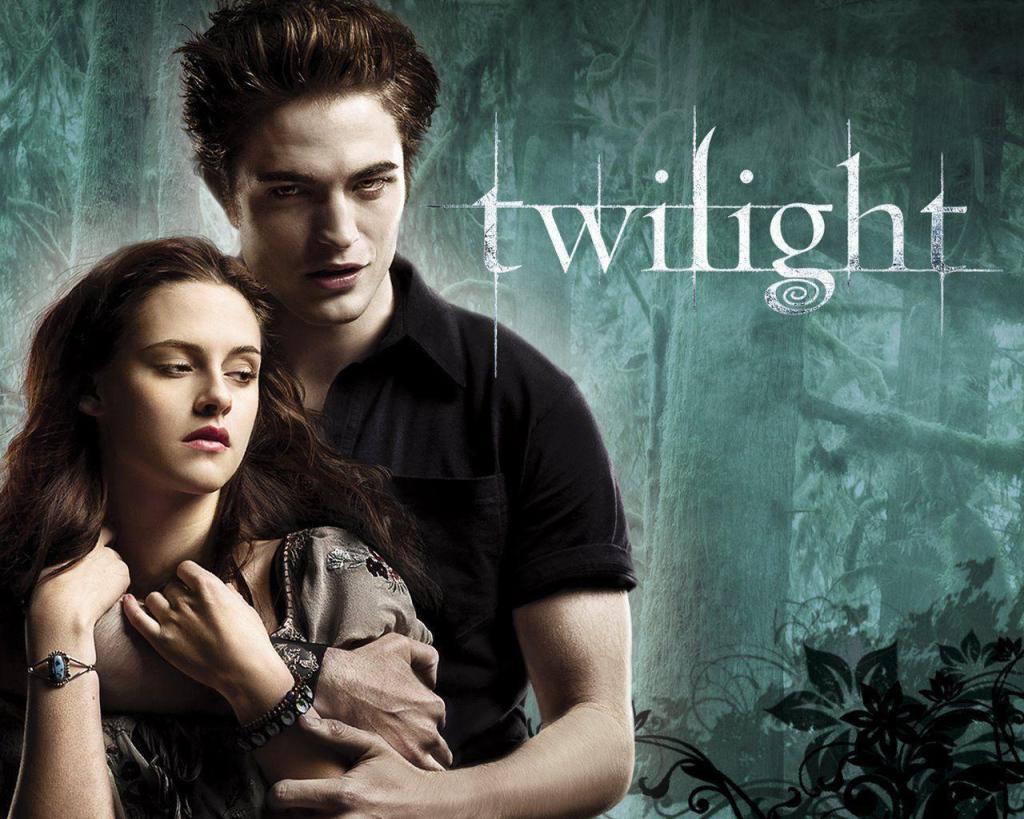
Supernatural themes are not uncommon in literature, film, or television, of course. And each generation seems to have their share of it. The year my own daughter turned twelve, 2005, she got her vampire and supernatural fix from the Twilight series of books. She and her friends were all agog over Bella, Edward, and Jacob, the main characters.

Vampires alive and well in the Twilight series of books and film

Being the ever watchful mother, I attempted to read the first novel so I would know what she was reading, but was put off by the pedestrian writing style and an overabundance of adverbs and gerunds. I never it made it to chapter two.

Somewhere along the way, apparently, I had become a grammar snob with a clear preference for active verbs and richer, more descriptive language.

But my daughter loved the books. And then the movies. I tried to watch one of those also but, alas, they just didn’t appeal to me.

Which brings us full circle to Dark Shadows. I’m certain if I were to watch the old episodes now the mystique would evaporate and I would find the characters and plot lines laughable. Instead, I choose to remember how much I enjoyed them as a pre-teen and let the snippets of a few remembered scenes live in my brain to serve as inspiration.

A couple of Infallible Wikipedia links:

https://en.wikipedia.org/wiki/Dark_Shadows

https://en.wikipedia.org/wiki/Twilight_(novel_series)

Jaws

Just when you thought it was safe to go back in the water

June 20, 2023

A Tuesday Newsday Classic from 2017 – updated

“We started the film without a script, without a cast, and without a shark.”

As quipped by Richard Dreyfuss on the filming of the classic film, Jaws, which premiered on June 20, 1975. Despite its rocky start, technical problems throughout filming, and costing more than double its budget, Jaws is regarded as one of the best films of all times. From the Infallible Wikipedia:

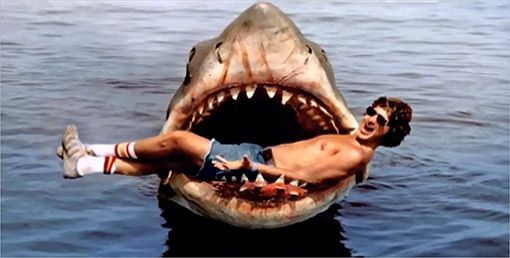
Steven Spielberg getting friendly with ‘Jaws’

“In the years since its release, Jaws has frequently been cited by film critics and industry professionals as one of the greatest movies of all time. It was number 48 on American Film Institute’s 100 Years… 100 Movies, a list of the greatest American films of all time compiled in 1998; it dropped to number 56 on the 10 Year Anniversary list. AFI also ranked the shark at number 18 on its list of the 50 Best Villains. Roy Scheider’s line “You’re gonna need a bigger boat” 35th on a list of top 100 movie quotes, Williams’ score at sixth on a list of 100 Years of Film Scores, and the film as second on a list of 100 most thrilling films, behind only Psycho. In 2003, The New York Times included the film on its list of the best 1,000 movies ever made.”

It took only two weeks for the film to recoup production costs and it is recognized as the first ‘summer blockbuster’ film, setting a template for future filmmakers.

Of course the long term effect was the impact on people’s psyches, preying on our fear of an unknown, unseen killer, lurking in the ocean’s depths. In reality the average number of people killed by great white sharks annually is six. Not exactly an Amity Island level of vicious attacks.

So should we be afraid to go back in the water?

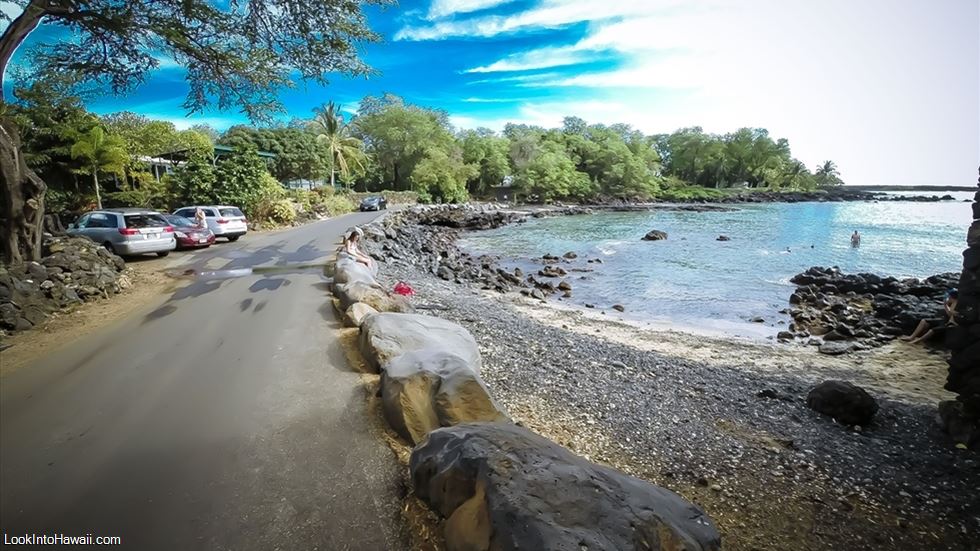
In December 2005 my family and I were about to go snorkeling at a benign looking bay called Kanahena Cove on Maui. It was early in the morning and we were the only four people there: myself, my husband and our son, age 15, and our daughter, age 12. Because we only had two snorkel sets we decided that my husband and son would snorkel first. So my daughter and I were on the lava rocks near where the guys had, a moment earlier, climbed into the water.

This the road where the woman stopped to yell at us. We were on the lava rocks near the trees on the far side. Photo of Kanahena Cove from LookIntoHawaii.com.

Just then, a car drives past on the road, maybe 20 yards away, and screeches to a halt. A woman erupts from the car and launches into a tirade:

“You know, there are sharks in the water,” she yells at us, “and one could take her in a single bite (pointing to my daughter).”

Dumfounded, I stare at the woman, unable to utter a word. She continues her rant:

“The sharks are angry at George Bush for the war in Iraq, which is why there have been increased shark attacks.”

My sister with the two girls braving the non-shark infested waters…

The screed went on for another minute although I don’t recall all she said. What I do know is that my 12 year old daughter WAS then afraid to get in the water. All four of us retain a rather vivid memory of that day.

Personally, I’m skeptical that politics motivate sharks. I would speculate that other factors such as increased human presence, changes in ocean water temperatures, and changes in food sources, are more likely to influence attacks. Even the time of year can affect it.

The daughter and my niece at Kanahena Cove 2006

For the record? In 2015 there were 98 shark attacks worldwide, six of them fatal…and one of those at Kanahena Cove on Maui. Those 98 shark attacks are 40 more than the number of attacks in 2005, nearly double.

But it does beg the question, ‘is it safe to go back in the water?’

I think the answer is that every activity in life involves risk. I read just the other day about several people getting chased and gored by Bison in Yellowstone National Park in 2022. Perhaps those people shouldn’t have been at Yellowstone at all or, more likely, they probably shouldn’t be out walking in the meadow and standing next to a one to two thousand pound animal with horns and mean streak trying to get a selfie.

I sometimes wonder if our era of seeing nature on TV and clips on YouTube has desensitized us to the dangers inherent in life? When watching something on a screen there is no danger.

The hubby says… it’s safe to go back in the water

At Kanahena Cove there is a line of demarcation across which I won’t cross. I snorkel in shallow waters and stay near the edges. The fish are better there in my opinion. And I’m constantly vigilant as to what is around me.

But back to shark attacks. Your chances of being bitten by a shark is 1 in 4.7 million. Maybe it is safe to go back in the water.

For more information about Jaws: https://en.wikipedia.org/wiki/Jaws_(film)

And about the record setting 2015 year: https://www.washingtonpost.com/news/post-nation/wp/2016/02/09/a-record-number-of-people-were-attacked-by-sharks-last-year/?utm_term=.edad50a5906e

WB Yeats

His Life Was Like A Novel

June 13, 2023

A Tuesday Newsday Classic from June 13, 2017

“Let us go forth, the tellers of tales, and seize whatever prey the heart long for, and have no fear. Everything exists, everything is true, and the earth is only a little dust under our feet.”

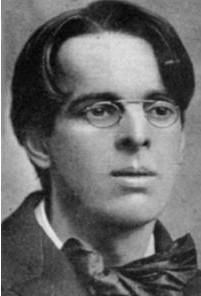
Awarded the Pulitzer Prize for literature in 1923, William Butler Yeats interpreted the honor as belonging to his beloved Ireland. The poet was born on June 13, 1865 and, despite a number of years in England, his writing and politics were inspired by his early life on the Emerald Isle.

William Butler Yeats

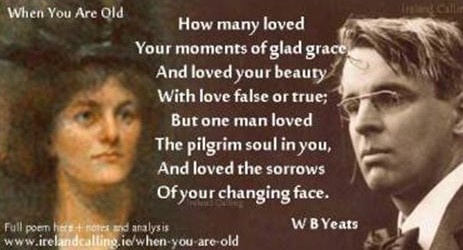
His poetry should be read through the lens of Yeats fascination with the occult. From the Infallible Wikipedia:

“Yeats had a life-long interest in mysticism, spiritualism, occultism and astrology. He read extensively on the subjects throughout his life, became a member of the paranormal research organisation “The Ghost Club” (in 1911) and was especially influenced by the writings of Emanuel Swedenborg.  As early as 1892, he wrote: “If I had not made magic my constant study I could not have written a single word of my Blake book, nor would The Countess Kathleen ever have come to exist. The mystical life is the centre of all that I do and all that I think and all that I write.”

Personally, I find his own life’s story even more implausible than his writing. He met Maud Gonne, the woman who most inspired him, when he was 24 years old. Thus began a relationship which spanned over 30 years, involved four marriage proposals and four rejections AND a fifth proposal to Maud’s 21 year old daughter. Maud’s own story is book worthy and she must have been one heck of a woman!

In fairness to Yeats – who seemed to have some warped code of honor – the fourth proposal to her involved terms and conditions which he hoped she would find unacceptable. Once that final offer was rejected he sought out a younger woman (he was 51 by then) who could produce an heir. Since Maud’s daughter, who at the age of 15 had herself proposed to him, upon his proposal said no he found another woman:

“That September, Yeats proposed to 25-year-old Georgie Hyde-Lees (1892–1968), known as George, whom he had met through Olivia Shakespear. Despite warnings from her friends—‘George … you can’t. He must be dead’—Hyde-Lees accepted, and the two were married on 20 October. Their marriage was a success, in spite of the age difference, and in spite of Yeats’ feelings of remorse and regret during their honeymoon. The couple went on to have two children, Anne and Michael. Although in later years he had romantic relationships with other women, Georgie herself wrote to her husband ‘When you are dead, people will talk about your love affairs, but I shall say nothing, for I will remember how proud you were.’”

Truly any fiction writer could not conceive of a plot line as convoluted as the true life of WB Yeats. Multiple proposals, unrequited love, political intrigue, and the execution of his romantic and political rival, connect the pieces of the tale!

One of the challenges in being a writer is deciding which of the myriad of ideas which populate my brain to bring to the page, so to speak. When I first read of Yeats life I thought, ‘now that would be interesting to research and write a fictionalized account of his life’.

But for anyone who has ever attempted – and completed – a novel, you know that it’s not enough to simply be interested. You have to be passionate about your topic.

The average mainstream fiction novel is between 75,000 and 90,000 words. To put that in perspective, I am capable – on my most prolific days – of writing about 2,500 words. It would take 36 days of doing that to get a 90,000 word novel written. Realistically, about 1,600 words per day are how many words I write before my brain starts getting lazy. Now it’s up to 56 days. As you can see, based on the amount of time you will spend with the story and the characters, you need to really love your story.

It is said that there are two types of writers: ‘plotters’ and ‘pantsters.’

The first, the plotter, is someone who maps out their entire novel, chapter by chapter, and writes little summaries of what’s going to happen.

The second is the author who writes by the ‘seat of their pants’, usually with a general idea of where they intend to go but it’s as much a mystery to them as it might be to someone who reads their work.

I discovered early on that I am firmly in the second category!

For every one of the seven novels I’ve completed, (For those keeping score at home I would say I land at about 85,000 words per novel, so I’ve written and KEPT 595,000 words) I’ve only ever had a concept of the story, not knowing where it would take me. For the plotters out there reading this you are, no doubt, running away in terror just about now.

But hear me out. I was about 30,000 words into one particular novel when I hit the dreaded sagging middle. For the non-novelist, this is the spot in the book when you run out of steam and ideas and your plot comes to a grinding halt. What to do?

The answer, almost always, is to introduce a new character.

The sink where I was doing the dishes…

So I was standing at my kitchen sink this one morning doing the dishes and contemplating how to get through the sagging middle. All of the sudden a voice – it was a man’s voice – says to me “Put me in the story.”

There is not anyone else in the house or the kitchen. But I knew who was talking to me. It was a character, introduced as a baby in the first book of the series I was writing, and he was definite about the request. He should be in the story.

And he was right. To this day, he’s one of my most favorite characters in, arguably, my favorite book which I’ve written, and his personality arrived fully formed and known.

So, despite knowing that someone could take Yeats story and write one heck of a fiction story based on his life, it won’t be me. I have too many characters living in my head that are waiting for their turn to help me do the dishes and convince me they need a voice.

To learn more about Yeats life there is the Wikipedia article: https://en.wikipedia.org/wiki/W._B._Yeats or a much tamer version here: https://www.poetryfoundation.org/poems-and-poets/poets/detail/william-butler-yeats

Drive-In Movies

Where shenanigans happened

June 6, 2023

A Tuesday Newsday Classic – updated for your reading pleasure

June 6 is an important day in US History. But since we all learned about D-Day in our US History classes (or you can pick up my friend Irene Fernandes wonderful novel ‘Long Time Passing’ for a firsthand account of a war-bride in England during WWII) I have instead chosen another ground breaking event for the subject this week.

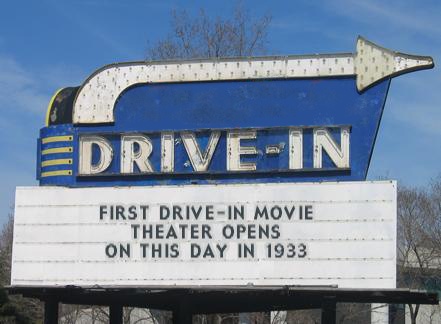
Yes, it was 90 years ago on June 6, 1933, when the first commercially successful drive in movie theatre opened in Pennsauken, New Jersey. The father of the drive in movie was one Richard Hollingshead. From the Infallible Wikipedia:

“Hollingshead conducted outdoor theater tests in his driveway at 212 Thomas Avenue in Riverton. After nailing a screen to trees in his backyard, he set a 1928 Kodak projector on the hood of his car and put a radio behind the screen, testing different sound levels with his car windows down and up. Blocks under vehicles in the driveway enabled him to determine the size and spacing of ramps so all automobiles could have a clear view of the screen. Hollingshead applied for a patent of his invention on August 6, 1932, and he was given U.S. Patent 1,909,537 on May 16, 1933.”

The American public, already in love with the automobile, also loved the drive-in movie. They reached their peak of popularity in the 1950’s and early 1960’s when some 4,000 Drive-ins existed throughout the United States.

Fruitvale Drive in sign

The phenomenon was not without its detractors, however, and drive in movies – which allowed people to view films from the privacy of their car – were labeled ‘passion pits.’ Teenagers, particularly, adored them as it afforded an opportunity to, well, you know.

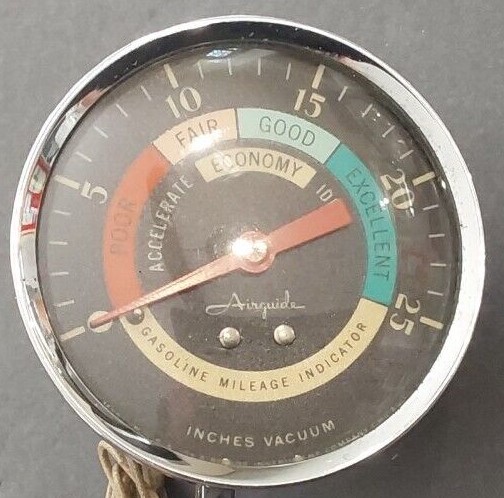
Speaking of which, there were several drive-in movie theaters in my hometown of Yakima, Washington. One evening my sister and I and two of our friends decided to go to the Fruitvale Drive-in (sadly, no longer there). The tank, er, car my sister drove was a 1950 yellow Cadillac with a red roof; a hand me down from our grandparents.  When the grandparents bought it new it had all the whistles and bells popular in 1950 including a gauge which told you how good your driving was.

Ok, not really, it had to do with gas mileage. I have a distinct memory as a child of about six who was enamored of my grandfather and fascinated with the device in that car. It was a round gauge with an arrow that pointed to words like ‘poor’, ‘fair’, ‘good’ and ‘excellent.’ My grandfather, in his affable way, told me that the gauge let him know how his driving was. We are driving the roads up near their cabin at Rimrock Lake and I’m watching that gauge and announcing every time it changes. Seems like it was often pointing to poor but that didn’t deter grandpa from driving. A few years later he turned the driving over to my grandmother who, apparently, agreed with the device.

The Cadillac featured a vacuum mileage meter similar to this one

That’s just an aside as, most important of all, the Caddy featured a movable spotlight affixed to the car just outside the driver’s side window. There was a handle inside the car to control the light. I guess it was there to find dead things on the side of the road or assist in deer hunting. The more common reason, and a lot more mundane, is that the spotlight allowed the driver to find house numbers at night. Who knew?

But then there was the infamous incident at the Fruitvale Drive In. On this particular night my sister, and her best friend Wendy, were in the front seat and me and my best friend Pam were in the back. For anyone who has ever been to a Drive In, you know that the movie cannot start until dusk at the earliest. While I don’t recall the exact day it was likely July 1972 and the sunset mid month is just before 9 p.m. The movie starts. No idea what movie we watched. Our options were limited as we were all under the age of 17. It must not have been a great movie because our attentions were soon drawn to the activities taking place in the backseat of the car parked in front of us. We watched with intense teenage curiosity as the silhouetted heads of the couple descended lower and lower until they were no longer visible. Now THIS was getting interesting (unlike the movie whose name I forget. A search of PG movies the summer of 1972 turns up a single one that it probably was: ‘The Candidate’ starring Robert Redford.). We, of course, giggled and speculated on WHAT exactly might be going on in that car and then my sister remembered ‘the light.’

My grandfather standing next to his 1950 Cadillac. Photo taken in Golden, British Columbia, 1957

“Do it!” we encouraged. We debated for several minutes as to the advisability of such an action. But eventually peer pressure won out. So she did. A moment later a blaze of floodlight swamped the erstwhile lovers and you never saw feet flail or heads snap up so fast! We descended into paroxysm of laughter. The light was off a moment later but then we worried that we would be in trouble for the illumination during the movie. A few horns honked in objection to the movie being disrupted and we two residents of the back seat ducked down so as not to be seen. Our prank, however, was not exposed and I do believe the lovers in the other car spent the rest of the movie upright. Talk about coyly ‘interrupt-us’.

If you want to know more about the rise and decline of the drive-in movie theater click on this link: https://en.wikipedia.org/wiki/Drive-in_theater

And a couple other links:

https://en.wikipedia.org/wiki/The_Candidate_(1972_film)

Hernando De Soto vs. The Crimson Tide

Florida in June? Not so much.

May 30, 2023

It’s a Tuesday Newsday Classic updated with fun new observations!

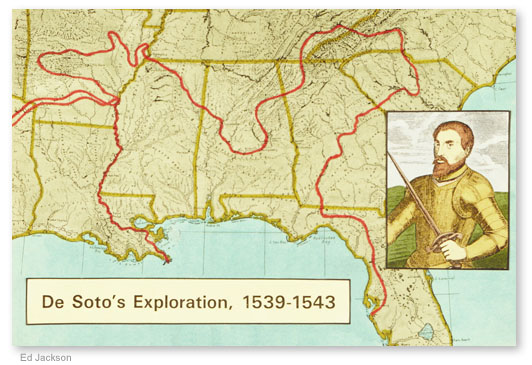
According to the “Today in History” site it was on May 30, 1539, when explorer Hernando de Soto landed near Tampa Bay, Florida. Being that it was almost June and not January, de Soto didn’t spend long there. After all, Disney World would not be carved from the alligator and snake infested swamp lands until October 1971, 432 years later. And June in Florida is rather hot and humid, so I can’t really blame him for not wanting to be there that time of year. Who would?

De Soto is an interesting explorer. Sponsored by Spain his mission appears to have been to claim what was to become the United States for the mother country. He left Florida and meandered about the south through Georgia, South Carolina and Tennessee. Things were going okay until he got to Alabama where he encountered a rather hostile group of native people. According to the Infallible Wikipedia:

“De Soto’s expedition spent another month in the Coosa chiefdom before turning south toward the Gulf of Mexico to meet two ships bearing fresh supplies from Havana. Along the way, de Soto was led into Mauvila (or Mabila), a fortified city in southern Alabama. The Mobilian tribe, under Chief Tuskaloosa, ambushed de Soto’s army. Other sources suggest de Soto’s men were attacked after attempting to force their way into a cabin occupied by Tuskaloosa. The Spaniards fought their way out, and retaliated by burning the town to the ground. During the nine-hour encounter, about 200 Spaniards died, and 150 more were badly wounded, according to the chronicler Elvas. Twenty more died during the next few weeks. They killed an estimated 2,000-6,000 warriors at Mabila, making the battle one of the bloodiest in recorded North American history.”

De Soto was, it would seem, the first visiting team to face the mighty Crimson Tide. The Spaniards escaped to Mississippi but their quest for a national championship was doomed. Their bad luck continued and they were plagued by more unhappy natives, disease and lack of supplies. De Soto, committed to his mission, eventually was stopped by the Big Muddy near what is the happy sounding, present day, Sunflower Landing, Mississippi. He saw that body of water as a pain in the neck, keeping him from his westward march for domination. His relationship with the Mississippi River did not end well.

Every once in awhile someone will record a video of the Florida natives…

No, it wasn’t the natives, the gators, or the snakes which killed him nor did he drown in the river. Instead it was a fever. He died May 21, 1542 in a native village on the western banks of the river near present day MacArthur, Arkansas.

Truly I am surprised that it wasn’t some sort of wildlife. Take alligators for instance. These fascinating creatures, according to urban legend, occupy EVERY pond, lake, roadside ditch and swamp in Florida. Consider that there are some 7,500 lakes, ponds, etc. What if most contain two gators? Or three? We are talking at least 15,000 alligators hanging out and waiting for some unsuspecting critter or person to wander by and provide them dinner. No thank you.

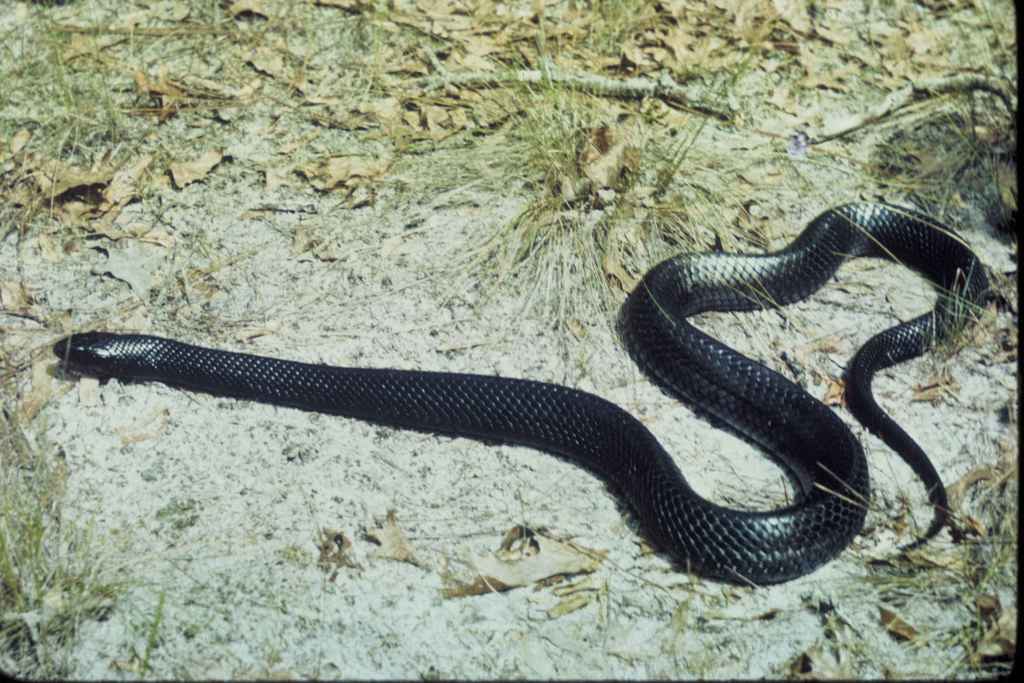
A black indigo snake

Then there are the snakes. With nearly 50 species which call Florida home the chances of seeing one is probably fairly high. Which the hubby and I found out when visiting there in May 2007. We had flown down for a conference he was attending and on our final day we walked across the street from the hotel to find a Geocache (https://barbaradevore.com/2022/05/03/geocaching/).

The GPS directed us to the other side of a band of scrubby trees. There was some knee high grass growing up through the cracks of abandoned asphalt and it all seemed perfectly benign. Right up to when the 47 foot black snake slithered towards us. Okay, so the snake wasn’t 47 feet. More like eight. I mean it was huge to us wusses from Western Washington who never have to deal with such things. The worst thing we ever see are garter snakes and those are about the cutest, most benign snake ever. The snake we saw in Florida was either a Black Indigo Snake or Black Racer Snake. Not one of the six venomous ones which live there. Right.

A quick internet search turned up one estimate that there are about 50,000 snakes just in Florida. That’s more snakes than people in the line ahead of you to ride the Tower of Terror.

Our snake encounter was dutifully recorded in our Geocaching log:

While visiting Florida was fun, encountering snakes, worrying about alligators, sinkholes, and hurricanes not so much.

As it turned out for Hernando, Florida was not quite ready to be colonized. It was the stodgy British who, seventy years later, successfully established colonies in the new world. But those people had to live in Massachusetts in the winter since cheap flights to Florida for a sunny getaway in dreary January were not yet a thing. I would have been stodgy too.

The author as far away from the snakes as possible in Florida.

For more about the life of Hernando de Soto: https://en.wikipedia.org/wiki/Hernando_de_Soto

For more about alligators: https://en.wikipedia.org/wiki/American_alligator

University of Florida guide to black colored snakes: https://edis.ifas.ufl.edu/publication/uw251

World Turtle Day

Protecting them since 2000

May 23, 2023

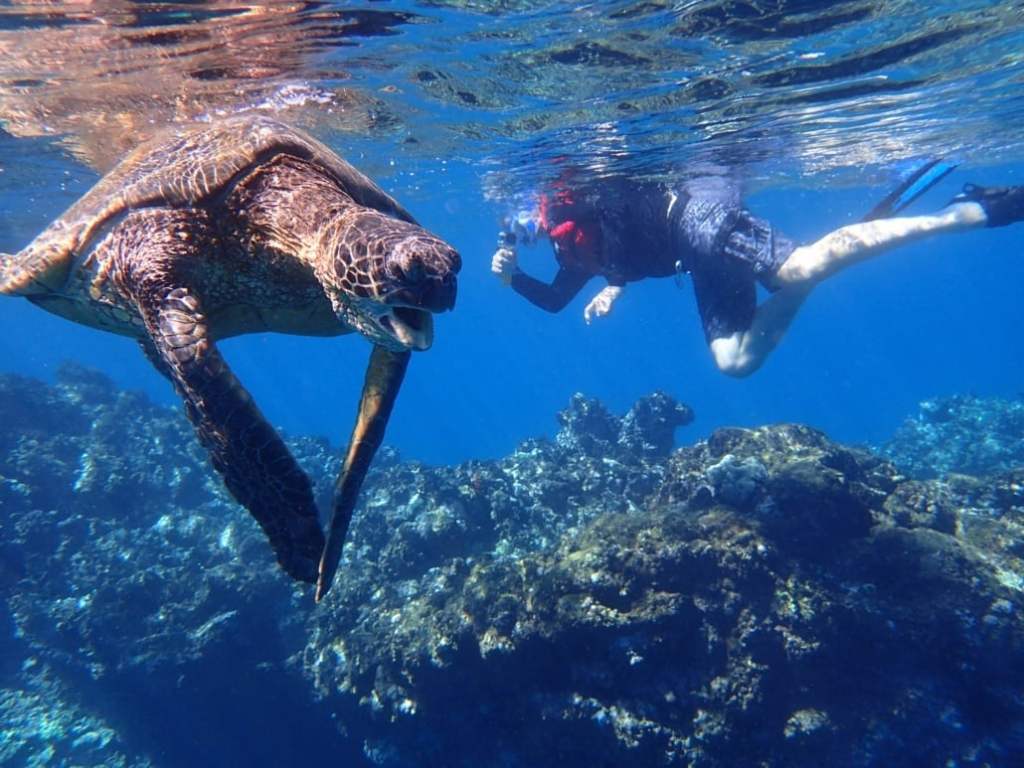
Occasionally a topic comes up which triggers a long forgotten memory. Such is the case for May 23. Today is World Turtle Day; a day which, since the year 2000, has been designated to bring awareness of the need to preserve and rescue turtles and tortoises.

It’s a thrill to swim with the Hawaiian Green turtles when snorkeling. This photo is from Hawaiianpaddlesports.com

First, a bit about Turtles from the Infallible Wikipedia:

“Turtles are an order of reptiles known as Testudines, characterized by a special shell developed mainly from their ribs. Modern turtles are divided into two major groups, the Pleurodira (side necked turtles) and Cryptodira (hidden necked turtles), which differ in the way the head retracts. There are 360 living and recently extinct species of turtles, including land-dwelling tortoises and freshwater terrapins.” 

Granted the scientific information does not really do the animal justice. Turtles are truly fascinating creatures due, in my opinion, to their exoskeleton bone cover which gives them a look unique to other creatures.

Turtles can be gigantic, like the huge leatherback turtle, which can be almost 9 feet in length and weigh more than 1,100 pounds, or as small as the Speckled Cape Tortoise. Native to South Africa it measures no more than 3.9 inches and weighs less than 6.1 ounces.

But back to the long ago memory. It is September 1966 and the long anticipated Central Washington State Fair. In those years, there was one weekday afternoon when every elementary aged school boy and girl was released at noon for “Fair Day.” Oh what a glorious event that was. The horde would descend upon the midway and rides filled with screaming children; cows, goats, and other livestock were terrorized by thousands of small hands all seeking to pet the animals; and the carnival barkers collected every last cent the kids had to spend.

This particular year – and to this day I’m not quite sure HOW it came to be – my sister and I happened upon a booth which was selling turtles. Incredibly cute and tiny turtles. Each one probably cost the victim buyer 50 cents but those turtles instantly became a ‘must have’ item. So we each got a turtle which, if I remember correctly, was put into a plastic bag partially filled with water and then ‘inflated’ to give the creature air, for us to carry home.

I also cannot recall my mother’s reaction but I imagine she was less than thrilled as a space had to be found for our two new residents. A large round avocado green tub was acquired and an ‘island’ was built inside for the turtles.

The author and her sister in the summer of 1967, saying goodbye to Gilligan and the Professor

My sister and I named our two turtles Gilligan (mine) and the Professor (hers) after two characters from one of the most popular and favorite TV shows of the time “Gilligan’s Island.”

My childhood memory is that we dutifully fed our turtles and took good care of them. No doubt the chore fell mostly to my mother who didn’t want the turtles in the first place.

On it went and then, in the summer of 1967, it was decided that Gilligan and the Professor had outgrown their avocado green paradise and needed to find a new home. That new home, it turned out, was Sportsman Park just east of the Yakima River.

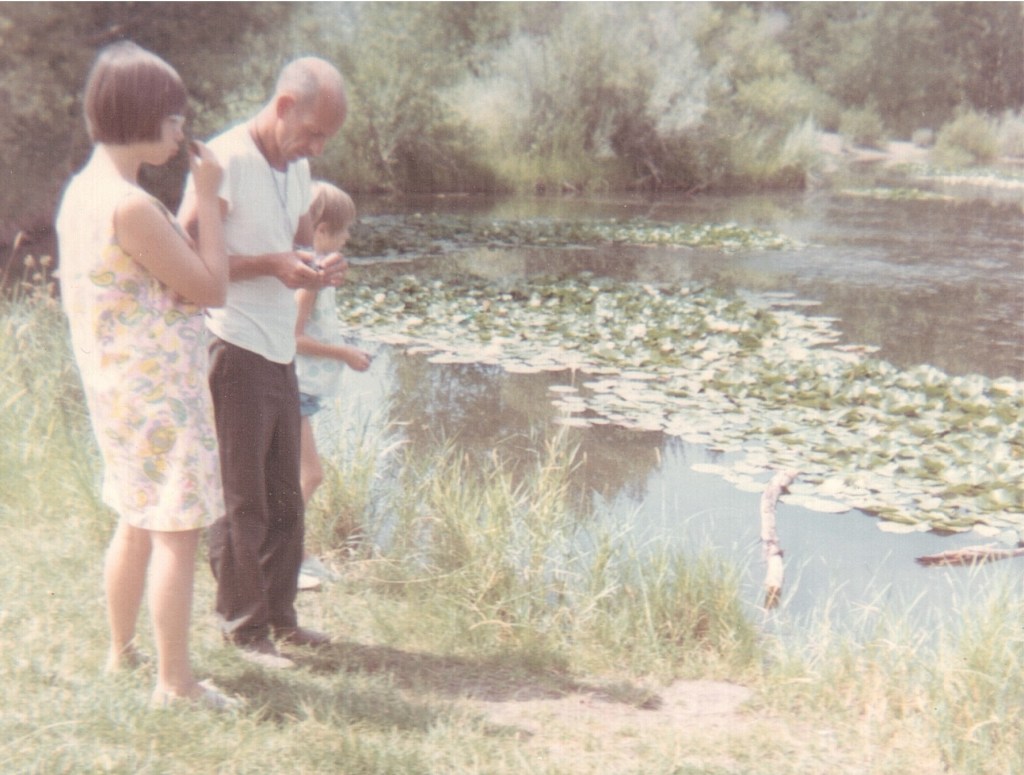
It was a hot summer day when my Dad, sister, and me took the turtles to the designated release spot. My grandmother – Dad’s mom – was along with us and took two pictures that day. On the back of one she wrote “Goodby turtles! Swim Happy! 1967” So my sister and me said our goodbyes, placed them on the ground and watched as they eagerly ran to the water and slipped into the pond, swimming away.

At Sportsman Park about to set the turtles free

I imagine I was a bit sad watching Gilligan leave but being that I was barely 10 years old, I got over it.

Fast forward to 2013, maybe 2014, and the hubby and I are Geocaching at Sportsman Park in Yakima. As we are walking along a path, I notice there are signs which tell about the various wildlife which lives there. We stop at this one pond and depicted there are pictures of turtles… which look just like Gilligan and the Professor.

I imagine there were other children whose parents also sought new ‘homes’ for turtles which had been brought home as a prize from the fair; I doubt ours were the only such creatures who found a new home in that pond.

On the other hand, while it was common practice to sell animals at fairs in the 1960’s, as a society we’ve come to appreciate that the introduction of non-native species can have a negative effect on the native species and the new habitat. Unfortunately, we didn’t know any better back then. The practice of selling turtles at fairs ended in the mid-1970’s.

So celebrate World Turtle Day through admiration of these amazing creatures and by leaving them alone to be, well, turtles.

For more information, a few links:

https://www.worldturtleday.org/

https://en.wikipedia.org/wiki/Turtle