One of the joys of being an author is in the inventing of fictional worlds in real places. When I started thinking about this story this is what went through my head:
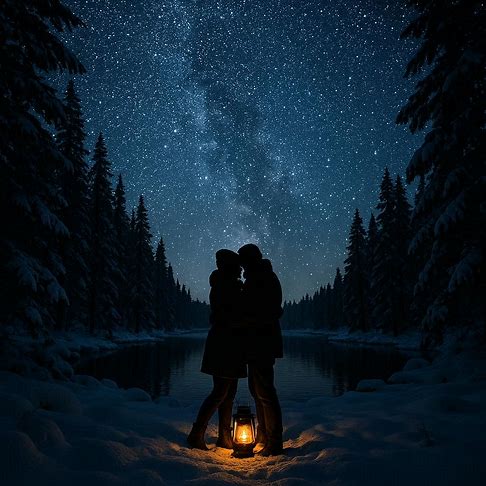
Nicole’s journey took her into the mountains of Montana on the winter solstice.
“What If?” I mused, a young man wanted to break out on his own and move to a place where he knew no one and just started his life over? I know! He answers an ad in a magazine and a few months later he’s living in the boondocks of Montana or Idaho or some other remote western state.
Oh yeah, he also needs to have a tie in to The Darling of Delta Rho Chi, since it needs to be part of series. Sam Paxton is the obvious choice. A young man living in the shadow of his older half-sister, Riley, who we met in book one.
Next, I needed a heroine; a heroine suffering from a calamitous event … who has a very good reason to drive all the way from the Gamma Alpha Beta house at the University of Washington to the boondocks of, er, someplace. Let’s call her Nicole.
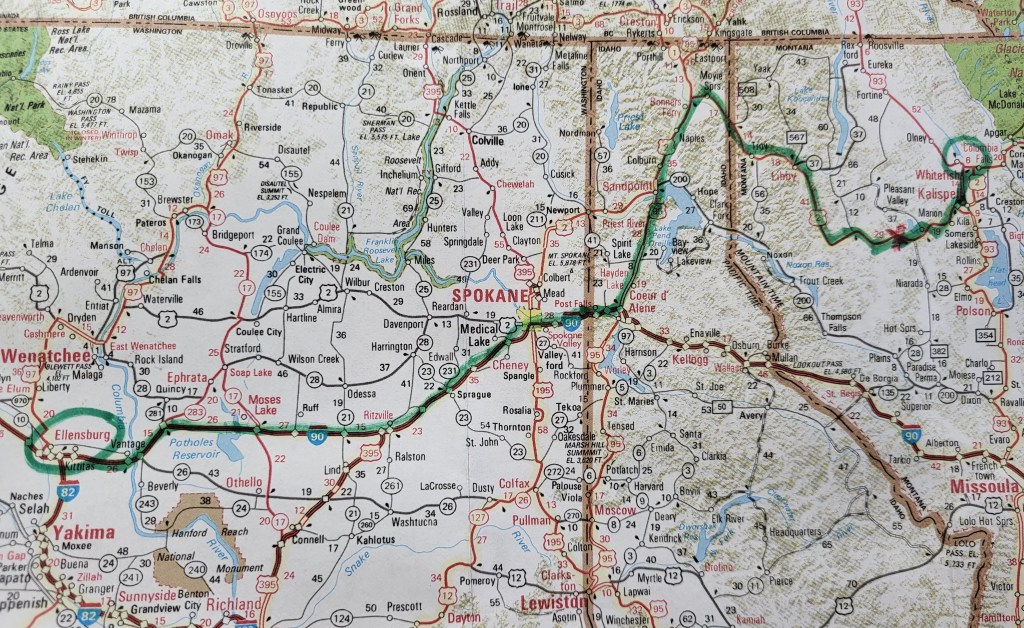
Nicole’s intended journey that fateful December day from Ellensburg to Big Mountain. She ends up stranded at the red ‘X.’
Out came the maps. Being that the story is set in December and during Christmas break, Nicole needed a hometown someplace in Washington. I picked Ellensburg. It’s a nice town and one I was familiar with, having grown up in nearby Yakima. From there she could travel eastward to the mystery destination. What about Sun Valley, Idaho? I soon learned it was over 500 miles and 8 plus hours of travel from the heroine’s hometown. Plus, I knew Nicole’s parents would NEVER agree to that trip.
I Googled ski resorts in Montana and up popped quite a few. Red Lodge was 716 miles east of Ellensburg and Big Sky was 604. Whitefish, at 425 miles, seemed just far enough to make it difficult for Nicole to get home but still had the elements needed to make it work.
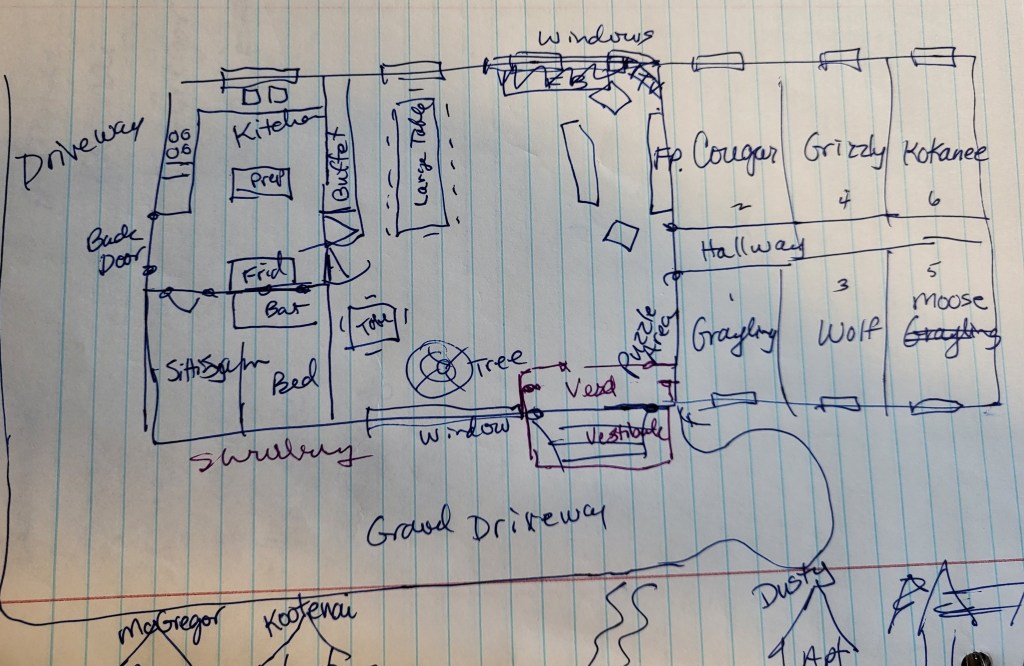
When I was 12 years old I became obsessed with designing the layout of houses. I used graph paper and would spend hours drawing them. This is my rough layout of the fictional Malloy’s Lakeside Lodge.
As the story took shape, more research was needed. Like knowing the specific weather on specific days. What was the layout of the lodge? Where could that lodge be located? What was the floor plan of Nicole’s family home?
All those details are, to me, part of the fun of story creation and I hope that you, my readers, will enjoy being immersed in the fictional world of Sam, Nicole, Dusty, and Beej! – Barbara DeVore
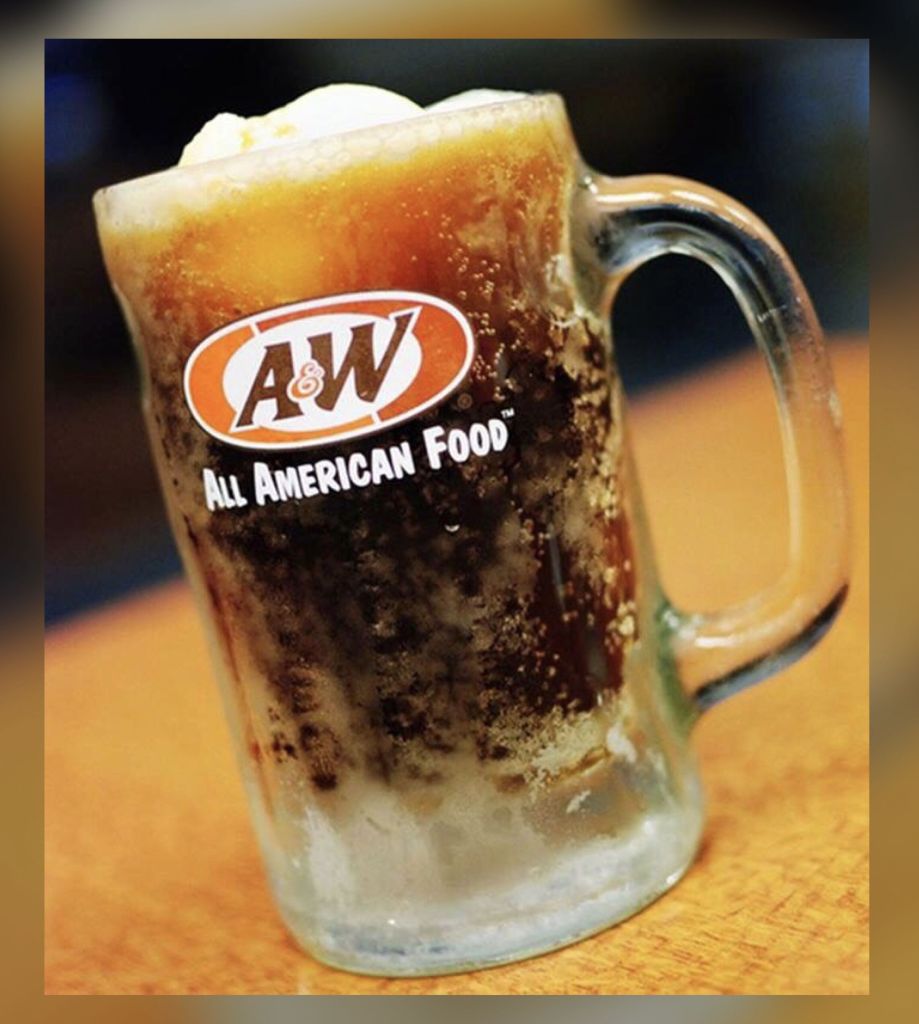
When I think back to the 1960’s and 1970’s, there is not – in my opinion – a better symbol of American culture than the A&W Root Beer stand.
It’s appropriate to write about it this week as June 17th is National Root Beer Day. I’m certain we can have a debate as to ‘which’ root beer brand is best: Hires, Barq’s, A&W, or, perhaps, a newer competitor like Mug. For me, it’s always been A&W. I suppose that is because it was THE root beer which my family always drank.
As expected, the Infallible Wikipedia expounds on the topic of Root Beer:
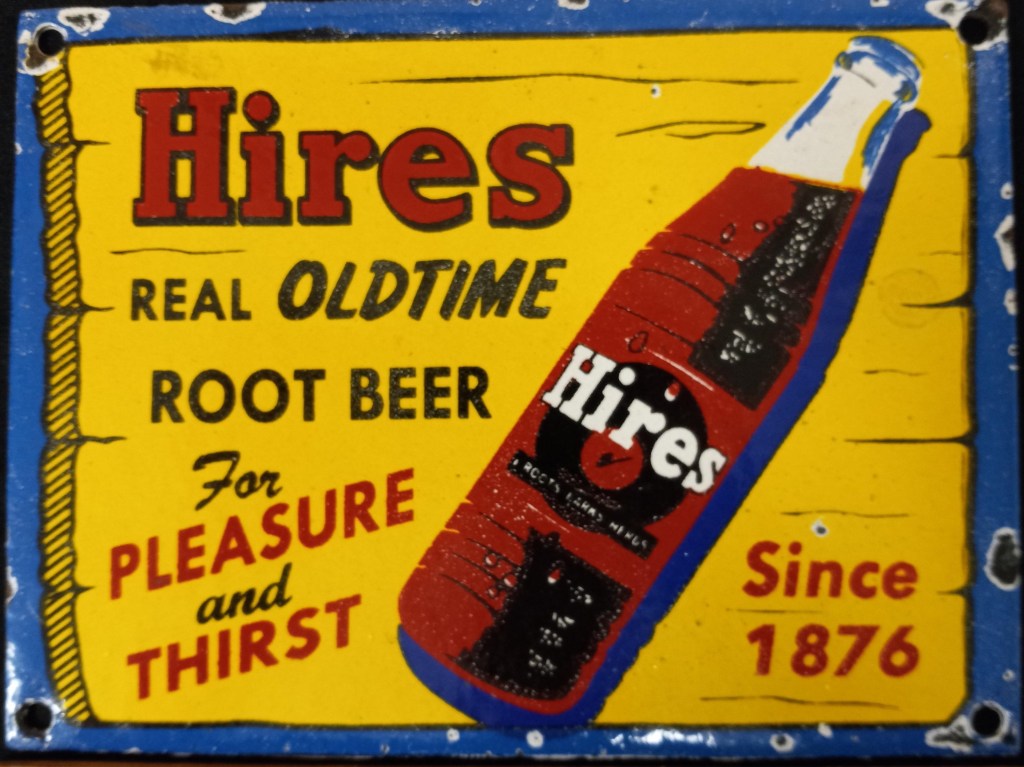
The original commercial root beer was Hires which often advertised its product as a health tonic.
“Root beer has been drunk in the United States since at least the eighteenth century. It has been sold in confectionery stores since at least the 1840s, and written recipes for root beer have been documented since the 1830s. In the nineteenth century, it was often consumed hot and was often used with medicinal intent. It was combined with soda as early as the 1850s; at that time it was sold as a syrup rather than a ready-made beverage.
Beyond its aromatic qualities, the medicinal benefits of sassafras were well known to both Native Americans and Europeans, and druggists began marketing root beer for its medicinal qualities. (Snip)
Safrole, the aromatic oil found in sassafras roots and bark that gave traditional root beer its distinctive flavor, was banned in commercially mass-produced foods and drugs by the FDA in 1960. Laboratory animals that were given oral doses of sassafras tea or sassafras oil that contained large doses of safrole developed permanent liver damage or various types of cancer.”
The article does give more detail about Charles Elmer Hires who was a pioneer in the commercial production and also mention’s Barq’s – developed by the Coca-Cola company.
But it was Roy Allen who opened the first root beer stand in 1919 in Lodi, California. It was a hit and four years later, in 1923, he teamed up with Frank Wright and they opened the first A&W drive-in restaurant in Sacramento. The Infallible Wikipedia tells us:
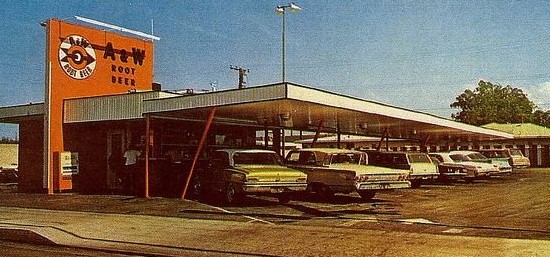
An A&W Root Beer drive in from the late 1950’s/early 1960’s. Not the one in Yakima but ours was similarly laid out.
“Curbside service was provided by tray boys and tray girls. In 1924, Allen purchased Frank Wright’s stake in the business. In 1925, Allen began franchising the root beer, while the franchisee added the other menu items and operated at their discretion. Most of the restaurants that opened under this scheme were on the highways of the Central Valley region, mainly for travelers. This may have arguably been the first successful food-franchising operation.”
Fast forward to the 1960’s, it is at the corner of 10th Avenue and Nob Hill Boulevard in Yakima, Washington, where my family went during those very rare times when we frequented any sort of restaurant – fast food OR sit down. It was always a treat to get to go to A&W and pull into a slot under the shaded carport style ‘drive in.’ Occasionally my parents would buy us food, but mostly it was just for the root beer.
My dad would turn on the head lights of the car and soon a perky teenage girl would be at his window to attach the tray holder. We’d wait with great anticipation until a short time later, she would reappear – the tray laden with the thick frosty mugs of root beer. Soon they were passed around the car and nothing ever tasted so good on a hot summer’s evening.
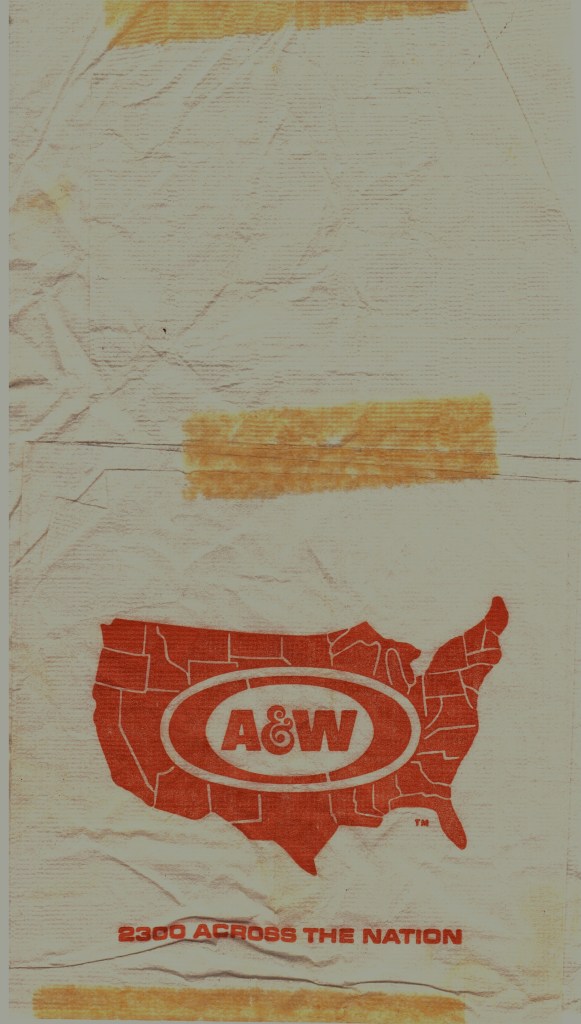
Who actually saves a 1972 napkin from A&W and stows it away in her teenage scrapbook? Oh, yeah, that would be the author. Unbelievable but true.
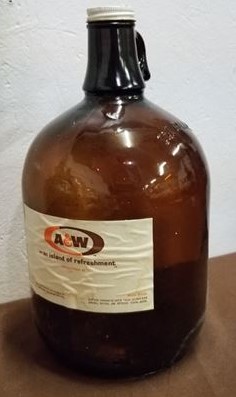
Sometimes – especially for the Fourth of July – my dad would come home with a giant glass jug full of A&W root beer and a five-gallon tub of vanilla ice cream. When the family was finished with the sparklers, pinwheels, and other small fireworks assortment, it was time for Root Beer floats.
Dad used to bring home a jug of root beer on the 4th of July similar to this one, no doubt.
Those were equally as good and a treat the family looked forward to every Independence Day.
At the time, I did not – of course – appreciate these special moments. It was, after all, what was normal for my family. I believe it was the summer of 1974 when I went to the drive-in on 10th & Nob Hill for the last time.
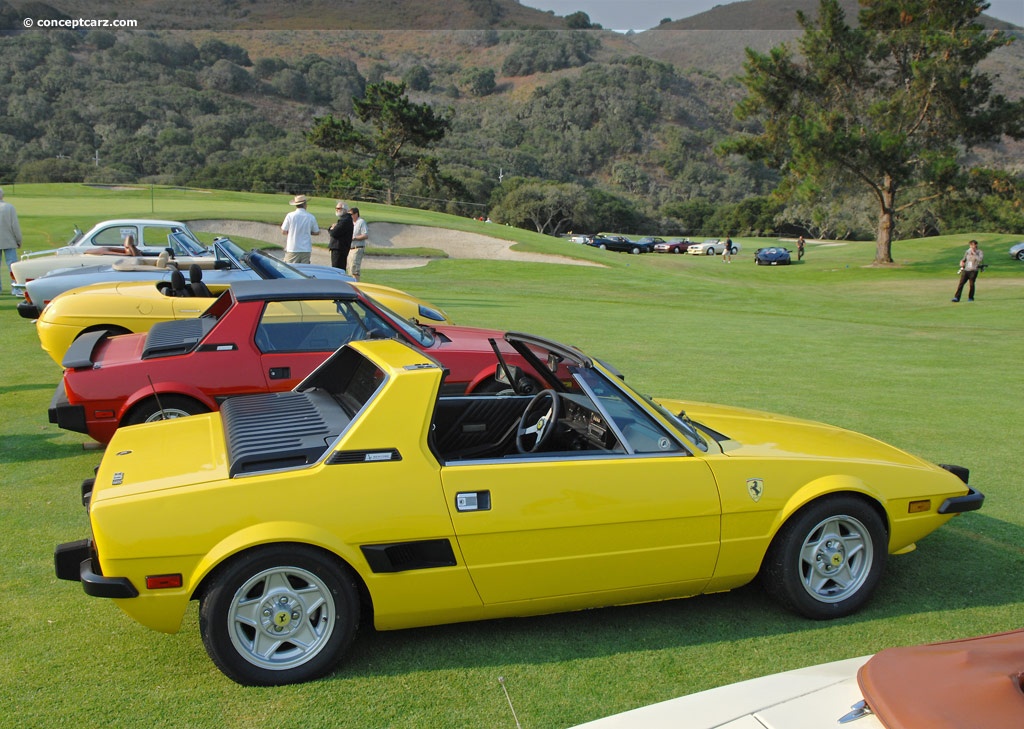
My brother – age 21 that year – was home from college and it fell to him and me to drive to A&W to buy the requisite jug of root beer for the Fourth of July floats. Being that he was immortal (a belief which tends to most affect young men ages 16 to 25 – a phenomenon the hubby and I refer to as being “nineteen and immortal”) he had purchased a rather fun car to drive and drive fast: a 1974 yellow Fiat X1/9.
Being that I was a teenage girl, there was a thrill to riding in a fast car even if it was with my older – and much cooler than me – brother. I did not think I was immortal but I was willing to take risks.
I climbed into the shotgun seat of his car and away we zipped down Tieton Drive. The roof of the car had been stowed in the forward ‘trunk’, the sun shining, and warm summer air surrounded us. We zipped down the hill to 16th, then a right turn and south to Nob Hill, and then left for the final six blocks east to the family favorite A&W. Soon I had the jug of root beer secured at my feet for the return trip.
A yellow 1974 Fiat X1/9 like the one my brother owned. The roof was removable and stored in the front compartment as the engine was in the back. Photo from http://www.conceptcarz.com.
We raced home, speeding west up Tieton Drive hill and I swear to this day that my brother never slowed down as the car careened around the corner onto our street. I am certain he hit the gas as we practically flew over the pavement. That moment is etched in my memory, my long blonde hair flying; I’m alternating between laughing and screaming, buckled in for my brother’s version of Mr. Toad’s Wild Ride.
After we were safely parked, I made him carry the root beer into the house as I did not trust my legs, certain they had turned to rubber.
Eventually that A&W location shut down and the era of carhops is all but gone.* Somehow going to a drive-through window just isn’t the same. But even so, when I pour myself a glass of A&W, I’m immediately transported back to a Yakima summer night and I smile when I think about that crazy ride with my crazy brother.
*Burgermaster has five locations in the greater Seattle area and still employs ‘carhops.’
If you are older than the age of 60 and you have lived in the Pacific Northwest most, if not all, of your life, I simply have to give you this date and time, you will immediately be able to tell me where you were and what you were doing: April 29, 1965, 8:29 a.m.
I can almost hear you exclaiming to your computer: that was the date of the first earthquake you experienced and/or remember.
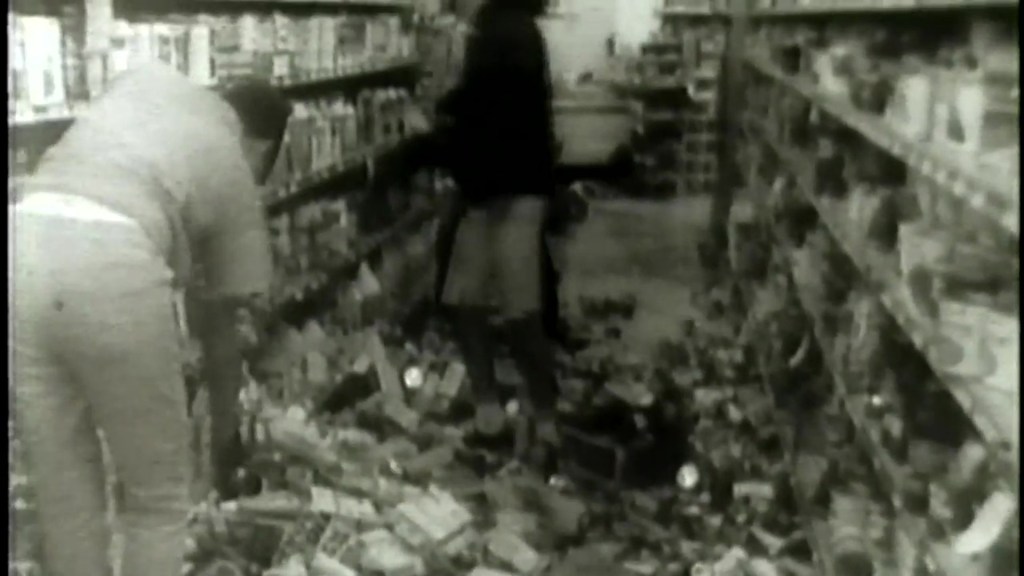
A number of grocery stores were hard hit during the 1965 earthquake
It was, after all, a pretty significant event. At the time it was the third strongest earthquake since the arrival of European settlers into the area. A quake estimated at magnitude 7.3 occurred in 1872 and another magnitude 7.1 in 1949. The 1965 quake registered 6.5 on the Richter scale.
While the Infallible Wikipedia does offer some information, Historylink.org – which has in depth articles about the Pacific Northwest – shares the following:
“The ground shook for about 45 seconds and was felt over a 190,000 square mile area including all of Washington state, northwest Oregon, southwest corner of British Columbia, north Idaho panhandle. The quake’s epicenter was located near Des Moines, Washington, at 47 degrees, 24 minutes North Latitude and 122 degrees, 24 minutes West Longitude. Total damage is estimated at $12,500,000 (approximately $65,000,000 in 1999), most of it in Seattle. In Olympia, the State Capitol Building was temporarily closed and government departments move to nearby motels while buildings are being repaired.”
The nearest I could come to identifying the epicenter of the quake is 202nd Street SW and Marine View Drive in the Normandy Park neighborhood, not far from Burien and Sea-Tac International airport.
Which becomes an important detail. On April 29, 1965, the hubby’s family lived in West Seattle, about 6 miles north of the epicenter.
For years, family gatherings often included discussion of that day and the months and years leading up to it.
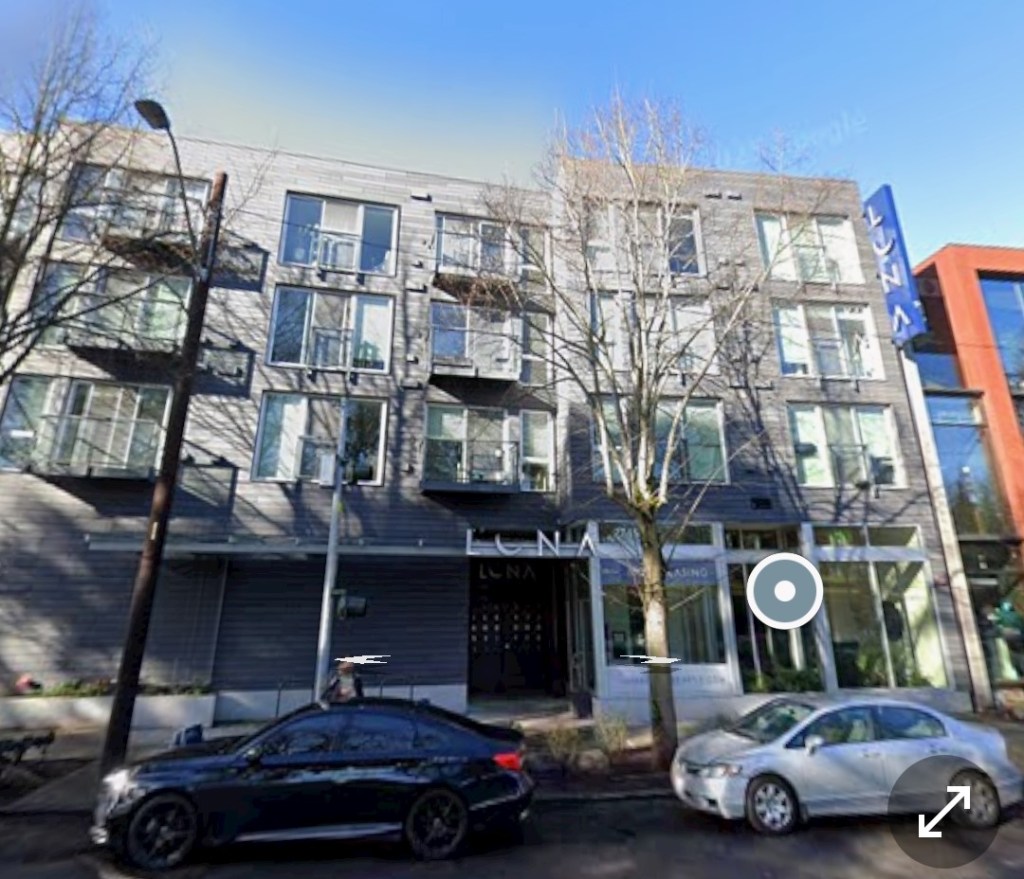
If you were to visit West Seattle today, the LUNA apartments are now located at approximately 2751 California Avenue SW. Up until six months before the April 29, 1965 quake there was a house at that address and it belonged to a trio of women: my hubby’s two Great-Great Aunts – Nelly and Ethel – and his Great Grandmother – Queenie Mae. All three were born in the 1880’s.
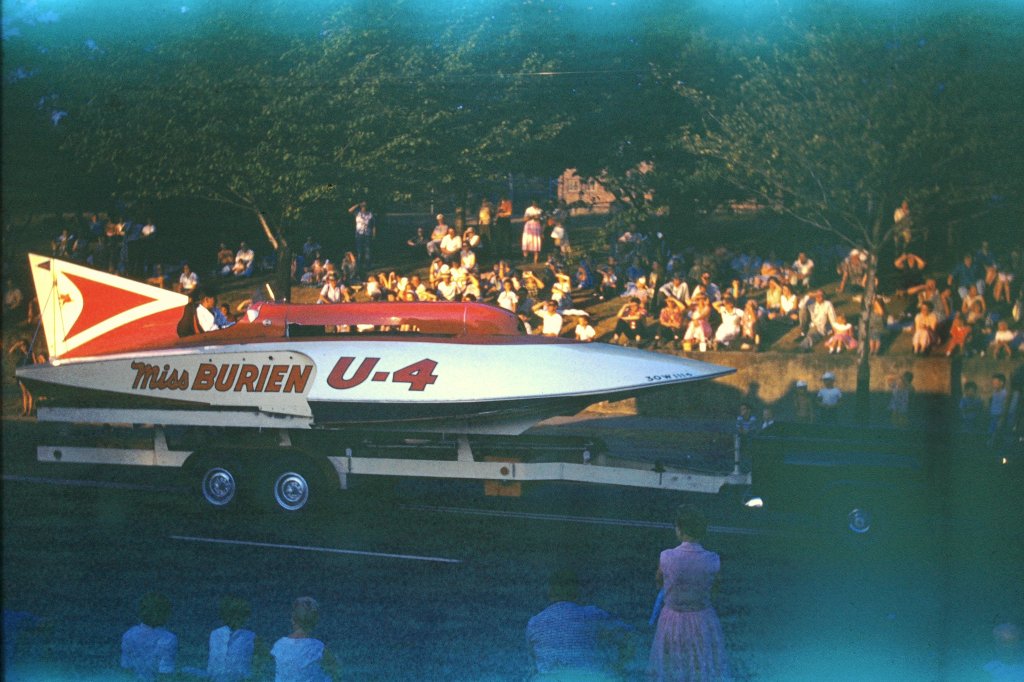
From the families collection is this photo of the Miss Burien limited hydroplane as it looked in the summer of 1960. This photo was taken from the house located at 2751 California Avenue SW, directly across from Hiawatha Park in West Seattle.
In the mid-1960’s, Queenie Mae had been deceased for about 8 years, so only Nellie and Ethel still lived in the house and, since they were now in their 70’s, it was decided to sell it. Which they did in the fall of 1964.
Soon the house was razed and a grocery store was erected and had opened, according to family lore, mere weeks before the earthquake hit. The damage to the store was severe.
The hubby recalls visiting the great aunts at that house as a child and every once in a while, the China dishes and tea cups stored in the display cabinet would ‘tinkle’ as if the earth was moving just a bit. Perhaps it was from traffic on California Avenue but the family always claimed that an earthquake fault ran under that house.
April 29th was a Thursday that year and, less than a mile north, the hubby – age 8 – had just gotten his breakfast and was leaving the kitchen, headed for the dining room table.
He was mid-step when the earthquake started and described what happened next:
“My recollection is that I was in the doorway to the living room holding a plate of scrambled eggs. Aunt Nell, who I think must have cooked the food for me, was sitting in the living room on a daybed we used as a couch. I stopped and was looking at her when the initial jolt bounced her up in the air. To this day, that is what I see.”
The spot where the house with the ‘tinkling’ china in the cabinet was once located.
Aunt Nell wasn’t the only one who went airborne as the hubby’s younger sister – who was just two weeks shy of her 4th birthday – was sleeping only to wake up on the floor. As she has always said “my bed threw me on the floor.”
The damage in West Seattle that day was extensive. According to Historylink.org, the worst damage was in West Seattle, Harbor Island, Duwamish River Industrial Area, and South Seattle.
“In West Seattle a survey was made of damaged chimneys. In a portion of West Seattle out of a total of 5,005 chimneys in 188 city blocks, the earthquake damaged 1,712 chimneys (34 percent of the chimneys). At Alki Beach, a part of West Seattle not surveyed, ‘virtually every chimney was down’ (U.S. Earthquakes 1965 p 98).”
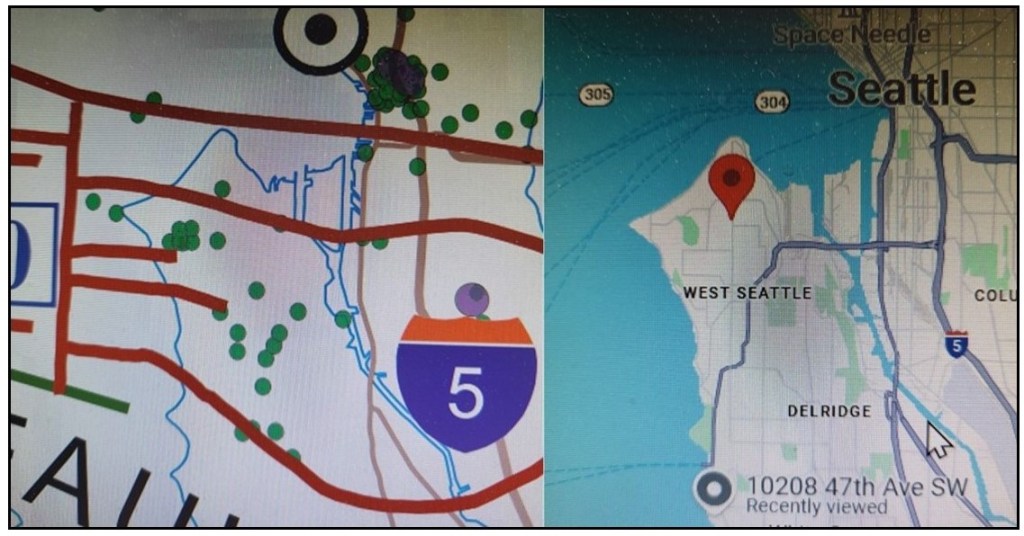
The map on the left shows the fault lines which run under West Seattle. The red marker on the right is the location of the house on California Avenue with the Earthquakes epicenter the gray dot to the south. When the two maps are overlaid, the fault line runs directly under where the house once stood.
The hubby believes he went to school after the earthquake as if nothing significant had just occurred. Oh, how times have changed!
As for the fault line under West Seattle? Yes, it does exist and was mapped in 2014 and when you overlay it onto that location, it runs pretty much under where their house once stood.
So where were you on April 29, 1965? I was in Yakima getting ready for school when that quake struck and our house shook. My mom was brushing my hair and she told me to hang on to the counter. Thankfully, I wasn’t tossed in the air.
When I typed the word ‘egg’ into the Infallible Wikipedia, it returned Egg, Eggplant, Eggs as Food, Egg decorating in Slavic Culture, Egg Harbor Township in New Jersey, and Eggnog.
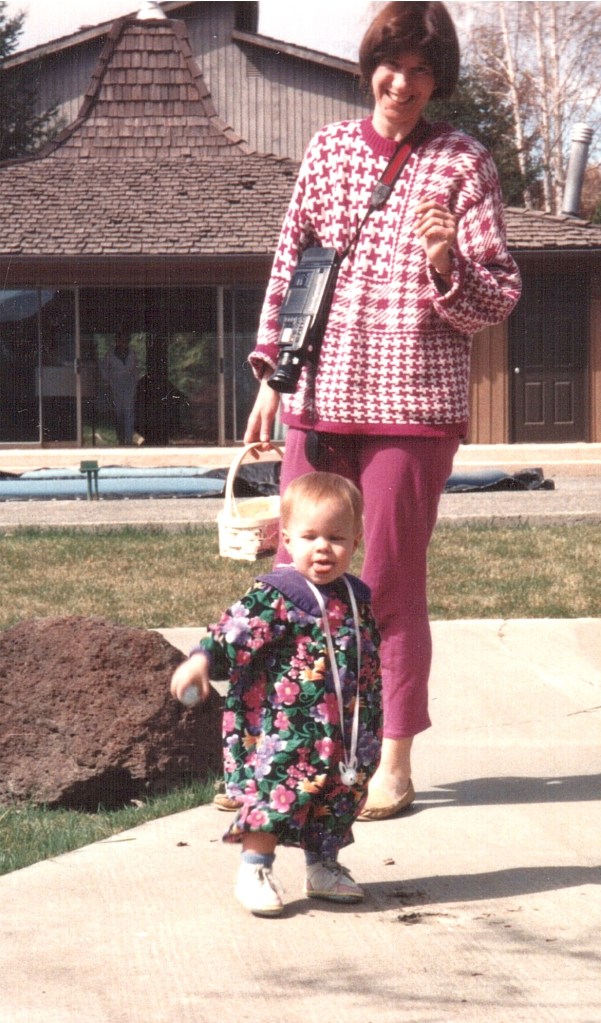
My daughter finding Easter Eggs. April 16, 1995.
While most people likely give little thought to eggs, they have – over the past couple of months – become one of the most talked about things in the United States. I’ve seen posts on Facebook and other social media with people complaining about the egg shortages which have swept the country and, of course, the skyrocketing price of eggs. About a month ago, I even overheard someone asking a Costco employee when they would be getting eggs again (since they were out of eggs that Saturday afternoon).
“Monday morning at ten will be the next delivery.” Guess where I was at ten that Monday morning?
But the egg shortage didn’t hold my interest. Instead, it’s the tradition of dyeing eggs for Easter.
Narrowing my search, I typed in “Easter Eggs.” It returned the one I wanted and yet another set of egg related pages including Easter Eggs in media, an Easter Egg tree, and – I kid you not – an “Easter Egger” – a breed of chicken. Eggs are, it turns out, a very popular topic.
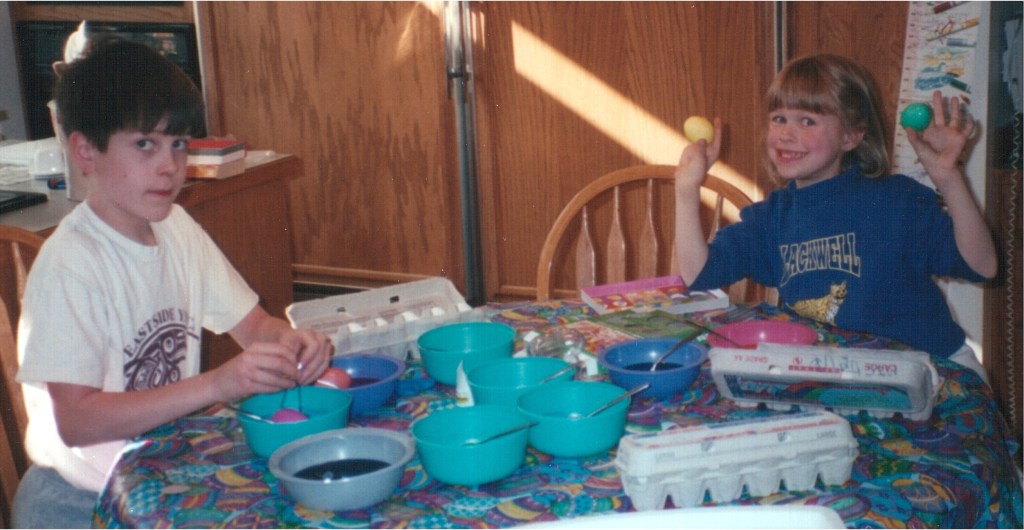
The dyeing of Easter eggs was a big deal for my kids. 1999.
But back to the Easter Egg. The dyeing and decorating of them is a tradition which goes back nearly two thousand years, begun by early Christians in Nicaea around 325 A.D. According to the aforementioned Infallible Wikipedia:
“Eggs in Christianity carry a Trinitarian symbolism as shell, yolk, and albumen are three parts of one egg. According to many sources, the Christian custom of Easter eggs started among the early Christians of Mesopotamia, who stained them with red colouring ‘in memory of the blood of Christ, shed at His crucifixion’. The Christian Church officially adopted the custom, regarding the eggs as a symbol of the resurrection of Jesus, with the Roman Ritual, the first edition of which was published in 1610 but which has texts of much older date, containing among the Easter Blessings of Food, one for eggs, along with those for lamb, bread, and new produce.”
The DeVore siblings showing off their eggs, Easter 1961.(taken from a Super8 movie reel)
The author with her bounty of eggs. Age 3.
While every holiday has something to recommend it, I think the dyeing and hiding of Easter Eggs makes this holiday one of my favorites. There are home movies from when I’m three showing off my Easter eggs at the family home in Clarkston, Washington. And, again, at various ages after we moved to Yakima. For a few years, we would join our cousins at my grandparent’s cabin up at Rimrock Lake and one year my grandmother hid eight dozen eggs. Yes, that’s right. She hid 96 eggs out in the long grasses. Not all 96 were found. The next year Easter was in late March and as it was too cold to hide them outside, she squirreled the nearly 100 eggs into every nook and cranny of the 1000 square feet available. I’m thinking all eight of us grandchildren were sent upstairs to the sleeping loft while the six adults remained on the first level. Not all of those were found either. At least not until later that spring when the missing eggs started to smell according to family lore.
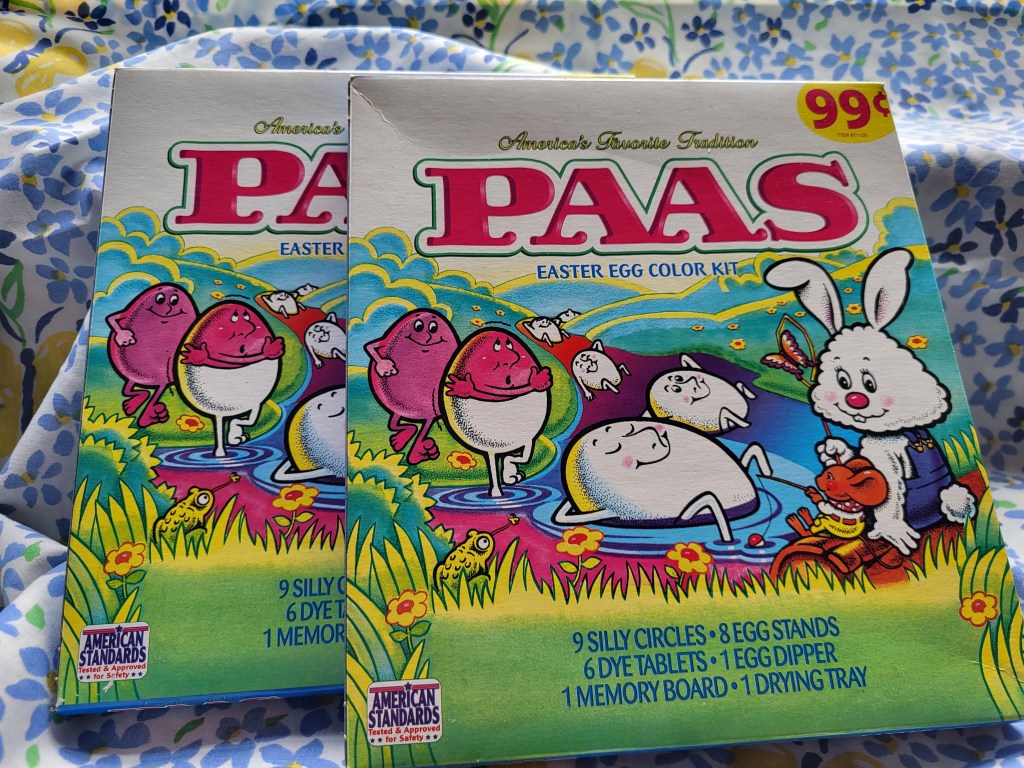
Alas, I grew up and quit dyeing Easter eggs. That was until I had kids of my own. And then it was full steam ahead! Every year I’d buy the PAAS egg tabs and soon had vinegar-based dyes in blue, green, yellow, red, orange, and purple. For a few hours I was transported back to my own childhood and the fun of coloring eggs; passing on the colorful tradition to my own children.
It was always fun to watch their brains at work. How many green ones? How many blue? How do you create one with every color on it? One year I think my son dyed all his eggs some shade of blue, while my daughter wanted the entire rainbow on every one of hers.
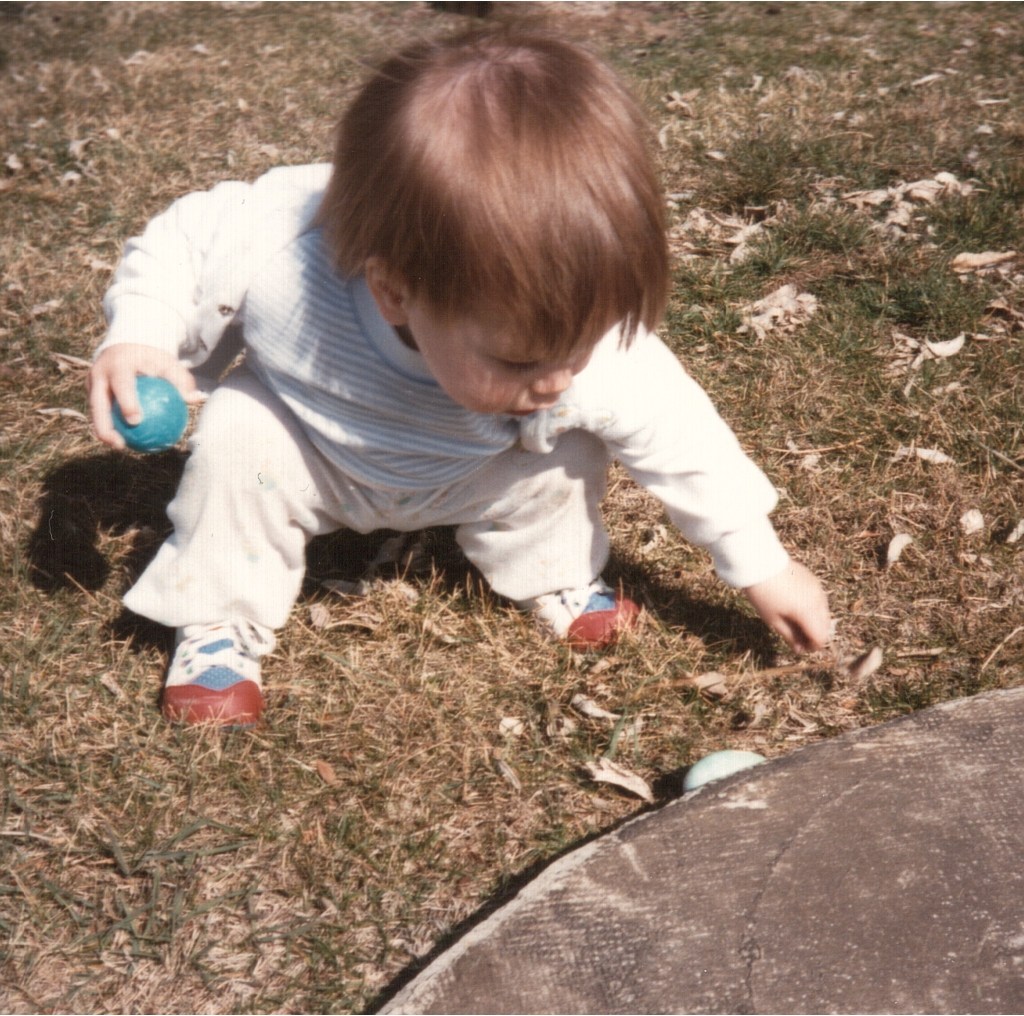
My just turned one year old daughter – under close supervision by me – with her first found Easter egg. 1994
My son, 14 months old, at his first Easter egg hunt. 1991.
As a child, I was much more regimented, making sure that there were two of each color, just in a darker or lighter shade. My mother would indulge me over the weekend, and let me get my box of eggs out of the refrigerator and admire them. At least until Sunday afternoon on Easter day. It was then the first eggs would get peeled, soon to be incorporated into potato salad and devilled eggs. To this day I still love hard boiled eggs and whenever I eat them I am pulled back, for a moment, to my childhood Easters.
But back to the egg hunt. As an adult, I was always able to recall where I had hidden my children’s eggs… well, except for that time when I snuck outside before breakfast to nestle them among the flora only to discover during the course of the hunt forty-five minutes later that the fauna – particularly slugs – love hard boiled eggs too. Who knew?
To try and take on this play is, I would conjecture, pure folly. Afterall, it is probably the most recognized literary work in the world. It is the story of two young lovers who forsake all else to be together. They risk the disapproval of family and friends and, ultimately, meet their demise all because they chose that which was forbidden.
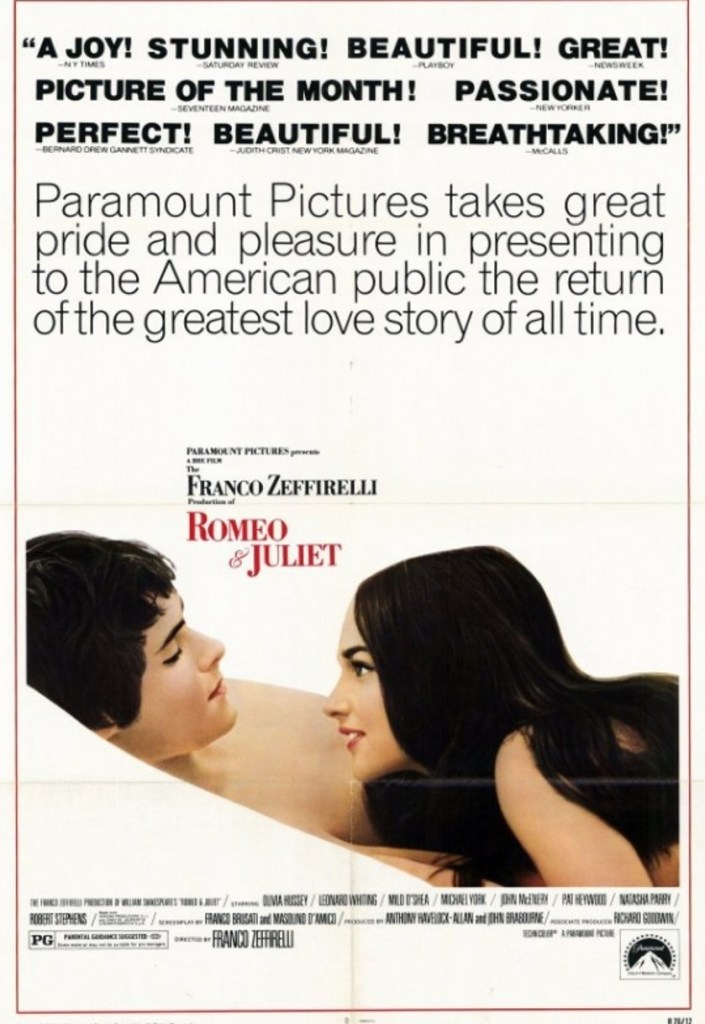
1968 Poster of Romeo and Juliet
“Romeo and Juliet” is William Shakespeare’s most famous works and March 11, 1302, is – according to OnThisDay.com – considered to be the date of the young lover’s marriage.
As is often the case, that is disputed since contextual clues from the play itself place the wedding date as being in mid to late July.
Regardless, today is as good a day as any to feature this iconic work.
For anyone who is unfamiliar with the storyline you can certainly access the Infallible Wikipedia. Which I did only to discover that the article there is 10,604 words long. Egads.
Instead, I found this one paragraph synopsis from the site Shakespeare.org.uk much easier to digest:
“An age-old vendetta between two powerful families erupts into bloodshed. A group of masked Montagues risk further conflict by gatecrashing a Capulet party. A young lovesick Romeo Montague falls instantly in love with Juliet Capulet, who is due to marry her father’s choice, the County Paris. With the help of Juliet’s nurse, the women arrange for the couple to marry the next day, but Romeo’s attempt to halt a street fight leads to the death of Juliet’s own cousin, Tybalt, for which Romeo is banished. In a desperate attempt to be reunited with Romeo, Juliet follows the Friar’s plot and fakes her own death. The message fails to reach Romeo, and believing Juliet dead, he takes his life in her tomb. Juliet wakes to find Romeo’s corpse beside her and kills herself. The grieving family agree to end their feud.”
But, honestly, only if you lived as a hermit in a rock cave on a remote island in the south Pacific would you NOT know about Romeo and Juliet (R&J).
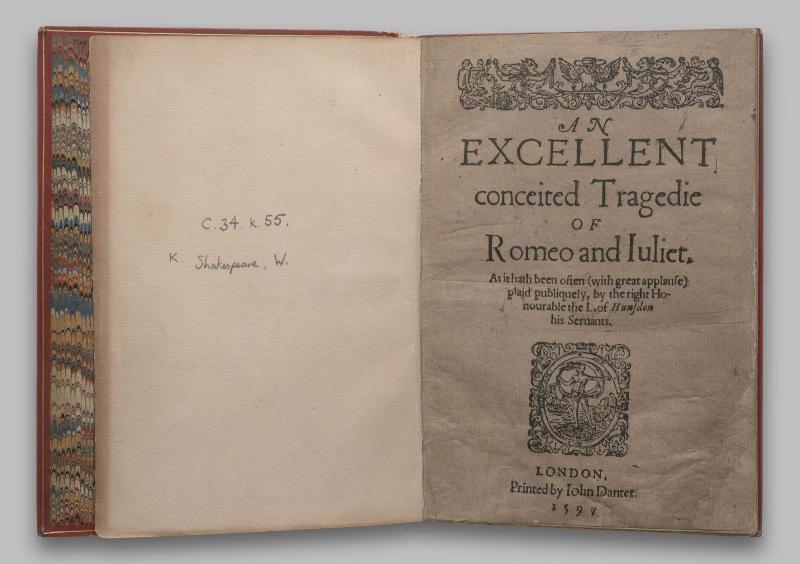
First edition Romeo and Juliet
When I started thinking about R&J, my mind drifted back to the early 1970’s and my experience at Wilson Junior High School in Yakima, Washington.
Wilson Junior High teachers 1971
It was there that I was introduced to R&J. At the time I had no appreciation for Shakespearean literature or for the incredible foundation which was given me by a trio of dedicated Jr. High English teachers. For my entire 8th grade year, my English teacher was Mr. Albrecht. To us students he seemed quite mature. When, in fact, he was the ripe old age of 27 that first year. We respected him because he treated us as intelligent people regardless of our limited years on earth; he rewarded those who worked hard and did their best.
The next year my English class experience was split into two segments. For the fall/winter semester I drew the formidable grammar teacher, Mrs. Eglin. I think she likely made students rip out their hair and cry at times. But, by God, you were going to learn: all the parts of grammar, how to diagram a sentence, and how to construct a proper paragraph. It was in her class that I discovered the evils of dangling participles, all about verbs, adverbs, nouns (both proper and pro-), adjectives, and every other part of speech. In other words, I learned how to write the correct way. She made me think about my writing in ways I’d never considered. I might not have always followed her methods, and I’m not perfect, but not for lack of instruction on Mrs. Eglin’s part.
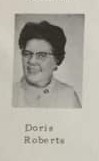
Mrs. Roberts 1971 yearbook photo
In the second half of the year, I had an even more demanding teacher – which I hadn’t thought possible after being with Mrs. Eglin – Mrs. Roberts. First name Doris. Which is telling. No one in my age demographic, or even a few years older, was named Doris. The name had, however, been the 8th most popular name for girls in the 1920’s. Mrs. Roberts was born in 1922 and was an ancient 50 that year. Ah perspective.
Mrs. Roberts assigned us every classical piece of literature she could find and we explored such themes as ‘man’s inhumanity to man’, ethics, morality, death and dying, cruelty, poverty… yes, we read some very dark stories. Like “Flowers for Algernon”, “The Grapes of Wrath”, “Fahrenheit 451”, and “Romeo and Juliet”.
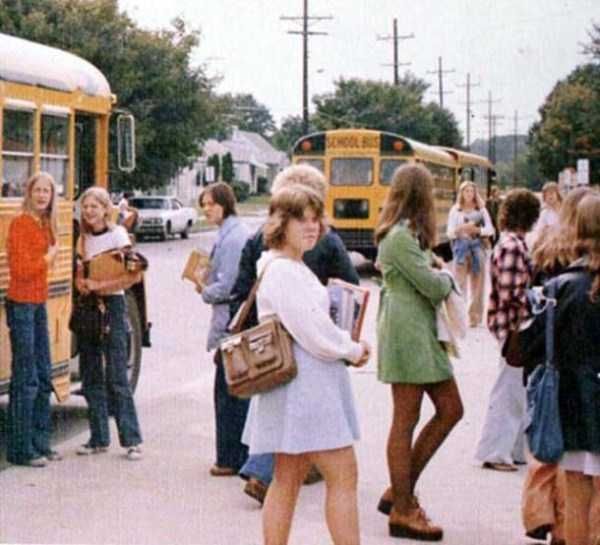
The clever thing which this band of teachers managed to accomplish was to make the course work relevant to the teenagers of the day. Somehow, they convinced the administration that it was educational to load some 250 ninth graders into school busses and send them to the movie theatre to see films based on what we were reading.
Pretty much how teenagers dressed in 1971-72. Found this photo on Pinterest.
Spoiler alert: it worked.
Of course, we kids thought we’d gotten a free pass for the day. Personally, I returned from those outings thinking about the films but also contemplating the books we read and then writing papers on the theme we thought was the best fit.
Sometime in the fall of 1971 I’m pretty certain we were whisked away in the busses to see the 1968 film version of Romeo and Juliet with Leonard Whiting and Olivia Hussey. Such clever English teachers, using the pop culture of the day to get us to learn. I did find a reference in my 1972 diary for both “Farenheit 451” and “Mary, Queen of Scots.” Sadly, my diary from 1971 does not seem to exist any longer, which surprises me as I was a faithful diary writer.
Now a few fun facts. I was able to find 49 times R&J was made into a movie in the Shakespearean tradition (from 1908-2021); an additional 118 films were produced which adapted the works in modern ways or with odd twists (like the truly bizarre 2011 Gnomeo and Juliet); there are also a few films which utilize R&J’s overarching theme in some new way (like the charming 2019 movie “Letters from Juliet”).
I owe a lot to my Junior High School English teachers for the great foundation they laid. It was the gift that has continued to give and bless me.
The first Tuesday of September was always a day which struck fear in my heart. In fact, no other day of the year caused more anxiety and distress than this one.
The reason, of course, was due to the fact that when I was growing up school always started on this day.
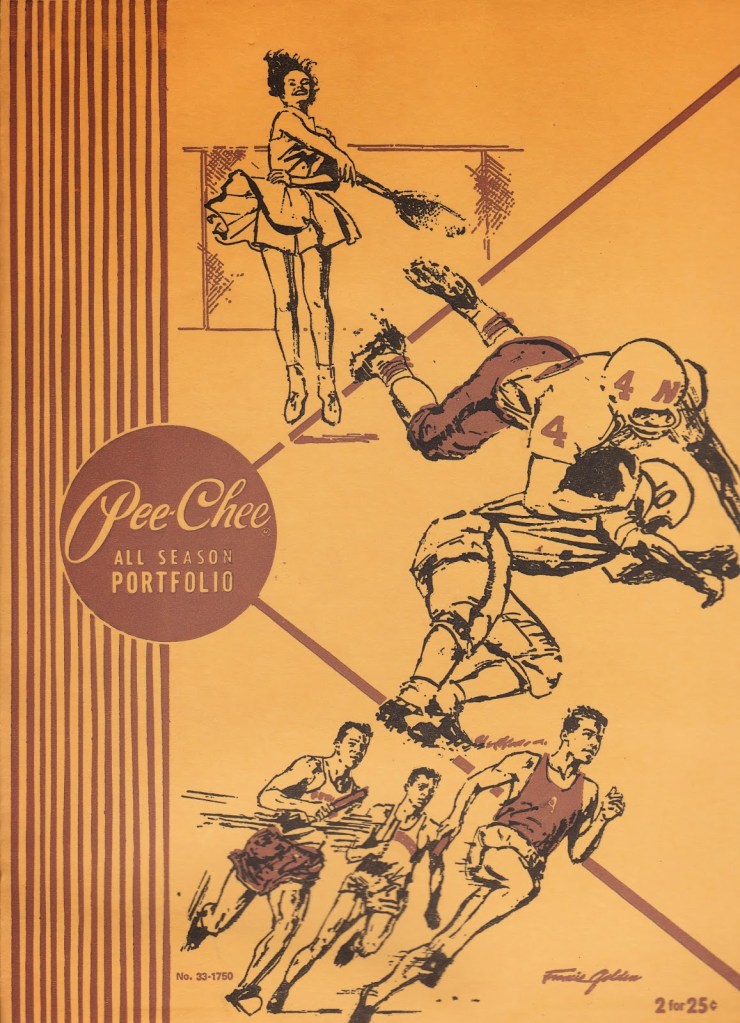
The ubiquitous Pee-Chee – an indispensible back to school item
Unlike in today’s world, where we are inundated with back-to-school ads for supplies and equipment beginning in late July, in the 1960’s and 70’s, we didn’t much think about going back to school. That was until one day in late August my mother would ominously announce that school started the next week.
So off we would go to get things. Our back-to-school supply list included Pee Chee folders, notebook paper, #2 pencils, and BIC pens. That was it.
For clothing, I was lucky to get one new outfit for the first day of school. And the most evil of all footwear ever invented: saddle shoes.
I’ll get back to those in a bit. First off, however, I imagine you are wondering about the Pee Chee. What is a Pee Chee? And why do so many people my age wax nostalgic over a folded in half piece of cardstock? I knew it deserved Tuesday Newsday status. Since I couldn’t find the official day they were introduced, the first Tuesday in September seemed the perfect opportunity to learn about them. From the Infallible Wikipedia:
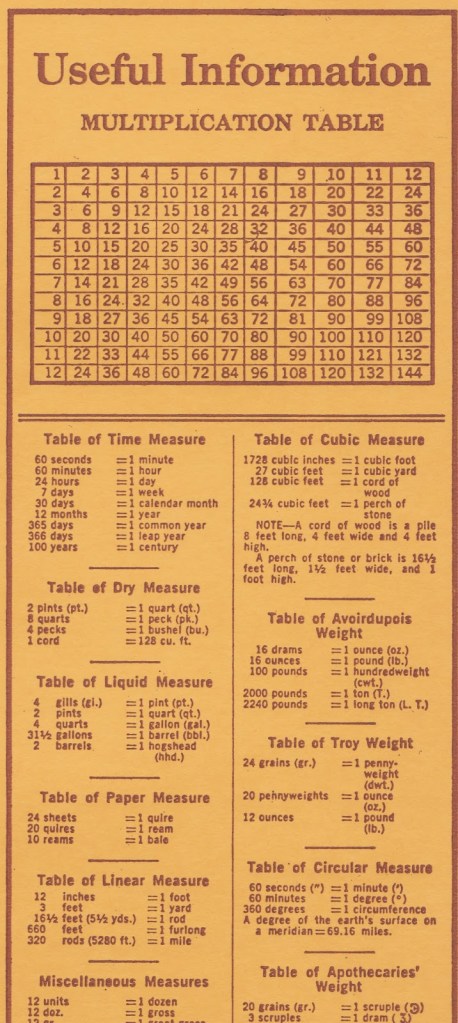
How we learned our multiplication tables and other useful information
“The yellow Pee-Chee All Season Portfolio was a common American stationery item in the second half of the 20th century, commonly used by students for storing school papers. It was first produced in 1943 by the Western Tablet and Stationery Company of Kalamazoo, Michigan. Pee-Chees were later produced by the Mead Corporation. (snip) These inexpensive folders are made of card stock with two internal pockets for the storage of loose-leaf paper. The pockets are printed with a variety of reference information including factors for converting between Imperial and metric measurement units, and a multiplication table. The folders had fallen out of general use by the 2000s, but are available from Mead as of 2014.”
Note the words “multiplication table.” This was probably the most valuable thing a Pee Chee provided as we were expected to memorize this table. By the time you arrived at the twelves, it got a bit difficult. The handy dandy Pee Chee came to your rescue. Of course, our teachers knew this and we had to put our Pee Chee’s away during test time.
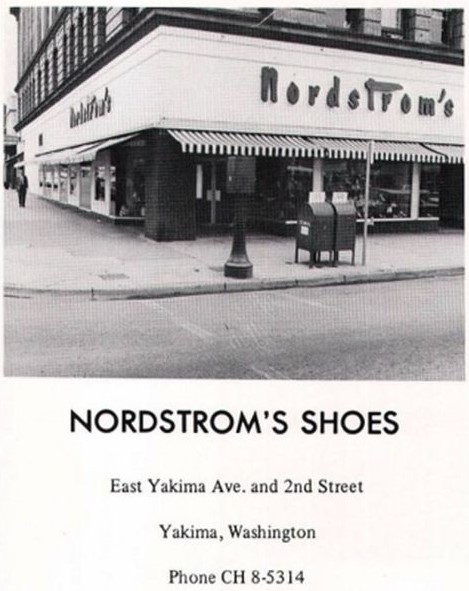
One of the eight Nordstrom shoe stores in the 1960’s
Every day, when I walked home from elementary school, I only carried a Pee Chee and rarely any books unless it was one checked out from the school library. By the time I was in Junior High and High School, books were part of the equation. Along with the Pee Chee of course.
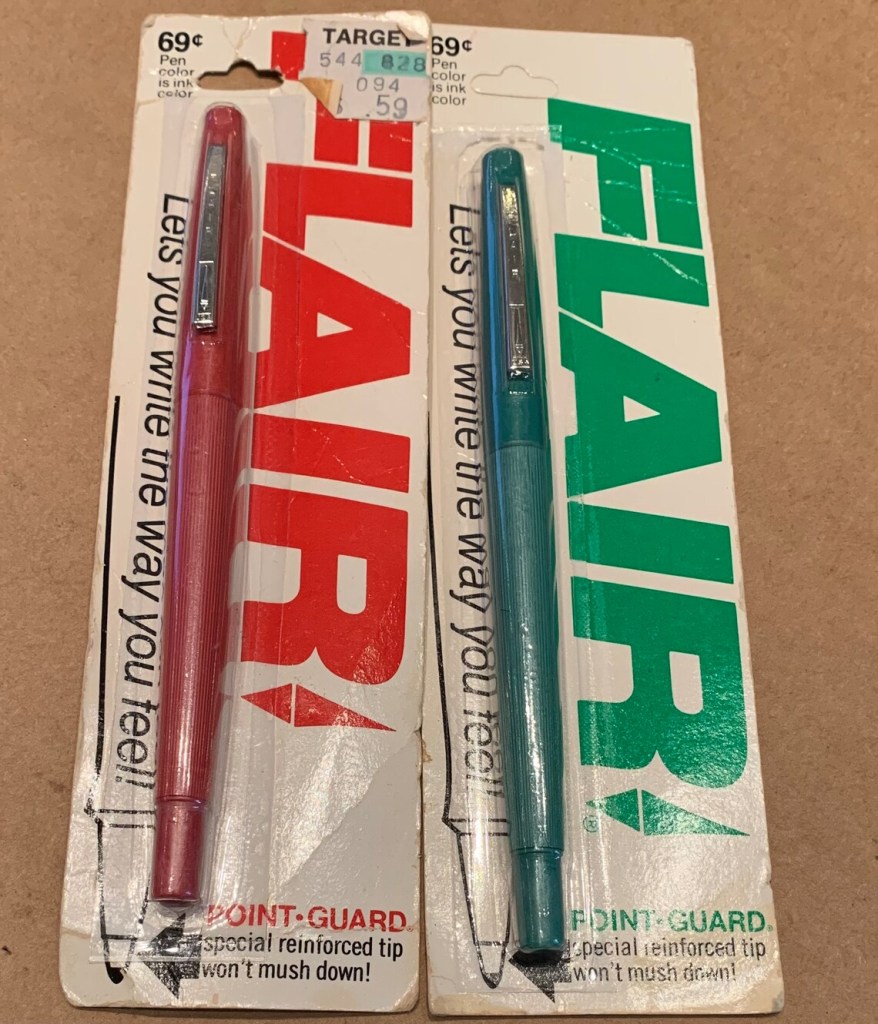
That brand new, unmarked, non-dog-eared Pee Chee was the best part of being forced to go back to school. And paper, pencils and BIC pens, of course. The best addition were colored Flair pens starting in Junior High! My favorite was the green one.
But the worst part? From first grade through sixth I was subjected to torture by being forced to wear saddle shoes. Whoever invented this shoe should have been required to wear a new pair every week for their entire lives just so they would know what pain they subjected multiple generations of girls to endure.
The evil saddle shoe…
My mother would take me and my sister to Nordstrom’s Shoe store… in the 1960’s in Yakima that’s all it was… a shoe store. We would bypass all the beautiful shiny black patent leather shoes and the cute Mary Janes and go directly to the rack of clunky saddle shoes. There they sat, big, bulky, and ugly. They had brown soles thicker than a slice of French toast. Across their beige bodies was a second strip of stiff brown leather, with laces through the holes, just waiting to cinch your foot into bondage. Heaven forbid that you got shoes which fit… no, they had to be a bit big so you’d grow in to them and not grow out of them before the following June.
We would wear them around the house for several days before school started in a futile effort to ‘break’ them in. It never worked. The first few weeks of school our feet bore witness to the horrors of saddle shoes; oozing red blisters were covered with adhesive tape and we’d limp through the day. Eventually the leather softened and the blisters abated… usually by October. Kids today just don’t realize how lucky they are to have been spared the scourge of saddle shoes.
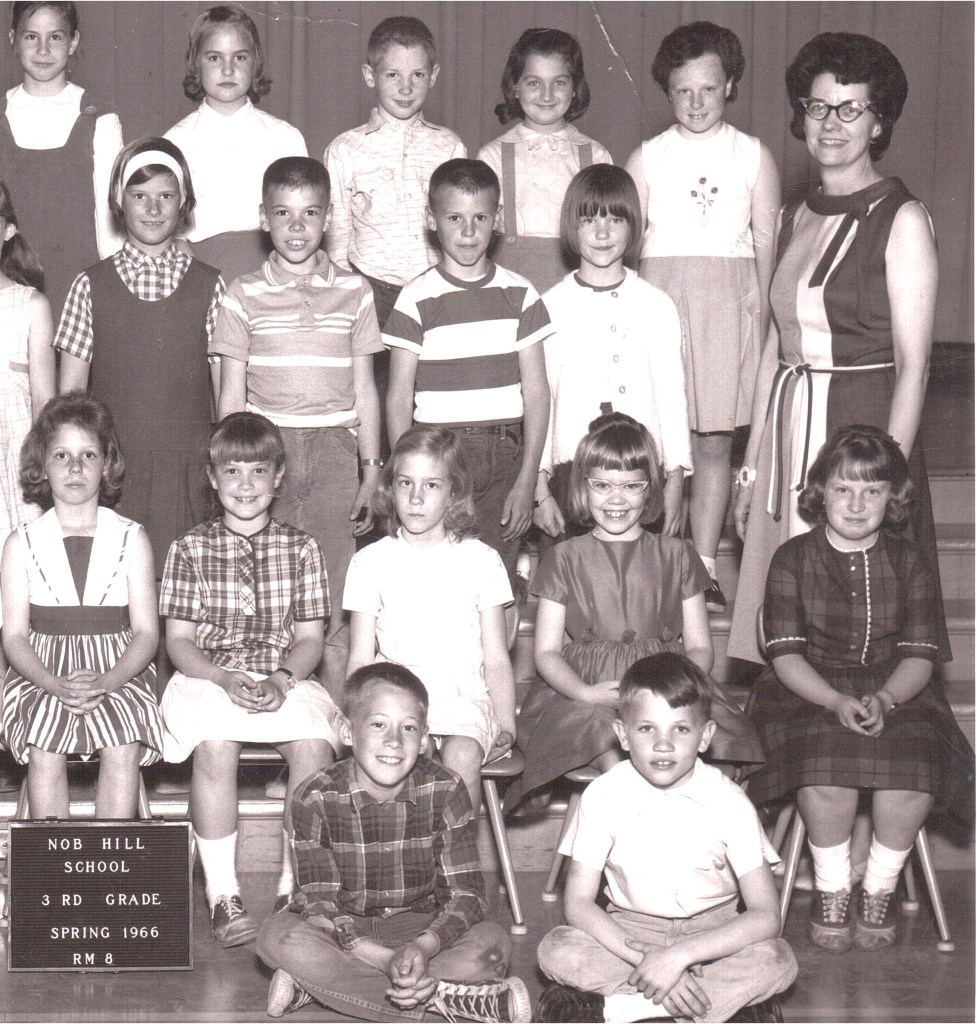
Note the saddle shoes on the two girls seated, Marla on the left and Rinda on the far right. This author is next to Marla undoubtedly also wearing saddle shoes. The girl in the glasses next to me? That was Kelly who NEVER had saddle shoes but always cute black patten leather shoes.
Flair pens were IT! Especially the green ones.
Even now the first week of September is my least favorite time of the year; despite the fact I do not have to go back to school nor do my children.
I am, however, very, very tempted to go hang out in the office supply store and indulge myself in the smell of paper and ink and the plethora of notebooks, papers, pens, and paperclips. Anyone who has seen my office knows that I have stacks of spiral notebooks, hundreds of colored paperclips (many with decorative tops), and a collection of G-2 pens of every hue. In fact, just writing about it inspires me to head to my nearest Office Depot Max to see what’s on sale. Unlike saddle shoes, office supplies never go out of fashion!
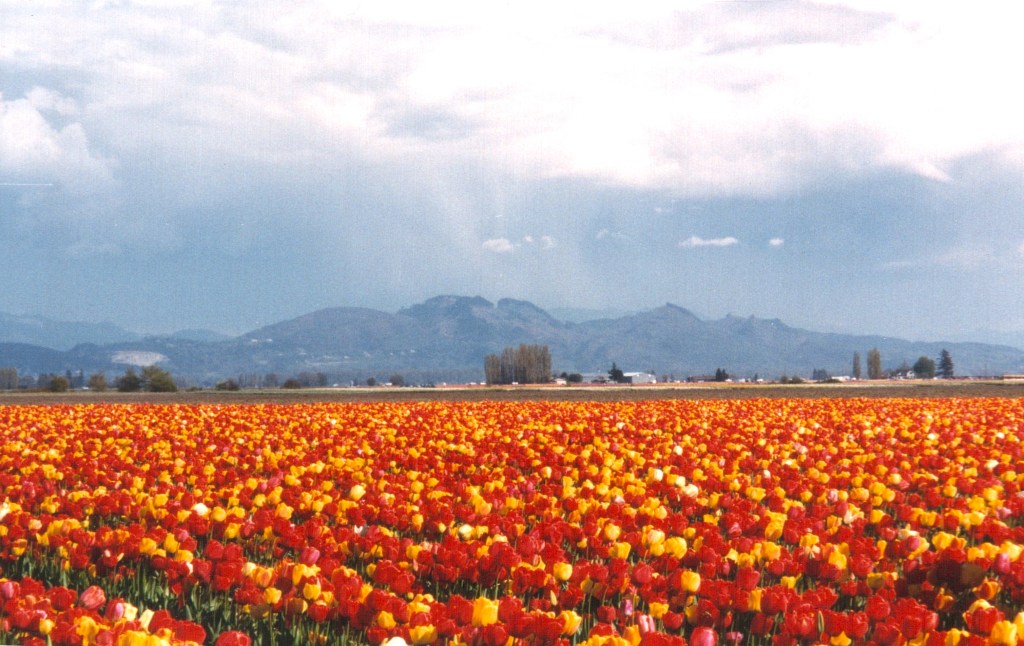
This annual event has come to define Mount Vernon and the surrounding area. Begun in April 1984, the Skagit Valley Tulip festival cemented Mount Vernon and the surrounding area’s identity as the tulip capital of the nation.
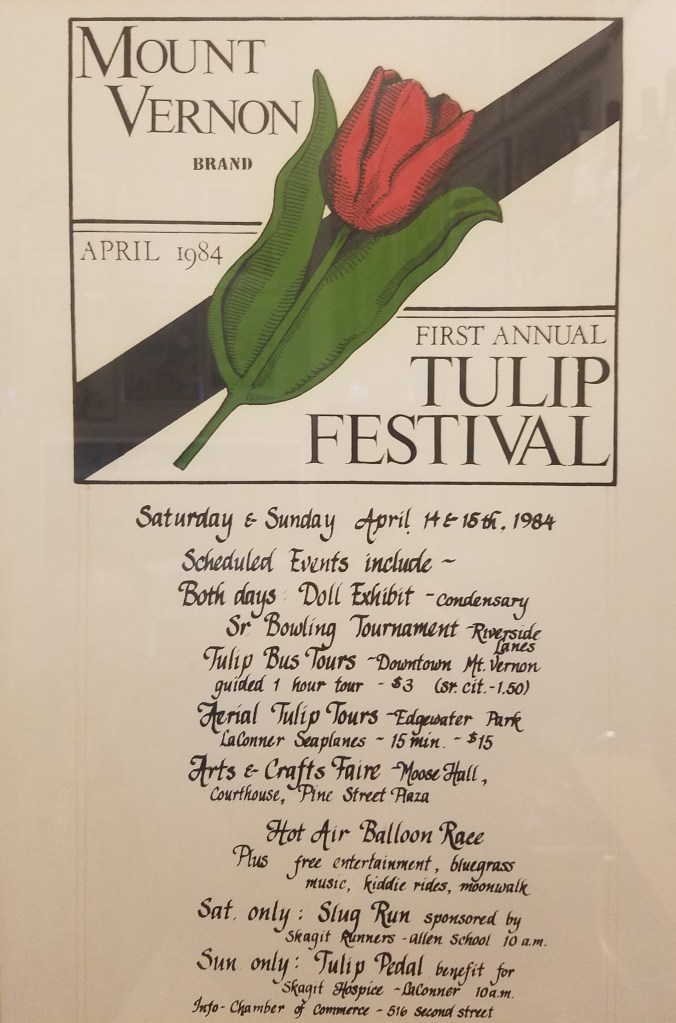
Schedule of Events from the 1984 Tulip Festival. Photo taken with permission by the author
The first tulip bulbs were brought to the Skagit Valley from Holland in 1906 by Mary Brown Stewart. Soon she had a mail-order bulb business, selling them to garden clubs in New England. Her son, Sam, joined the operation 20 years later which coincided with a ban by the Federal government on bulbs imported from Holland.
This event triggered many of the bulb growers to send family members to the United States to establish farms. Through trial, error, and success, the bulb growers discovered that the Skagit Valley was a prime bulb growing region, eclipsing Bellingham and Lynden, Washington, where colder winters were not ideal for the plants.
In the late 1940’s, the embargo was lifted and, once again, the Skagit Valley bulb growers were impacted. Many of the smaller farmers were forced out of business with consumers ability to import bulbs from Europe once again.
Relative late comers William and Helen Roozen, Dutch immigrants, purchased the Washington Bulb Company in 1955.
The Infallible Wikipedia gives a short summation:
Photo taken by the author on her first visit to the tulip fields, April 13, 1998
“In 1946, William Roozen arrived to the United States, leaving behind a successful bulb-growing business spanning six generations in Holland. After working on several different farms, Roozen started his own in Skagit County in 1950, and in 1955 purchased the Washington Bulb Company, making him the leader among the four flower-growing families in the area, and the Washington Bulb Company the leading grower of tulip, daffodil, and iris bulbs in North America. The farm operates a public display garden and gift shop called Roozengaarde, which, alongside the DeGoede family’s Tulip Town, is a major attraction during the Tulip Festival.
Local tulip growers showcased their bulbs through display gardens for decades prior to the formation of an official festival. The Mount Vernon Chamber of Commerce established the Skagit Valley Tulip Festival as a 3-day event in 1984 to add festivities during the bloom month. The event has since grown to a month-long event and coincides with street fairs, art shows and sporting events.”
Celebrating its 40th year in 2024, the Tulip Festival has become one of the most popular events in the state. Weekends in April produce Mount Vernon traffic jams which rival a bad morning commute in Seattle. The festival organizers estimate that nearly a million people will trek to see the tulips during April. A look at their website, tulipfestival.org, provides a list of hundreds of events throughout Skagit County, helpful ‘bloom’ maps, and lists of where to eat and stay.
In 2019,the Hubby and I visited the tulip festival offices as I was researching for this article, first published in 2019. We were amazed by the steady stream of people coming in to obtain information. One of the volunteers – a friend we know through a different organization –said there are times when the crowds spill out on the sidewalk.
Having only moved to Mount Vernon one year earlier, we purchased three prints of Tulip Festival posters and then headed out on what has become one of the things the Hubby and I ‘do’ together which is drive around the valley.
The three Tulip Festival posters which we purchased in 2019, had framed ,and now hang on our favorite artworks wall. Our way to honor our new home in Mount Vernon.
It was, as we had experienced several times since moving to the area, another magical day. We found a flock of well over a thousand snow geese (they will be gone by mid-May) in a field on Fir Island and were treated to an aerial display which took my breath away. From there we drove up a hill to the west of the flower fields and could see the ribbons of red, yellow, purple, and white cut across the expansive landscape.
We visited a daffodil field which, two weeks earlier, had been a cheery harbinger of spring but the once vibrant blooms were mostly faded. From there we ventured to ground zero, noting that although there were crowds, they were not yet of the epic proportion expected the next two weekends. The red and yellow tulips were approaching full bloom but the purple, white, pink, and variegated ones were still a week or two away.
April 13, 1998 with my kids, then ages 8 and 5. Along with my friend, Kelly, we drove up from Sammamish on the Monday of spring break. The wind cut through us that day!
We vowed that, for 2020, we would go visit Roozengaarde or the other large player, Tulip Town. When Covid hit, that shut down our plans. Perhaps one of these years we will be ‘tourists’ for a day and visit one or both. But for the most part we just enjoy driving around and seeing how the fields change each year. But not on a weekend. We’re not THAT crazy.
For those who want to come see the tulip fields in bloom, visit the official tulip festival website:
The era of professional football in the United States was ascendant in the 1950’s and into the early 1960’s. Pretty much every major city in the United States wanted to get in on the action.
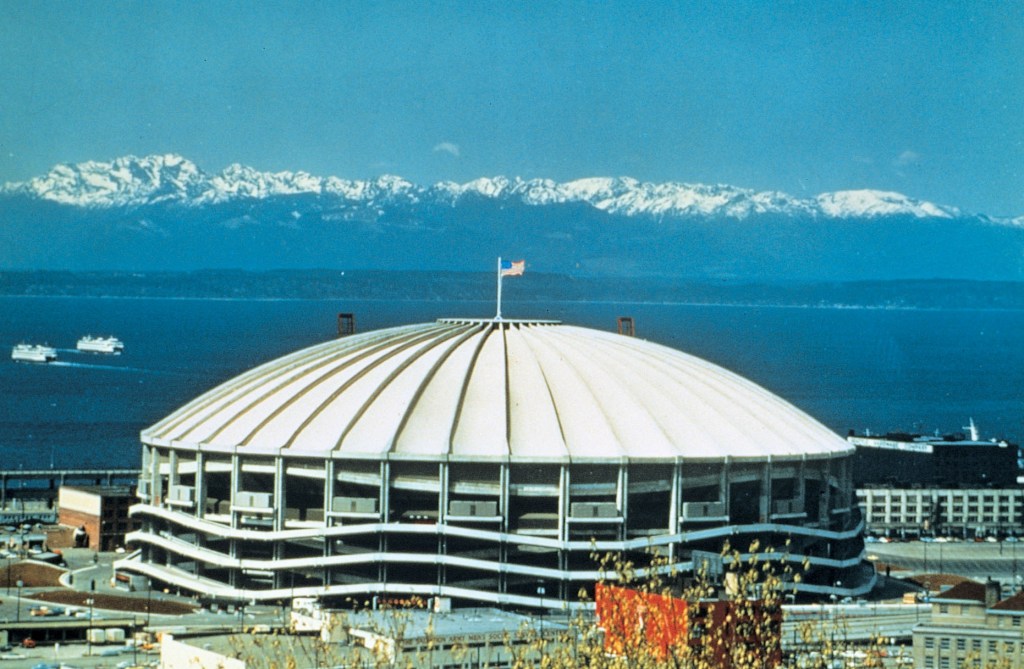
On the day of the Mariner’s last game in the building 1999.
But for many cities, weather was a limiting factor. After all, playing in a foot of snow, blistering heat, or constant rain, was not ideal for the players or the fans. In the 1950’s the dream of indoor stadiums took hold. It was in Houston, in the early 1960’s, when the first such venue – the Astrodome – became a reality. Others followed.
Many in Washington State longed to have a pro-football franchise and believed the rainy climate on the west side of the Cascade Mountains called for an indoor stadium. Thus began the quest to build what would eventually be named “The Kingdome.”
It was in 1959 when the idea was first proposed but it took until 1976 for the vision to become a reality. The Infallible Wikipedia tells us:
“The idea of constructing a covered stadium for a major league football or baseball team was first proposed to Seattle officials in 1959. Voters rejected separate measures to approve public funding for such a stadium in 1960 and 1966, but the outcome was different in 1968; King County voters approved the issue of $40 million in municipal bonds to construct the stadium.
Jim Zorn and Steve Largent in the early days of the Seahawks franchise
Construction began in 1972 and the stadium opened in 1976 as the home of the Sounders and Seahawks. The Mariners moved in the following year, and the SuperSonics moved in the year after that, only to move back to the Seattle Center Coliseum in 1985.”
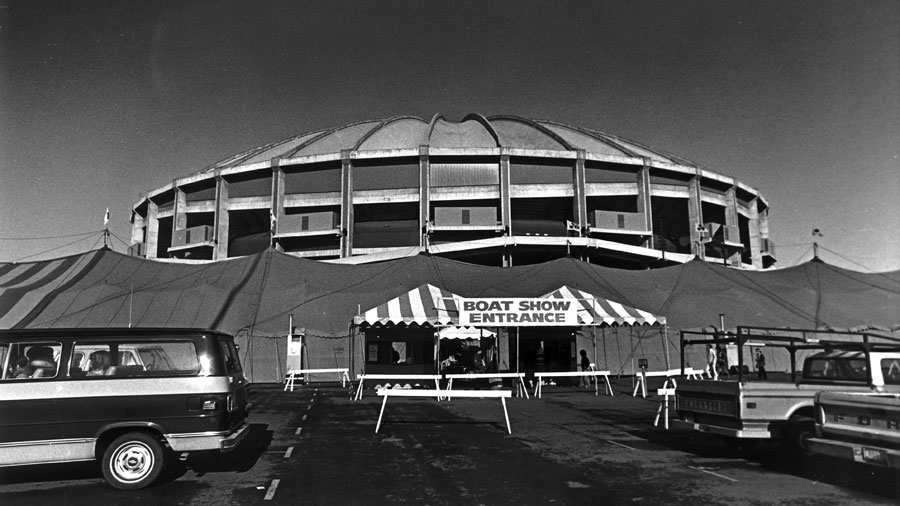
The Kingdome, named as such due to its location in King County, Washington, served the community as a venue not only for the Seahawks and other sports teams, but also as an event center to host large events such as the Seattle Home Show and the Seattle Boat Show as well as many rock concerts over the years.
“In the Seahawks’ heyday, the Kingdome was known as one of the loudest stadiums in the league. Opposing teams were known to practice with jet engine sounds blaring at full blast to prepare for the painfully high decibel levels typical of Seahawks games. It was where Seahawks fans, who were long called “the 12th Man” and led the Seahawks to retire the number 12 in honor of them in 1984, made their reputation as one of the most ravenous fan bases in the NFL, a reputation that has carried over to what is now Lumen Field. The Kingdome’s reputation contributed to the NFL’s 1989 vote in favor of enacting a rule penalizing home teams for excessive crowd noise.”
A view of the Kingdome during one of the Boat Shows
But, if there was one word to describe the Kingdome it would be ‘utilitarian.’ How else to explain the huge gray cement mushroom which lacked any aesthetic appeal? But it did the job and also became infamous among the indoor venues for the noise levels. Also from the Infallible Wikipedia:
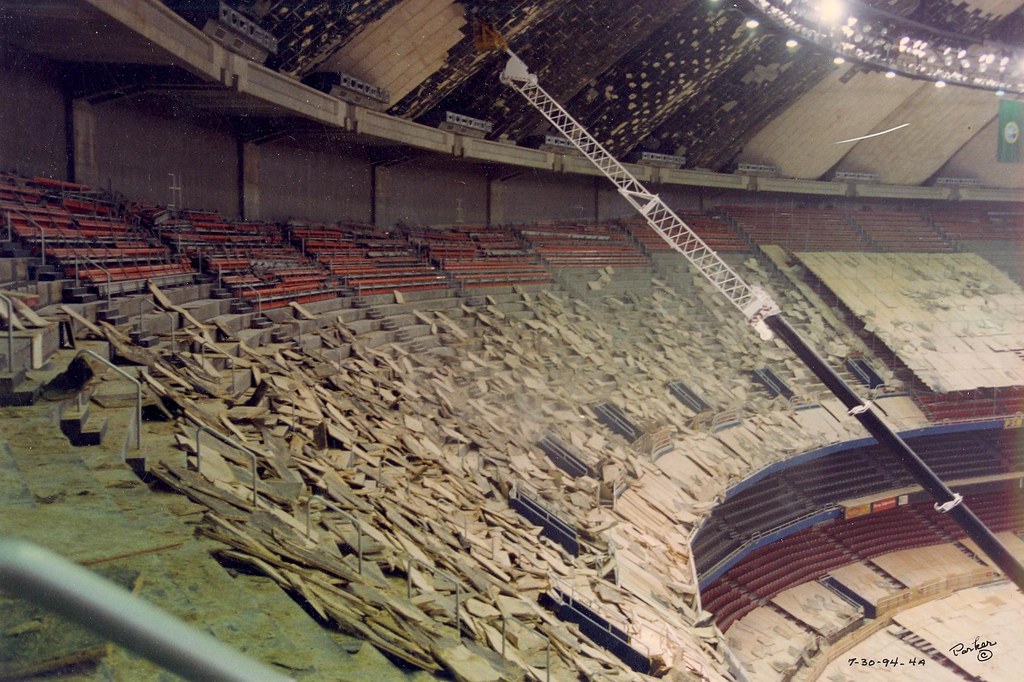
By the 1990’s, the first iteration of domed stadiums had outlived their appeal and useful life. The Kingdome’s roof – problematic from the beginning – had a partial roof collapse in July 1994, and the venue was closed for repairs for nearly four months. But the problems did not end there, threats by then owner, Ken Behring, to move the team out of Seattle – and the Mariners insistence on a new baseball venue – eventually led to the decision to replace the Kingdome.
It was on Sunday, March 26, 2000, when the Kingdome was finally reduced to a pile of rubble, paving the way for the construction of the next generation of a football stadium in Seattle.
The interior of the Kingdome in 1994 during removal of the ceiling tiles.
It was a clear and pleasant day and, of course, all the local TV stations had been covering the story for months as everything from inside the building was removed leaving, at last, the concrete shell. For weeks – who knows maybe it was months – holes were drilled in the walls and a serpentine of detonating cord was laid. Eventually dynamite was inserted into the holes and it was all connected up in anticipation of the implosion which would take down the concrete beast.
At the time, my family was living on the eastside of Lake Sammamish, about 13 miles – as the crow flies – from the Kingdome. We gathered around the TV and watched live as the first sticks of dynamite on the roof sent streaks of sparks down the spines and the chain reaction encircled the building. It was over in a matter of seconds as clouds of dust obliterated the area. Me, the hubby, and our two kids – then ages 10 and 7 – once the main event was over, rushed out to our west facing deck and a few seconds later the sound waves of the Kingdome’s demise reached us.
A recap of King5’s coverage and a bit of history of the Kingdome. We were likely watching this channel that morning.
It was a surreal experience.
In some ways I miss the Kingdome and all it represented. It was Seattle – and Washington States’ – message to the world that we were ready to play with the big boys. The construction of the Kingdome represented a heady era in Seattle as we welcomed the Seahawk celebrities of the era: Jim Zorn, Steve Largent, and Sherman Smith to name a few. We were hometown proud of the Nordstrom family for owning the team and you could find no more loyal fans anywhere.
It was, truly, a bittersweet day when the Kingdome came down. It’s been gone for 24 years now but for those of us who lived in King County in that era, it won’t ever be forgotten.
327 Tuesday Newsday Articles and 2 published novels
January 9th
The author’s collection of dictionaries. The Webster’s New World Dictionary, third from the left, was often used for playing ‘Dictionary.’
A Tuesday Newsday Classic
Back in the early 1980’s I was introduced to a game my hubby and his family loved to play. There was no game board or markers to move around. Instead it required a dictionary, a piece of paper for each player, and a pen. They called the game Dictionary.
A search of the internet reveals, from the Infallible Wikipedia, that the genre is more commonly known by another name: Fictionary. In the years since being introduced to this delightful pastime there have been actual games developed and sold. As noted by the Infallible Wikipedia:
“The board games Balderdash, Dictionary Dabble, Flummoxed, and Weird Wordz are based on Fictionary. In one round of the board game Derivation, players describe or fabricate a word’s etymology; players who provide a correct etymology receive one point for doing so, but their entries are then removed from play, and they lose their chance to receive multiple points by drawing multiple votes from other players. Similarly, in the board game Wise and Otherwise, the Picker randomly chooses a quotation and reads the beginning, and other players try to create realistic endings to the quotation.”
It’s amazing what interesting words one can find when perusing a dictionary.
While these games have been successful, I rather like how we played it: Get a group of people together (the more the better) and then pick one person each round who looks through the dictionary until they find a sufficiently obscure word. They then announce the word to the group and each person has to come up with a definition for that word. The chooser writes down the REAL definition.
Once everyone has written his or her definition, the papers are passed to the person who picked the word and they read each entry aloud, being sure to hide the papers from others. Each participant then decides which might be the real meaning of the word. Those who guess correctly get one point. The chooser gets one point for every incorrect guess.
Now, I’m sure you are wondering what this has to do with the title of this week’s Tuesday Newsday, Coddiwomple. Up until the hubby and I were driving home from Yakima on New Year’s Day this year I had never heard of Coddiwomple. But it immediately made me think of playing Dictionary and probably the most favorite word I ever found and used which is ‘gardyloo.’
The hubby had read an article on the term Coddiwomple and shared it with me. What I learned, from author and philosopher David Marlowe – who coined the term – is this:
I was immediately struck by the rhythm of the word and how it seems to fit its definition. Of course the purpose of the word is to help people stop and contemplate what, exactly, they are each trying to accomplish in life.
It was on this date in 2017 when I wrote my first Tuesday Newsday article. At that time I had no idea where I was going with it; only that, via a very decidedly Coddiwomple experience, I had been nudged to take the path of starting a website for ‘someday.’
That ‘someday’ was aimed for that moment, in the murky future, when I would have a book published and be able to share it on my website.
And thus began a Coddiwomple journey toward a vague destination. My first Tuesday Newsday was all about one of my favorite musical artists, Jim Croce.
Of course I screwed it up a bit on that first go round – being unfamiliar with WordPress and how it all worked – and accidently posted it on Wednesday, January 10th instead of that Tuesday, January 9th. So I ended up with TWO articles about Jim Croce a year apart, with the other one on January 11th the following year. (here’s the link to both which I combined into one for ONLY January 10th): https://barbaradevore.com/2017/01/10/jim-croce/)
But that was okay because, well, Jim Croce. One of his best songs… and so bittersweet.
What I did know after that first post is that in addition to the fiction stories which invade my brain and compel me to write, I had a whole lot of personal stories which came pouring forth.
Some have been funny, some philosophical; they range from recounting early childhood memories to recent impactful events. They cover music, TV, movies, nature, history, geeky musings, and cultural references. War and politics are never included.
But what do any of these ramblings have to do with traveling purposefully toward a vague destination?
For me, no matter what think I chose to do, it is the desire to fully embrace each experience in life. New opportunities frequently present themselves and, as someone who probably has undiagnosed ADHD, I am often distracted by such shiny objects.
Yet, as I have matured, I’ve come to understand a universal truth: our most precious commodity is TIME. I’ve become quite protective of my time. And the one thing in life which is elemental to who I am and where I want to spend my time is writing. It’s been that way since I first put a piece of chalk to a chalkboard desk I received as a Christmas present at age three when my family still lived in Clarkston, Washington.
The author, age 3, with her chalk board. Captured with a cell phone camera from the home movies my dad took.
So now I begin year nine of my blog in basically the same way as I did in 2017, traveling in a purposeful manner toward a vague destination. Coddiwomple.
Now, if you’ll excuse me I need to go write Nicole out of the entanglement in which she finds herself. Who will she choose: Nathan, Sam, or ???. And how will her parents react? I’m not sure she has quite embraced Coddiwomple but then again she’s only 21 and has a lifetime ahead of her.
Sneak preview of just a bit of the cover art for ‘Rivals’!
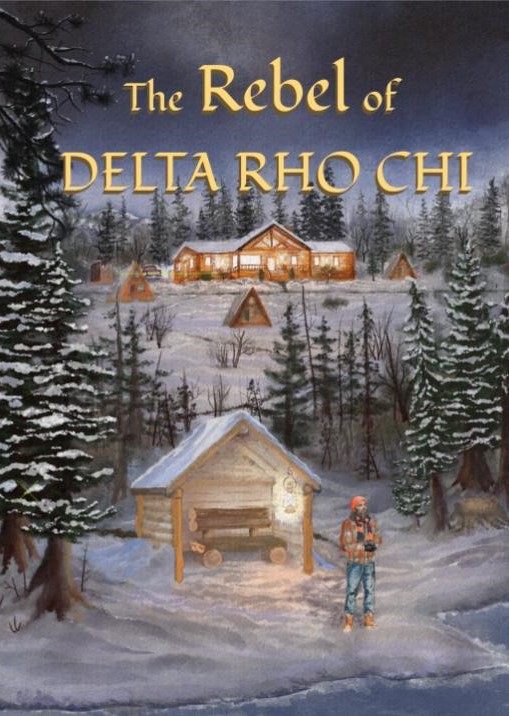
Well, that was LAST year’s dilemma. Since then, Nicole and company made their appearance with the publication of “The Rebel of Delta Rho Chi” on September 16, 2025. Now I’m thick in the lives of Kara, Brooke, Jason, and Erik who, as early twenty college students, are challenged to figure out the eternal question, “Who am I and what am I doing here?” I think they’ll get there but currently things are a bit messy in “The Rivals of Delta Rho Chi.” Look for their story this summer.
Finally, for those who have read all the way to the bottom, here’s your reward. Gardyloo is, according to Dictionary.com, “a cry formerly used in Scotland to warn pedestrians when slops were about to be thrown from an upstairs window.” Oh those crazy Scots. You’re welcome. Of course if you looked closely at the photos, you already knew the definition.
It’s been the source of much confusion and for those of us from the ‘state’, a source of consternation. When, on December 12, 1800, Congress carved out the ‘District of Columbia’ from Maryland and a bit of Virginia, I doubt they knew how it would all play out.
The trouble began in 1853 when, by an act of Congress, the territory of Washington was created from the larger Oregon territory.
From the Infallible Wikipedia:
“The territory was originally to be named ‘Columbia’, for the Columbia River and the Columbia District, but Kentucky Representative Richard H. Stanton found the name too similar to the District of Columbia (the national capital, itself containing the city of Washington) and proposed naming the new territory after President Washington. Washington is the only U.S. state named after a president.
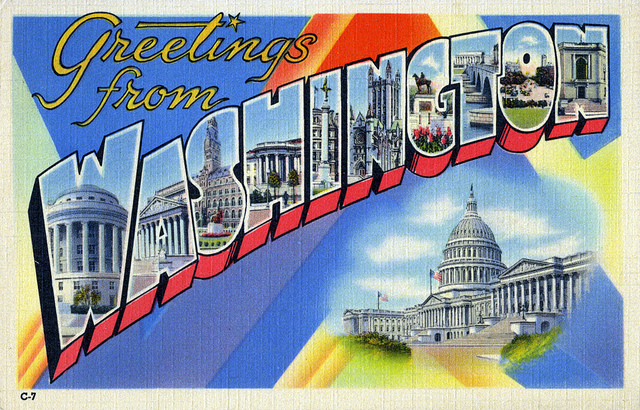
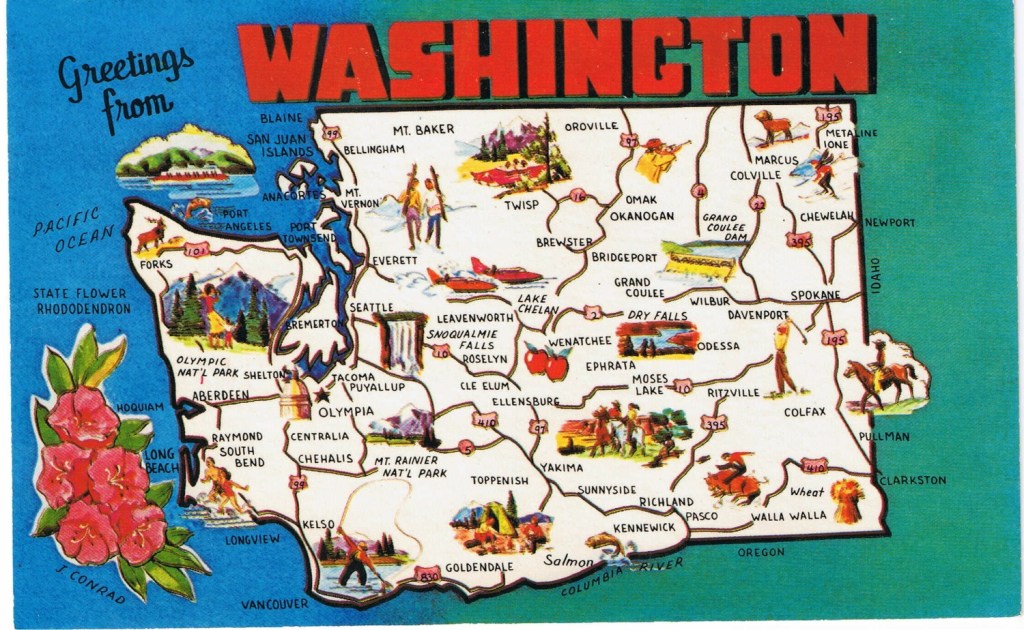
Historical Postcard from Washington State
Confusion over the state of Washington and the city of Washington, D.C. led to renaming proposals during the statehood process for Washington in 1889, including David Dudley Field II’s suggestion to name the new state ‘Tacoma.’ These proposals failed to garner support. Washington, D.C.’s own statehood movement in the 21st century includes a proposal to use the name ‘State of Washington, Douglass Commonwealth’, which would conflict with the current state of Washington.
To distinguish it from the national capital, Washington may be referred to as ‘Washington State’, or, in more formal contexts, as ‘the State of Washington’. Residents of Washington (known as ‘Washingtonians’) and the Pacific Northwest simply refer to the state as ‘Washington’, and the nation’s capital ‘Washington, D.C.’, ‘the other Washington’, or simply ‘D.C.’.”
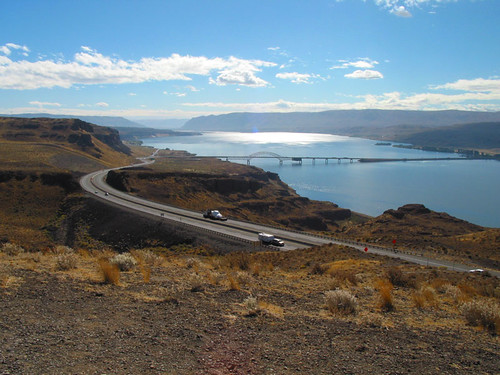
The Columbia River at Vantage looking south. The river truly defines the state of Washington as 783 miles of its total 1243 mile length are located in the state or serves as the border with Oregon. The river traverses the entire state from north to south.
Ironically, had they named our state Columbia there would not be any confusion today over which ‘Columbia’ is being discussed since the entire world pretty much calls the nation’s capital ‘Washington.’
Bills continue to be introduced in Congress for precisely the purpose of granting statehood to the District of Columbia. I understand the push for that. But, (my opinion) in the category of stupid ideas it’s also been proposed to call the new entity the “State of Washington, DC.”
Can’t imagine that might be confusing…
2023 Update:
The push to make the ‘State of Washington, Douglass Commonwealth’ the fifty first state continues. While how to do that is still fraught with challenges, I find it insulting that they cling to giving it a state name of ‘Washington’ as if my state doesn’t already exist.
Having finally had the opportunity to visit our nation’s capitol in August of this year I can see how that happens. The city is vibrant and dynamic. It hums with cars, busses, scooters, and trains. The mass of humanity overwhelms the brain with its unceasing activity. Everywhere we went it was a crush of people vying to see and visit all the same places. You get a sense that those who are there believe it to be the center of the universe.
And it certainly is not a kind place or a place inclined to introspection.
Two incidents summed up my visit to D.C. proper. The first involved the train system. Renting a car to get around D.C. makes zero sense, as the traffic is crazy and the parking expensive. Instead, the hubby and I decided to buy a five day Metro SmartPass. On that first day, we walked to the DuPont Circle station – about a half mile from our hotel – and descended the escalator into the depths of Hades. Okay, maybe it wasn’t that deep. Train tracks lined either side of the concrete platform and entry stiles and a security booth prevented access to the inner workings. The place smelled a bit like poop. We just wanted to get to the train but first riders must purchase their fare.
We stood at the automated purchase station – like an ATM – and worked through the process only to have our credit card rejected. Multiple times. Over to the booth we went to ask for assistance. Wrong. ‘Sorry, you can only buy the pass at the ATM. Can’t help you here.’ Can we pay cash? Nope. Have to use the machine.
Now frustrated, it was back up to street level we went, trying to figure out why our Credit Card didn’t work. The hubby, who experiences severe vertigo when confronted with edges and heights, was just about done in by the escalator.
Which meant that I won the lottery and my reward was to descend into the depths for round two and another attempt to purchase our passes. In the meantime, the hubby was fending off crazy street people and working the bank angle up at street level to figure out the problem.
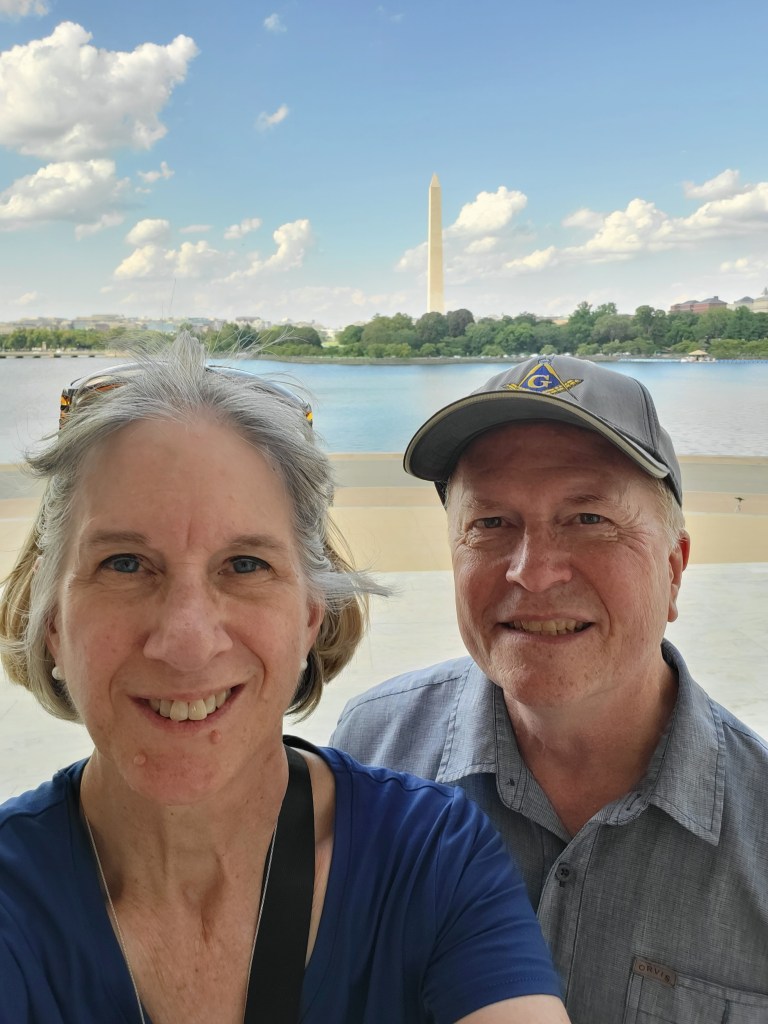
More than any other structure in D.C., the Washington Monument is almost always visible.No wonder they only consider it ‘Washington.’
So I’m down in the dim bowels of the DC train system at the Metro ATMish machine and, suddenly, on the fourth or fifth attempt to purchase the hubby’s pass, the machine works. And then it works for mine too. Elated, I return to street level to discover that he’d been successful in getting the block on the card lifted and we can now continue on our adventures.
We discover a tucked away elevator which makes descending easier for the hubby but harder on the olfactory as IT smells like urine. Much worse than in the train area.
We find the right train which takes us within a couple blocks of the White House and we spend the afternoon walking about. Finally, we decide to hop on a bus to try and get to the Capitol Mall. Being that we are unfamiliar with the city and the system, we get on a bus we think is headed the direction we want to go. At each stop, a few people leave the bus until we are literally the only people still there save the driver – an older woman – and we are happily traveling along. (Me especially as my feet hurt at that point) The bus stops and she says something with words I am not able to understand. We cannot tell if she’s talking to us or on her radio.
So she says it louder and still we don’t understand what she’s saying or even that she’s talking to us. The next thing we experience is the bus driver literally coming up out of her seat and screaming at us to get off. I swear she would have physically grabbed us and tossed us into the street if we hadn’t moved. I was so undone by her unhinged yelling I jump up and run off the bus. It was only later that I realized I had left my sun hat (which I’d had for years) on the seat, not noticing it in my upset.
The takeaway, for me, was that in D.C. there’s no patience for anyone who can’t immediately figure it out. Things I take for granted in my daily life were visibly absent: regular people who will hold the door for you, say ‘please’ and ‘thank you.’ Accomodation for those who need a bit of help. Smiles.
On the train to Reagan National Airport. Now old pros, we could actually figure out the map (behind the hubby)
On the last morning there – now veterans in navigating the trains and busses – the hubby and I packed our suitcases and literally rolled them down the street for the half mile walk to DuPont Circle. Down the now familiar elevator we went, bought our fare (the passes had expired two days earlier), waited for the Red train and then rolled the cases on and rode to Metro Center, departed that train then descended the escalator and connected with the Blue train to Reagan National Airport. Easy Peasy.
I was glad we went and visited. But I think those who live and work in D.C. should come and visit the ‘other Washington’ before stealing our identity. Perhaps it might change their minds when they see our beautiful white capped peaks, blue waters and blue skies, rolling wheat fields, mighty rivers. Smaller towns where the people are friendly and smile at you. In my mind there’s no comparison as to which Washington is better.
To learn more about this whole mess be sure to check out these links:













 barbaradevore.com