Archives

April 29, 1965: The Day Seattle Shook

April 29th

If you are older than the age of 60 and you have lived in the Pacific Northwest most, if not all, of your life, I simply have to give you this date and time, you will immediately be able to tell me where you were and what you were doing: April 29, 1965, 8:29 a.m.

I can almost hear you exclaiming to your computer: that was the date of the first earthquake you experienced and/or remember.

A number of grocery stores were hard hit during the 1965 earthquake

It was, after all, a pretty significant event. At the time it was the third strongest earthquake since the arrival of European settlers into the area. A quake estimated at magnitude 7.3 occurred in 1872 and another magnitude 7.1 in 1949. The 1965 quake registered 6.5 on the Richter scale.

While the Infallible Wikipedia does offer some information, Historylink.org – which has in depth articles about the Pacific Northwest – shares the following:

“The ground shook for about 45 seconds and was felt over a 190,000 square mile area including all of Washington state, northwest Oregon, southwest corner of British Columbia, north Idaho panhandle. The quake’s epicenter was located near Des Moines, Washington, at 47 degrees, 24 minutes North Latitude and 122 degrees, 24 minutes West Longitude. Total damage is estimated at $12,500,000 (approximately $65,000,000 in 1999), most of it in Seattle. In Olympia, the State Capitol Building was temporarily closed and government departments move to nearby motels while buildings are being repaired.”

The nearest I could come to identifying the epicenter of the quake is 202nd Street SW and Marine View Drive in the Normandy Park neighborhood, not far from Burien and Sea-Tac International airport.

Which becomes an important detail. On April 29, 1965, the hubby’s family lived in West Seattle, about 6 miles north of the epicenter.

For years, family gatherings often included discussion of that day and the months and years leading up to it.

If you were to visit West Seattle today, the LUNA apartments are now located at approximately 2751 California Avenue SW. Up until six months before the April 29, 1965 quake there was a house at that address and it belonged to a trio of women: my hubby’s two Great-Great Aunts – Nelly and Ethel – and his Great Grandmother – Queenie Mae. All three were born in the 1880’s.

From the families collection is this photo of the Miss Burien limited hydroplane as it looked in the summer of 1960. This photo was taken from the house located at 2751 California Avenue SW, directly across from Hiawatha Park in West Seattle.

In the mid-1960’s, Queenie Mae had been deceased for about 8 years, so only Nellie and Ethel still lived in the house and, since they were now in their 70’s, it was decided to sell it. Which they did in the fall of 1964.

Soon the house was razed and a grocery store was erected and had opened, according to family lore, mere weeks before the earthquake hit. The damage to the store was severe.

The hubby recalls visiting the great aunts at that house as a child and every once in a while, the China dishes and tea cups stored in the display cabinet would ‘tinkle’ as if the earth was moving just a bit. Perhaps it was from traffic on California Avenue but the family always claimed that an earthquake fault ran under that house.

April 29th was a Thursday that year and, less than a mile north, the hubby – age 8 – had just gotten his breakfast and was leaving the kitchen, headed for the dining room table.

He was mid-step when the earthquake started and described what happened next:

“My recollection is that I was in the doorway to the living room holding a plate of scrambled eggs. Aunt Nell, who I think must have cooked the food for me, was sitting in the living room on a daybed we used as a couch. I stopped and was looking at her when the initial jolt bounced her up in the air. To this day, that is what I see.”
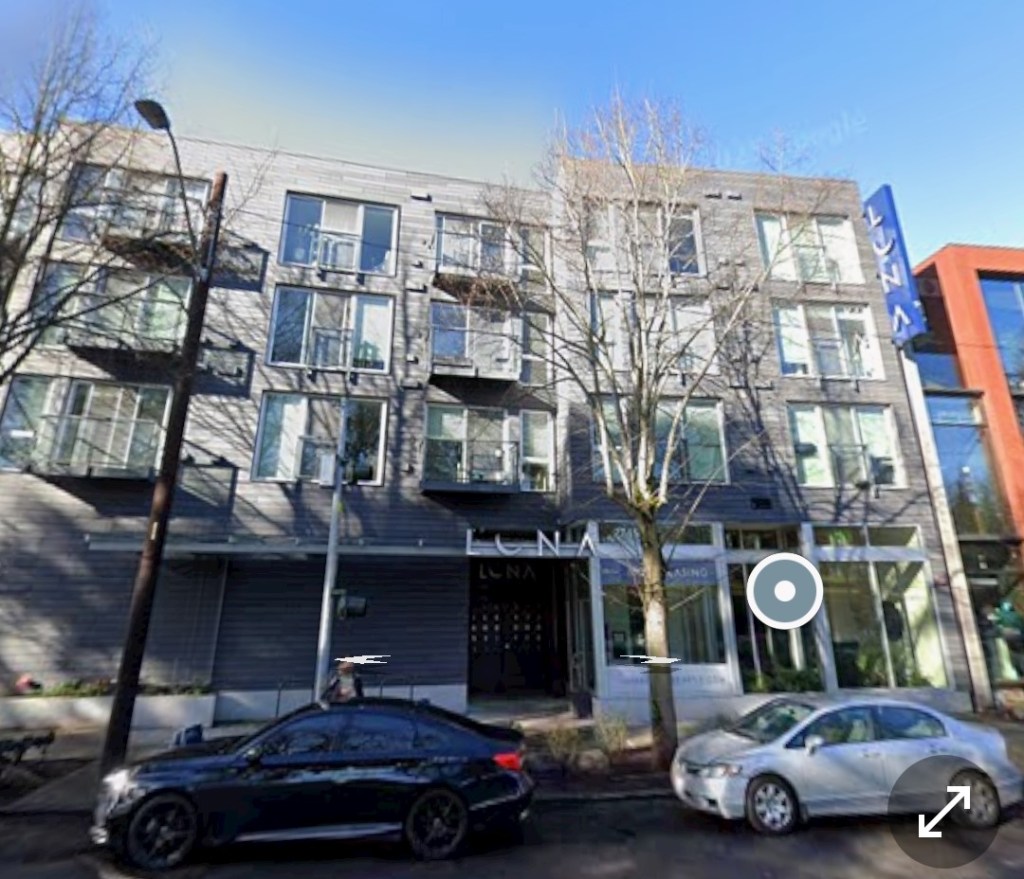
The spot where the house with the ‘tinkling’ china in the cabinet was once located.

Aunt Nell wasn’t the only one who went airborne as the hubby’s younger sister – who was just two weeks shy of her 4th birthday – was sleeping only to wake up on the floor. As she has always said “my bed threw me on the floor.”

The damage in West Seattle that day was extensive. According to Historylink.org, the worst damage was in West Seattle, Harbor Island, Duwamish River Industrial Area, and South Seattle. 

“In West Seattle a survey was made of damaged chimneys. In a portion of West Seattle out of a total of 5,005 chimneys in 188 city blocks, the earthquake damaged 1,712 chimneys (34 percent of the chimneys). At Alki Beach, a part of West Seattle not surveyed, ‘virtually every chimney was down’ (U.S. Earthquakes 1965 p 98).”
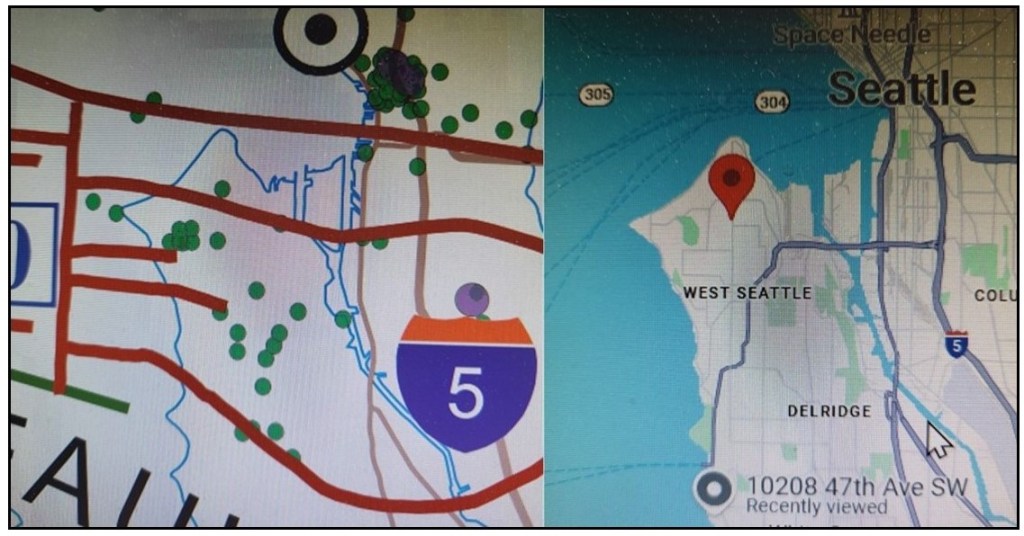
The map on the left shows the fault lines which run under West Seattle. The red marker on the right is the location of the house on California Avenue with the Earthquakes epicenter the gray dot to the south. When the two maps are overlaid, the fault line runs directly under where the house once stood.

The hubby believes he went to school after the earthquake as if nothing significant had just occurred. Oh, how times have changed!

As for the fault line under West Seattle? Yes, it does exist and was mapped in 2014 and when you overlay it onto that location, it runs pretty much under where their house once stood.

So where were you on April 29, 1965? I was in Yakima getting ready for school when that quake struck and our house shook. My mom was brushing my hair and she told me to hang on to the counter. Thankfully, I wasn’t tossed in the air.

The links:

https://www.historylink.org/File/1986

https://en.wikipedia.org/wiki/1965_Puget_Sound_earthquake

https://assets.pnsn.org/HIST_CAT/1965.html

https://www.dnr.wa.gov/publications/ger_ofr2014-05_fault_earthquake_map.pdf?o91ywfh

Confessions of a former Tax Season widow

April 15th
April 15th is, in the United States, the day Federal Income tax is due from all citizens.

Federal income tax began in 1913, when the 16th amendment to the US Constitution was ratified by Congress and two thirds of the states. It all seems so simple. But of course, it is not. This is the opening paragraph of the veeerrry lengthy Infallible Wikipedia article:

“The United States federal government and most state governments impose an income tax. They are determined by applying a tax rate, which may increase as income increases, to taxable income, which is the total income less allowable deductions. Income is broadly defined. Individuals and corporations are directly taxable, and estates and trusts may be taxable on undistributed income. Partnerships are not taxed (with some exceptions in the case of federal income taxation), but their partners are taxed on their shares of partnership income. Residents and citizens are taxed on worldwide income, while nonresidents are taxed only on income within the jurisdiction. Several types of credits reduce tax, and some types of credits may exceed tax before credits. Most business expenses are deductible. Individuals may deduct certain personal expenses, including home mortgage interest, state taxes, contributions to charity, and some other items. Some deductions are subject to limits, and an Alternative Minimum Tax (AMT) applies at the federal and some state levels.”

More interesting than taxes… a spotted towhee in the rockery I see from my office window.

Got that? Me either. In fact, my eyes glazed over just reading that and I decided that the spotted towhee I spotted in the rockery across the road is much more interesting.

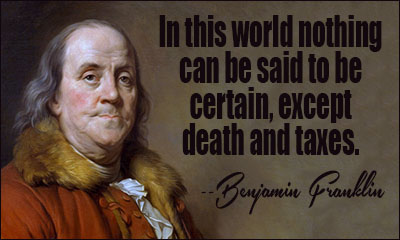
But, as Ben Franklin once famously wrote, the only things certain in life are “death and taxes.”

So, dear readers, if your thing is dissecting the tax code and taking a deep dive into the history of marginal tax rates, or whether or not a progressive tax is even constitutional, knock yourselves out.

I, fortunately, am married to someone who has a four-year degree in accounting. He understands numbers. He understands how finance and taxes work. And for the first couple years we were married, I was an April 15th tax accountant widow.

For those who don’t know what that is, I shall enlighten you. For most Certified Public Accountants (CPA’s) the year is broken up into two parts. There’s tax season and then everything else.

For everything else that means handling mostly business-y type things – quarterly taxes and financial statements. More things that make my eyes glaze over and rollback in my head.

When it’s these types of things, the CPA can expect to get into the office at a reasonable 8 to 9 a.m. and leave at a reasonable 5 to 6 p.m. You know, normal-ish business hours.

But then January happens. When the new year arrives, so do all the various documents from employers which the US Government requires be sent out. These trigger tax season. W-2’s and 1099’s must be sent to employees and independent contractors no later than January 31st. Every year. No exceptions.

On February 1st, if you are married to a practicing CPA, kiss your social life goodbye because weekends become non-existent. Holidays such as Valentine’s Day and President’s Day? Well, you might get them off but plan to snuggle up with your blanket and favorite Hallmark movie or go skiing by yourself because your CPA spouse will be working.

This goes on, of course, until midnight on April 15th since that’s the moment ALL taxes (and extensions if your taxes aren’t yet done) must be postmarked or electronically submitted to the IRS.

But sort of like getting over a bad cold or the flu, recovering from tax season takes some time. By early May, your CPA spouse is probably back to semi-normal hours. Thank goodness the IRS set the taxes due date in April. That way – at least in the northern part of the U.S. – you are not missing out on nice weather.

When I mentioned to the hubby that I would be featuring the Income Tax for today’s Tuesday Newsday he immediately told me about his ‘liberation’ day.

It was fairly early in our marriage, and I never knew about this experience for him until last week. Since graduating from college in 1978, he had worked as a CPA for two different firms in greater Seattle. He worked at Christensen, Schafer, and Husmo (C, S & H), in Burien for a couple of years but made a change to Don Sparling and Co. to gain much needed auditing experience. Everything was great at Sparling until the owner’s nasty divorce derailed the business. The hubby lost his job but, in the spring of 1981, was rehired by C, S & H as they had recently gotten a new client who needed an auditor: Nintendo of America. Experience the husband had recently gained.

In the late spring of 1982 – after being their CPA for a year – Nintendo hired the hubby as their first Controller and he left the world of being a tax accountant.

On April 15, 1983 – a Friday – the high temperature in Seattle was 65 degrees and sunny with a bit of breeze. The perfect sort of day to do a little yard work. Since he was home from work while it was still daylight, he was outside doing yard work (I was probably inside making dinner) when he stopped for a moment and remembered that it was Tax Day. And that he was not going to be burning the midnight oil and felt an incredible sense of relief.

For the rest of his career, he has put his CPA training and math brain to good use whether as a company controller, a consultant, or – currently – with his volunteer work.

As for me, my eyes still glaze over when taxes, marginal rates, and exemptions start being discussed. I do my best to hide it but with little success. It’s probably best for me – and everyone else – that I stick to writing and leave the accounting to the professionals.

For the record, I did send this to the hubby for a bit of fact checking and he liked what I wrote but reminded me – and all of you – of the following: “Very entertaining! If you file for an automatic extension, you have an additional six months to file your return, but you still have to pay your estimated taxes by April 15th.”

So be sure to send the IRS your money TODAY by midnight and I hope everyone has a very happy tax day!

One link with links to the links to the links:

https://en.wikipedia.org/wiki/Income_tax_in_the_United_States

A Font of Fun? No Fooling!

April 1st

You’d pretty much have to be living on an island far from civilization to NOT know that today is April Fool’s Day. It’s celebrated each year on April 1st.

Considered by many as the greatest hoax of all time is this 1957 BBC documentary about harvesting spaghetti from trees. https://en.wikipedia.org/wiki/Spaghetti-tree_hoax

The day has murky beginnings which date back hundreds of years. Some say that Geoffrey Chaucer, in the unreadable ‘Canterbury Tales’, makes reference to the day. But that’s disputed. In 1508 some obscure French poet I’ve never heard of wrote about ‘poisson d’avril’ – translated ‘April’s Fish’ – which apparently doesn’t mean fish but ‘fool.’ Yet another theory is that at one time the new year was marked as being on March 25th but was then changed to January 1st (Actually March 25th makes more sense what with spring, birth, and renewal, but whatever). Those who clung to their old traditions were derided as Fool’s and I guess it took 6 days of their protests against moving New Years before someone decided to take any action.

The previous paragraph is, however, as in depth as I plan to go regarding the origins as, quite honestly, it’s a bit boring for this day devoted to mirth and mischief. Sadly, I found the Infallible Wikipedia article to be deadly serious and who wants that?

Anyway, I had soon climbed down the rabbit hole that is the internet and found a website truly worthy of April Fool’s Day: The Museum of Hoaxes. OMG. I knew I could spend hours reading about all the clever things people have conjured up to fool others. Decisions, decisions. WHICH of the hundreds of hoaxes was worthy of Tuesday Newsday fame? It was a weighty decision.

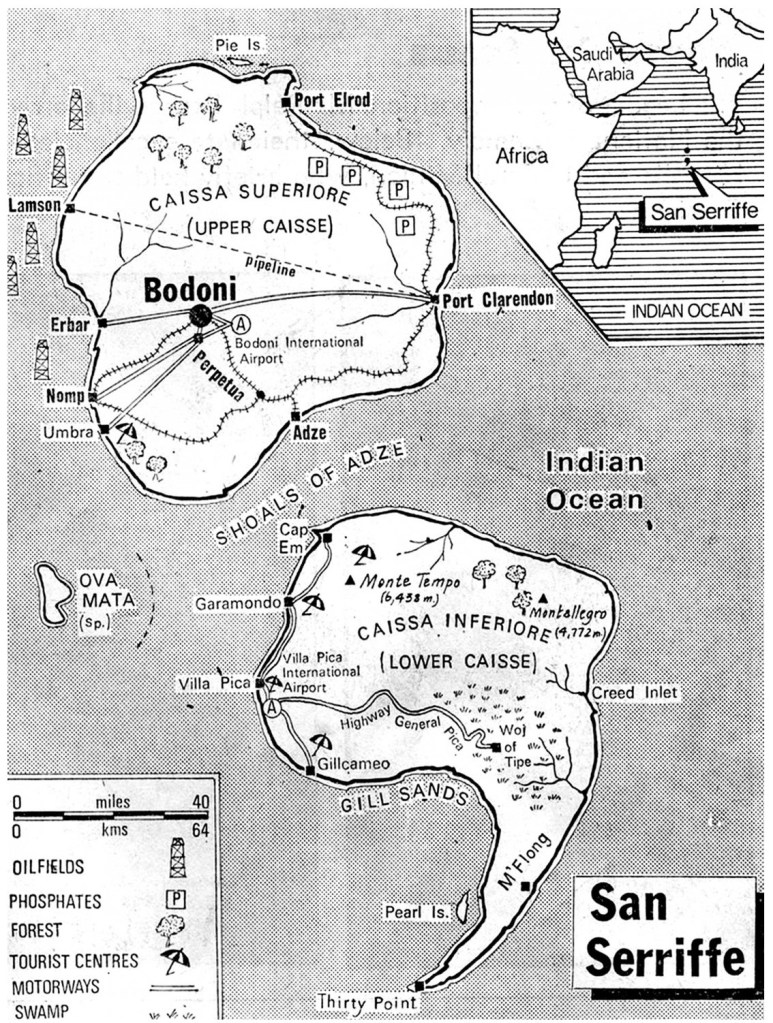
The islands of San Serriffe are a Perpetua(l) delight

Presenting the Island of San Serriffe!

As a writer, word nerd, and someone whose earliest childhood goal was to be able to create programs, newsletters, flyers, etc., the name San Serriffe resonated.

The year was 1977 and the British newspaper, The Guardian, was looking for something fun as a joke for their April Fool’s Day edition. Brainstorming occurred and the results were hilarious. From the hoaxes.org website:

“On April 1, 1977 the British newspaper The Guardian published a seven-page ‘special report’ about San Serriffe, a small republic located in the Indian Ocean consisting of several semi-colon-shaped islands. A series of articles described the geography and culture of this obscure nation.

The report generated a huge response. The Guardian‘s phones rang all day as readers sought more information about the idyllic holiday spot. However, San Serriffe did not actually exist. The report was an elaborate April Fool’s Day joke — one with a typographical twist, since numerous details about the island (such as its name) alluded to printer’s terminology.

The success of this hoax is widely credited with inspiring the British media’s enthusiasm for April Foolery in subsequent years.”

The best part of this story is, for me, the map. These people had waaaaaay too much time on their hands apparently.

The capital of San Serriffe: Bodoni; There’s Monte Tempo and Montallegro; Creed Inlet and Thirty Point; Villa Pica International airport and a beach town named Garamondo. Truly, the map is a font of fun.

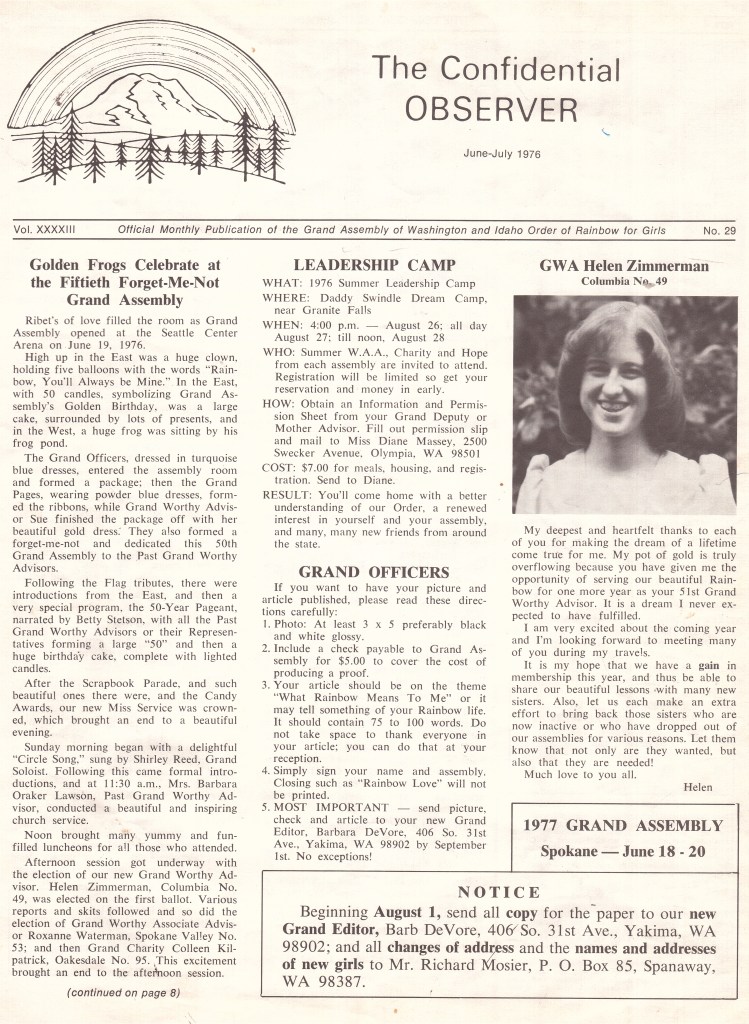
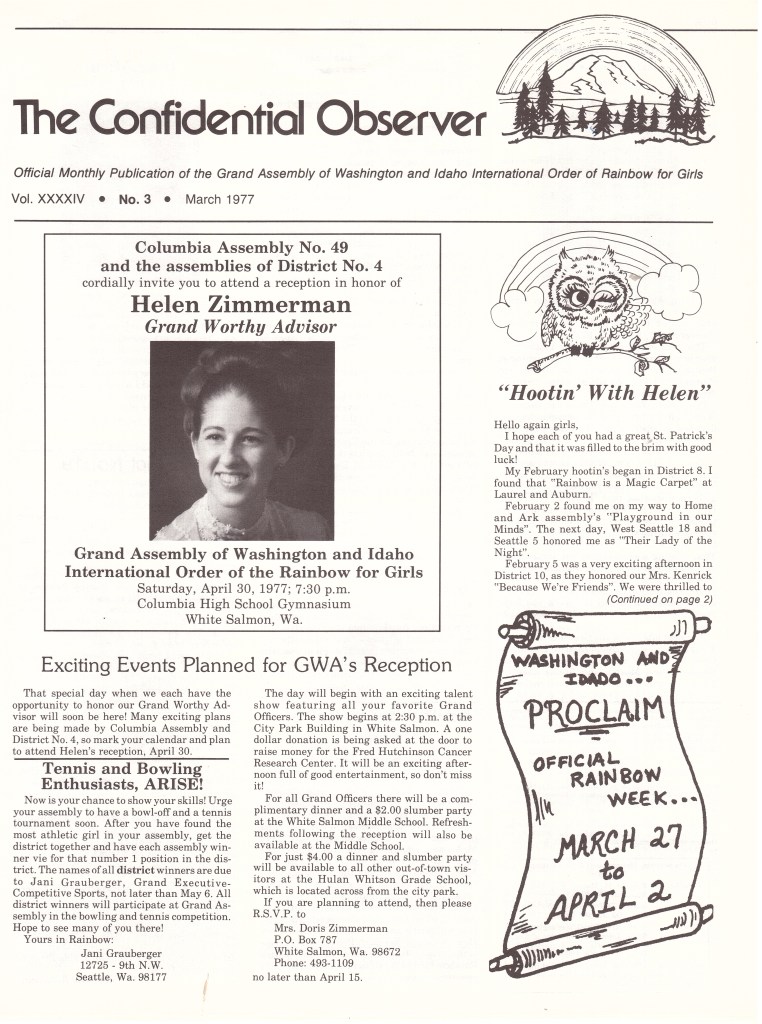
I’m a bit sad that it took me over 40 years to learn about San Serriffe since, in 1977, I was heavily involved in the world of publishing. I was one of three editors for the weekly Yakima Valley Community College “Galaxy” and also the youth editor of the Washington Idaho Rainbow Girls newsletter titled “The Confidential Observer.”

I was hungry to learn everything there was about journalism, writing, and layout. One of my big passions was experimenting with new fonts. I could not get enough of them!

The adult advisors for the Rainbow Girls publication, I’m certain, had no idea what hit them that year as I shook things up, at least in the world of Fonts. Well, and layout and artwork and, pretty much everything I was capable of changing. The fonts went from Helvetica and Times New Roman to Garamond and Bodoni to name a couple of them.

I changed the mast head; I varied the font sizes; I used boxes around things to emphasize and tried to make it more aesthetically pleasing.

Two versions of the front page of the Rainbow Girls paper. Top is how it looked the issue before I started changing things. Bottom is how it looked six months later.

Now, way back in the dark ages, publication was not a simple thing. First I had to get articles from people from all over the states of Washington and Idaho who mailed them in envelopes. Some of these came handwritten on notebook paper, full of spelling and grammatical errors. I often had to retype and all had to be edited. When that was done I would mail it all from where I lived in Yakima to the printers in Tacoma, who then retyped it (with the fonts I’d chosen) and created galleys to fit our three-column format. These were then returned to me via mail. I would cut – with an exacto knife – the galley articles and glue the proofs on to paper in the correct configuration with everything marked as to where it was supposed to go and then would cross my fingers that they did it right. Spoiler: not always.

It was the fall of 1976 and the artwork that was to top the column for our state president that year had gotten lost by them. I sent in my package a hastily drawn picture (I’m no artist!) with a note attached saying “this is sort of what the artwork looks like that’s missing” and asking them to look around for it. Instead of reaching out, however, they ‘published’ what I had sent. It was awful and upsetting and bothers me to this day. Eventually, they found the missing clipart.

To this day I cannot fathom any professional printer looking at the owl on the left and thinking that’s what they should print…

With the introduction of the Apple Macintosh and their GUI (Graphical User Interface) layout in the mid-1980’s, I was finally able to create a newsletter on a computer and print it out. It was then I got my first laser printer. It was still a clunky process and the clipart was lacking, but it moved me forward.

Over the years as the GUI technology has improved, my ability to create has expanded. Artificial Intelligence has made it even easier.

So hats off to San Serriffe Island. I found the above picture of the island through an easy Google search, saved it as a jpg, and then printed it on my less than $200 Epson printer. I’m sticking it in a frame and hanging it in my office and will look at it often and cheer the fun of April Fool’s Day and 1977, the year of San Seriffe’s creation.

As always a few links:

https://hoaxes.org/archive/permalink/san_serriffe

https://hoaxes.org/af_database/display/category/guardian

https://en.wikipedia.org/wiki/April_Fools’_Day

Microsoft Millionaires

My ‘Forrest Gump-esque’ experience in the 1980’s

January 21, 2025

A Tuesday Newsday Classic Updated

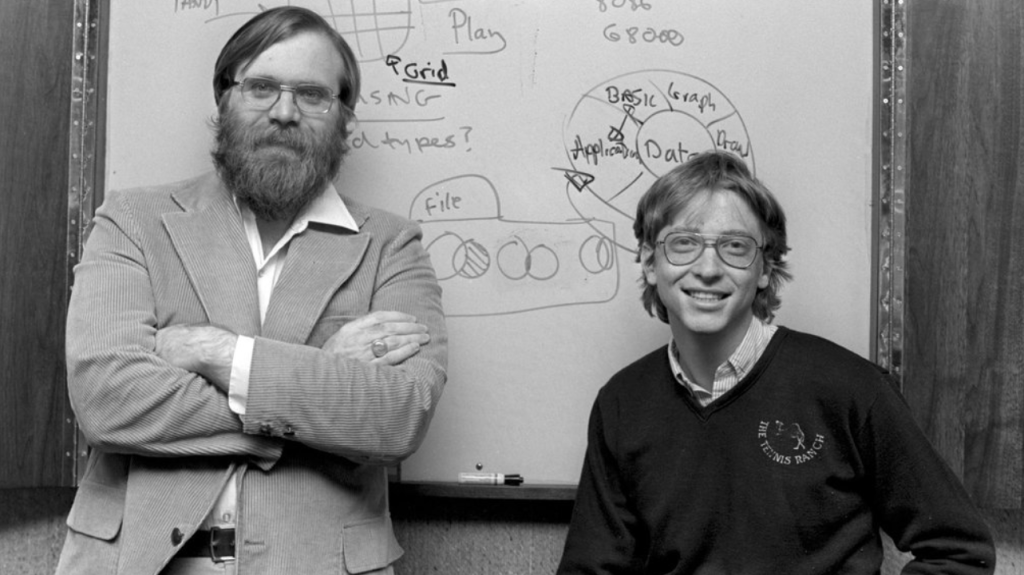
Paul Allen and Bill Gates in the late 1970’s and how I picture both of them in my memory.

When this young man dropped out of college, I’m sure it was a huge disappointment to his family. After all, he’d scored a perfect 1600 on his SAT’s and graduated from the prestigious Lakeside School in Seattle. But the world was changing rapidly in the early to mid-1970’s and he had bigger visions than attending classes and frat parties.

Of course, we all know his story. Along with a close friend, he went on to become a co-founder of one of the world’s most successful computer software development companies: Microsoft.

Early 1980’s Company Logo

But I’m not writing about Bill Gates. This is about Paul Allen, the less ‘famous’ of the Microsoft pair. And without whom Microsoft would never have existed.

If he were alive today, he would be celebrating his 72nd birthday.

According to the Infallible Wikipedia:

“He attended Lakeside School, a private school in Seattle where he befriended Bill Gates, with whom he shared an enthusiasm for computers, and they used Lakeside’s Teletype terminal to develop their programming skills on several time-sharing computer systems. They also used the laboratory of the Computer Science Department of the University of Washington, doing personal research and computer programming; they were banned from the laboratory in 1971 for abuse of their privileges there.

Gates and Allen joined with Ric Weiland and Gates’ childhood best friend and first collaborator, Kent Evans, to form the Lakeside Programing Club and find bugs in Computer Center Corporation’s software, in exchange for extra computer time. In 1972, After Evan’s sudden death due to a mountain climbing accident, Gates turned to Allen for help finishing an automated system of Lakeside’s entire class scheduling procedure. They then formed Traf-O-Data to make traffic counters based on the Intel 8008 processor. According to Allen, he and Gates would go ‘dumpster diving’ in their teenage years for computer program code.

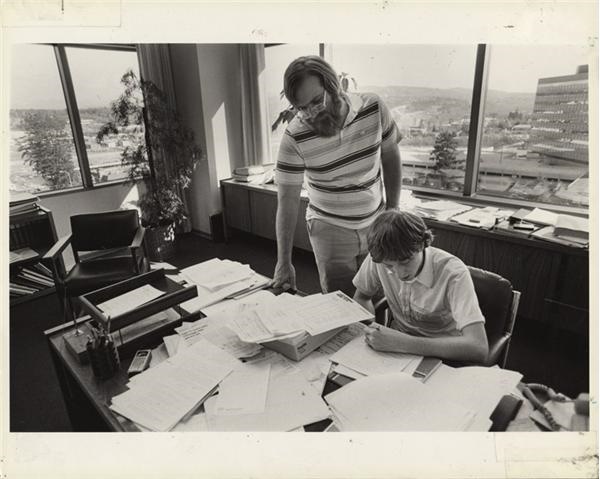
This photo purports to be from 1984. If so, it was likely right after the company moved ‘across’ I-520 to Corporate Campus East. This would have been my final year at Microsoft.

Allen attained a perfect SAT score of 1600 and went to Washington State University, where he joined the Phi Kappa Theta fraternity.”

Allen was hired by Honeywell, located in Boston, as a computer programmer and left WSU. Gates, now attending nearby Harvard, and Allen reconnected. It was Allen who convinced Gates to leave Harvard, move to Albuquerque, New Mexico and form Micro-Soft (To combine the two terms microcomputer and software). In January 1979, the company moved to Bellevue, Washington.

Also from the Infallible Wikipedia:

“The relationship became less close between Allen and Gates as they argued even over small things. Allen effectively left Microsoft in 1982 after being diagnosed with Hodgkin’s lymphoma, though he remained on the board of directors as vice chairman. Gates reportedly asked Allen to give him some of his shares to compensate for the higher amount of work that Gates was doing. According to Allen, Gates said that he ‘did almost everything on BASIC and the company should be split 60–40 in his favor. Allen agreed to this arrangement, which Gates later renegotiated to 64–36. In 1983, Gates tried to buy Allen out at $5 per share, but Allen refused and left the company with his shares intact; this made him a billionaire when Microsoft went public. Gates later repaired his relationship with Allen, and the two men donated $2.2 million to their childhood school Lakeside in 1986. They retained a friendship for the rest of Allen’s life.”

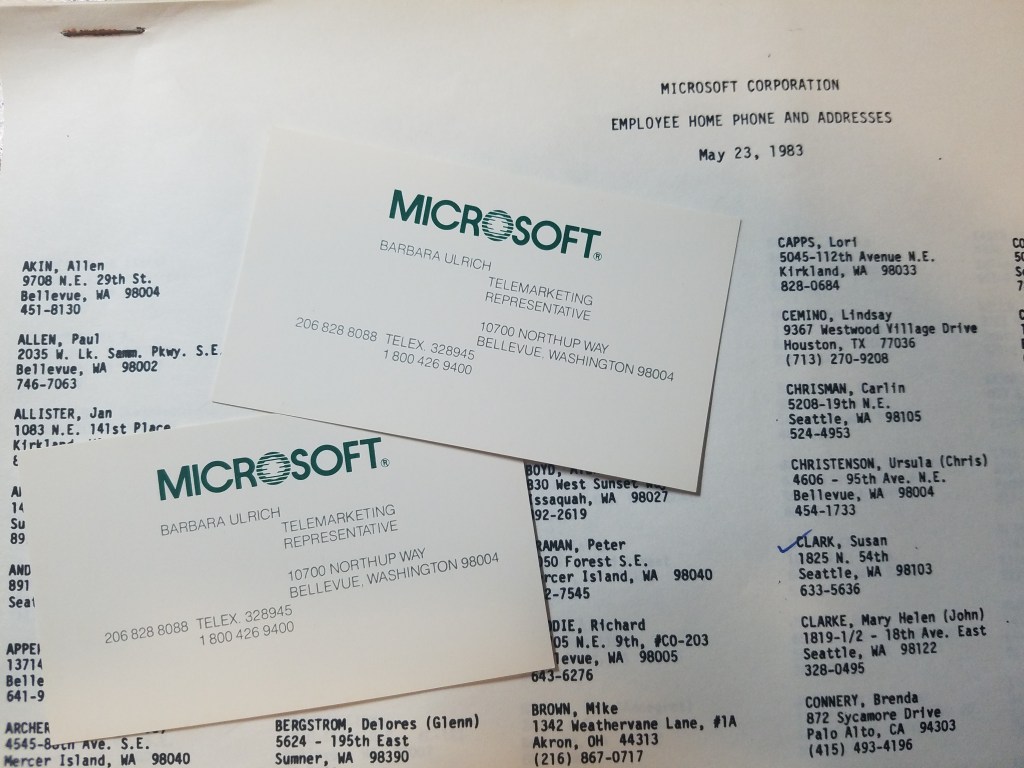
Being that I keep anything which might be historical in nature, I still have several Microsoft employee address lists and a few of my business cards. When I joined the company in early January 1983 there were 205 people at corporate and 21 field sales reps. Which means I was one of the first 250 employees of Microsoft.

Allen went on to do many great things for the world including donating over $2 Billion towards science, technology, education, wildlife conservation, the arts, and community services.

You can read more about Allen’s extraordinary life and find links to his biography here:

https://en.wikipedia.org/wiki/Paul_Allen

In the past eight years of writing my Tuesday Newsday blog I’ve shared only a few stories about my ‘Forest Gump-esque’ experiences at Microsoft. I was hired there in early 1982 as part of a group of three young women who would be launching a retail telemarketing division for the company.

Our trio faced nearly insurmountable odds – which we did not know when we took the jobs – as we were tasked with calling out to every retail store in our region (I had the west coast. The. Entire. West. Coast.), working in conjunction with Microsoft’s field sales reps, to sell such programs as Basic, Fortran, and Cobol compilers, the always popular Flight Simulator and Typing Tutor, and the early spreadsheet program, MultiPlan.

The phone calls were often brutal with the stores’ buyers either not taking our calls or, more often, asking if we sold Lotus 1-2-3, our competitors sizzling hot multi-functional program which dwarfed Microsoft’s Multiplan. Word Processing program? Bah. Didn’t exist then.

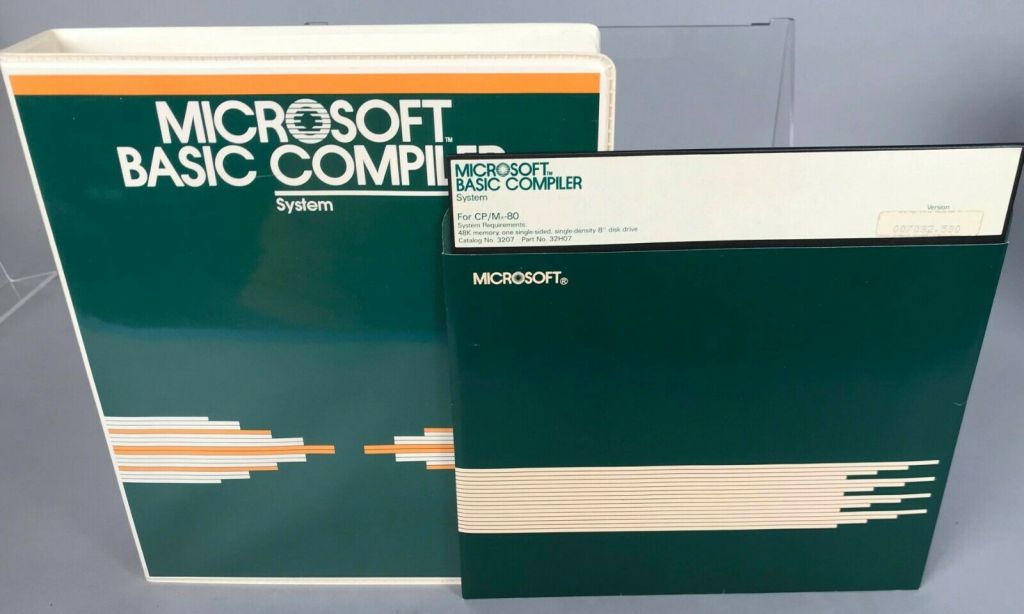
There was nothing sleek OR sexy about the early Microsoft products. But they were green…

We worked hard, we played hard, and the burnout rate was high.

I left Microsoft, having experienced that same mentioned burnout, in the fall of 1984 and went to work for another computer company located in Kirkland six weeks later. One day, likely the summer of 1986, my then boss, Tom, took me to lunch for my birthday. We went to a favorite Japanese sushi place in Totem Lake called Izumi.

We sat up at the small sushi bar, the only people in the restaurant when we arrived. We had just gotten our food when a group of 4 or 5 men also arrived, and took a table nearby. I didn’t pay much attention to the group as Tom and I were talking. Tom, being a loud and gregarious individual, dominated the exchange and the room.

Izumi was a favorite where the hubby and me liked to go

Somehow our conversation got on to Microsoft and Tom asked why I had left the company. Before I could answer, I noticed the table of nearby men had gone silent and were all looking at us, and one of them said “I can’t escape it, no matter where I go.” That man was Paul Allen.

Perhaps that moment, more than any other, illuminated how he felt about Microsoft – at least in 1986 when he and Gates were still working to repair their relationship – and summed up for me my Microsoft experience also. For anyone living in the Seattle area, you either worked for, know someone who worked for, or you once worked for, Microsoft. It was inescapable. And not particularly pleasant.

I wanted to say something to Paul Allen that day, but felt that if I had it would have been about as welcome as a drunk fan asking a movie star for an autograph. Instead – as if by mutual agreement – he returned his attention to his group and Tom and I changed our topic.

I left Applied Computer Sciences and the corporate world in the late 1980’s, putting my energies in to raising my kids and doing volunteer work.

If I had any regrets in leaving Microsoft it was, perhaps – unlike Paul Allen – that I was never eligible for stock options, a nice perk that would have made life a bit easier.

I did, however, learn something much more valuable and it is a mantra I’ve carried through my life which goes like this:

Bill Gates and Paul Allen were wildly successful. Microsoft was wildly successful. But just because I worked for the company, however, was not enough to make me wildly successful. It is up to each of us, individually, to follow our own path, pursue our own dreams and interests, and find those things which bring us joy and fulfillment. That, I think, is the true definition of success.

It was a hard lesson but I’m forever thankful for learning it and those brief, brutal, and impactful, Microsoft years.

https://en.wikipedia.org/wiki/Paul_Allen

https://en.wikipedia.org/wiki/Microsoft

My Wawona

Like Yosemite National Park, it’s a treasure

October 1, 2024

A Tuesday Newsday Classic

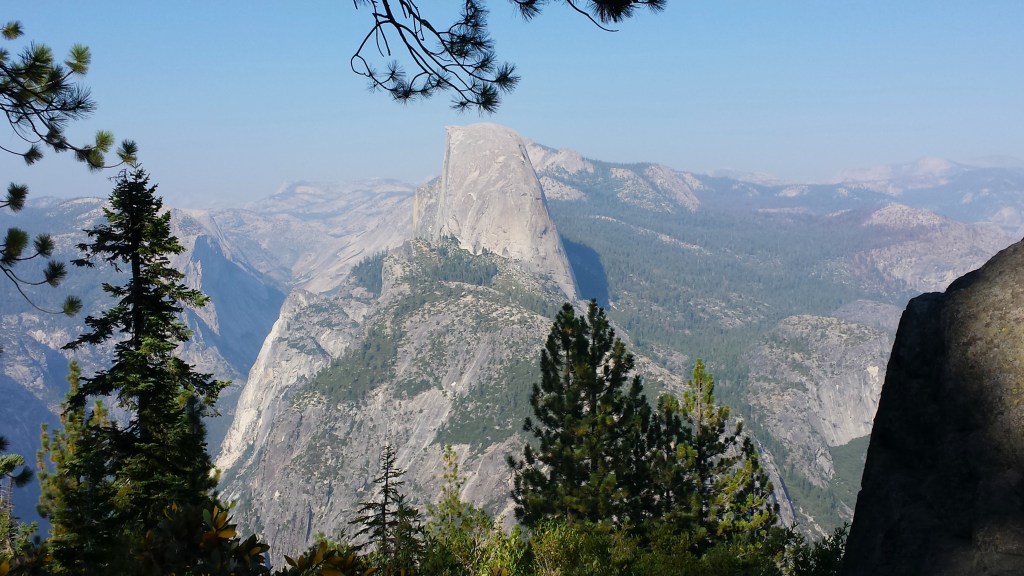
Half Dome, Yosemite National Park, from Glacier Point overlook September 2015

October 1, 1890 marked the official inclusion of this region into the newly formed National Park System. Long before that, however, the Yosemite Valley had inspired the natives who resided in the area as well as the early white settlers.

It was, contrary to popular belief, James Mason Hutchings and artist Thomas Ayres who were the first Americans to tour the area in 1855.

From the Infallible Wikipedia:

“Hutchings and Ayres were responsible for much of the earliest publicity about Yosemite, writing articles and special magazine issues about the Valley. Ayres’ style in art was highly detailed with exaggerated angularity. His works and written accounts were distributed nationally, and an art exhibition of his drawings was held in New York City. Hutchings’ publicity efforts between 1855 and 1860 led to an increase in tourism to Yosemite.”

Although the greater Yosemite area had been set aside by Congress in 1864, the Valley and Mariposa Grove were ceded to California to manage as a state park. The two areas had seen an influx of homesteaders and were being rapidly commercialized as well as being used for the grazing of sheep and cattle; the old growth sequoias were being logged.

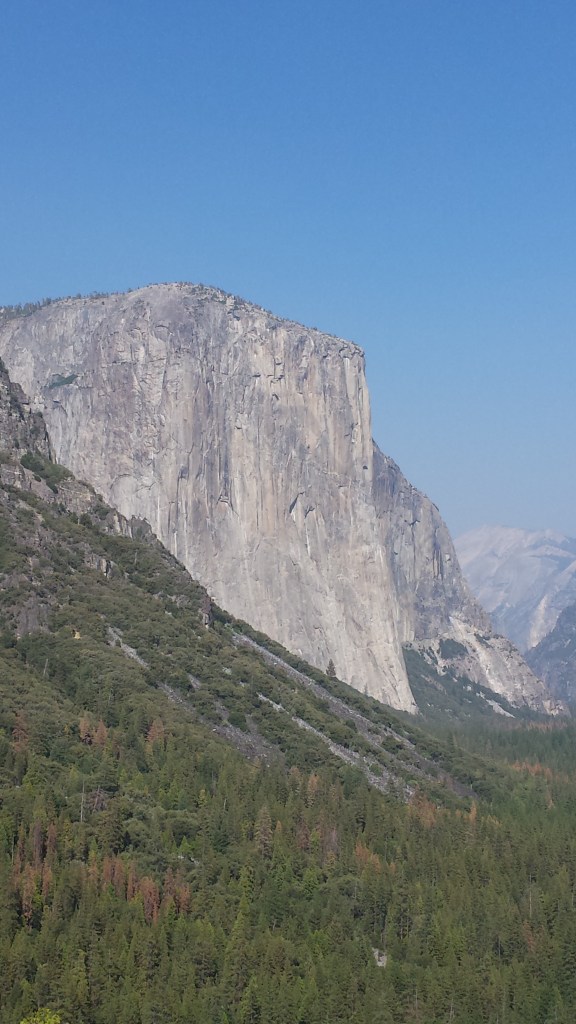
The iconic El Capitan

Most people associate the founding of Yosemite with early environmentalist John Muir. Rightly, he is credited with not only pushing for park expansion but also lobbied for the federal government to take back the iconic valley and grove.

Also from the Infallible Wikipedia:

“It was because of Muir that many National Parks were left untouched, such as Yosemite Valley National Park. One of the most significant camping trips Muir took was in 1903 with then president Theodore Roosevelt. This trip persuaded Roosevelt to return ‘Yosemite Valley and Mariposa Grove to federal protection as part of Yosemite National Park.’”

The years long efforts paid off when, in 1906, Roosevelt signed a bill which stripped the two areas still managed by California from the state and they were returned to the federal government which finally created a unified Yosemite National Park.

One trip to Yosemite is all it takes for a person to understand the grandeur and how special a place it is. From towering El Capitan, to the massive Half Dome, or the fascinating Tuolumne Meadows, Yosemite is a visual feast.

And the hubby and I wondered, when we visited in September 2015, how come it had taken us so long to get there. We arrived on the day after Labor Day which was a good thing as the summer crowds were gone. Reservations are generally required months – if not a year – in advance for the various hotels. I figured we were out of luck but checked anyway as we drove south a few days before our planned stay. What a surprise! There were rooms available at the Wawona Hotel or space in ‘dry’ tents. We opted for the hotel.

It was only after we arrived at the park that it dawned on me that the Wawona Hotel was nowhere near the Yosemite Valley. That day had turned into a driving ordeal. My hubby suffers from vertigo. Being close to any ledge can trigger a sensation of spinning as well as nausea. Knowing this, it was my duty to do the driving so that he could close his eyes as needed when navigating cliff-side roads.

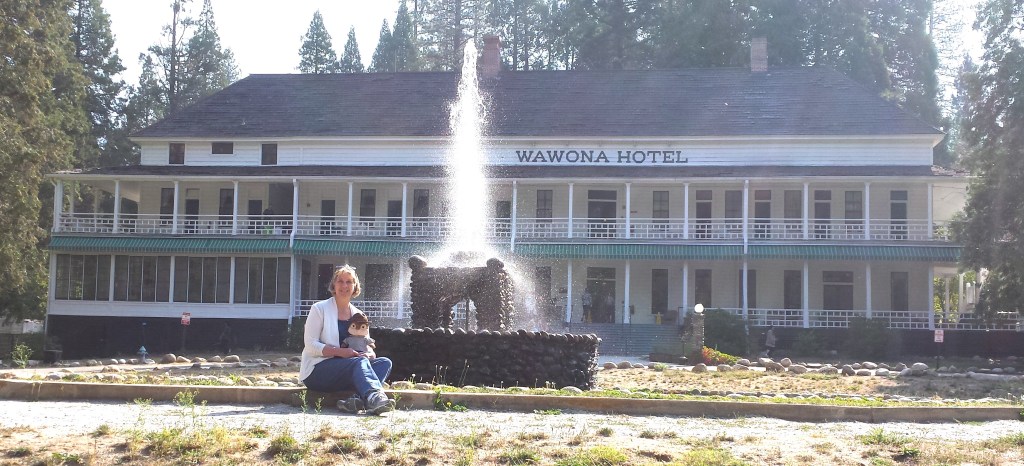
The author, along with Alvin the Chipmunk traveling companion, at the Wawona Sept. 2015

Up, up, up we traveled from the eastern side of the park to the 9,943-foot-high Tioga Pass – the highest mountain pass in California. Come to find out, THAT was the easiest road. From there we wound our way through Yosemite’s high country. Then we had to go down. From Tuolumne Meadows – elevation 8,619 feet – to the Valley floor was a 4,619 foot descent. And all of it seemed to be a series of endless switchbacks and curvy roads carved in to the sides of mountains.

It was with a sense of relief we reached the bottom when it hit me… Wawona was another 30 miles which we had to add to the 230 we’d already traveled that day. No rest for the driver as the road climbed back up the other side through yet another series of switchbacks, cliffs, and amazing vistas.

Now close to sunset, we found the hotel and were charmed at the thought of staying in an 1870’s structure.

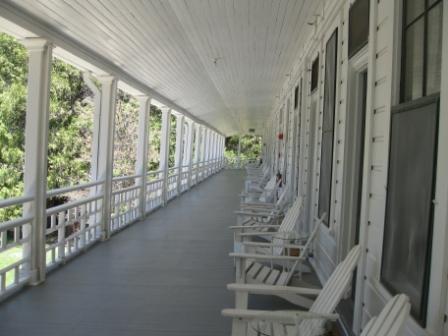
Our room was in the more recently added section… built at the turn of the last century. Located at the far western end of the first floor, the room opened out on to a wide veranda adorned with honeysuckle.

But that’s where the charm ended. The room itself featured a double bed and a twin bed. There was a sink attached to the wall next to the twin bed with a door in the wall next to it. The door, however, was locked.

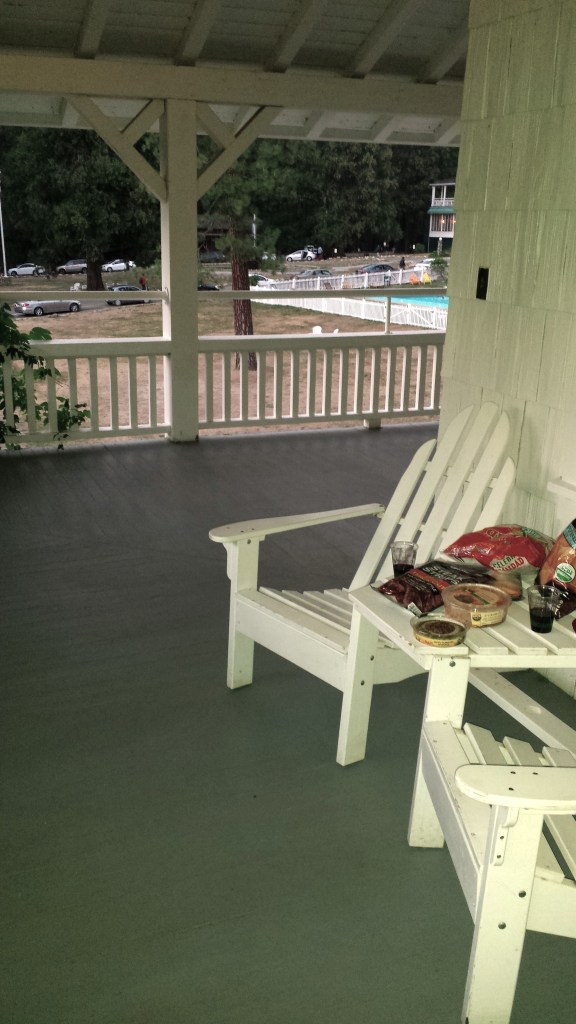
Table for two on the verandah

The room was completed with a small square closet, small dresser and a table and chair. No TV and no phone. But we were up for the adventure and the price – less than $70 a night – was a steal even with having to use the bathroom down the stairs.

As we went to bed that night we could hear, through the thin walls, talking in the room next door; two men were conversing in German. We laughingly dubbed them Hans and Fritz and, although the hubby had taken German in high school, were unable to decipher their conversation.

The next day, after breakfast in the hotel dining room, we headed out for a full day of touring. That evening we bought deli meats, fruits, crackers, and a bottle of wine which we ate and drank while sitting in the Adirondack chairs outside our room on the veranda. A pink and purple sunset was the perfect icing on a wonderful day.

View to the west from the verandah outside our room

Despite the older beds and somewhat rustic accommodations we slept well… that was until about 7:30 the next morning when our German neighbors’ talking awoke us. It was then we discovered where the locked door next to the sink led. When the hotel was built, the rooms all shared Jack and Jill bathrooms. To accommodate a more modern customer the bathrooms had been designated as a private bath for one of the rooms only, and the door to the adjacent room was locked.

We had the room without a private bath. Our German neighbors, Hans and Fritz, had the bathroom. Did I mention that the walls were paper-thin and not insulated?

Soon, some rather unfortunate sounds penetrated into our hearing range. We dressed as quickly as we could and headed to breakfast… and decided that the Germans would hereafter be known as Fritz… and a scatological term which rhymes with Fritz.

Staying at the Wawona harkens back to a different time

Of course the thing one most recalls about any trip are the occurrences which are out of the ordinary. Our stay at the Wawona turned out to be the most memorable part. And we wouldn’t change a thing.

Update 2024: A few weeks ago it was announced that the Wawona Hotel would be closing for an indefinite period of time as they evaluate the structure. The news article said it needs a new roof but with some more in-depth evaluation the repairs could be more extensive.

A couple of websites to visit:
https://en.wikipedia.org/wiki/Yosemite_National_Park
https://en.wikipedia.org/wiki/Wawona_Hotel
For those who want to see the Wawona Hotel’s claim to fame, be sure to check out the movie “36 Hours.”
https://en.wikipedia.org/wiki/36_Hours_(1965_film)

The Sewing Machine

An invaluable invention which changed women’s lives

September 10, 2024

A Tuesday Newsday Classic

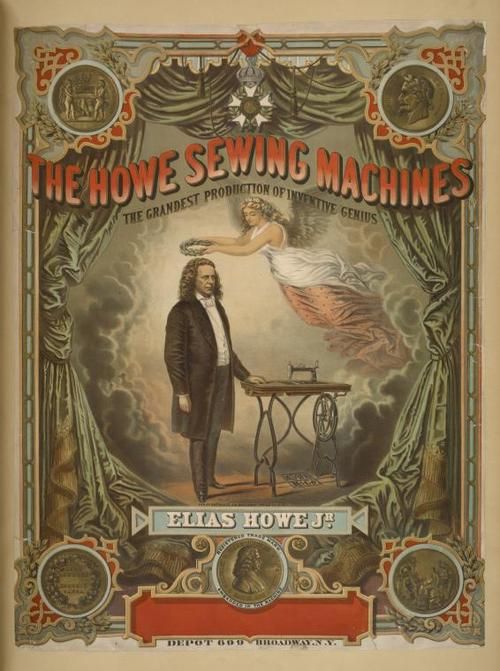
This invention truly revolutionized American life. The sewing machine was granted a patent on September 10, 1846. While most people associate the name Singer with the sewing machine it was actually an inventor by the name of Elias Howe who conceived of and created the first such machine. From the Infallible Wikipedia:

“He almost beggared himself before he discovered where the eye of the needle of the sewing machine should be located. It is probable that there are very few people who know how it came about. His original idea was to follow the model of the ordinary needle, and have the eye at the heel. It never occurred to him that it should be placed near the point, and he might have failed altogether if he had not dreamed he was building a sewing machine for a savage king in a strange country. Just as in his actual working experience, he was perplexed about the needle’s eye. He thought the king gave him twenty-four hours in which to complete the machine and make it sew. If not finished in that time death was to be the punishment. Howe worked and worked, and puzzled, and finally gave it up. Then he thought he was taken out to be executed. He noticed that the warriors carried spears that were pierced near the head. Instantly came the solution of the difficulty, and while the inventor was begging for time, he awoke. It was 4 o’clock in the morning. He jumped out of bed, ran to his workshop, and by 9, a needle with an eye at the point had been rudely modeled. After that it was easy. That is the true story of an important incident in the invention of the sewing machine.”

Alas, Elias Howe had competition in the development of the sewing machine and another, much more recognized name, came to dominate the industry. Also from the Infallible Wikipedia:

“Despite his (Howe) efforts to sell his machine, other entrepreneurs began manufacturing sewing machines. Howe was forced to defend his patent in a court case that lasted from 1849 to 1854 because he found that Isaac Singer with cooperation from Walter Hunt had perfected a facsimile of his machine and was selling it with the same lockstitch that Howe had invented and patented. He won the dispute and earned considerable royalties from Singer and others for sales of his invention.”

An A-line pattern that beginning seamstresses could master as they learned to sew.

Howe, like Singer, ended up a multimillionaire.

Before this society altering machine was invented, it took some 14 hours for a person – usually a woman – laboring at home and sewing each seam by hand to make a shirt. Those hours were invested after all other chores were done: cooking, cleaning, washing, and child care. The sewing machine, which at first was used in factories, eventually made its way to the home allowing women to sew stronger, better garments, and saving hundreds of hours of valuable time.

For me, my relationship with the sewing machine is a love/hate affair. When in Junior High I took Home Economics classes which, at Wilson Junior High in Yakima, were split into two segments. One was to learn all the skills needed to cook. The other was to learn how to sew. I was in eighth grade in the sewing segment when I received my first lessons.

Our initial project was to sew a basic A-line dress. For those unfamiliar with the term, what that meant was a dress of three pieces: front, and two mirror image back pieces with a zipper down the middle. No sleeves, just armholes with armhole facings; darts at the bodice completed the fitting. In all, the pattern consisted of 8 pieces. Five of those pieces were facings around the arms and neck.

Our teacher sent us out on the mission to purchase material for our dresses. I acquired a very loud, very late 1960’s/early 1970’s fabric, with colorful and bold flowers on a white background. Day by day we labored. One day the pattern pieces had to be carefully laid out and pinned down, paying attention to concepts such as grain lines as we learned how to ‘read’ the pattern. The next step, after our teacher approved our work, was to cut the fabric, making sure to follow the printed lines of the pattern and the little tabs to be matched. Day by day we succeeded in sewing together our creation. We learned the proper way to sew darts (the dress had four of them), install a zipper, finish edges, tack down the facings, and to sew (by hand) a hem.

Typical of Popular fabrics designs from the early 1970’s

When my dress was complete that fall I was excited to wear it… only to discover that due to my physical similarity to a long-legged colt, the length of the dress was such that all anyone noticed were my knock-kneed legs extending a mile from the hem to the floor.

This might have been due to the fact that the mini skirt was the dominant fashion in the late 1960’s. Or it might have been that between my 8th and 9th grade years of school I grew, literally, six inches in height. From the time I started the dress to when it was finished, I had gained most of this height.

But I was not discouraged as I had discovered I now possessed a valuable ability. Soon I had a bit of a cottage industry going. As a member of the Rainbow Girls the need for custom dresses for its members provided clients. The very first dress I made for someone else was for my friend, Wende, who paid me $15 to sew a dress.

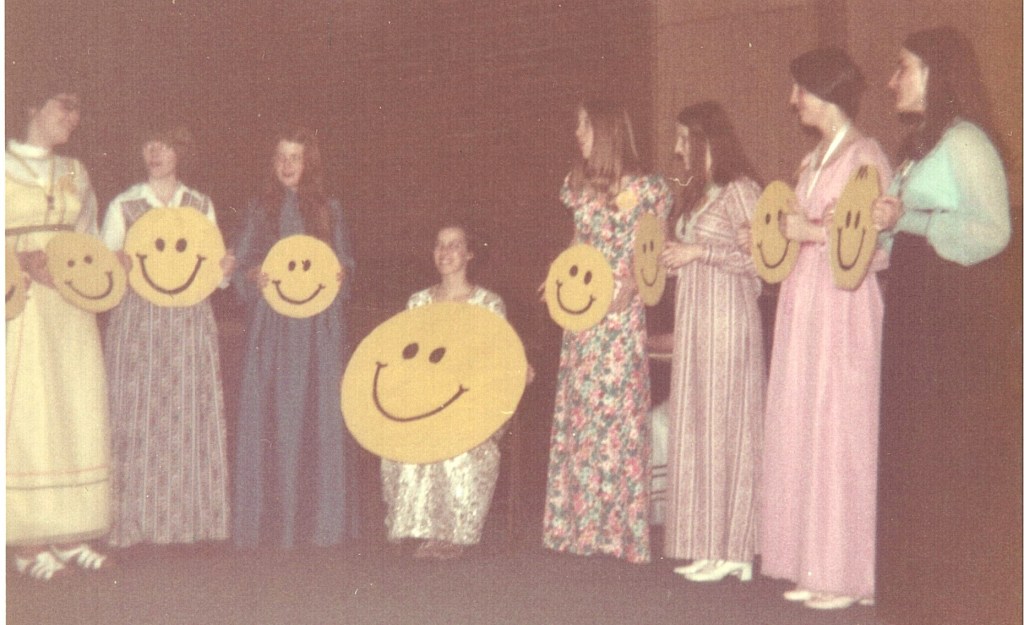
March 1972. This was taken at a Rainbow Girls meeting in Yakima. I’m standing immediately to the right of the girl seated and wearing a dress I sewed using popular bright floral colors. I wrote in my diary that day “I wore my new formal that I made and everyone seemed to like it.
.

Over the years knowing how to sew has come in handy. I can mend pretty much anything and can create clothing. I’ve made costumes for my children, dresses for countless Rainbow girls, and my most recent project (in 2019) of sewing 21 identical aprons for gifts.

The most painful experience occurred, however, in January 2010. Sewing is, despite Mr. Howe’s invention, a time consuming process.

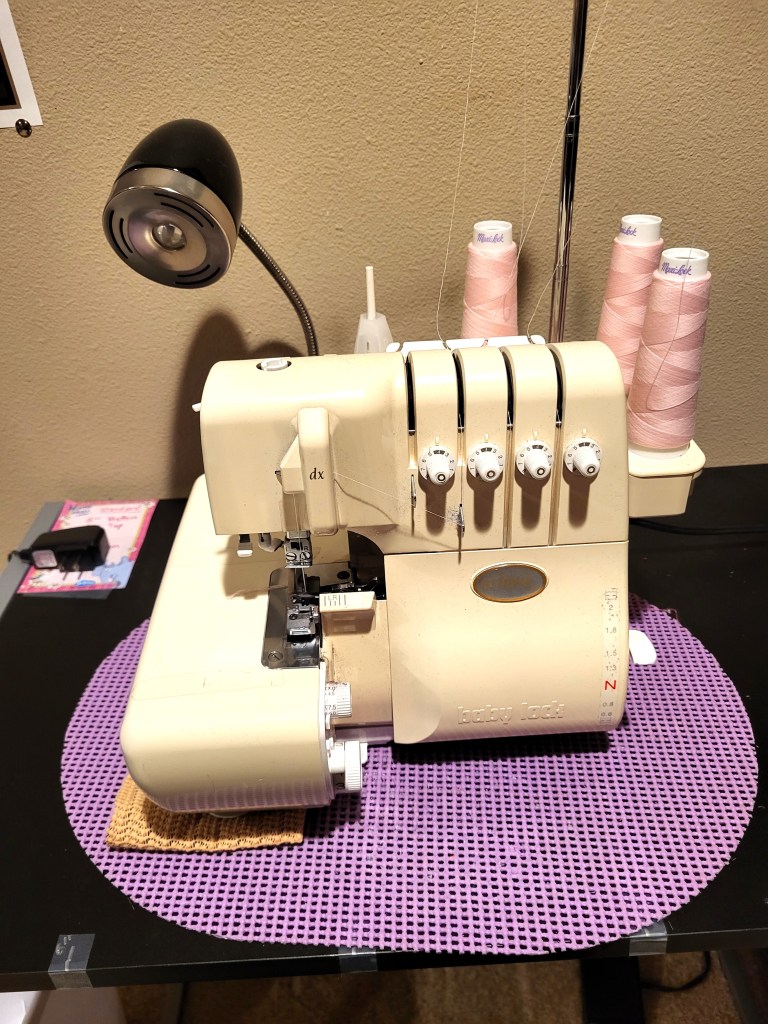
My Baby Lock serger – a Christmas present to myself – purchased in early 2010 and still being used.

Enter into my world the serger. Improving on the functionality of the sewing machine, a serger completely binds a seam, cutting and simultaneously sewing together two pieces of fabric into a never to be undone union. The addition of the serger was a miracle for me. Seams which before had taken 20 minutes each now required but a few minutes.

Until. Until I was sewing my first project using the serger in January 2010. It was to be a rather delicate and beautiful blue dress using a pattern in the same style as the wedding dress worn by Kate Middleton for her marriage to Prince William. There was lace. There was satin. It was going to be stunning. I was happily serging the seams in anticipation of the dress being completed when my foot slipped on the pedal and the serger went one stitch too far. I looked down at the garment and there, in the nearly completed dress, was a perfect cut into the midriff in the shape of a small upside-down V.

I stared in horror at the incision and wondered how to fix the mistake. Could I bind the edge to repair it? Could I tuck in under?

The reality of the situation hit me. There was no way to ‘fix’ the mistake. The dress would have to be taken apart, a complete new section cut out and replacing the irreparably damaged midriff piece.

The dress which the serger attacked…

The memory of that day is forever seared into my brain. I continued to study the ruined bodice for what seemed like several minutes. At last I stood. I turned off the machine. I left the dress right where it was, a testament to the old adage “A stitch in time saves nine.”  I left my sewing room for the rest of day, literally sick over the fact that I would have to recreate the destroyed section, learning in that moment that a serger was but a tool which, if not used correctly, was no more useful than any other tool in the wrong hands.

The next day I returned to the sewing room, cut out the new section and was able to recreate the damaged piece. My mistake had added a couple of hours to the project. The dress? It turned out beautifully, a true masterpiece on the lovely young woman who wore it. Because I knew that sometimes ‘things happened’, I had enough extra material to fix what had been so easily destroyed.

As for me, sewing is something I do because it serves an end, but it’s not my life’s passion. My passion is this: writing.

I do find, however, that when my brain is tired from the creative process of writing, sewing can provide a comfort in the sheer rote of its methods. Seams are seams. There are only so many ways to put a garment together and once you master that you can make pretty much anything so long as you respect the machines which make it possible.

But writing… well, that taps into my creative mind as I’m always looking for new and different ways to share ancient truths.

So I leave the sewing to those whose passion it is. Artistry comes in many forms.  Except for an occasional project, my 10 hour sewing days are behind me and I’ve closed the shop.

I also think it’s time to bring back Home Ec. classes like sewing. We’ve now raised a couple generations of people, the majority of whom seem to lack basic life skills. Being able to sew a seam, and put up a hem is just one example of valuable ability. Cooking, carpentry, and mechanical aptitude should be added to that list also.

So I salute Elias Howe and his vision for the modern sewing machine. It truly changed the life of women.

The Infallible Links:

https://en.wikipedia.org/wiki/Sewing_machine

https://en.wikipedia.org/wiki/Elias_Howe

The Rotary Telephone

The only downside was the cord

August 20, 2024

A Tuesday Newsday Classic Updated

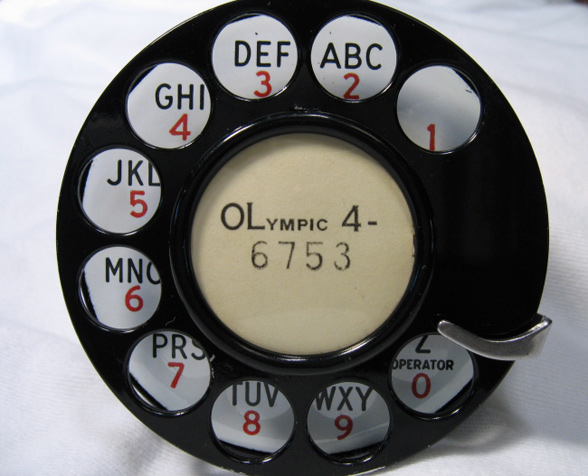
A vintage rotary dial possibly from the state of Washington.

For young people in the 1960’s and 70’s, this device was as essential to teenagers as the smart phones of today.

The difference being that this device was tethered to a specific location and it allowed you to do but one thing: talk.

Nearly every household in middle America had one and, by the early 1960’s, all featured a rotary dial, the patent for which was applied for on August 20, 1896. The device was, of course, the telephone.

It was, however, the addition of the rotary dial which made it possible for the telephone to become a common household essential. As is often the case, controversy surrounded the granting of patents. The first rotary style was developed in 1891. According to the Infallible Wikipedia:

“Almon Brown Strowger was the first to file a patent for a rotary dial on December 21, 1891, which was awarded on November 29, 1892, as U.S. Patent 486,909. The early rotary dials used lugs on a finger plate instead of holes, and the pulse train was generated without the control of spring action or a governor on the forward movement of the wheel, which proved to be difficult to operate correctly.”

It was only a few short years later when three inventors in Kansas – brother’s Charles and Frank Erickson along with their friend Frank Lundquist – provided the refinement needed and the rotary dial with finger holes that we know was invented. Different enough from Strowger’s design, it became the standard. From the historical files of the Kansas Collection:

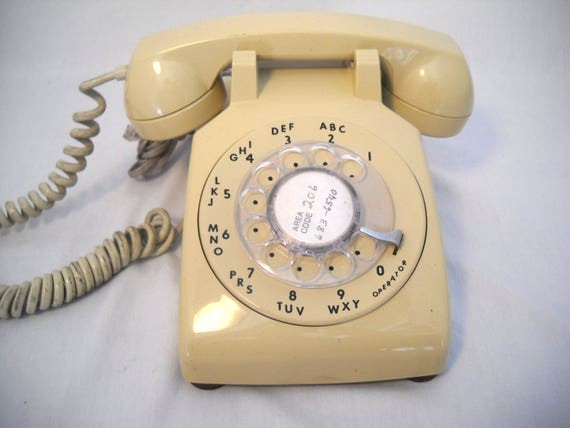
We had a beauty like this one in both the kitchen and my parents bedroom

“The most dramatic contribution of the Ericksons in telephony is associated with the invention and development of the dial telephone. Application for the patent was made by (A.E.) Keith and the Ericksons on August 20, 1896, and Patent No. 597,062 was granted on January 11, 1898. The dial method was based upon a finger wheel dial instead of the push buttons, which were cumbersome and impractical. The dial method, with the switching and trunk systems, provided full access to the vast resources of a telephone exchange. R. B. Hill, an authority in telephony, has described this important development as follows: ‘Dialing a number wound up a spring whose tension, when the finger was withdrawn, caused the dial to return to its normal position. The return rotation was limited to a moderate speed by an escapement mechanism, and, during the return, the required number of circuit interruptions took place to control the movement of the central office apparatus.’”

Telephone numbers in the 1960’s were identified by a combination of letters and numbers. Eight of the finger holes on the phone had 3 letters. My phone number growing up, then, was listed as follows: Glencourt 2-4100, or in its phone book listed form, GL2-4100. Translation for the kids of today: 452-4100. Area Codes were added in 1947 but unlike today were not needed for all calls.

In my household the phone was strategically placed in the kitchen. When it rang, you answered as there was no answering machine. Up until about 1971 the phone was never for me and the conversations were usually brief as the device was a method for setting up an appointment or such other daily business.

With teenagers in the house, however, its use ballooned. My sister used it, especially, for the higher purpose of dialing in to radio stations to make song requests and to try to win things. With transistor radio on one ear and the telephone on the other she’d dial incessantly to be the 10th or 20th or 93rd caller. She seemed to win. A lot.

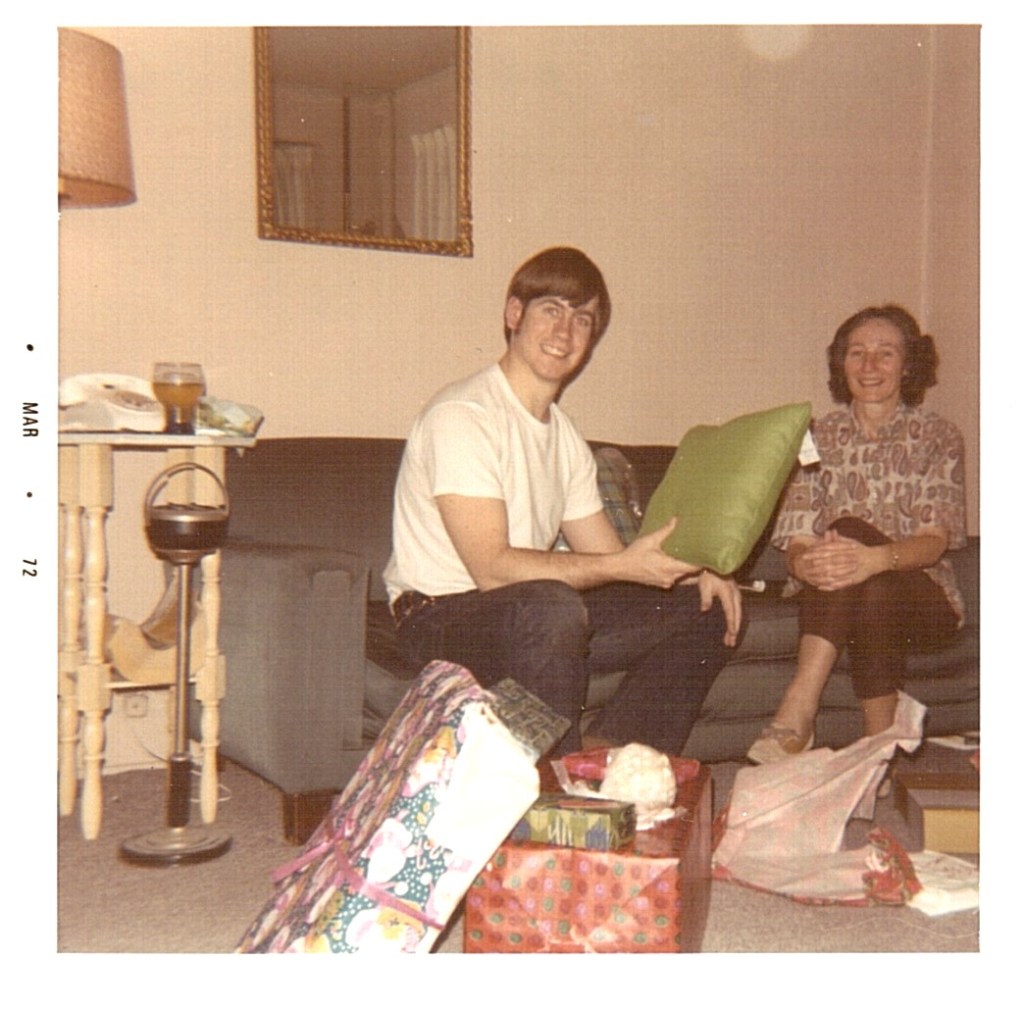
Unlike today, photos of people with phones was uncommon. In going through old photo albums this was the only picture I found with a phone in it. I took this photo at my older brother’s apartment (he was 24) when me and my parents drove to Seattle on December 27, 1971, to bring him Christmas. Mom is on the right. Rotary dial phone is on the left.

My long-suffering parents finally tired of chatty teenagers doing their teenager business in the middle of the family area and a second phone was installed.

This phone was the holy grail of all things teen. Located in my parents’ bedroom it provided the one thing we craved: privacy.

When boys started to call my older sister – and eventually me – we were allowed to use the phone in my parent’s bedroom. There was no chair next to the phone, just the bed and the floor. Many an hour was spent sitting on that floor, back against the bed, talking to the boy of the month… at least until Mom would come in to the room and give us the sign to wrap it up.

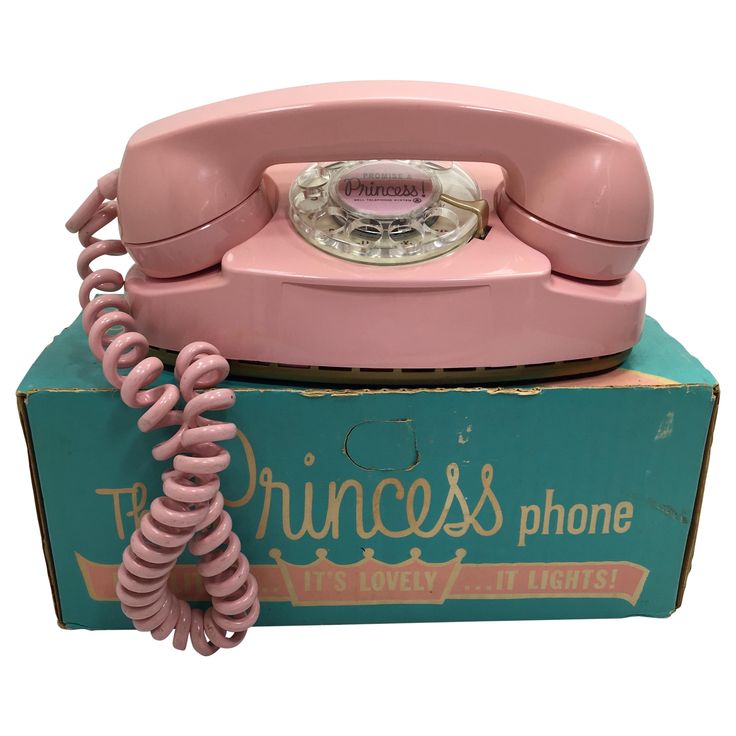
We envied the few friends who had their own phone in their room, usually a princess style and pink or white. What a luxury!

The most envied of all devices: a pink princess phone

When I became a parent and cell phones (before the smart phones took over) were a thing it became very difficult to monitor what the child was doing. No doubt it’s even more difficult now with text messages, unfettered internet access, and apps like Instagram and TikTok. It was much easier for my parents as they could cut the conversation off at any time and when the household went to bed no teen was sneakily talking or texting on the phone.

No doubt my most memorable event with a corded, old-style phone, came in 1992 when my son was two years old. Although cordless phones for use in a house had made some inroads by that time, I found them unreliable and they would often have static and bad reception. So, as a mother with a young child, I had hit on the perfect solution: a phone with a 25-foot-long cord.

It afforded me the ability to talk on the phone while also being able to get to my child anywhere in the kitchen/family room. Which was important since my first born being a VERY curious child required my eternal vigilance as he had a propensity for getting into places and things which he shouldn’t. In fact I discovered, to my great dismay, that there was not a baby lock you could install on a cupboard or drawer which could deter him.

One particular morning, I get a phone call from my best friend in Yakima, Daphne. My son is happily playing and Daphne and I have been chatting for about 10 minutes. I happened to be standing and looking out the window of our dinette area between the kitchen and the family room when all of the sudden the phone line goes dead.

I pull the phone away from my ear and stare at the now silent receiver, wondering what might have happened. Only then did I turn around and standing in front of me, scissors in hand and a cut in half phone cord laying at his feet, is my two-year-old.

A mixture of emotions course through me. Anger at this child who had the audacity to end my phone call but also awe at the problem-solving ability he had just displayed. And, of course, fear at the fact that he had dragged a chair to the kitchen, climbed on it, opened the drawer – with the baby lock on it – and retrieved the tool he understood was needed to complete his mission.

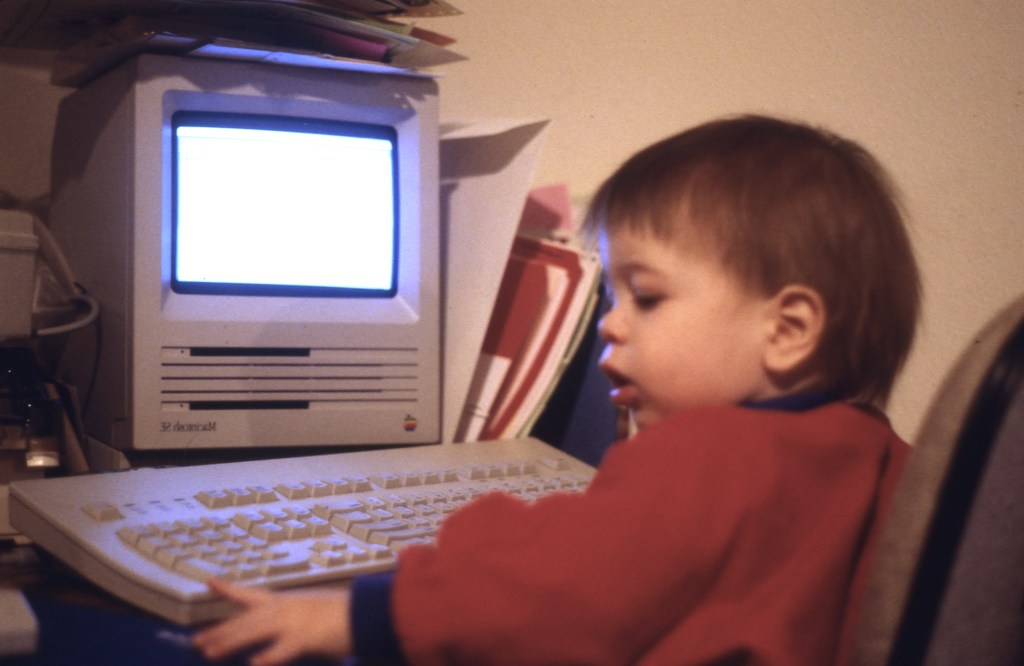
My curious child also learned how to use a computer early when he wasn’t cutting telephone cords.

Trying to reason with a one or two-year old is like trying to reason with a cat and was out of the question so in the end I came down on the side of awe. That was the one and only time he ever cut the phone cord… but there WAS the whole apple incident. That’s a story for another Tuesday Newsday. Eventually the technology improved and the cordless phone became the norm. Nowadays, very few people even have ‘land lines’ and phones are radically different than they were 30 years ago.

But back to the advantage of growing up with a device on which the only thing you could do was talk. I attribute my ability to pick up a phone and call anyone to the training I received as a teenager. Back then the only way anything was going to happen was by grabbing the phone and twisting those 10 little holes to make a call. Ah, the good old days.

A couple of links for those who wish to learn more about phones and the rotary dial:

https://en.wikipedia.org/wiki/Rotary_dial

https://en.wikipedia.org/wiki/Rotary_dial

Aurora Borealis

A once in a lifetime show

May 14, 2024

Once in a lifetime event… Eaglemont, Mount Vernon, Washington May 10, 2024. Photo by the author.

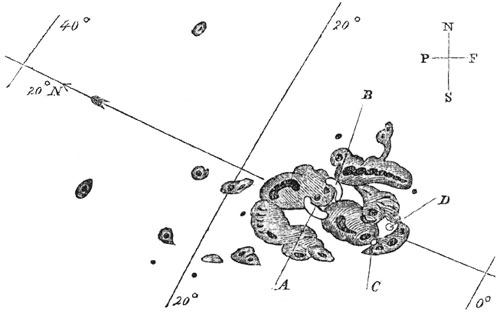
Known as the Carrington Event, the solar storm of September 1-2, 1859, was the first time scientists had connected a solar flare with the appearance of the aurora borealis.

Two British astronomers, Richard Carrington and Richard Hodgson, independently witnessed the huge September 1st solar flare through telescopes and Carrington, after whom the Carrington Event is named, sketched his observations.

Astronomers everywhere were, no doubt, excited by this discovery.

From the Infallible Wikipedia:

“The geomagnetic storm is thought to have been initiated by a major CME (Coronal Mass Ejection) that traveled directly toward Earth, taking 17.6 hours to make the 150-million-kilometre (93-million-mile) journey. Typical CMEs take several days to arrive at Earth, but it is believed that the relatively high speed of this CME was made possible by a prior CME, perhaps the cause of the large aurora event on 29 August that ‘cleared the way’ of ambient solar wind plasma for the Carrington Event.

By Richard Carrington – Page 540 of the Nov-Dec, 2007 issue of American Scientist (volume 95), Public Domain, Link

Just before noon on 1 September 1859, the English amateur astronomers Richard Christopher Carrington and Richard Hodgson independently recorded the earliest observations of a solar flare. Carrington and Hodgson compiled independent reports which were published side by side in Monthly Notices of the Royal Astronomical Society and exhibited their drawings of the event at the November 1859 meeting of the Royal Astronomical Society.

Because of a geomagnetic solar flare effect (a ‘magnetic crochet’) observed in the Kew Observatory magnetometer record by Scottish physicist Balfour Stewart, and a geomagnetic storm observed the following day, Carrington suspected a solar-terrestrial connection. Worldwide reports of the effects of the geomagnetic storm of 1859 were compiled and published by American mathematician Elias Loomis, which support the observations of Carrington and Stewart.”

Up until Friday, May 10, 2024, there had only been ten additional northern light displays which were of a magnitude similar to the 1859 Carrington event. The Infallible Wikipedia continues:

“Another strong solar storm occurred in February 1872. Less severe storms also occurred in 1921 (this was comparable by some measures), 1938, 1941, 1958, 1959 and 1960, when widespread radio disruption was reported. The flares and CMEs of the August 1972 solar storms were similar to the Carrington event in size and magnitude, however unlike the 1859 storms, they did not cause an extreme geomagnetic storm. The March 1989 geomagnetic storm knocked out power across large sections of Quebec, while the 2003 Halloween solar storms registered the most powerful solar explosions ever recorded. On 23 July 2012, a “Carrington-class” solar superstorm (solar flare, CME, solar electromagnetic pulse) was observed, but its trajectory narrowly missed Earth. The May 2024 solar storms are the most recent historic geomagnetic storms, with auroras being sighted as far south as Puerto Rico.”

I cannot recall when, exactly, I first learned that there was such a thing as the Northern Lights. What I do know is that I’ve had a long simmering desire to see them ‘just once’ during my lifetime.

Wings of an angel… Northern Lights May 10, 2024. Photo by the author.

On a trip to Fairbanks, Alaska, in March 2017, I thought for sure that dream would come true. Alas, it did not. There have been other times when there was a possibility but, despite staying up and attempting to see them from time to time, it never happened.

That was true until this past Friday when the weather and solar winds finally aligned.

As a geek who loves anything to do with sciency stuff like stars, eclipses, equinoxes, solstices, snow storms, and windstorms, I’ve covered all of the above in the pages of my Tuesday Newsday blog over the past eight years.

The dancing lights of the Aurora Borealis eluded me but not for lack of paying attention. For years – at least 15 or 20 – I have used Spaceweather.com to follow what’s going on out past this large sphere on which we live.

In the middle of last week, I became aware of a giant sunspot which erupted in several consecutive explosions, hurling CME’s directly at earth. It was, it turned out, the moment I had waited years to occur.

A little before 10 p.m. on May 10th, I checked the Spaceweather.com site and the reports had already begun claiming that people in Florida(!) were seeing the auroras. Even though I had to be up at 5:30 the next morning this was, I was certain, that ‘once in a lifetime’ event.

I am fortunate to live an hour-plus north of the Seattle Metro area and there are dark places not far from my home. I knew where I would go and the hubby and I drove the half mile to the top of Eaglemont Drive in search of the perfect viewing spot.

When we arrived, there was no one else about so we parked next to the golf course driving range and I got out of the car. At first it seemed as if nothing was happening.

Contrary to popular belief, it does NOT rain on the westside of the Cascade mountains every day. May 10th, it turned out, was clear, sunny, and nearly 80 degrees. A truly perfect day in my opinion.

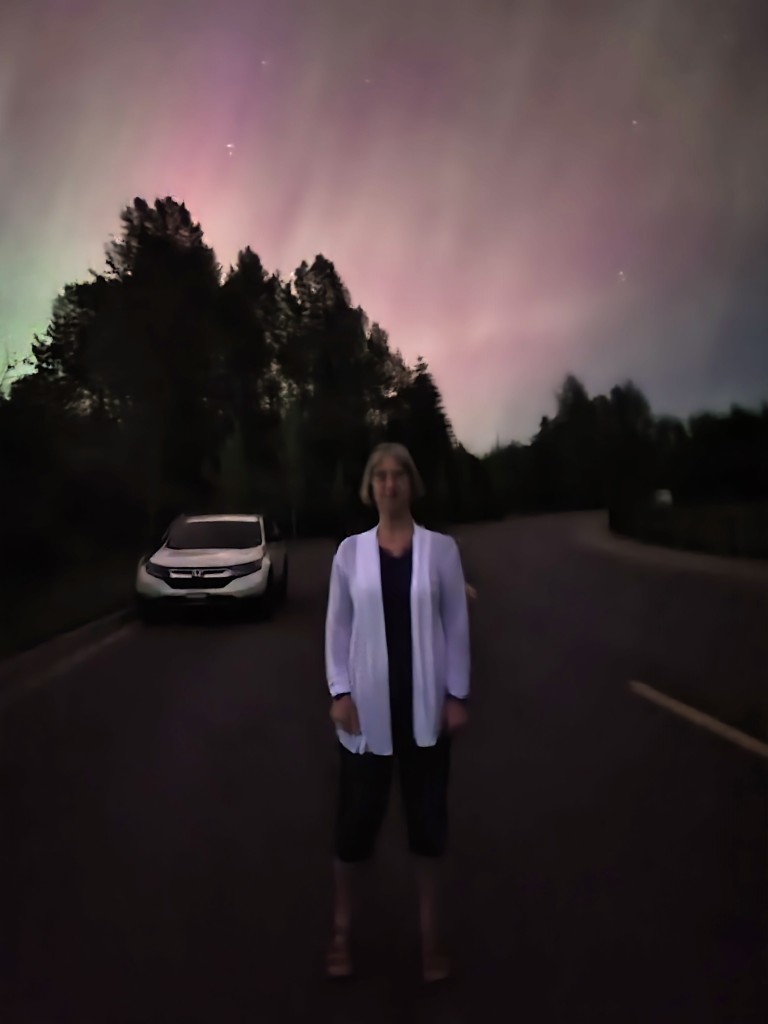
Even the author appears as an apparition with the Auroras erupting behind her.

By ten, of course, the sun had been set for an hour and twenty minutes, so it was dark. Even so, as I looked up I noticed what appeared to be wispy clouds streaking the sky in ribbons from the northeast to the southeast. Since it had been a cloudless day, I wondered, ‘could those clouds be be the solar stream?’

As we looked toward the northeast the sky at the tree line seemed to brighten a bit. My heart quickened. No longer in doubt, I was – finally – seeing the aurora borealis.

It was 10:07 p.m. when I turned on the video on my phone and it captured an almost ghost like apparition of the solar stream as it bounced and danced. At that point the plasma was only gray. A couple minutes later I videoed again and faint pinks and greens now appeared.

Others, having the same idea as me, had started to arrive. Some cars drove past and then, not seeing anything spectacular, would turn and leave. Most parked down by the currently closed clubhouse (as the golf course is up for sale) and we could hear people talking. Around 10:35 another couple pulled up and parked close by and we shared what we knew with them.

The wife said that someone told her to take photos in night mode and that the extra exposure time would bring out the colors. So I did.

If there had been any question before, the photo I got at 10:39 dispelled all doubt that we were witnessing the northern lights.

At 10:45 there was a change in the intensity. As I looked directly overhead there now appeared to be a ‘cross’ in the sky and it was faintly pink, even to the naked eye. The wispy streaks expanded and filled the sky from the middle of the ‘cross’ and then from the eastern horizon to the west and the north to the south.

https://youtube.com/shorts/K-0cowAqjTA?feature=share

All the streams seemed to be converging into that one spot, forming a dome over where we stood. Then, at 10:53 pm, the sky overhead exploded into red and green with bright white sheets of light cascading down on all sides. Every inch of sky was bathed in the glow.

It was impossible to capture all of it on video – nor did I want to. Up until that moment I understood the science… but to experience it as a living human being is quite different. Tears pricked at the back of my eyes and I raised my arms towards the heavens and at what looked like an angel whose head was red and green and whose arms and body were draped with great white, shimmering wings, cast down to embrace me, its whole being surrounding me.

I stood there, enraptured, until the lights began to fade, forever changed by the experience, certain that the science behind the Aurora Borealis will never be able to adequately describe being immersed in it. And if I never see them again, I think that’s okay as I will forever hold the memory of the night I was touched by an angel.

At the height of the geomagnetic storm 10:53 p.m. on Friday, May 10, 2024

www.spaceweather.com

https://en.wikipedia.org/wiki/Carrington_Event

https://en.wikipedia.org/wiki/May_2024_solar_storms

A second video link from that night:

https://youtube.com/shorts/WrVwrAhu87E?si=wGjv3vopFdzaFnqH

The Kingdome

Years to build… 17 seconds to implode…

March 26, 2024

The era of professional football in the United States was ascendant in the 1950’s and into the early 1960’s. Pretty much every major city in the United States wanted to get in on the action.

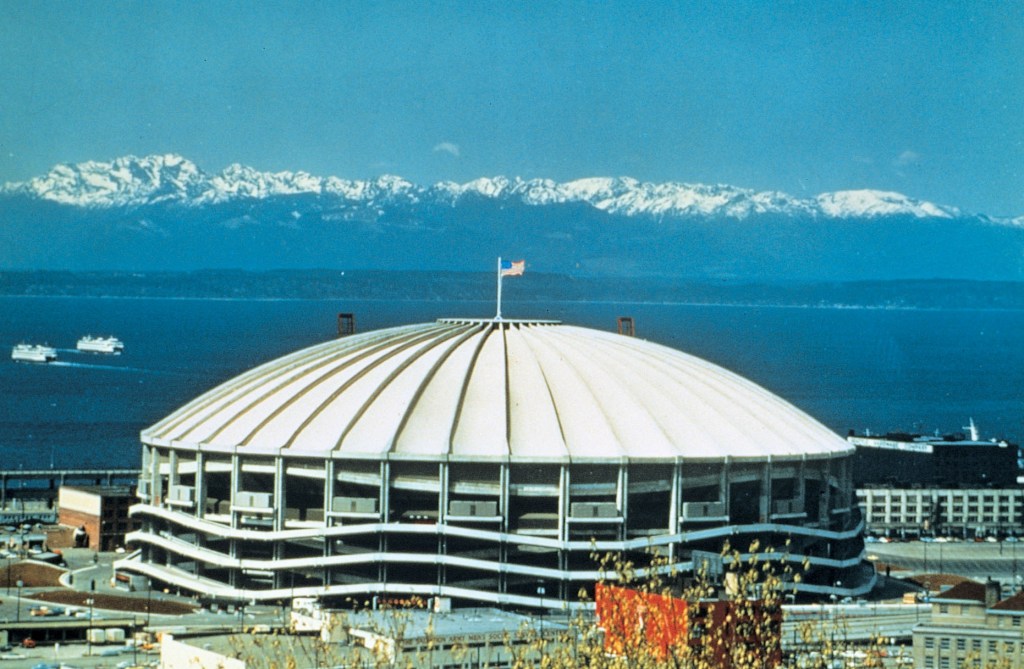
On the day of the Mariner’s last game in the building 1999.

But for many cities, weather was a limiting factor. After all, playing in a foot of snow, blistering heat, or constant rain, was not ideal for the players or the fans. In the 1950’s the dream of indoor stadiums took hold. It was in Houston, in the early 1960’s, when the first such venue – the Astrodome – became a reality. Others followed.

Many in Washington State longed to have a pro-football franchise and believed the rainy climate on the west side of the Cascade Mountains called for an indoor stadium. Thus began the quest to build what would eventually be named “The Kingdome.”

It was in 1959 when the idea was first proposed but it took until 1976 for the vision to become a reality. The Infallible Wikipedia tells us:

“The idea of constructing a covered stadium for a major league football or baseball team was first proposed to Seattle officials in 1959. Voters rejected separate measures to approve public funding for such a stadium in 1960 and 1966, but the outcome was different in 1968; King County voters approved the issue of $40 million in municipal bonds to construct the stadium.

Jim Zorn and Steve Largent in the early days of the Seahawks franchise

Construction began in 1972 and the stadium opened in 1976 as the home of the Sounders and Seahawks. The Mariners moved in the following year, and the SuperSonics moved in the year after that, only to move back to the Seattle Center Coliseum in 1985.”

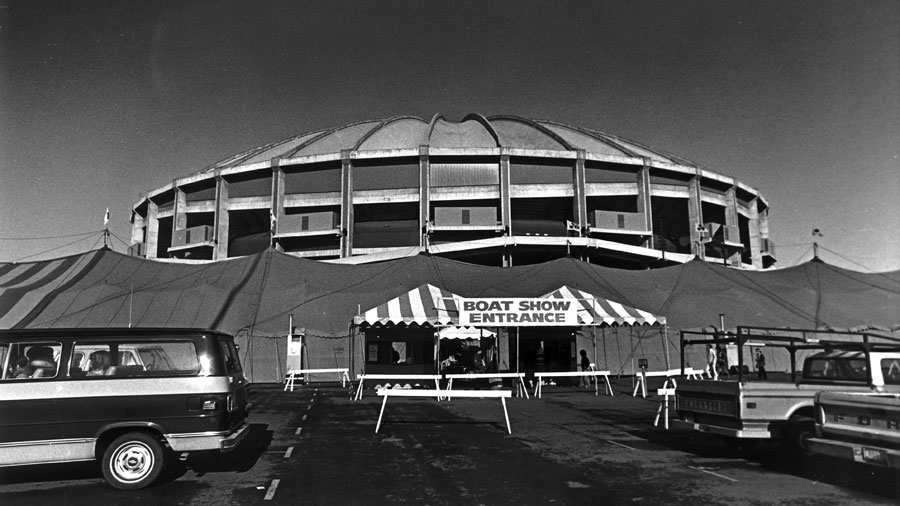
The Kingdome, named as such due to its location in King County, Washington, served the community as a venue not only for the Seahawks and other sports teams, but also as an event center to host large events such as the Seattle Home Show and the Seattle Boat Show as well as many rock concerts over the years.

“In the Seahawks’ heyday, the Kingdome was known as one of the loudest stadiums in the league. Opposing teams were known to practice with jet engine sounds blaring at full blast to prepare for the painfully high decibel levels typical of Seahawks games. It was where Seahawks fans, who were long called “the 12th Man” and led the Seahawks to retire the number 12 in honor of them in 1984, made their reputation as one of the most ravenous fan bases in the NFL, a reputation that has carried over to what is now Lumen Field. The Kingdome’s reputation contributed to the NFL’s 1989 vote in favor of enacting a rule penalizing home teams for excessive crowd noise.”

A view of the Kingdome during one of the Boat Shows

But, if there was one word to describe the Kingdome it would be ‘utilitarian.’ How else to explain the huge gray cement mushroom which lacked any aesthetic appeal? But it did the job and also became infamous among the indoor venues for the noise levels. Also from the Infallible Wikipedia:

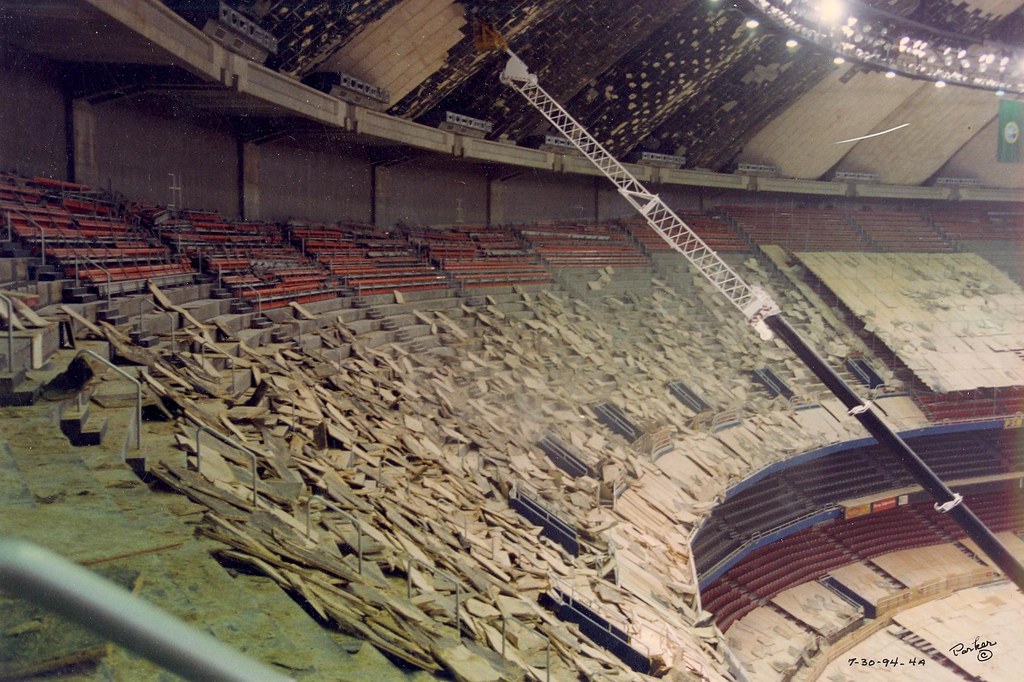
By the 1990’s, the first iteration of domed stadiums had outlived their appeal and useful life. The Kingdome’s roof – problematic from the beginning – had a partial roof collapse in July 1994, and the venue was closed for repairs for nearly four months. But the problems did not end there, threats by then owner, Ken Behring, to move the team out of Seattle – and the Mariners insistence on a new baseball venue – eventually led to the decision to replace the Kingdome.

It was on Sunday, March 26, 2000, when the Kingdome was finally reduced to a pile of rubble, paving the way for the construction of the next generation of a football stadium in Seattle.

The interior of the Kingdome in 1994 during removal of the ceiling tiles.

It was a clear and pleasant day and, of course, all the local TV stations had been covering the story for months as everything from inside the building was removed leaving, at last, the concrete shell. For weeks – who knows maybe it was months – holes were drilled in the walls and a serpentine of detonating cord was laid. Eventually dynamite was inserted into the holes and it was all connected up in anticipation of the implosion which would take down the concrete beast.

At the time, my family was living on the eastside of Lake Sammamish, about 13 miles – as the crow flies – from the Kingdome. We gathered around the TV and watched live as the first sticks of dynamite on the roof sent streaks of sparks down the spines and the chain reaction encircled the building. It was over in a matter of seconds as clouds of dust obliterated the area. Me, the hubby, and our two kids – then ages 10 and 7 – once the main event was over, rushed out to our west facing deck and a few seconds later the sound waves of the Kingdome’s demise reached us.

A recap of King5’s coverage and a bit of history of the Kingdome. We were likely watching this channel that morning.

It was a surreal experience.

In some ways I miss the Kingdome and all it represented. It was Seattle – and Washington States’ – message to the world that we were ready to play with the big boys. The construction of the Kingdome represented a heady era in Seattle as we welcomed the Seahawk celebrities of the era: Jim Zorn, Steve Largent, and Sherman Smith to name a few. We were hometown proud of the Nordstrom family for owning the team and you could find no more loyal fans anywhere.

It was, truly, a bittersweet day when the Kingdome came down. It’s been gone for 24 years now but for those of us who lived in King County in that era, it won’t ever be forgotten.

https://en.wikipedia.org/wiki/Kingdome

https://youtu.be/Yt2ekbkDVv4?si=MPgKbrFeS3BCkCtZ – Issued on the 20th anniversary from the Seahawks is this recap of the implosion

https://www.concertarchives.org/venues/kingdome

https://en.wikipedia.org/wiki/Astrodome

https://www.historylink.org/File/2164

Anne Frank

Diary of A Young Girl

March 12, 2024

A Tuesday Newsday Classic Updated

Margot and Anne Frank

Required reading for all junior high students in the 1970’s, Anne Frank: Diary of a Young Girl, both inspired and dismayed.

Although the exact date of the 15 year olds death is in question, March 12, 1945, is designated as such.

While I tend to avoid controversial and depressing topics, there is no question that this book ranks within the top tier of the most important works of the 20th century and deserves recognition as such.

Anne Frank lived in the Netherlands on June 12, 1942 – her 13th birthday – along with her parents and sister. It was on that date she was given her first ‘diary.’ From the Infallible Wikipedia:

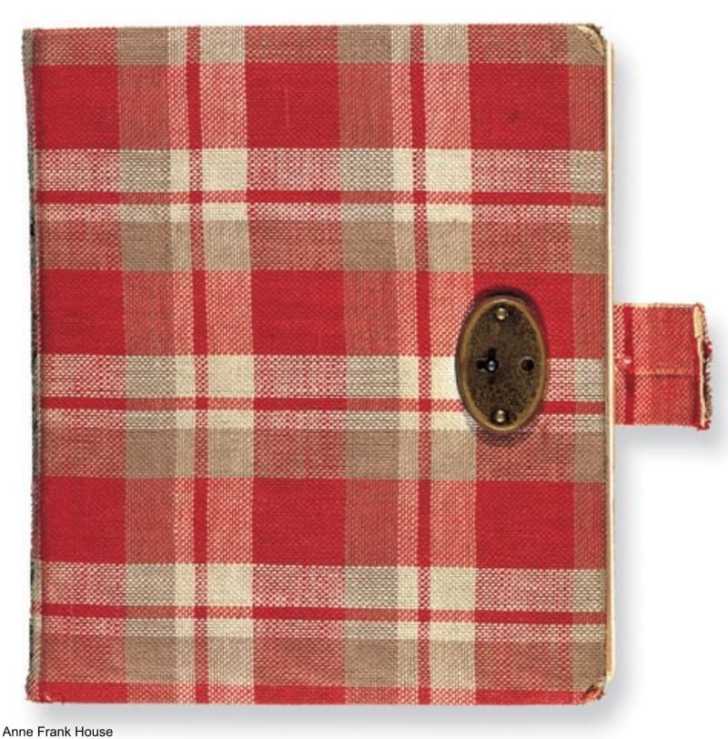
“During the Nazi occupation of the Netherlands, Anne Frank received a blank diary as one of her presents on June 12, 1942, her 13th birthday. According to the Anne Frank House, the red, checkered autograph book which Anne used as her diary was actually not a surprise, since she had chosen it the day before with her father when browsing a bookstore near her home. She began to write in it on June 14, 1942, two days later.

Anne Frank’s Diary which is preserved at the Anne Frank House museum

On July 5, 1942, Anne’s older sister Margot received an official summons to report to a Nazi work camp in Germany, and on July 6, Margot and Anne went into hiding with their father Otto and mother Edith. They were joined by Hermann van Pels, Otto’s business partner, including his wife Auguste and their teenage son Peter. Their hiding place was in the sealed-off upper rooms of the annex at the back of Otto’s company building in Amsterdam. Otto Frank started his business, named Opekta, in 1933. He was licensed to manufacture and sell pectin, a substance used to make jam. He stopped running his business while everybody was in hiding. But once he returned, he found his employees running it. The rooms that everyone hid in were concealed behind a movable bookcase in the same building as Opekta. Mrs. van Pels’s dentist, Fritz Pfeffer, joined them four months later. In the published version, names were changed: The van Pelses are known as the Van Daans, and Fritz Pfeffer as Albert Dussel. With the assistance of a group of Otto Frank’s trusted colleagues, they remained hidden for two years and one month.”

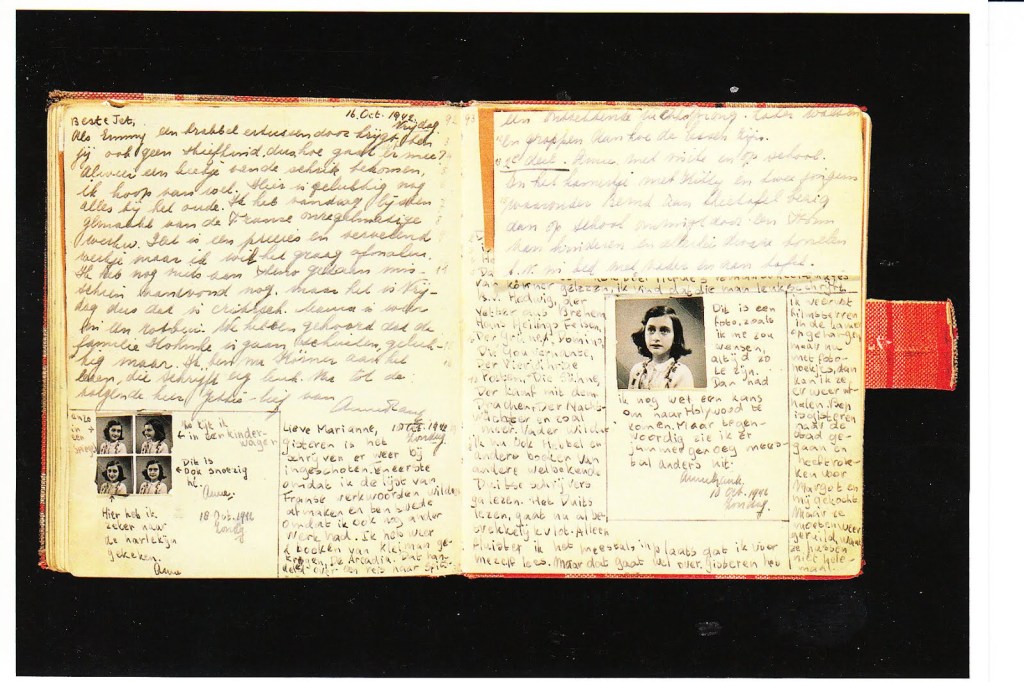
Interior pages of Anne’s Diary

The family and the others were discovered in August 1944 and taken to concentration camps. It was in the Bergen-Belsan camp where Anne, who contracted Typhus, and her sister both died. Of the hidden group, only Otto Frank survived. Those who concealed the family found and saved her diaries and gave the books to her father. It was he who got them published.

I can’t say exactly when I was first required to read the book, but no doubt it was in junior high (middle school to Americans under the age of 40). The timing of it likely coincided with when I became obsessed with keeping a diary. Perhaps I had visions of my musings being enshrined forever in a similar manner. Young teenage girls are, particularly, susceptible to drama and tragedy. Unlike Anne Frank, however, my diary entries included such riveting entries such as this one:

“March 1 (1972)

Well here we go again another month gone by. I’m 14 years, 7 months today. It was strange today we have had about four inches of snow, oh joy! I felt like I was being watched. We had a meeting at Mrs. Hughey’s this evening. We started Co-education volleyball in P.E. but I didn’t take it because I can’t, doctor’s orders. Yea! It can’t be that bad but if you take a look at last year’s diary today, you’d understand!”

When I look back to that first week of March of 1971, the misery of having to play co-ed volleyball with 14 year old boys screams through the pages. I know for certain those boys wanted to play Co-ed volleyball about as much as the girls did. Which was not at all. I imagine they were frustrated by the experience also.

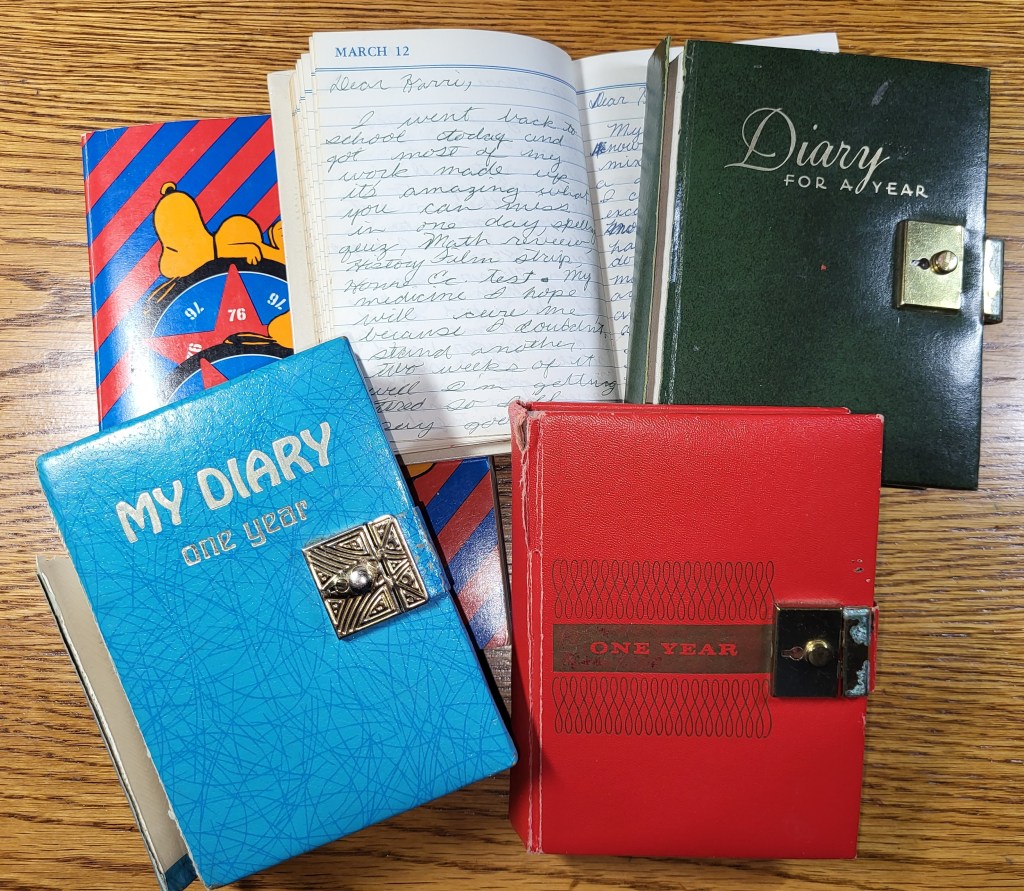
The five diaries I have saved. One year I switched to writing in a looseleaf notebook and ALWAYS used a green Flair pen. I am not sure what happened to that year. The 1976 diary is the last one I kept but by then I was 18 and the entries are few and far between. In 1971 I decided to write to my diary which I named Karri. Who knows!

For me, playing co-ed volleyball when you have the co-ordination and look of a newborn colt, is about the worse torture you can inflict on a teenage girl. The reason I couldn’t play volleyball in 1972 is that I was still recovering from a nine day case of the hard measles. (We didn’t have a measles vaccination then… get your kids vaccinated. Trust me on this) While I was sick I lost approximately 10 pounds… weight I could not afford to lose since I was, according to the identification pages at the front of my diary, 5’7” and 110 pounds. Yes, the colt reference is accurate. And, apparently, getting snow in early March isn’t that uncommon either.

What I do know is that the keeping of a diary galvanized for me a thing which has been a lifelong passion: to write. My musings are juvenile and without finesse and yet I do a credible job in dutifully recording all that was going on in my life at that time.

I am thankful that my teenage years were during an easier time in history; they will never carry the same weight and warnings of Anne Frank. The five years of books which I still have are a reminder that being a teenager is an awkward time in life regardless of the era. I suspect, also, that every teenager experiences some angst to one degree or another. Well, except maybe the most popular girl in my class… I’m certain HER life was perfect. Or not.

Anne Frank’s diaries – despite being written under the most challenging of circumstances – still ring true as to the thoughts and emotions of a girl on the cusp of becoming a woman. While her story had a tragic ending, I am thankful that her father made it his mission to see her words published and to serve as a reminder that each generation must be vigilant as to the dangers of persecution.

For more about Anne Frank and her diary, a couple of links:

https://en.wikipedia.org/wiki/The_Diary_of_a_Young_Girl

https://en.wikipedia.org/wiki/Anne_Frank