Archives

Don’t It Make My Brown Eyes Blue

And a few musings on Blue vs. Brown eyes

June 24th
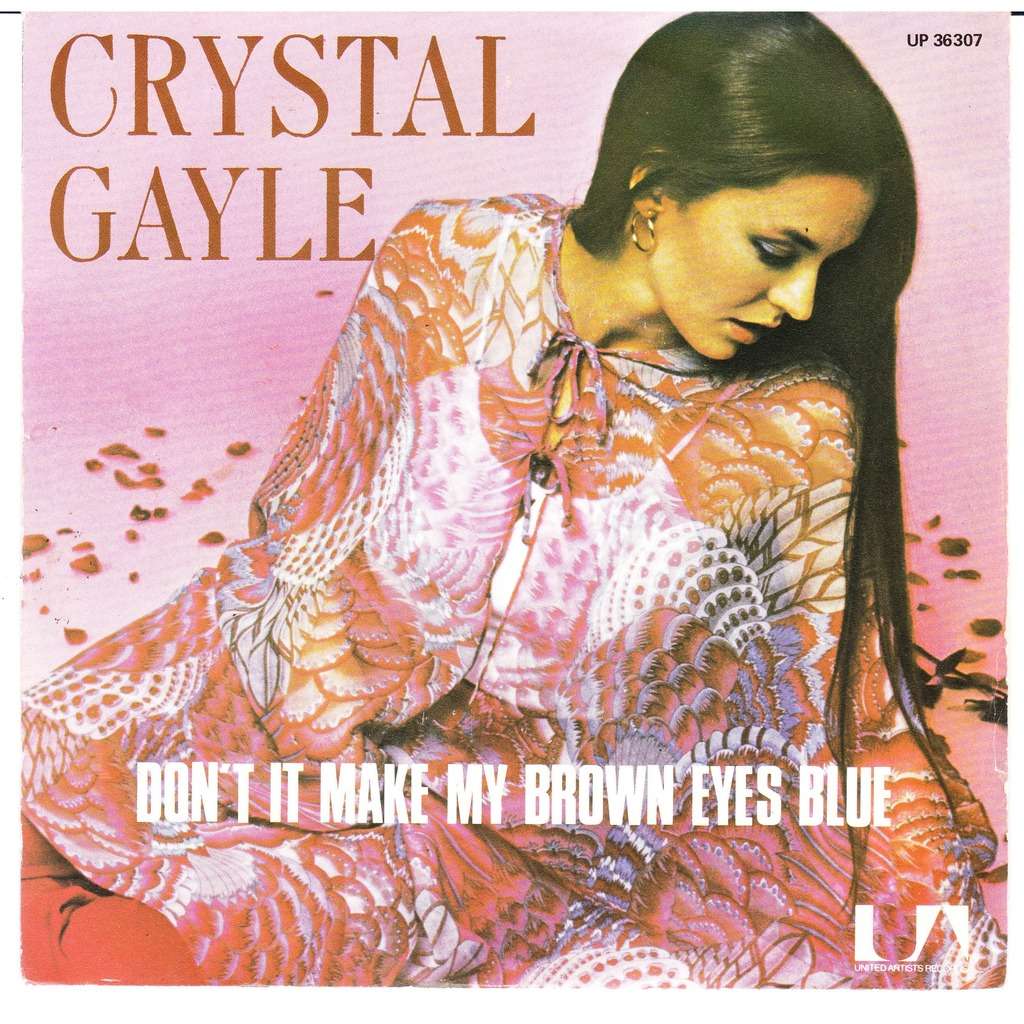
This song, released in June 1977, was one of those rare pieces which successfully crossed over from country to pop. It was number one on the country chart for five weeks in the summer of 1977 and peaked at number two on the Billboard Hot 100 chart in late November 1977. It was kept from the top position by Debby Boone’s You Light Up My Life (YLUML). As I wrote in my blog about that song, there were any number of infinitely better songs during the number one run of YLUML, including this one. https://barbaradevore.com/2024/11/19/you-light-up-my-life-2/

Don’t It Make My Brown Eyes Blue catapulted artist Crystal Gale into stardom and she had a series of commercially successful songs which followed.

The Infallible Wikipedia shares:

“In 1975, ‘Wrong Road Again’ became Gayle’s first major hit. However, it was in 1977 when Gayle achieved her biggest success with ‘Don’t It Make My Brown Eyes Blue’. The single topped the Billboard country chart, crossed over to the top five of the Billboard Hot 100 and became a major international hit.

Gayle continued having success from the late 1970s and through late 1980s. Her biggest hits included ‘Ready for the Times to Get Better’ (1977), ‘Talking in Your Sleep’ (1978), ‘Half the Way’ (1979) and ‘You and I’ (1982).”

Don’t It Make My Brown Eyes Blue is one of those songs which has gained in popularity and critical acclaim over time. Also from the Infallible Wikipedia:

“The song became Gayle’s signature piece throughout her career. In 1978, the song won Gayle a Grammy Award for Best Female Country Vocal Performance. In 1999, the song was recognized by ASCAP as one of the ten most-performed songs of the 20th century. (snip)

In 2024, Rolling Stone ranked the song at #109 on its 200 Greatest Country Songs of All Time ranking.”

I had not intended to feature this as today’s Tuesday Newsday topic. But sometimes things just sort of take a serendipitous route. Yesterday, while on our way to Seattle, the hubby, my son, and me were driving south on I-5 from Mount Vernon and my son – who has been visiting for the past week – commented about the low cloud ceiling and gray skies and how, since it was the first full day of summer, shouldn’t be happening. I think he’s forgotten what it’s like here since he lives in Guadalajara, Mexico, and he’s acclimated to the sunny and hot climate.

Being that it was June 22 and one of the longest days of the year, one might think it should be sunny and bright. But nope. Over the weekend we got a ‘welcome to summer’ soaking from Mother Nature.

As we approach the Stillaguamish River, the cloud cover has now lifted and is several hundred feet higher. Of course I do what any self-respecting, blue-eyed, Western Washingtonian would do, I put on my sunglasses.

Just like my hubby and son did. Or not. Why? Because they do not have blue eyes.

Of course, that sends me down the rabbit hole of mental gymnastics and I start thinking about blue eyes vs. brown eyes and that then led me to start humming today’s featured song. See how easy that was?

But back to the brown vs. blue eyes and the problem blue eyed people have: light sensitivity.

According to Health.com:

“Several studies have found that people with light-colored eyes are more sensitive to the effects of light than people with dark-colored eyes. Researchers speculate this may be due to lower amounts of melanin (pigment) in light-colored eyes. Less melanin in the eyes may increase their susceptibility to the negative effects of sun and light exposure.”
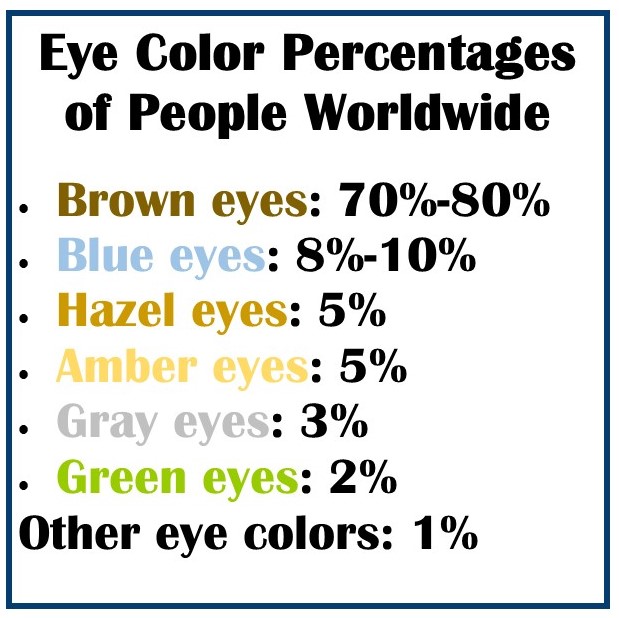
My son has teased me over the years about being a ‘blue-eyed freak.’ He’s not totally wrong. People with blue eyes make up only 8 to 10 percent of the human population as shown in the chart to the right:

Those of us who have blue eyes can trace the majority of our ancestry to northern European and Scandinavian countries. Finland, according to one report I saw, leads the world with a whopping 89 percent of its population boasting blue eyes.

I took a peek at my DNA results and learned that of the top 10 countries with the highest percentage of people with blue eyes, I match to seven of those countries – which makes up 93 percent of my DNA – including Finland with 13 percent of the total.

But back to the light problem. From the time I was a little girl, bright lights have always made me squint or even close my eyes. Bright lights when my eyes have adjusted to the darkness are just downright painful.

The hubby calls me a ‘darkie’ because I often move about the house without turning on lights. The way our lower level is set up is that we have a closet across from the bathroom near our bedroom. That closet has a motion-detecting light that is designed to turn on when one enters the closet. But sometimes, if you fly too close to the sun – er, opening – it will spring to life, flooding the area with blinding light. Okay, maybe that’s a bit hyperbolic.
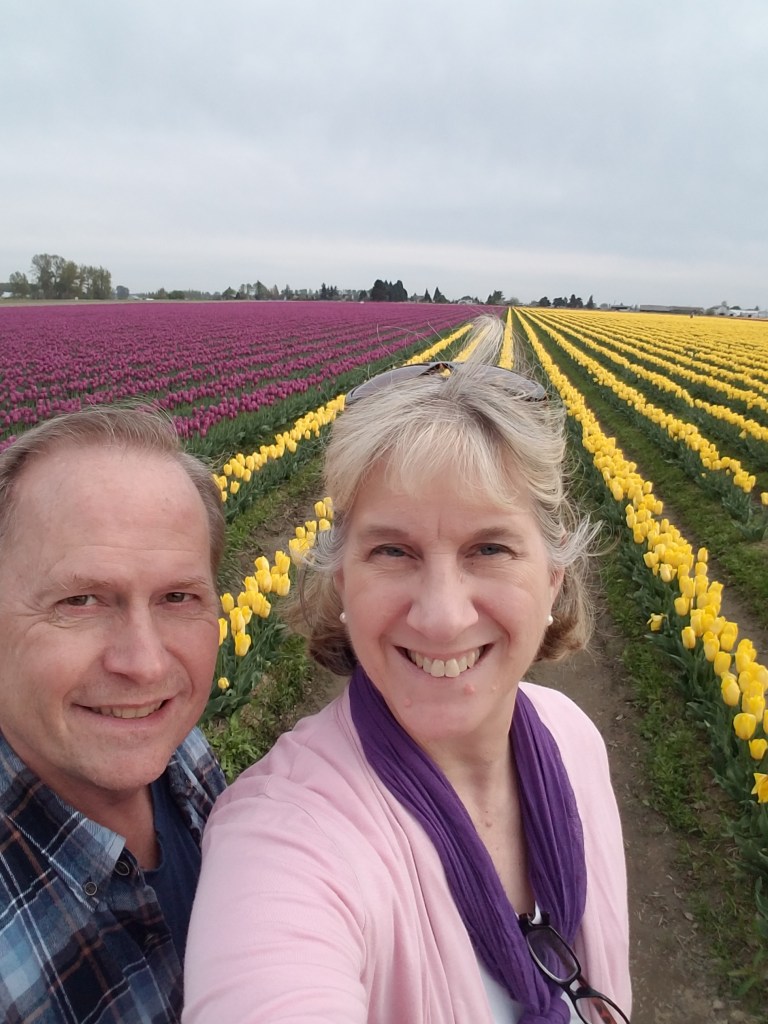
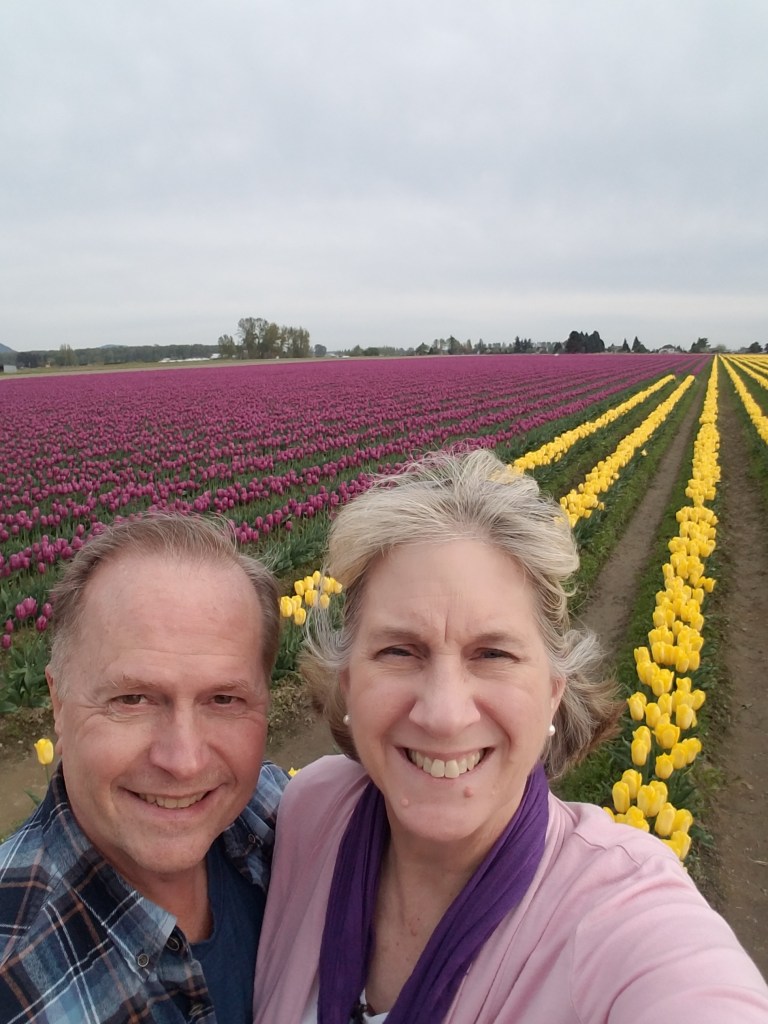
Eventually we got a reasonable photo… notice the hubby is unfazed by the light.
It took several attempts to get photos that day due to my inability to keep from painful squinting…

But I have learned to be very, very careful how I walk past that doorway when I get up in the mornings so as to not trigger the light and cause painful, but temporary, blindness. I keep as close to the wall opposite as possible and slow my gait as I float past, nearly a ghost in the predawn dark.

It’s either that or wear sunglasses at night. But that’s a whole different song for another Tuesday Newsday.

So, I think my mantra, rather than “Don’t It Make My Brown Eye’s Blue” is really, “Don’t it Make my Blue Eyes Squint.” Somehow that’s not nearly as catchy as Crystal Gayle’s 1977 hit song.

The links:

https://en.wikipedia.org/wiki/Don%27t_It_Make_My_Brown_Eyes_Blue

https://en.wikipedia.org/wiki/Crystal_Gayle

https://en.wikipedia.org/wiki/List_of_Hot_Country_Singles_number_ones_of_1977

https://www.health.com/are-blue-eyes-more-sensitive-to-light-11690558

https://www.insidermonkey.com/blog/top-10-countries-that-have-the-most-blondes-and-blue-eyes-as-a-percentage-of-population-605109/?singlepage=1

https://worldpopulationreview.com/country-rankings/eye-color-percentage-by-country
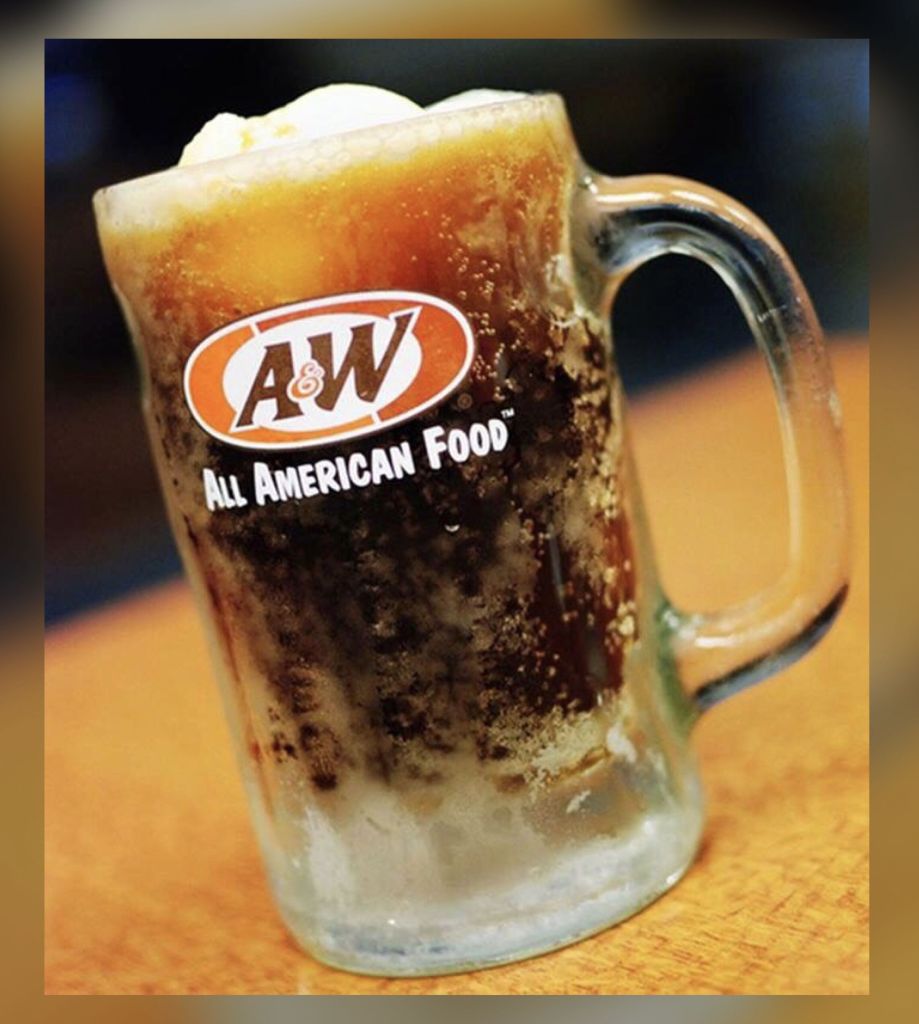
Root Beer: an American Original

A Tasty Treat on a Summer afternoon

June 17th

When I think back to the 1960’s and 1970’s, there is not – in my opinion – a better symbol of American culture than the A&W Root Beer stand.

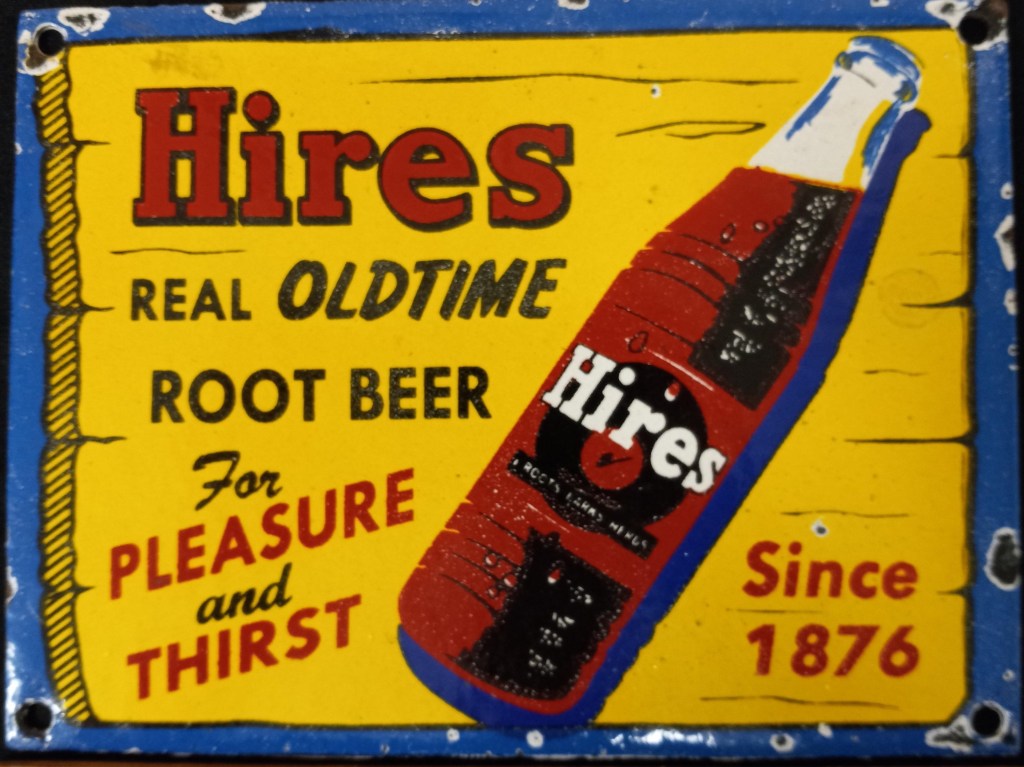
It’s appropriate to write about it this week as June 17th is National Root Beer Day. I’m certain we can have a debate as to ‘which’ root beer brand is best: Hires, Barq’s, A&W, or, perhaps, a newer competitor like Mug. For me, it’s always been A&W. I suppose that is because it was THE root beer which my family always drank.

As expected, the Infallible Wikipedia expounds on the topic of Root Beer:

The original commercial root beer was Hires which often advertised its product as a health tonic.

“Root beer has been drunk in the United States since at least the eighteenth century. It has been sold in confectionery stores since at least the 1840s, and written recipes for root beer have been documented since the 1830s. In the nineteenth century, it was often consumed hot and was often used with medicinal intent. It was combined with soda as early as the 1850s; at that time it was sold as a syrup rather than a ready-made beverage.

Beyond its aromatic qualities, the medicinal benefits of sassafras were well known to both Native Americans and Europeans, and druggists began marketing root beer for its medicinal qualities. (Snip)

Safrole, the aromatic oil found in sassafras roots and bark that gave traditional root beer its distinctive flavor, was banned in commercially mass-produced foods and drugs by the FDA in 1960. Laboratory animals that were given oral doses of sassafras tea or sassafras oil that contained large doses of safrole developed permanent liver damage or various types of cancer.”

The article does give more detail about Charles Elmer Hires who was a pioneer in the commercial production and also mention’s Barq’s – developed by the Coca-Cola company.

But it was Roy Allen who opened the first root beer stand in 1919 in Lodi, California. It was a hit and four years later, in 1923, he teamed up with Frank Wright and they opened the first A&W drive-in restaurant in Sacramento. The Infallible Wikipedia tells us:

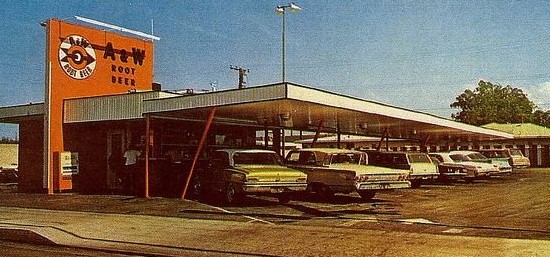
An A&W Root Beer drive in from the late 1950’s/early 1960’s. Not the one in Yakima but ours was similarly laid out.

“Curbside service was provided by tray boys and tray girls. In 1924, Allen purchased Frank Wright’s stake in the business. In 1925, Allen began franchising the root beer, while the franchisee added the other menu items and operated at their discretion. Most of the restaurants that opened under this scheme were on the highways of the Central Valley region, mainly for travelers. This may have arguably been the first successful food-franchising operation.”

Fast forward to the 1960’s, it is at the corner of 10th Avenue and Nob Hill Boulevard in Yakima, Washington, where my family went during those very rare times when we frequented any sort of restaurant – fast food OR sit down. It was always a treat to get to go to A&W and pull into a slot under the shaded carport style ‘drive in.’ Occasionally my parents would buy us food, but mostly it was just for the root beer.

My dad would turn on the head lights of the car and soon a perky teenage girl would be at his window to attach the tray holder. We’d wait with great anticipation until a short time later, she would reappear – the tray laden with the thick frosty mugs of root beer. Soon they were passed around the car and nothing ever tasted so good on a hot summer’s evening.

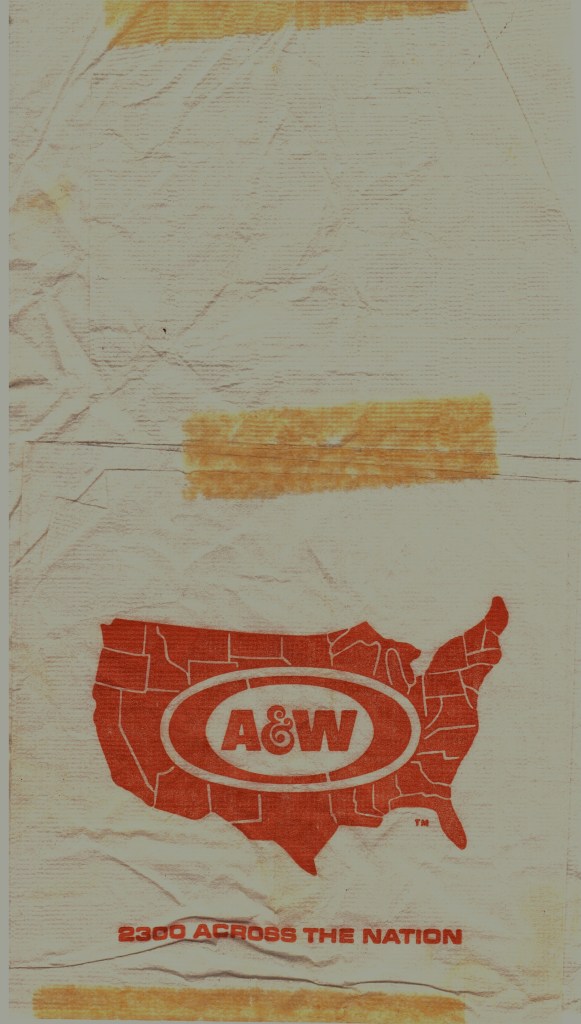
Who actually saves a 1972 napkin from A&W and stows it away in her teenage scrapbook? Oh, yeah, that would be the author. Unbelievable but true.

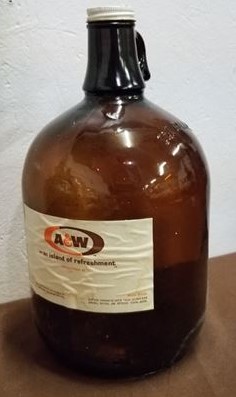
Sometimes – especially for the Fourth of July – my dad would come home with a giant glass jug full of A&W root beer and a five-gallon tub of vanilla ice cream. When the family was finished with the sparklers, pinwheels, and other small fireworks assortment, it was time for Root Beer floats.

Dad used to bring home a jug of root beer on the 4th of July similar to this one, no doubt.

Those were equally as good and a treat the family looked forward to every Independence Day.

At the time, I did not – of course – appreciate these special moments. It was, after all, what was normal for my family. I believe it was the summer of 1974 when I went to the drive-in on 10th & Nob Hill for the last time.

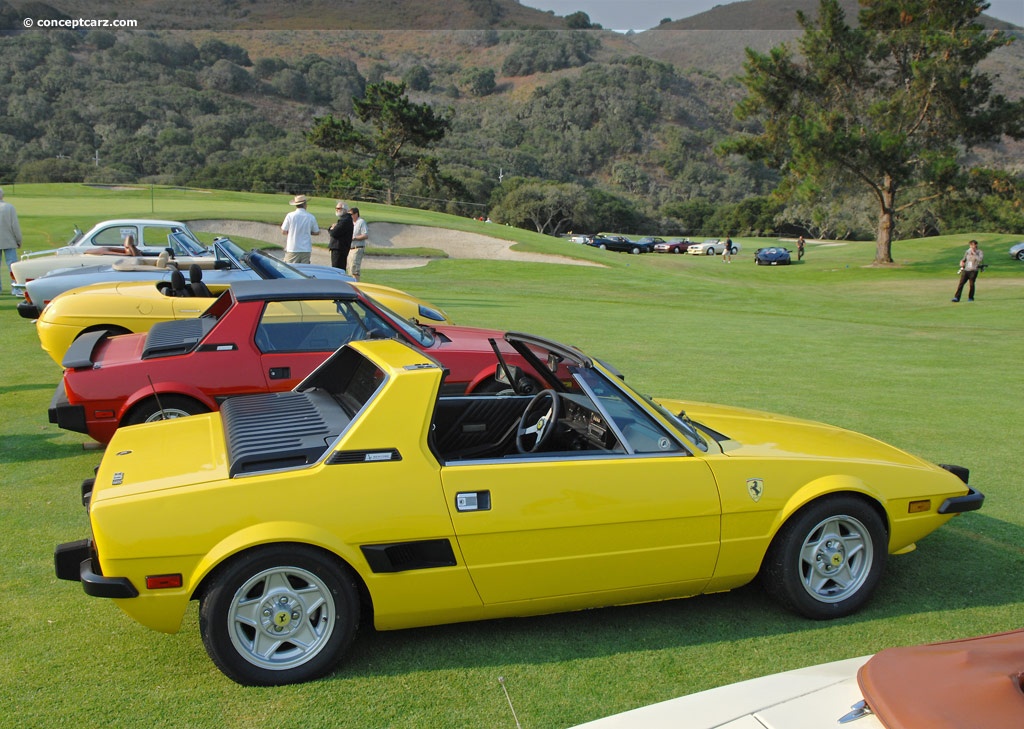
My brother – age 21 that year – was home from college and it fell to him and me to drive to A&W to buy the requisite jug of root beer for the Fourth of July floats. Being that he was immortal (a belief which tends to most affect young men ages 16 to 25 – a phenomenon the hubby and I refer to as being “nineteen and immortal”) he had purchased a rather fun car to drive and drive fast: a 1974 yellow Fiat X1/9.

Being that I was a teenage girl, there was a thrill to riding in a fast car even if it was with my older – and much cooler than me – brother. I did not think I was immortal but I was willing to take risks.

I climbed into the shotgun seat of his car and away we zipped down Tieton Drive. The roof of the car had been stowed in the forward ‘trunk’, the sun shining, and warm summer air surrounded us. We zipped down the hill to 16th, then a right turn and south to Nob Hill, and then left for the final six blocks east to the family favorite A&W. Soon I had the jug of root beer secured at my feet for the return trip.

A yellow 1974 Fiat X1/9 like the one my brother owned. The roof was removable and stored in the front compartment as the engine was in the back. Photo from http://www.conceptcarz.com.

We raced home, speeding west up Tieton Drive hill and I swear to this day that my brother never slowed down as the car careened around the corner onto our street. I am certain he hit the gas as we practically flew over the pavement. That moment is etched in my memory, my long blonde hair flying; I’m alternating between laughing and screaming, buckled in for my brother’s version of Mr. Toad’s Wild Ride.

After we were safely parked, I made him carry the root beer into the house as I did not trust my legs, certain they had turned to rubber.

Eventually that A&W location shut down and the era of carhops is all but gone.* Somehow going to a drive-through window just isn’t the same. But even so, when I pour myself a glass of A&W, I’m immediately transported back to a Yakima summer night and I smile when I think about that crazy ride with my crazy brother.

*Burgermaster has five locations in the greater Seattle area and still employs ‘carhops.’

A few links:

https://en.wikipedia.org/wiki/Root_beer

https://en.wikipedia.org/wiki/A%26W_Restaurants

https://en.wikipedia.org/wiki/Fiat_X1/9

How to Roast Perfect Marshmallows: A Family Tradition

Plus a bit of history about this delicious treat

June 10th

The marshmallow plant

If you have ever wondered how the marshmallow got its name, just read a bit further as we explore this tasty treat, most associated with being roasted during summer nights around a campfire with friends and family.

The fluffy round white confection made of sugar, water, gelatin, and a coating of cornstarch, is nothing at all like the original marshmallow. For our purposes we will call the original a marsh-mallow, as it is a plant which is native to Europe, North Africa, and Asia. As the name indicates it grows in wetlands and the roots proved to be an effective medicinal for treating coughs and sore throats.

According to the Infallible Wikipedia, there is evidence that the plant was used by ancient Egyptians some 4000 years ago. Now that’s staying power!

The entry tells us:

“Whether used for candy or medicine, the manufacture of marsh-mallows was limited to a small scale. In the early to mid-19th century, the marsh-mallow had made its way to France, where confectioners augmented the plant’s traditional medicinal value. Owners of small confectionary stores would whip the sap from the mallow root into a fluffy candy mold. This candy, called Pâte de Guimauve, was a spongy-soft dessert made from whipping dried marsh-mallow roots with sugar, water, and egg whites. It was sold in bar form as a lozenge.

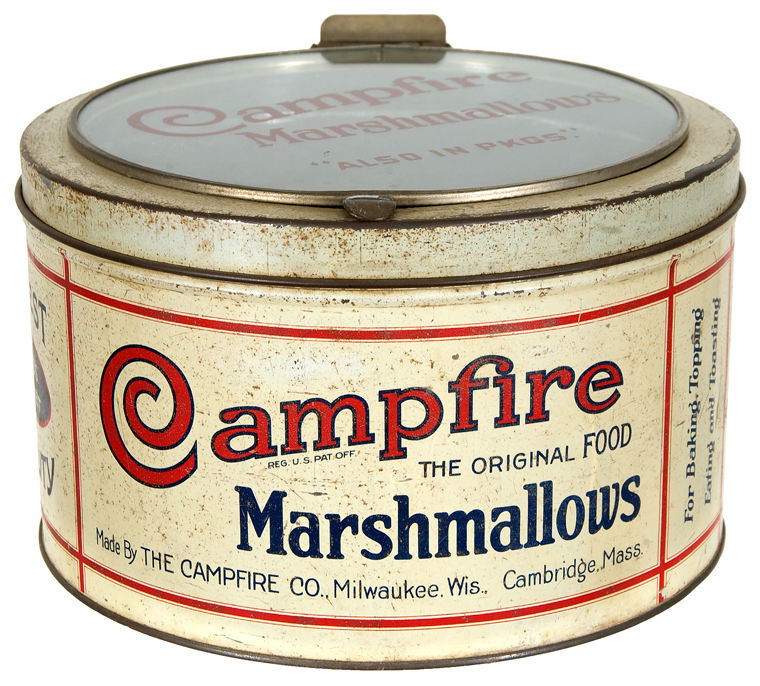
Campfire Marshmallows have been a favorite for over 100 years.

Drying and preparation of the marsh-mallow took one to two days before the final product was produced. In the late 19th century, candy makers started looking for a new process and discovered the starch mogul system, in which trays of modified corn starch had a mold firmly pushed down in them to create cavities within the starch. The cavities were then filled with the whipped marsh-mallow sap mixture and allowed to cool or harden. At the same time, candy makers began to replace the mallow root with gelatin, which created a stable form of marshmallow.”

Eventually, the modified marshmallow – the one which did not contain any of the plant – made its way across the ocean. It was in 1956 when an entrepreneur by name of Alex Doumak invented an extrusion device where the ingredients were sent through a tube and long ropes of marshmallows came out the other end. From there, they were cut in to the fluffy white rounds known as marshmallows.

Our family favorite marshmallows are the Jet-Puffed brand

The Infallible Wikipedia tried to figure out when, exactly, the roasting of marshmallows over a campfire began, but the origins are iffy. They were able to find a reference to it in a New Jersey newspaper from 1892. I imagine it probably started by accident when someone accidentally browned one and thought “Hey, this tastes really good.” Thus, the tradition of roasting marshmallows began.

There are any number of variations on how to use marshmallows: cooks have used them as toppings on Jello, added at the last minute to Thanksgiving sweet potatoes, floating on a steamy mug of hot chocolate, or taking the roasted campfire varieties and sandwiching a couple between two graham cracker squares and a hunk of chocolate.

Marshmallows also find their way into a variety of children’s craft projects such as gingerbread houses and winter snowmen.

I am, however, a traditionalist. While I will have a s’more at a beach or camp fire, I find that I prefer a perfectly toasted marshmallow eaten in a very specific manner.

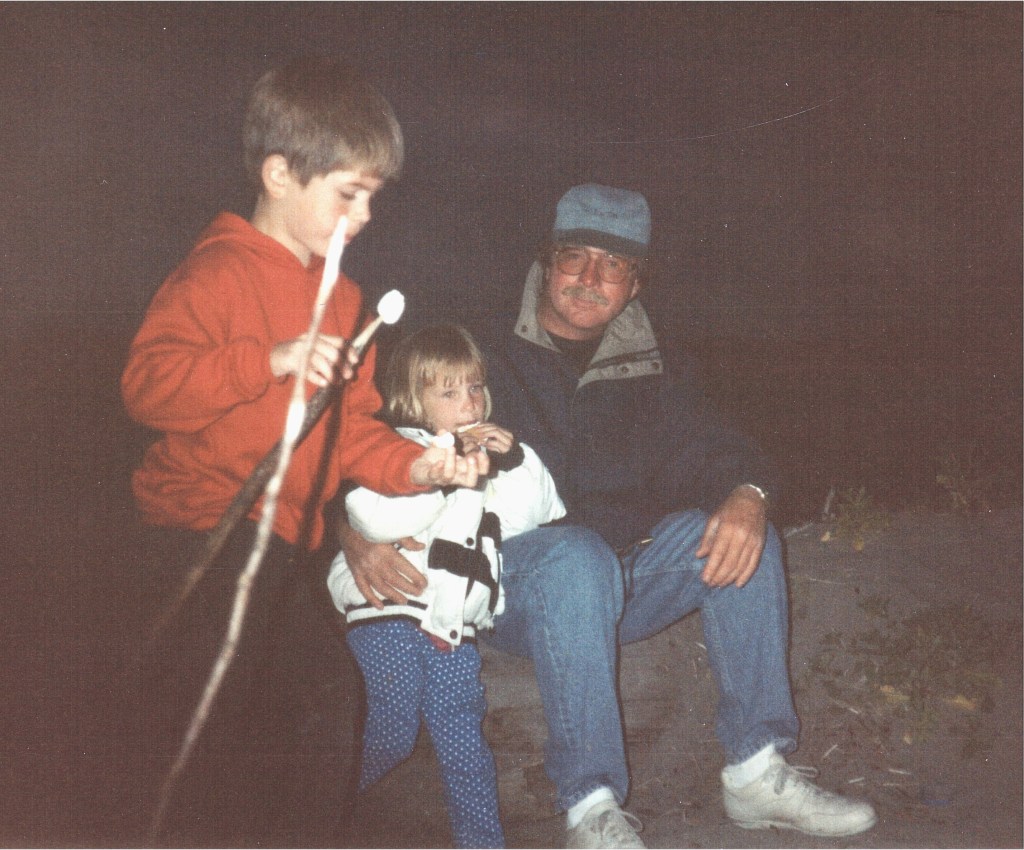
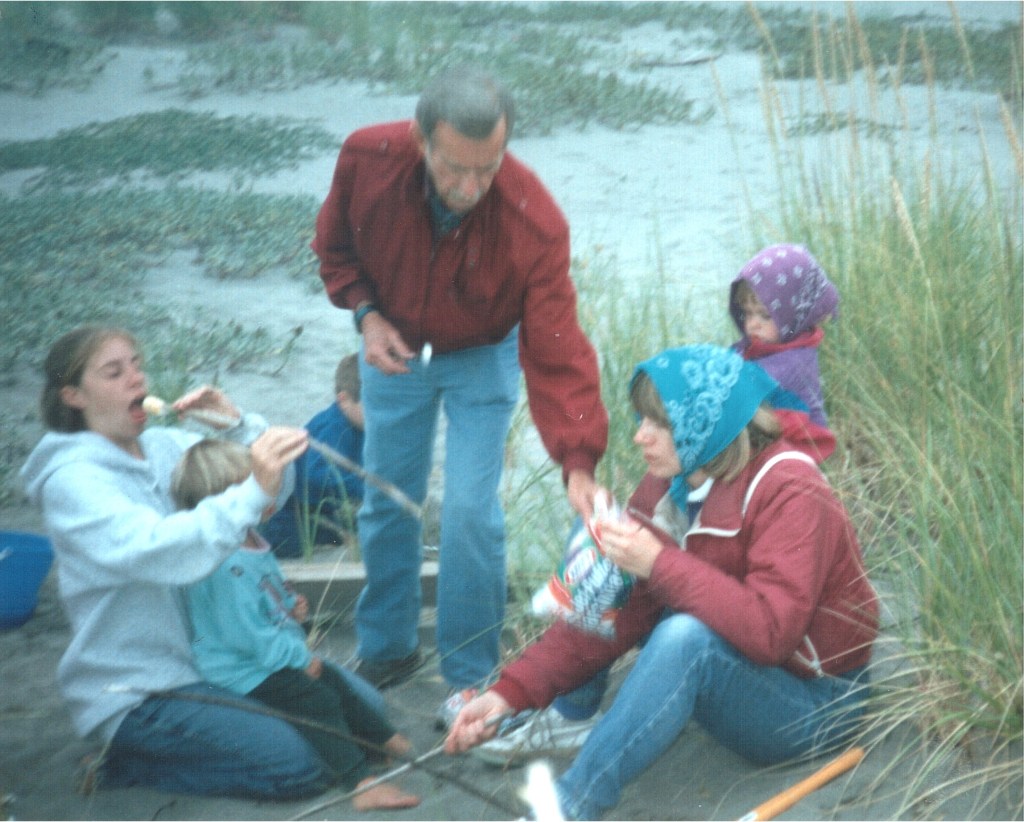
Family at a Long Beach marshmallow roast, circa 1998

Here’s the recipe:

Start a campfire. Let it burn hot for about 45 minutes until coals accumulate at the base. Let the flames die down enough that you can sit about a foot away from the fire. Using a stick you have found, whittle the narrower end into a point with a pocket knife until the white wood shows and the bark is removed (make sure to pick a non-toxic wood!).

Sit on a log, camp chair, or old blanket. Open a bag of 1 inch diameter marshmallows, remove one from the bag, and press it firmly onto the pointed end of the whittled stick.

Study the coals to determine the perfect spot to cook the marshmallow. Turn it so one side is about two to three inches from the hot coals. Hold it next to the coals until the skin starts to turn gold then rotate your stick a quarter turn and toast the second side. Repeat until all sides have been roasted.

Remove the marshmallow and evaluate. If there are white spots, return it to the coal area and give it a couple of seconds to brown.

Finally, tip the head of the marshmallow toward your coals and cook the top until it puffs up and is golden brown.

If you happen to lose control of the cooking process and, heaven forbid, your marshmallow erupts in flame, remove immediately and wave in the air, and then offer it to the lazy person who doesn’t want to cook their own.

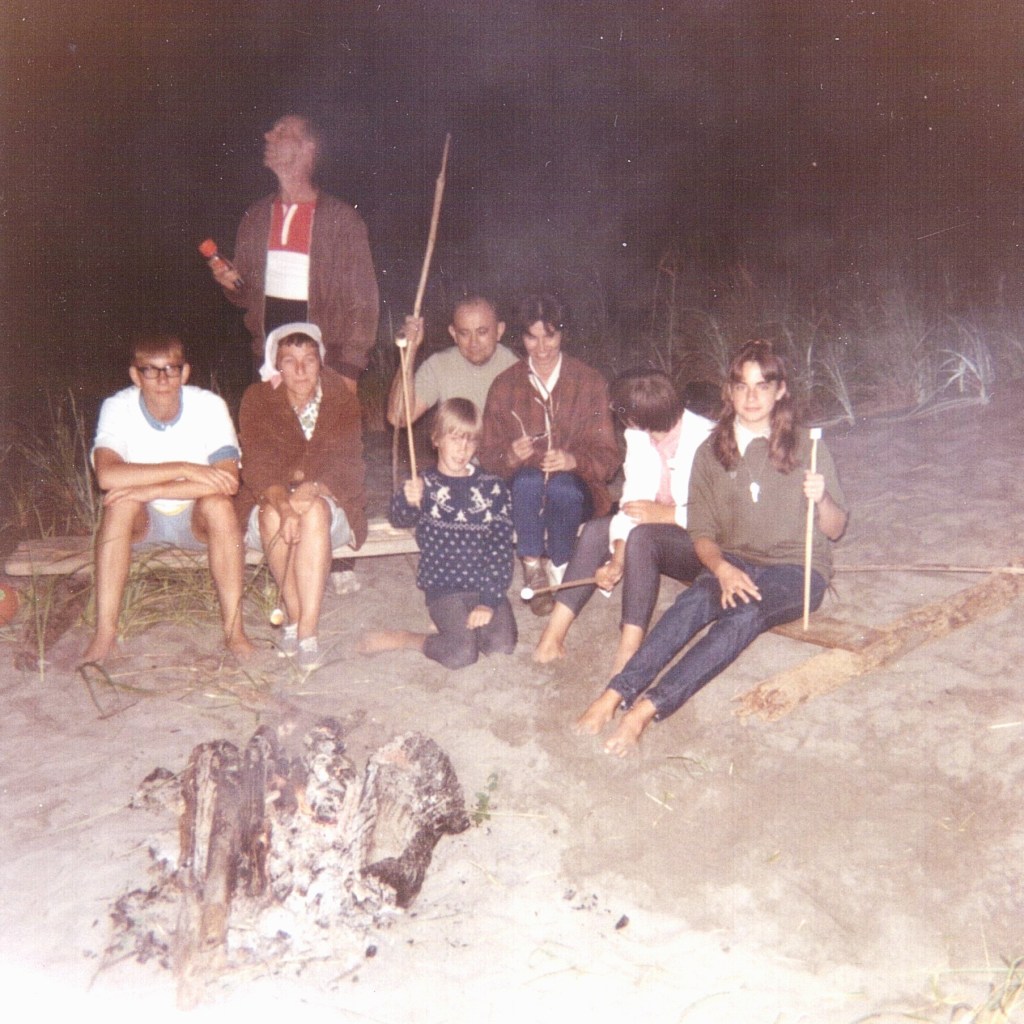
Brother, Mom, Dad, Uncle, Aunt, sister, and cousin – author in the middle wearing the blue ski sweater – enjoying a marshmallow roast at the beach. Photo taken by the author’s grandmother.

Repeat.

When you finally have the perfectly roasted marshmallow, it is time to pull the roasted outer layer up and off the stick, and eat just that thin layer. Once eaten, it is back to the fire to roast the gooey middle and then eat it too.

It’s a funny thing, when I started thinking about this topic, I could not remember a time when roasting marshmallows was not a part of my family’s annual vacation to Long Beach, Washington, for two weeks each summer.

So long as it wasn’t raining, after dinner was finished and everyone was dressed appropriately, we would walk down past the dunes and onto the beach for our nightly fire. In my minds eye I can see my mom in her pedal-pushers, head scarf, jacket, and keds, walking ahead of me (in a single line as the path was narrow), the bag of marshmallows in one hand and a half dozen roasting sticks in the other. My dad would lead the way with newspaper, matches, and a shovel, ready to start the fire.

We kids were assigned the task of searching for pieces of wood to serve as kindling and, if luck was on our side, we’d also retrieve the occasional larger pieces left behind by some other campfire builder from a previous night.

Soon my dad had the fire going and the adults would tend it while the kids built sandcastles or played hide and seek in the nearby dunes.

Marshmallow roast 1995. The participants shown are the author, my kids, two of my nieces and my dad – aka Grandpa.

Just as the sky got dusky (in Washington state the sun sets as late as 9:14 p.m. in mid-June making for longer light filled evenings) it was time. We’d all assemble around the fire, jockeying for the best ‘spot’ and my mom would push a marshmallow onto the end of our sticks.

After we had our fill and the sky was fully dark, the uncooked marshmallows would be safely stored in their bag, and then my dad would shovel sand onto the remnants of the beach fire. Soon we reversed our earlier trip, following the beam of the flashlight my dad now held as he led the family back through the night to the rented cabin.

It was the simplest of traditions, but also the best. For the price of a bag of marshmallows everyone was entertained for the evening. No cell phones. No TV. Just two glorious weeks of fun at the beach capped off each night by roasting marshmallows around a fire. It doesn’t get much better than that.

https://en.wikipedia.org/wiki/Marshmallow

The Enduring Legacy of the Piano

May 27th

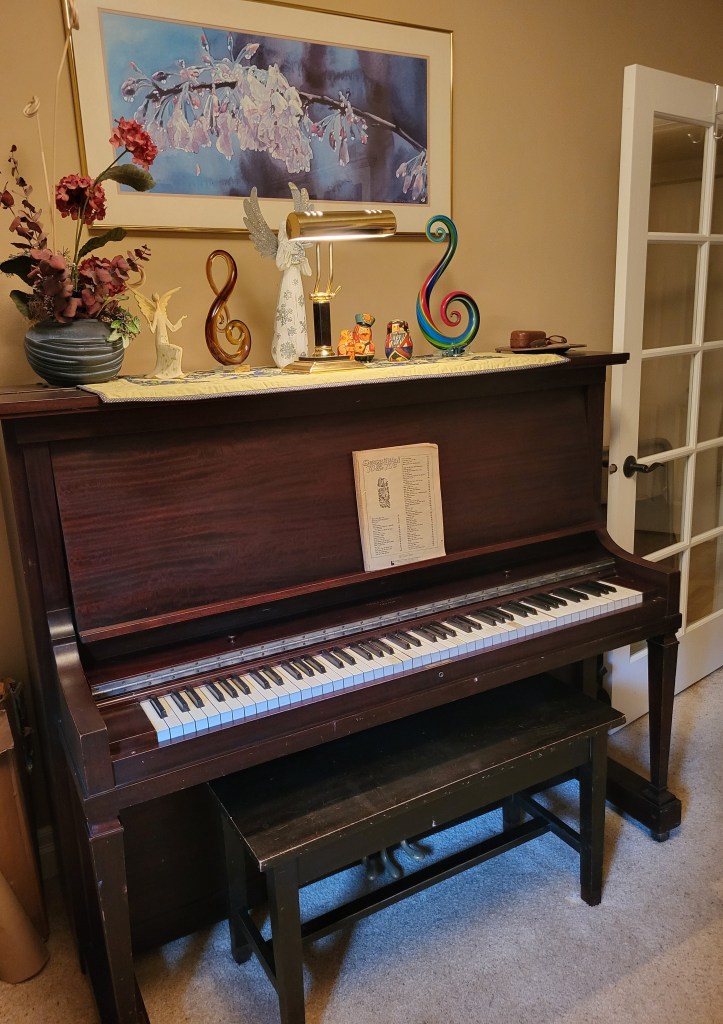
My grandmother’s 1922 Price & Teeple piano – three generations of owners over 103 years

I hate it when I get a nugget of an idea only to have it lead absolutely nowhere. Such was this week’s Tuesday Newsday nugget which, it turns out, led to an unsolvable mystery. And I do love a good mystery.

It was on this date, May 27, 1796, when James Sylvanus McLean – a resident of New Jersey – was awarded a US patent for “an improvement in piano fortes.”

Realizing I’ve never done a Tuesday Newsday about the instrument known as the piano, I decided it was a worthy topic and eagerly typed ‘piano’ into the Infallible Wikipedia only to be bombarded with every last bit of minutiae one can imagine about the origins of this ancient instrument. But Mr. McLean’s improvement? Lost to history when the US patent office burned in December 1836.

Undeterred, I dug further and wondered what improvements were so significant to warrant a patent? Was it the design of what we think of as the modern upright instrument which made the acquisition of a piano available to an average family? Or perhaps the addition of felt ‘hammers’ that were used to strike the metal strings inside the instrument? Maybe it was the use of wood to create the box where the music is made? Or how the wires are strung? We will never know.

Now for those who don’t KNOW what a piano is, here’s the description from The Infallible Wikipedia:

“A piano is a keyboard instrument that produces sound when its keys are depressed, activating an action mechanism where hammers strike strings. Modern pianos have a row of 88 black and white keys, tuned to a chromatic scale in equal temperament. A musician who specializes in piano is called a pianist.

There are two main types of piano: the grand piano and the upright piano. The grand piano offers better sound and more precise key control, making it the preferred choice when space and budget allow. The grand piano is also considered a necessity in venues hosting skilled pianists. The upright piano is more commonly used because of its smaller size and lower cost.

When a key is depressed, the strings inside are struck by felt-coated wooden hammers. The vibrations are transmitted through a bridge to a soundboard that amplifies the sound by coupling the acoustic energy to the air. When the key is released, a damper stops the string’s vibration, ending the sound. Most notes have three strings, except for the bass, which graduates from one to two. Notes can be sustained when the keys are released by the use of pedals at the base of the instrument, which lift the dampers off the strings. The sustain pedal allows pianists to connect and overlay sound, and achieve expressive and colorful sonority.”

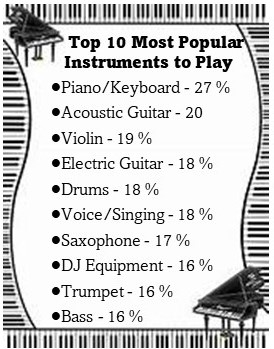
The popularity chart from a 2022 Newsweek article.

Enough of the technical description. What I do know is that the musical instrument we call the piano has been the most popular instrument in the world for centuries, according to multiple articles I found. That said, the debate now rages whether the guitar has overtaken the piano for the top spot. I also found articles to support that conjecture.

But back to the piano. It was sometime in the mid-1960’s when a piano came into my life. Although I was a young child, I remember the day vividly.

My maternal grandmother, Eva, had decided that she no longer wanted the piano which my grandfather, Mike, had bought her when they got married in June 1922. Why this was the case, I don’t know for sure. But once she made her mind up (I attribute that to her ¼ Scottish heritage) it stayed made up.

So my family became the recipients of said piano.

I do recall her being at our house when the instrument arrived and she sat down and reeled off a song from memory! I was awed and knew then that I wanted to play it just like her.

My older brother – in high school at the time – also seemed to have the musical ability and soon he was picking things out on the piano and adding chords, etc. They both made it look so easy.

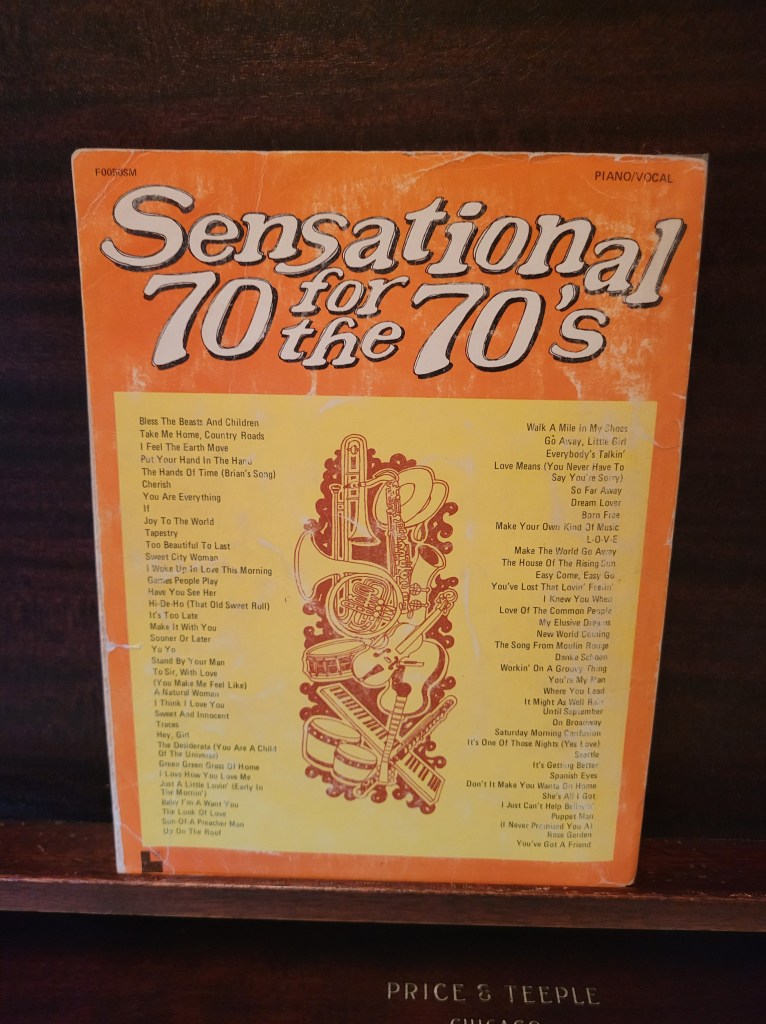
Dog-eared and worn is my Sensational 70 for the 70’s book

Of the four siblings, however, I was the only one who showed the interest and inclination to actually learn how to read music and how to play.

That year my mother signed me up for group lessons which were being taught as summer school classes at Franklin Junior high. I dutifully attended each and every class with one Mr. Lyons, a curmudgeon of a man, who would get so irritated with the ineptitude of the class that, more than once, he’d kick us all out and we’d wander the halls of the building until someone came to pick us up.

This alone would probably deter most 8 and 9-year-olds. But not me. I, apparently, had some of that Scottish stubbornness, and continued to practice and learn.

That fall my mother signed me up for lessons from a good friend of hers, Nancy Mayo. Mrs. Mayo was the pianist for the Bel Canto women’s singing group, a teacher, and a talented musician in her own right. She was the polar opposite of Mr. Lyons, infinitely patient and gentle with her young charges. I know I took lessons from her for a couple of years. I don’t know why I switched to a new teacher, but I did so in Junior high to my final teacher whose name I can no longer recall.

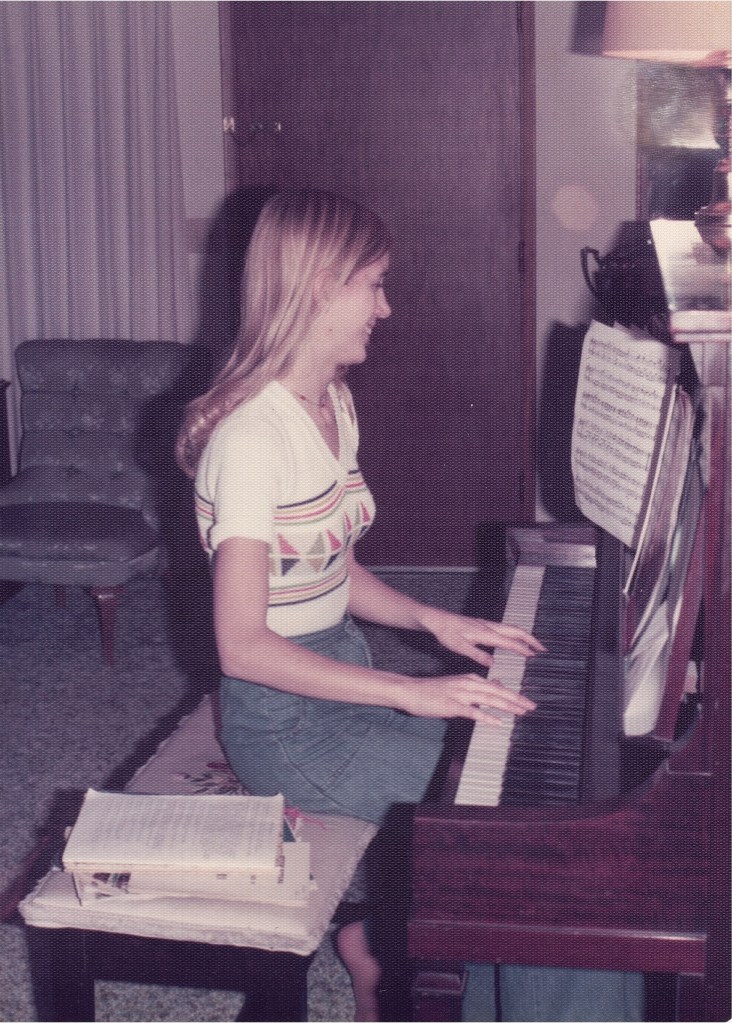
The author about age 16

I took seven years of lessons. When I was in high school, I spent a number of years being the musician for the Yakima Rainbow Girls and actually played in public. I sometimes accompanied people both with voice and other instruments. Somehow I could not memorize a song to save my life. I also was never able to easily change keys as the chords would give me fits. I was a reasonable technician, but a long way from being an artist.

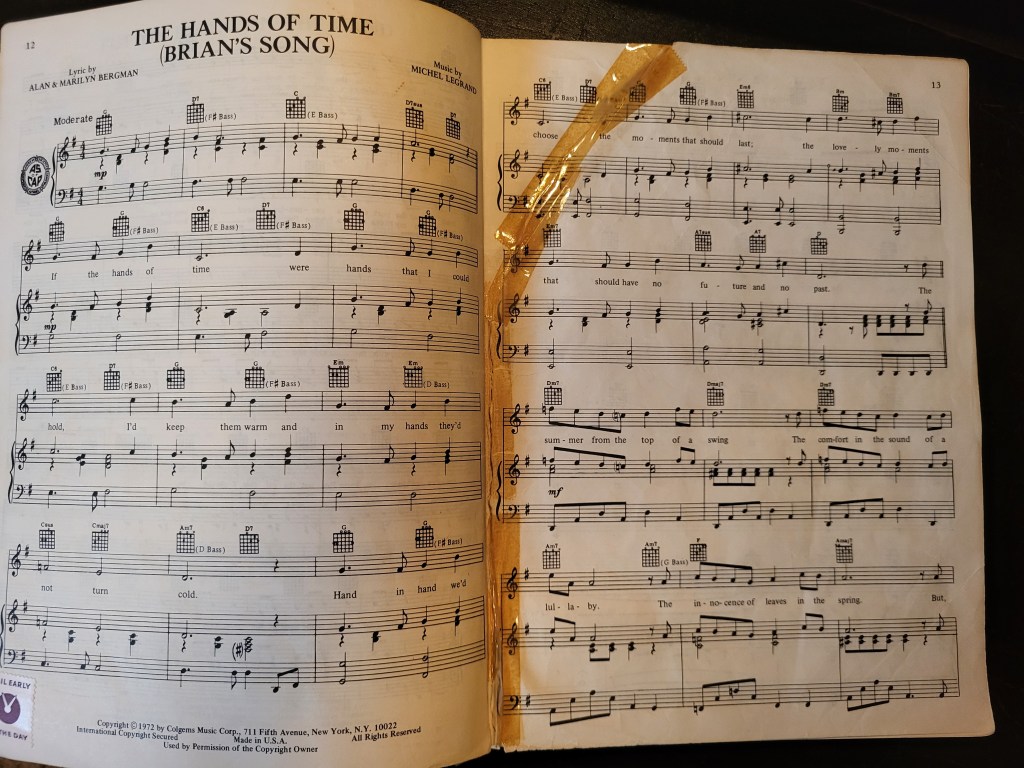
One of my after-school habits, however, was to sit down at the piano and play songs that I loved. I had a song book titled “Sensational 70 for the 70’s’” which had three of my four favorites: The Hands of Time (Brian’s Song), Too Beautiful To Last (Theme from the move Nicholas and Alexandria), and IF (by Bread).

I had a lot of others I played, but those three, plus the love theme from Romeo and Juliet, were always part of my daily concert.

This habit continued through my three years at Eisenhower High School and the two years I lived at home while attending Yakima Valley College. Then, in the fall of 1977, I moved to Tacoma to finish my education at the University of Puget Sound.

Sometime that autumn, when home on a break, I sat down to play the piano and my mother appeared in the living room and said to me that the hardest adjustment for her with me going off to college was the absence of the music in the afternoons.

It was a powerful moment as it was only then that I understood how something I enjoyed as a way for relaxation had become a special thing for my mom; it was how she experienced the empty nest syndrome common once all the children leave home.

No doubt my favorite song of all time to play on the piano as evidenced by the decades old scotch tape holding the pages together

When my parents sold that house in 1984, grandma’s piano came to live at my house. It’s been moved multiple times since and the now 103-year-old instrument definitely needs a tune up. But nowadays, I don’t seem to make the time for playing the piano.

It’s a shame, really. I no longer have delusions of grandeur that I’ll be some fabulous pianist; it’s really more about doing something that would bring me a bit of personal enjoyment.

So here’s to the piano, one of the most enduring and versatile instruments ever invented.

https://en.wikipedia.org/wiki/Piano

https://amis.mircat.org/jamis/1976_005.pdf (The only information I could find on James McLean)

The Evolution of Denim: Cultural Changes Over Time

May 20th

It was on May 20, 1873 when Levi Strauss and Jacob David patented the denim garment which has, arguably, become the most popular type of clothing in the Western hemisphere: jeans.

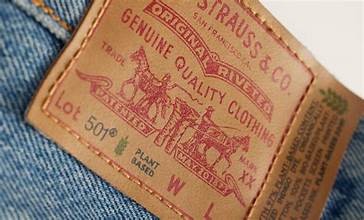
The iconic Levi Strauss authenticity tag from the official website.

While the actual origins of the garment are unclear, there are records of the fabric and the type of clothing it was made into in Genoa, Italy, and Nimes, France, as early as the 1500’s.

The Infallible Wikipedia shares some history on the origin of the name:

“Research on the trade of jean fabric shows that it emerged in the cities of Genoa, Italy, and Nîmes, France. Gênes, the French word for Genoa, might be the origin of the word ‘jeans‘. In Nîmes, weavers tried to reproduce jean fabric but instead developed a similar twill fabric that became known as denim, ‘de Nîmes’, meaning ‘from Nîmes’. Genoa’s jeans fabric was a fustian textile of ‘medium quality and of reasonable cost’, very similar to cotton corduroy for which Genoa was famous, and was ‘used for work clothes in general’.”

Modern day jeans were popularized as a workman’s garment, specifically miners, at the time it was patented by Davis and Strauss. And they might have remained that way until popular culture got involved. In the 1950’s both Marlon Brando and James Dean donned jeans in two culturally significant movies: The Wild One and Rebel Without a Cause. The two men were both bad boys of the big screen and exuded a ‘coolness’ which rocketed them to popularity with youth.

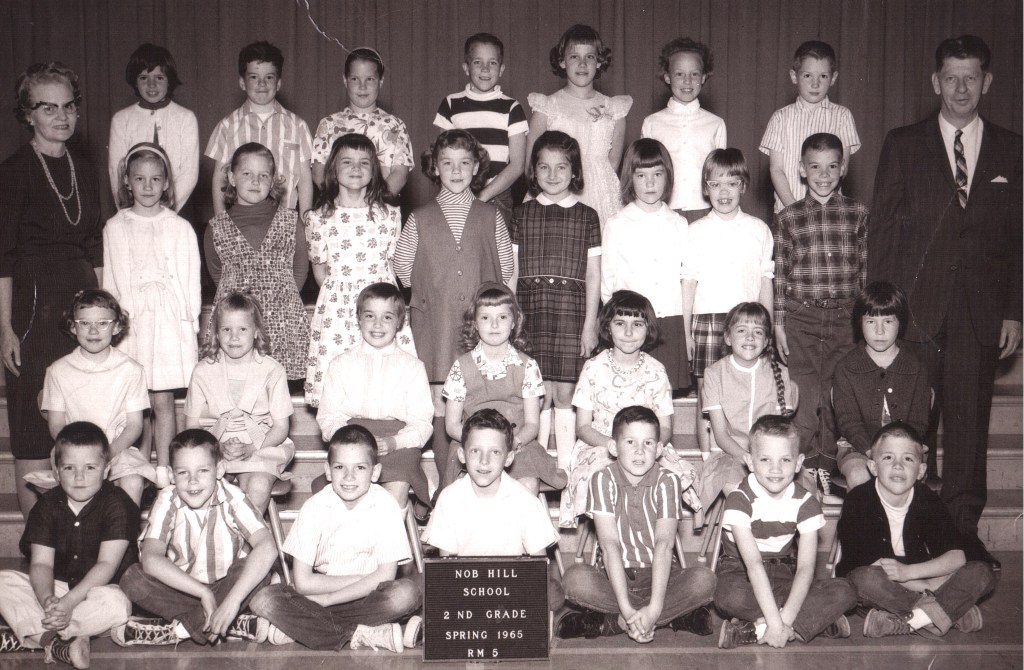
1965 – all the boys in the front row are wearing jeans with the exception of one. All the girls in dresses. 2nd Grade at Nob Hill Elementary school in Yakima, Washington

By the 1960’s, jeans became a popular garment to wear to school for boys. But not for girls. In fact, girls wore dresses to school. The first time I was ever allowed to wear pants was the winter of 1968-69 and only because of extreme cold temperatures. During the week of January 20-24, the overnight lows in Yakima were in the single and minus digits and the day time highs in the low teens. January 23rd, a Thursday, had a high of only 11 degrees, up from minus 7 degrees overnight. The next week wasn’t much better as the cold persisted PLUS it snowed 10 inches.

In those days, school was not cancelled because of weather. Instead, the Yakima School District very generously gave all the girls permission to wear pants to school. But they could NOT be jeans! A popular style that year were knit stretch pants and I can still see, in my minds eye, what those pants looked like. It was a big, big deal to get to wear pants.

It took quite some time for the weather to moderate that year (in the ‘balmy’ mid-30’s by mid-February), and it was back to dresses worn with socks and the dreaded saddle shoes. (Which I wrote about here https://barbaradevore.com/2024/09/03/the-first-tuesday-in-september-3/)

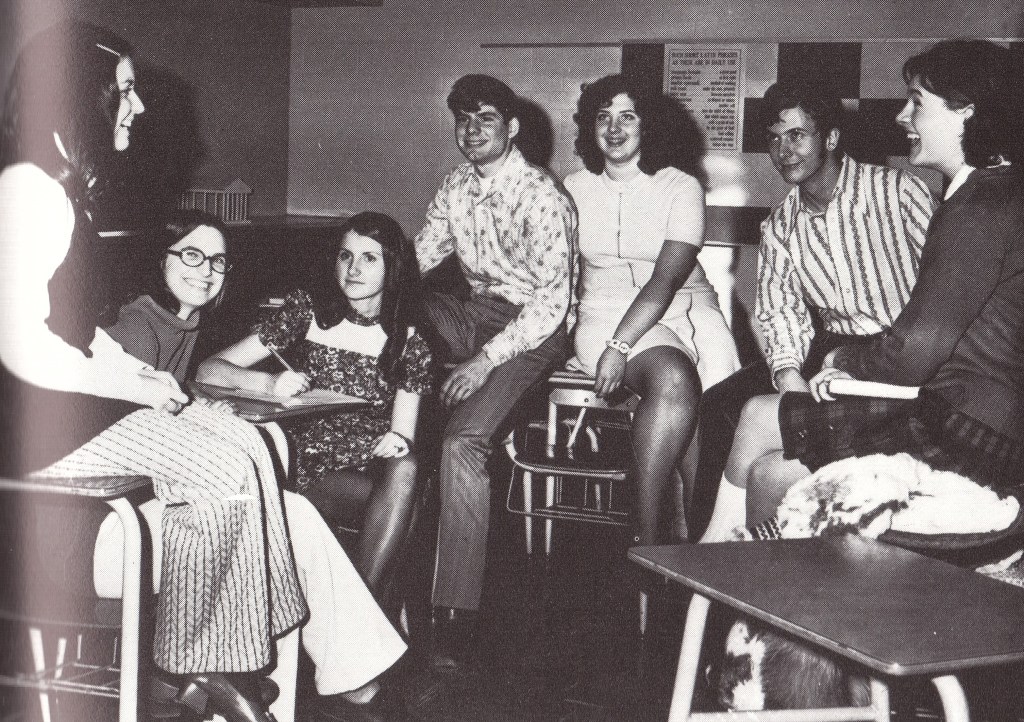
From the 1972 Eisenhower High School Reveille yearbook. A club photo with the guys in in jeans, the girls in dresses except for one, who is wearing fashionable slacks of the day. Yakima, Washington

Then the 1970’s happened. While many people think of the 1960’s as the big social upheaval, the 70’s were the years when all that rebellion was codified. The movement was so huge, that it became a cultural tsunami, washing over every institution we know.

I think it was probably 1971 when girls were allowed to wear pants to school regardless of the weather. But still no jeans that first year. A look through the high school annuals of that era reveal that shift through photos. The 1972 Eisenhower annual shows most girls still wearing dresses to school with a smattering here and there of one in pants and, rarely, jeans.

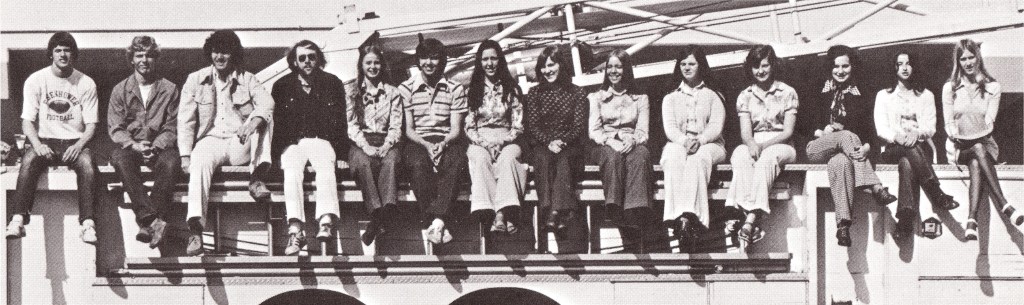
A portion of the 1975 yearbook staff of Eisenhower High school. The girls all in pants, some in jeans, and only one dress. Yakima, Washington

By 1975, easily half to two-thirds of the girls at my school are wearing pants – often jeans – in the day-to-day photos of regular school activities; jeans were the standard for after school clothing.

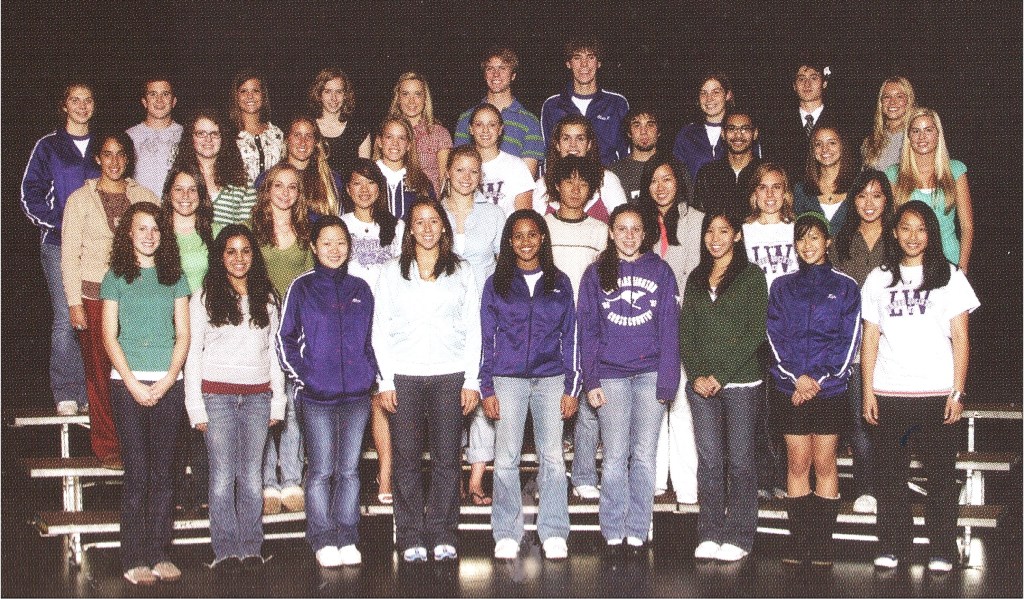
In today’s world, people wear jeans everywhere; I would posit that pretty much every American teen and adult owns at least one pair, and likely multiple pairs, of jeans.

2008 at Lake Washington High School in Kirkland, Washington. A couple of skirts, but most the girls are wearing jeans as their daily ‘go to’ clothing.

I know I have at least three pairs of jeans and two pairs of capri length denim pants that I rotate in my day-to-day wardrobe. I’ve been thinking lately that I really do need another pair. I discovered a Gloria Vanderbilt style that fits well and is comfortable. That is, in my opinion, what the wearing of jeans is all about: comfort. Time to go shopping – on Amazon since I know they have the jeans that fit me – for a new pair of America’s favorite clothing item.

The links:

https://en.wikipedia.org/wiki/Jeans

https://www.smithsonianmag.com/smithsonian-institution/the-origin-of-blue-jeans-89612175/https://www.extremeweatherwatch.com/cities/yakima/year-1969

A Fasten-ating Beginning: Velcro

The Velvet Hook

May 13th

I suppose that this Tuesday Newsday topic falls in the category of ‘Geeky Musings’ as I doubt this product, which was patented in 1955, is ever given much – if any – thought for most people. It was on May 13, 1958, when the term ‘Velcro’ was trademarked by its inventor.

Inspired by burrs which clung to his dog, the inventor spent over a decade in search of how to replicate one of nature’s stickiest plants. The Infallible Wikipedia tells us:

“The original hook-and-loop fastener was conceived in 1941 by Swiss engineer George de Mestral, which he named velcro. The idea came to him one day after he returned from a hunting trip with his dog in the Alps. He took a close look at the burs of burdock that kept sticking to his clothes and his dog’s fur. He examined them under a microscope, and noted their hundreds of hooks that caught on anything with a loop, such as clothing, animal fur, or hair.”

What followed was a period of trial and error as he sought to make his tiny hook and eye concept a reality. Also from the Infallible Wikipedia:

“The fastener consisted of two components: a lineal fabric strip with tiny hooks that could ‘mate’ with another fabric strip with smaller loops, attaching temporarily, until pulled apart. Initially made of cotton, which proved impractical, the fastener was eventually constructed with nylon and polyester.

Up close and personal with velcro

De Mestral gave the name Velcro, a portmanteau of the French words velours (‘velvet’) and crochet (‘hook’), to his invention, as well as to the Swiss company he founded; Velcro SA.

At first, the applications for Velcro were astronauts space suits and then for ski clothing. For me, however, Velcro really came into its own when it was incorporated into children’s shoes and clothing. It was, for mothers everywhere, a game changer.

When I was a child there was no greater accomplishment than learning how to tie my shoe laces, or being able to buckle my shoe strap, somewhere around age 4 or 5. My mother mostly put me in slip on tennis shoes, thus avoiding the tedious task of tying and then re-tying the laces of shoes on small children.

Even small girls can enjoy Adidas shoes with velcro fasteners

As I was contemplating Velcro, I could not recall any exact moment or time when it came into my conscious, although it was probably when my children were babies. While the first shoes my son had when he started to walk did have laces, my daughters footwear featured a hook and loop fastener. At some point both my children learned to tie their laces but nowadays I do wonder if that is a skill which has been lost with the proliferation of Velcro fastened shoes.

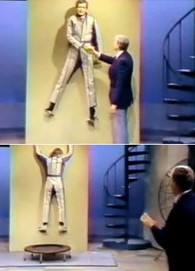
David Letterman attached to a wall with the aid of Velcro.

The first shoes I recall having Velcro were a pair of black Skechers in a ‘Mary Jane’ style. Instead of a buckle on the narrow strap, it was secured with Velcro. Which worked fine for a time, but eventually it started to fail as the Velcro lost its stickiness. The technology from those early 2000’s pair of shoes to now has been greatly improved. I easily have a half dozen pairs of sandals, particularly, which all have Velcro straps and none have the failure problem like those early Skechers.

Of course, Velcro is not just for shoes. As I look around my house I find it in a variety of applications. Like the narrow strips I have in my office to control unruly cords. Or the ones which hold our Good-To-Go pass to the windshield of our vehicle. There’s Velcro on the pockets of bags and cases which I use daily. I have a Ziplock bag full of hook and loop fasteners in various colors and sizes as one never knows when they will be needed.

Taking outdoor inflatibles to a new level with velcro ‘barfly’ suits

Back in the 80’s a phenomenon known as ‘Velcroing’ became popular when late night TV personality David Letterman featured it on his program. The concept was simple, a person wears clothing with one side of the Velcro facing out and then using a trampoline jumps up onto a wall with the other half of the Velcro connection and becomes attached to the wall some 10 to 15 feet high.

It has since become entertainment for parties and in drinking establishments and is known, colloquially, as “Bar Fly” or “human wall jumping.” What could possibly go wrong? But leave it to people to always come up with new and innovative ways to use a product, especially one like Velcro which has stuck around for 70 years and shows no sign of loosening its grip anytime soon.

So cheers to George de Mestral whose curiosity and dogged persistence led to the invention of Velcro, a creation we might be able to live without, but should be thankful we don’t have to.

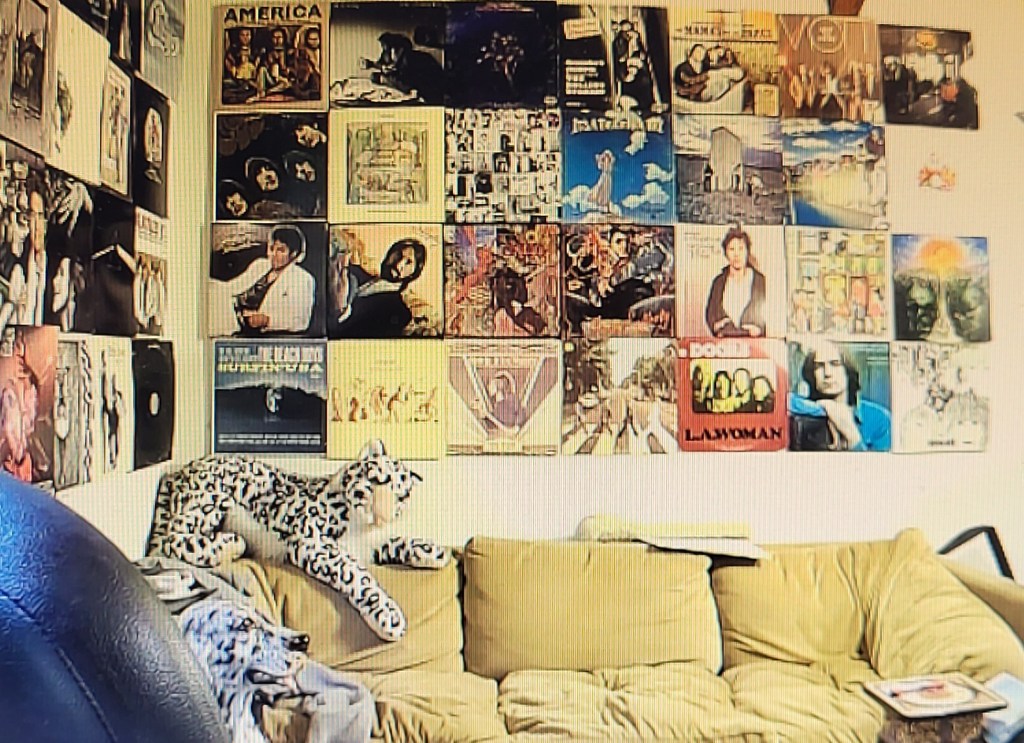
My friend Roger shared that he used Velcro to attach his vinyl album collection to the wall of his office. Very creative!

A few links:

https://en.wikipedia.org/wiki/Velcro_Companies

https://en.wikipedia.org/wiki/Hook-and-loop_fastener

https://scholar.lib.vt.edu/VA-news/ROA-Times/issues/1992/rt9201/920127/01250332.htm

https://knockoutentertainments.com/bar-fly/

https://youtu.be/-SGhBvwLGIs?si=0b0EikqUtRW-41k1 (David Letterman show)

Jo-Ann Fabrics: The End of an Era

The 82 year icon is closing all stores this month

May 6th

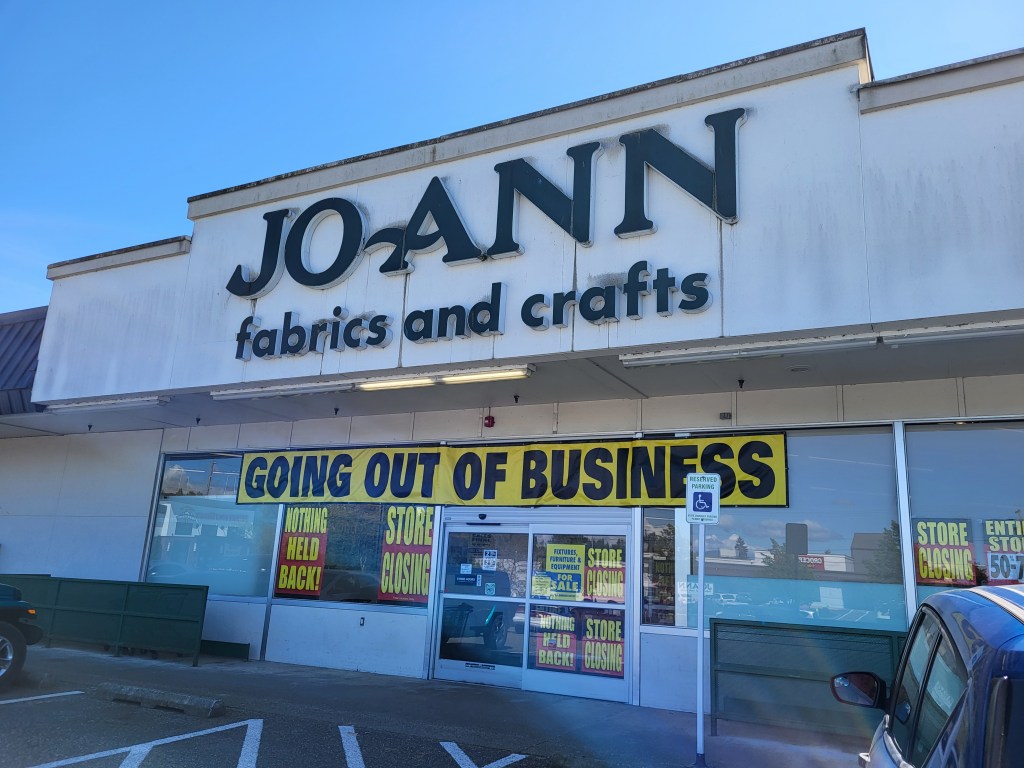
Over the past few months, I have been mourning the end of an era. One day, very soon, Jo-Ann Fabrics will be out of business.

The Mount Vernon, Washington Jo-Ann Fabrics will soon be gone.

The demise of the fabric store giant is, in my opinion, a sign of the times. Like woodshop and home economics, the era of learning how to build a table or sew a garment is no longer something the majority of young people learn.

Certainly, there will still be specialty fabric stores where quilters can go to buy their fabric but, it seems, the days of a high school girl sewing her own homecoming or prom outfit are over.

Jo-Ann Fabrics was founded in 1943. It was a venture for two families and, when they expanded in the early 1960’s, changed the name to Jo-Ann Fabrics. Yes, there is an Infallible Wikipedia page which shares the following:

“German immigrants Hilda and Berthold Reich, Sigmund and Mathilda Rohrbach, and Justin and Alma Zimmerman opened the Cleveland Fabric Shop in Cleveland, Ohio in 1943. After further expansion, the store’s name was changed to Jo-Ann Fabrics in 1963. The store’s name was created by combining the names of the daughters from both families: Joan and Jacqueline Ann.

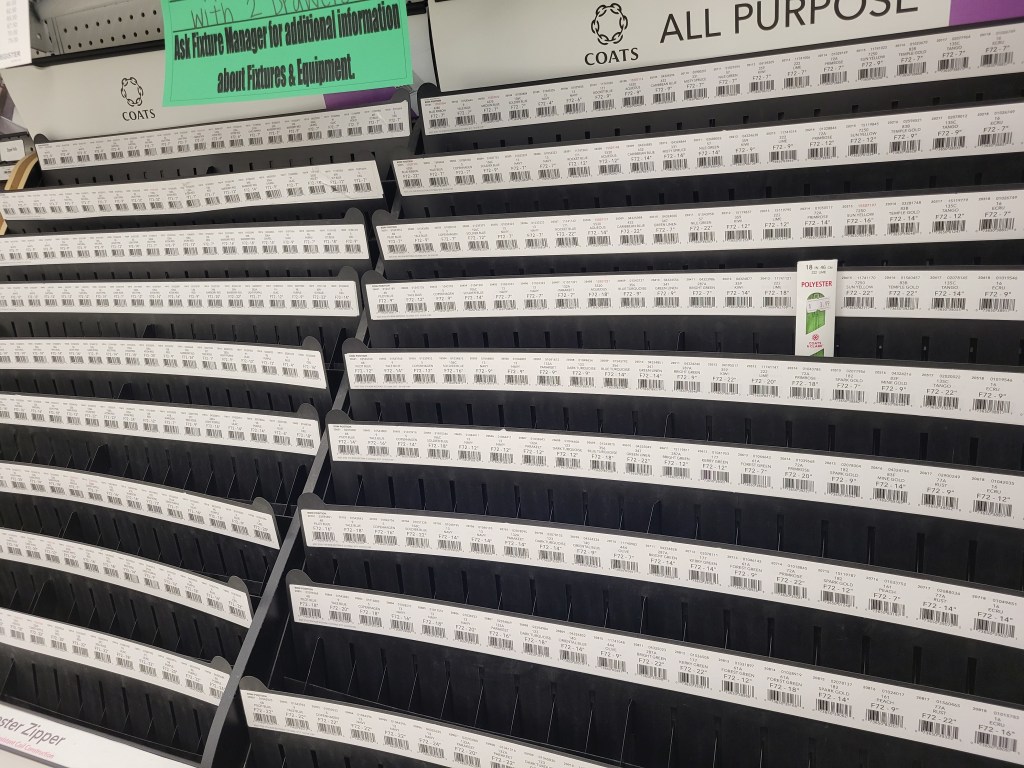
There were a total of two neon green zippers available for sale last weekend

Jo-Ann Fabrics became a publicly held corporation traded on the American Stock Exchange under the name of Fabri-Centers of America, Inc. in 1969. The company made its first acquisition with the purchase of Cloth World, a 342-store southern company, in 1994. At the time of the acquisition, Fabri-Centers operated 655 stores.”

There are many reasons for the decline of Jo-Ann Fabrics – non-profitable stores, too much debt, inability to find an investor – to name the primary reasons.

But I get back to what I think is the biggest reason: people are simply not learning, or interested in learning, how to sew.

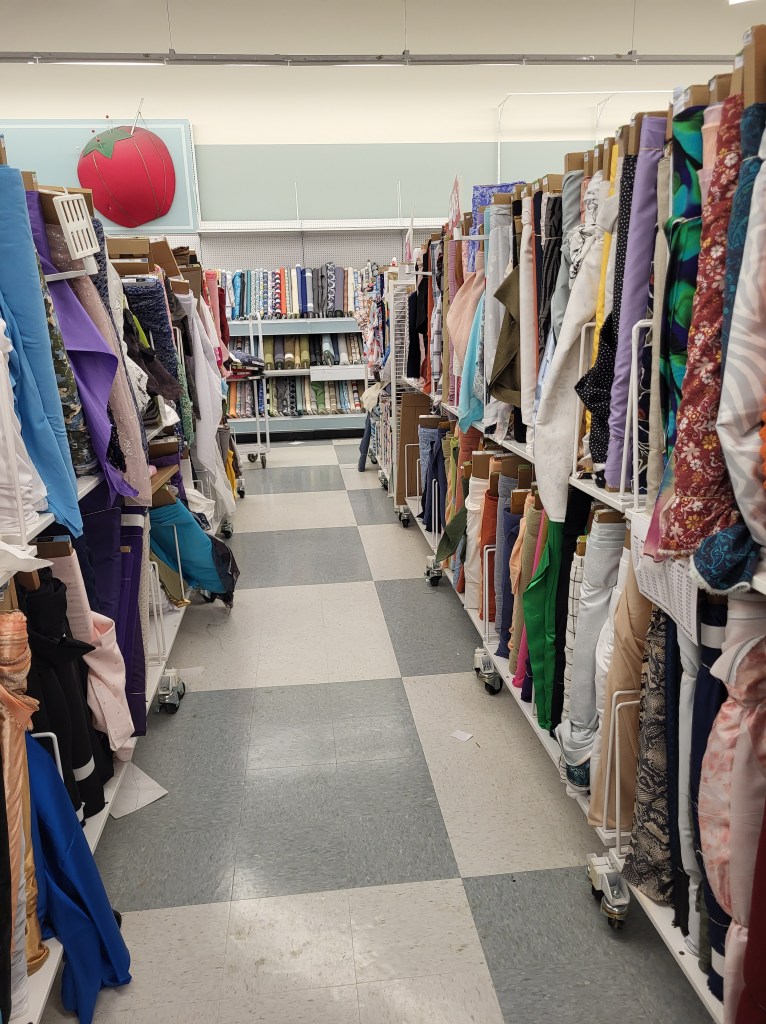
Still quite a bit of fabric to be had.

My seventh grade year I attended Wilson Junior High school (no middle schools in those days!) in Yakima, Washington, and there was no greater shock to my system than having what had been a half mile, approximately 15-minute walk, to Nob Hill Elementary school, to now making a daily 1.3 mile hike each way to my new Junior High.

I pretty much hated it but there was NOT a choice. My mother was not going to be driving me to school every day, so I just had to suck it up.

Another thing I absolutely hate is being late. So every morning – and believe me some of those mornings were dark and cold, sometimes snowy – I would haul my 12- to 14-year-old self out the door to make sure I made it to Wilson on time.

But afternoons were another story. My route home, just in reverse, always – yes ALWAYS – included a stroll through the strip mall where a Safeway was located. The layout of the stores was, actually, pretty clever. You entered at the west end, for example, and could walk through every store and exit on the east end, enjoying heat in the cold months and air conditioning in the warm months. Plus, there were interesting things to see.

So every afternoon I would start with Discount Fabrics on the west, then buy a Big Hunk candy bar or a bag of Corn Nuts at Tieton Village Drugs, make my way through Safeway and, sometimes, go into Wigwam (think Dollar Tree but more eclectic), before continuing on my way home.

Tieton Village Shopping Center as it looks on May 6, 2025. When I was in Junior High, Discount Fabrics was on the far right, then the drug store, Safeway, and Wigwam.

When I was in eighth grade, I took my first Home Economics class and the first half of the year was sewing. When we were assigned the task of getting a yard of fabric because we were going to be making a dress, my world was opened up and suddenly Discount Fabrics became a very important place.

Over the next four years, I spent many hours there looking at, feeling, considering, contemplating, and buying fabric, thread, zippers, and buttons. Except for collecting pens and stationery, there was nothing I loved more than looking at and thinking about fabric. I even considered, when applying for my first job, working in either an office supply store or a fabric store. I ended up as a filing clerk for a Ford dealership which probably saved me spending all my earnings on office supplies or fabric.

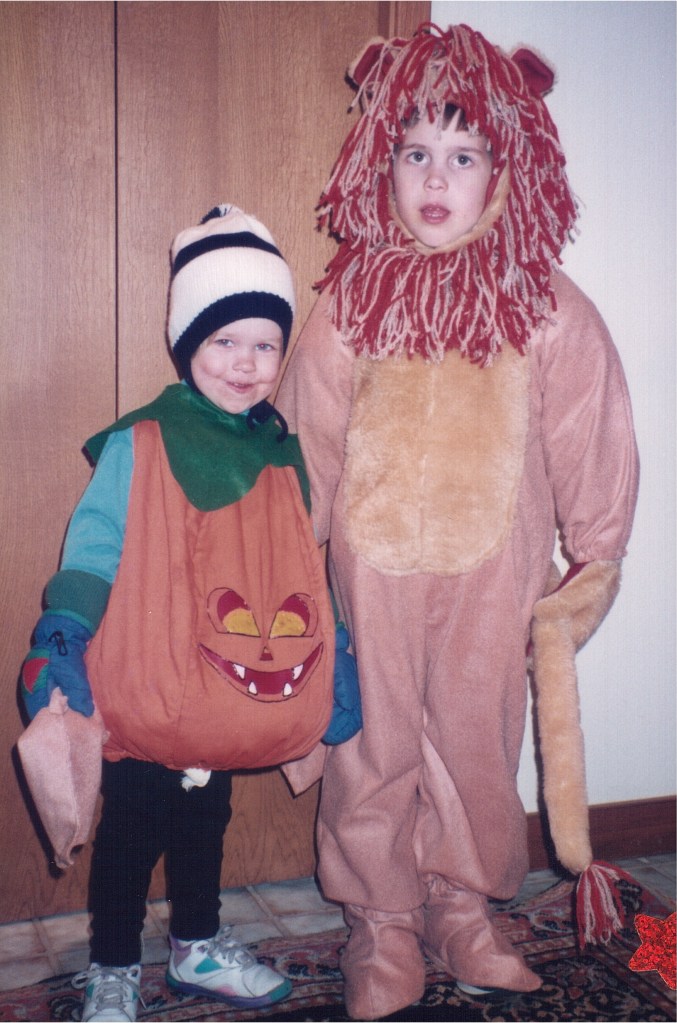
Halloween 1994. I sewed both the lion costume and the pumpkin costume for my kids.

It turned out that I was good at sewing and it filled a creative need. I’ve made tablecloths and placements, sewn children’s costumes, put together bean bags and stuffed animals, made what’s known as a ‘puff’ quilt and tied fleece blankets. And I pretty much never got rid of any of the leftover fabric remnants.

Best of all, there was always a nearby fabric store to feed my version of sourdough starter. When the hubby and I first got married, I was introduced to Hancock Fabrics at the corner of Fauntleroy Way and Alaska street in West Seattle. It was there I bought most of the fabric to make the hubby the aforementioned puff quilt. That quilt took me four years to complete, by the way, but we still have it.

When we moved to what is now Sammamish, the nearest fabric store was Jo-Anns in Bellevue, about a twenty minute drive from our home on the Sammamish plateau. Up until our kids were born, those were the years of making tablecloths, napkins, and placements. I also made an adorable teddy bear themed baby quilt which I gave to my sister-in-law when she was expecting my niece.

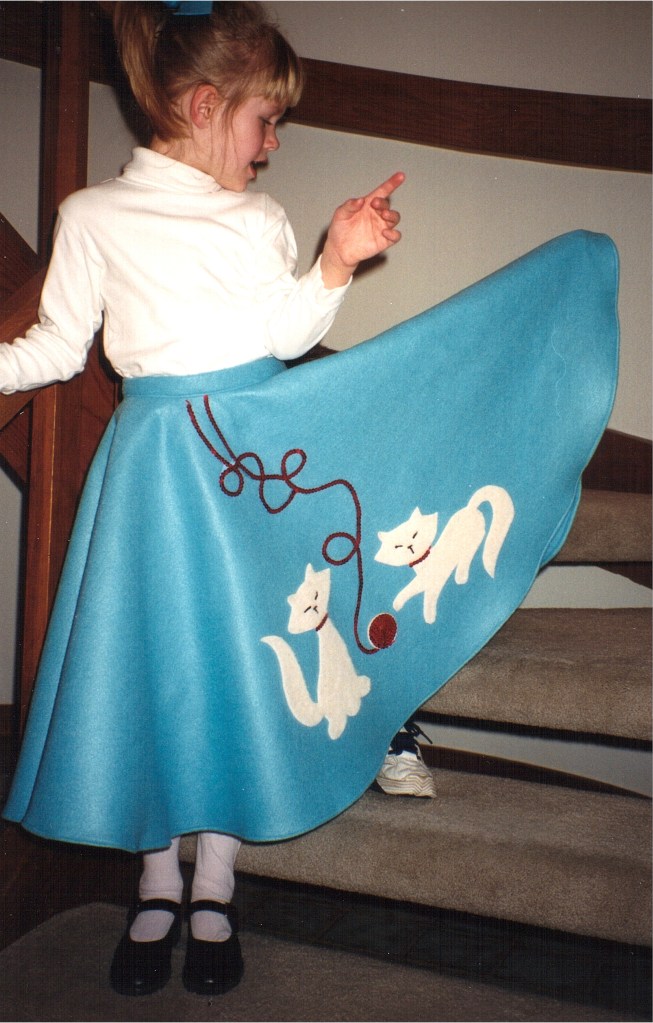
A felt poodle skirt for a father daughter-dance 1998 ish.

In the 1990’s I sewed costumes for my daughter and son, including a princess dress and wizard robes for them to wear at her seventh birthday party, as well as many other garments for school events and Halloween.

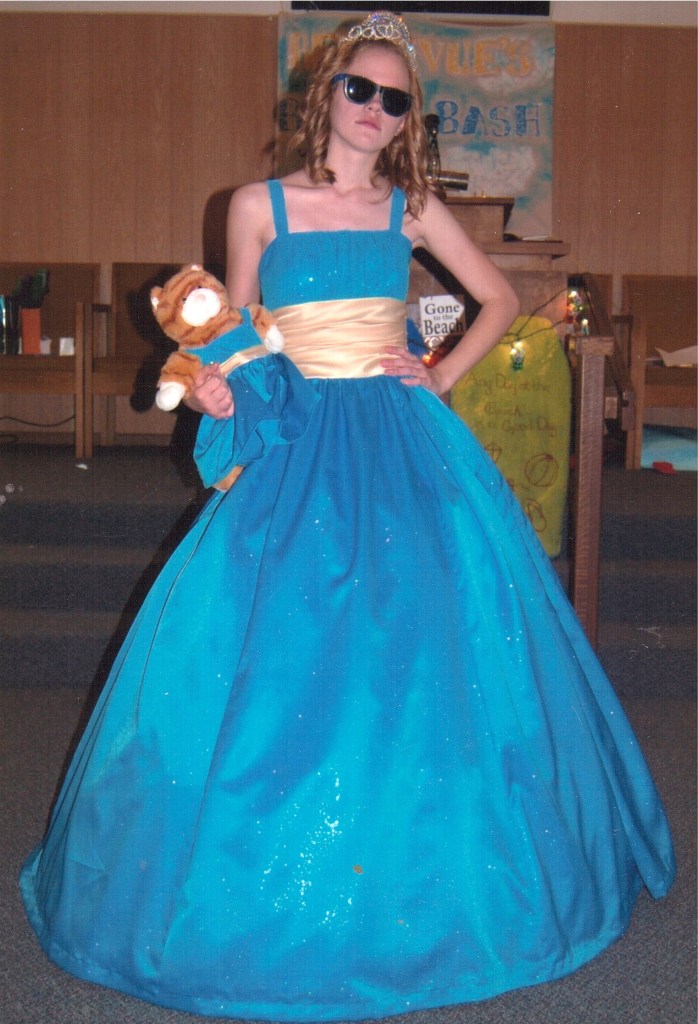
I sewed the dress for my daughter’s installation as the Worthy Advisor of the Rainbow Girls… and the matching one for her ‘mascot.’ 2009.

When we moved to Kirkland in 2004, our house was about a half mile from Hancock Fabrics and, being that the Rainbow Girls I advised needed custom dresses, this marked my peak sewing years. I was at Hancock’s at least twice a week, or so it seemed, for about seven years. The chain went bankrupt in 2016 and it was back to JoAnn’s whenever I needed something.

After our move to Mount Vernon, there were the occasional projects which required a visit to Jo-Anns, a short ten-minute drive. And while I have made the occasional trek there for a project, my days of intense sewing are now past me.

Saying goodbye to an old friend. I’m wearing a scarf I made with material from Jo-Ann’s.

I’ve discovered that sewing had become something I did out of necessity, not because it’s been my true passion. I know people whose passion it is and you can hear it in their voice and see it on their face when they start talking about their projects.

For sure there was always a sense of pride when I finished a beautiful dress. But. There was something else there too. A sense of relief that it was finished. The number of people asking me to sew them a dress got to be so many that I finally had to impose an oath on anyone I DID sew for to promise to never disclose who their seamstress was.

My sewing days are – mostly – over. But for some reason I still have a small stack of Rubbermaid bins with fabric remnants from years of projects. You just never know when some new inspiration will hit and that fabric will come in handy.

A few links:

https://en.wikipedia.org/wiki/Jo-Ann_Stores

https://en.wikipedia.org/wiki/Hancock_Fabrics

https://en.wikipedia.org/wiki/Wigwam_Stores_Inc.

In a previous blog post about the invention of the sewing machine and I delve into some of my sewing adventures and mishaps: https://barbaradevore.com/2019/09/10/howe-its-made/

The Colorful Tradition of Dyeing Easter Eggs

A favorite family activity

April 22

When I typed the word ‘egg’ into the Infallible Wikipedia, it returned Egg, Eggplant, Eggs as Food, Egg decorating in Slavic Culture, Egg Harbor Township in New Jersey, and Eggnog.

My daughter finding Easter Eggs. April 16, 1995.

While most people likely give little thought to eggs, they have – over the past couple of months – become one of the most talked about things in the United States. I’ve seen posts on Facebook and other social media with people complaining about the egg shortages which have swept the country and, of course, the skyrocketing price of eggs. About a month ago, I even overheard someone asking a Costco employee when they would be getting eggs again (since they were out of eggs that Saturday afternoon).
“Monday morning at ten will be the next delivery.” Guess where I was at ten that Monday morning?

But the egg shortage didn’t hold my interest. Instead, it’s the tradition of dyeing eggs for Easter.

Narrowing my search, I typed in “Easter Eggs.” It returned the one I wanted and yet another set of egg related pages including Easter Eggs in media, an Easter Egg tree, and – I kid you not – an “Easter Egger” – a breed of chicken. Eggs are, it turns out, a very popular topic.
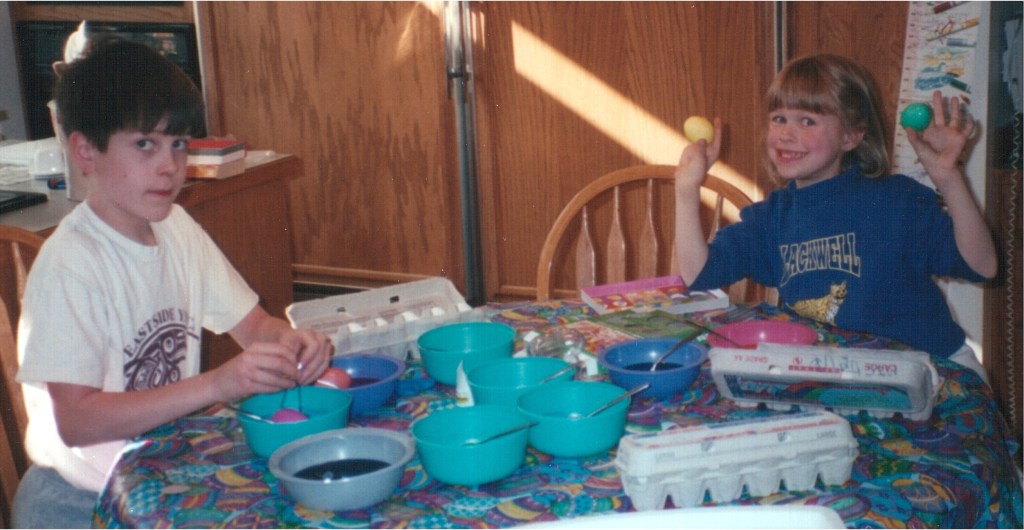
The dyeing of Easter eggs was a big deal for my kids. 1999.
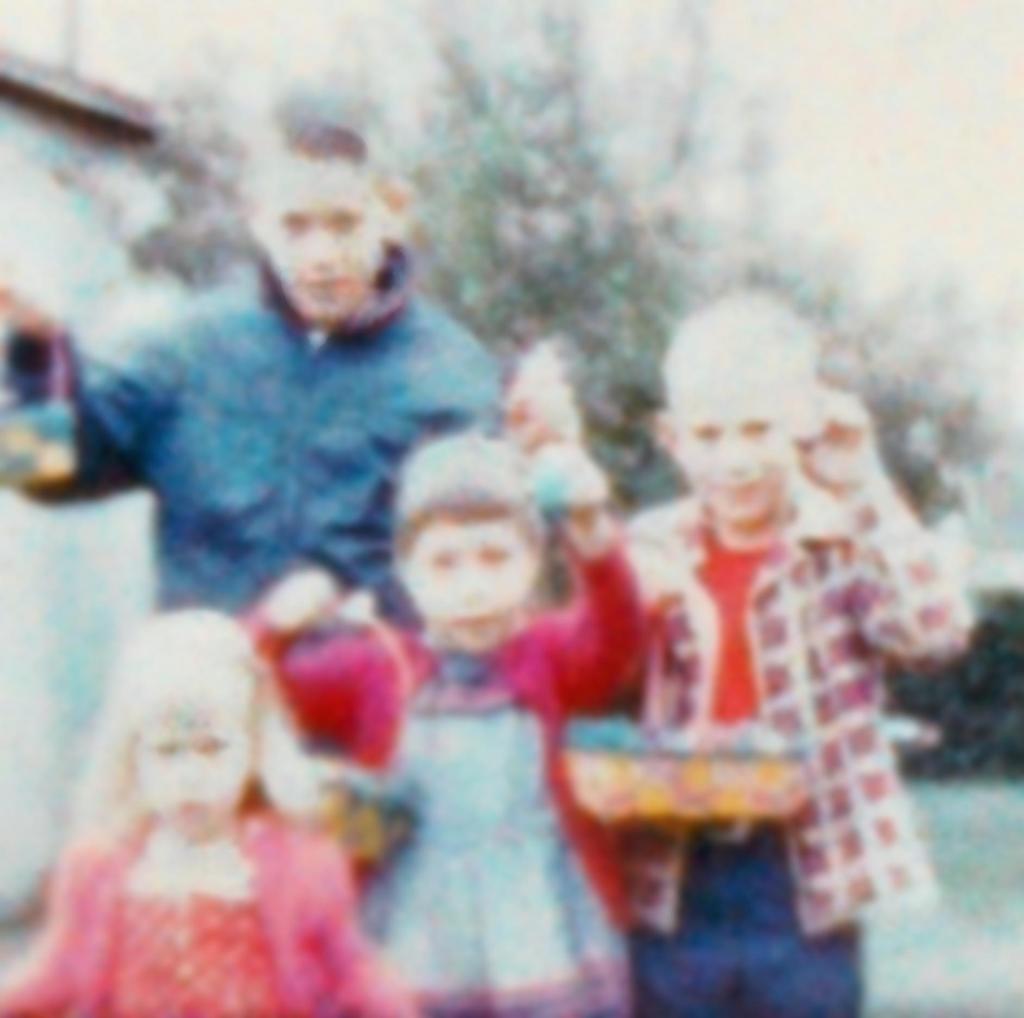
But back to the Easter Egg. The dyeing and decorating of them is a tradition which goes back nearly two thousand years, begun by early Christians in Nicaea around 325 A.D. According to the aforementioned Infallible Wikipedia:

“Eggs in Christianity carry a Trinitarian symbolism as shell, yolk, and albumen are three parts of one egg. According to many sources, the Christian custom of Easter eggs started among the early Christians of Mesopotamia, who stained them with red colouring ‘in memory of the blood of Christ, shed at His crucifixion’. The Christian Church officially adopted the custom, regarding the eggs as a symbol of the resurrection of Jesus, with the Roman Ritual, the first edition of which was published in 1610 but which has texts of much older date, containing among the Easter Blessings of Food, one for eggs, along with those for lamb, bread, and new produce.”

The DeVore siblings showing off their eggs, Easter 1961. (taken from a Super8 movie reel)
The author with her bounty of eggs. Age 3.

While every holiday has something to recommend it, I think the dyeing and hiding of Easter Eggs makes this holiday one of my favorites. There are home movies from when I’m three showing off my Easter eggs at the family home in Clarkston, Washington.  And, again, at various ages after we moved to Yakima. For a few years, we would join our cousins at my grandparent’s cabin up at Rimrock Lake and one year my grandmother hid eight dozen eggs. Yes, that’s right. She hid 96 eggs out in the long grasses. Not all 96 were found. The next year Easter was in late March and as it was too cold to hide them outside, she squirreled the nearly 100 eggs into every nook and cranny of the 1000 square feet available. I’m thinking all eight of us grandchildren were sent upstairs to the sleeping loft while the six adults remained on the first level. Not all of those were found either. At least not until later that spring when the missing eggs started to smell according to family lore.

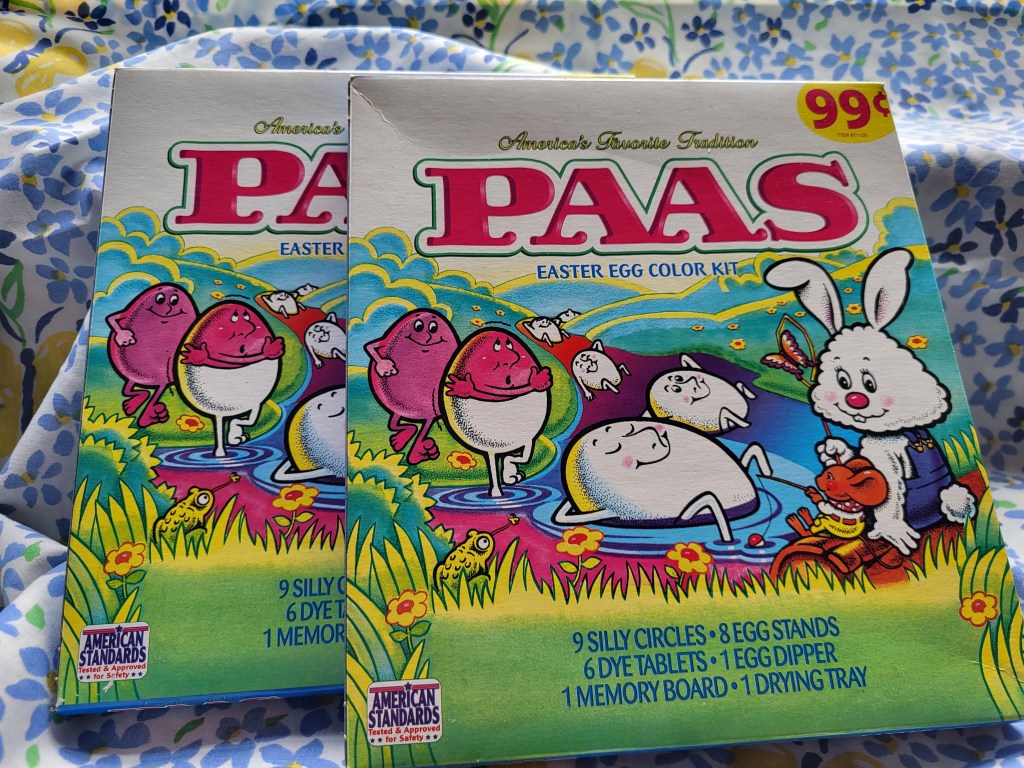
Alas, I grew up and quit dyeing Easter eggs. That was until I had kids of my own. And then it was full steam ahead! Every year I’d buy the PAAS egg tabs and soon had vinegar-based dyes in blue, green, yellow, red, orange, and purple. For a few hours I was transported back to my own childhood and the fun of coloring eggs; passing on the colorful tradition to my own children.

It was always fun to watch their brains at work. How many green ones? How many blue? How do you create one with every color on it? One year I think my son dyed all his eggs some shade of blue, while my daughter wanted the entire rainbow on every one of hers.

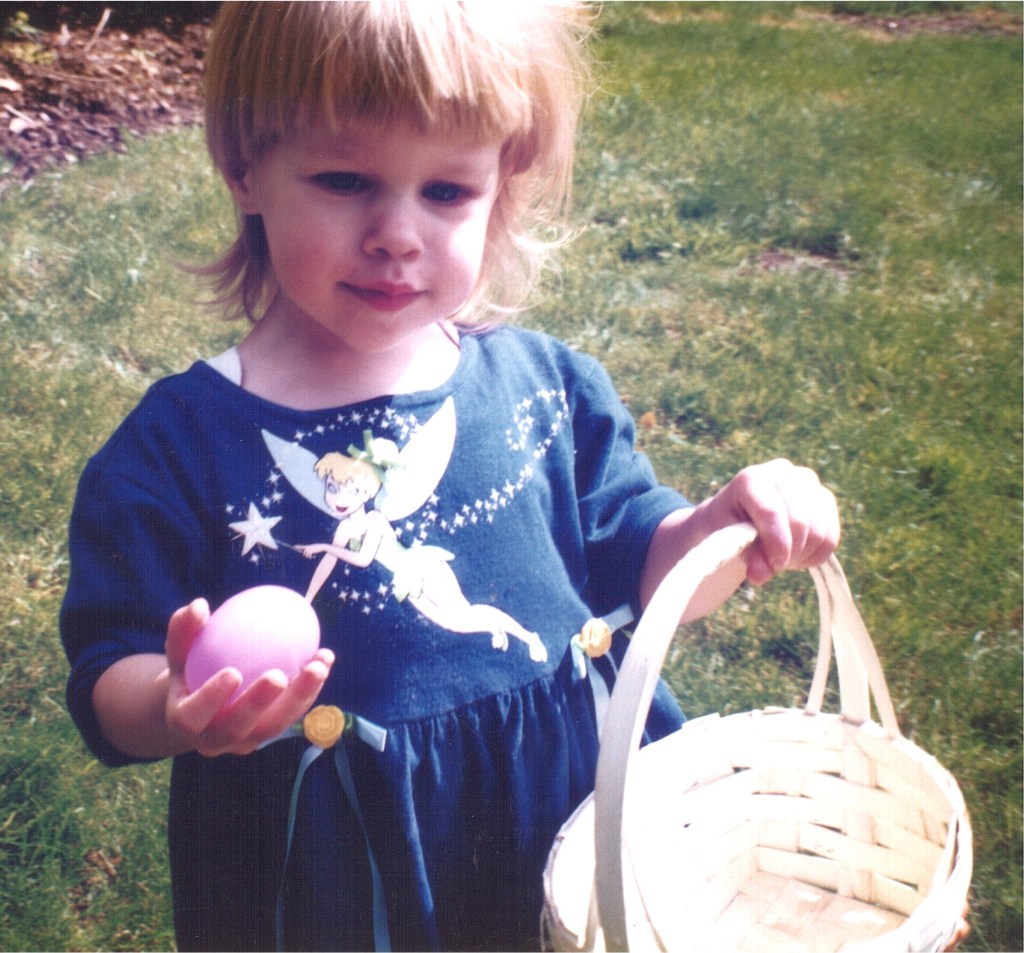
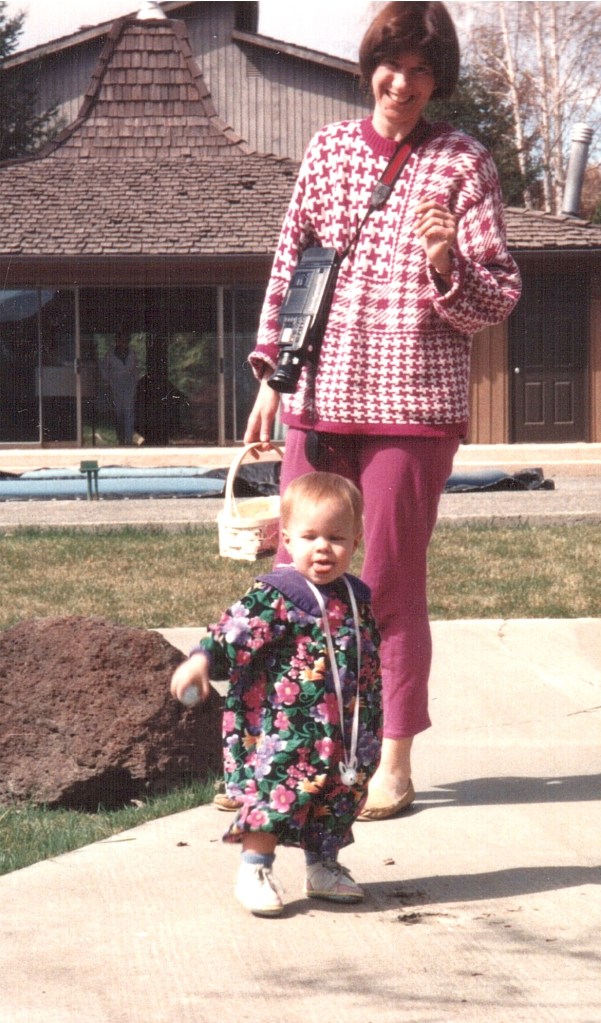
My just turned one year old daughter – under close supervision by me – with her first found Easter egg. 1994
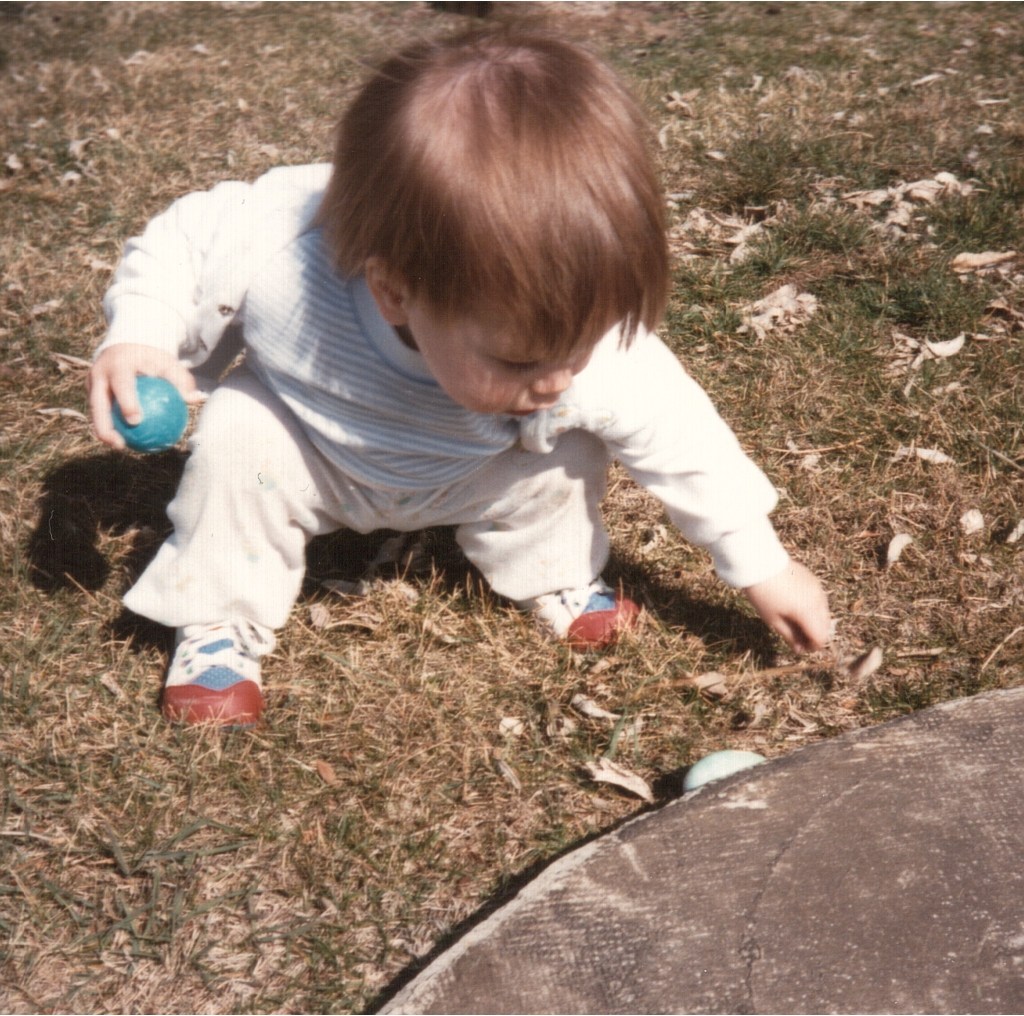
My son, 14 months old, at his first Easter egg hunt. 1991.

As a child, I was much more regimented, making sure that there were two of each color, just in a darker or lighter shade. My mother would indulge me over the weekend, and let me get my box of eggs out of the refrigerator and admire them. At least until Sunday afternoon on Easter day. It was then the first eggs would get peeled, soon to be incorporated into potato salad and devilled eggs. To this day I still love hard boiled eggs and whenever I eat them I am pulled back, for a moment, to my childhood Easters.

But back to the egg hunt. As an adult, I was always able to recall where I had hidden my children’s eggs… well, except for that time when I snuck outside before breakfast to nestle them among the flora only to discover during the course of the hunt forty-five minutes later that the fauna – particularly slugs – love hard boiled eggs too. Who knew?

The links:

https://en.wikipedia.org/wiki/Easter_egg

https://paaseastereggs.com/

Billy Joel: The Iconic Journey of a Storyteller

The Piano Man

April 8

This song only ever reached number 25 on the Billboard Charts. Yet its one of the most memorable songs of the 1970’s and marked the beginning of one artist’s career which has spanned 50 years.

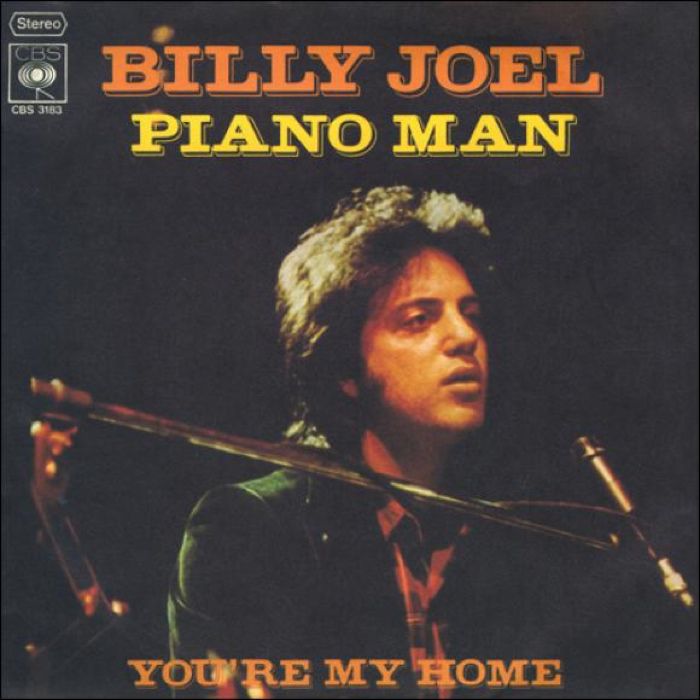
The song? The iconic “Piano Man.” The artist? Billy Joel.

It was in April of 1974 when “Piano Man” peaked on the charts. It could not even be described as a ‘one-hit wonder’ based on its ranking. By any measure, it should have faded away and been forgotten. Billy Joel, however, possessed the needed ingredients which have defined his long running career: grit, determination, and talent.

Undaunted by the middling success of “Piano Man” he continued to write songs and produce records. Both “Piano Man” and “Captain Jack” – his most successful early 1970’s releases – were an anathema to the music of that era. It was a time when soft rock and bubblegum dominated the pop category. I’m pretty sure no one was quite sure where this storyteller who saw and sang about the seamier side of life fit in.

“The Stranger” album, released in the fall of 1977, changed the public perception of Joel. I attribute it first and foremost to the song “Just the Way You Are.”  Written for his then wife Elizabeth Weber (married in 1974, divorced in 1983), I think it encapsulates a more optimistic look at life and, perhaps, that Joel was in a much happier place at that time as he had hit his stride with his career.

The American public responded. From the Infallible Wikipedia:

“Spending six weeks at No. 2 on the US Billboard 200 chart, The Stranger was Joel’s critical and commercial breakthrough. Four singles were released in the US, all of which became Top 40 hits on the Billboard Hot 100 chart: ‘Just the Way You Are’ (No. 3), ‘Movin’ Out (Anthony’s Song)’, ‘She’s Always a Woman’ (both No. 17), and ‘Only the Good Die Young’ (No. 24). Other songs, such as ‘Scenes from an Italian Restaurant’ and ‘Vienna’, have become staples of his career and are frequently performed in his live shows. The album won two awards at the 21st Annual Grammy Awards in 1979: Record of the Year and Song of the Year for ‘Just the Way You Are’. It remains his best-selling non-compilation album to date and surpassed Simon & Garfunkel’s Bridge over Troubled Water (1970) to become Columbia’s best-selling album release, with more than 10 million units sold worldwide. Rolling Stone magazine ranked the album number 70 on its 2003 list of the ‘500 Greatest Albums of All Time’, repositioned to number 169 in a 2020 revision. In 2008, The Stranger was inducted into the Grammy Hall of Fame.”

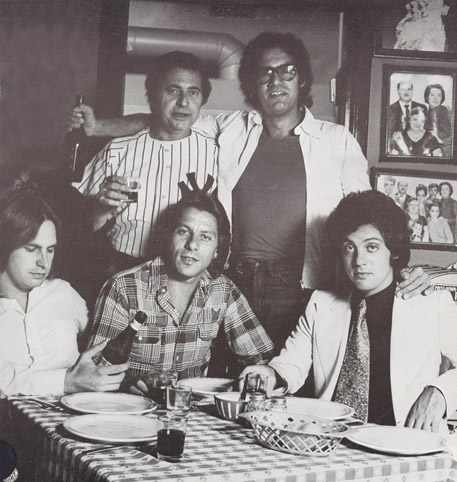
Billy Joel – seated far right – with members of his band at Guidos Italtian Restaurant. This photo was the back cover of the album, The Stranger.

As readers of my blog know, I greatly admire those who can tell a story through song. Joel has done this so very well. Perhaps my favorite of his ‘storytelling’ songs is “Scene’s from an Italian Restaurant.” When I listen to that song, I can visualize a couple of old friends – probably in their early 30’s – meeting up and soon their conversation is reliving the ‘good old days’ with such lyrics as:

Cold beer, hot lights
My sweet romantic teenage nights
.

My favorite part of the song has to be when he starts singing about prom king and queen, Eddie and Brenda, who were once the most popular kids in school. In a few short verses we learn about their marriage, their troubles, their divorce and that:

Brenda and Eddie had it already by the summer of ’75
From the high to the low to the end of the show
For the rest of their lives.

Storytelling at its finest.

It was in May 1984 when I attended my first rock concert. Yes, by then I was in my 20’s. My mother did not approve of rock concerts or anything else which might pollute young and impressionable minds so as a teenager going to such an event was forbidden.

I could have gone to a concert sooner, being that I had been an adult for several years. But after the hubby and I were married in 1980 we didn’t have the resources for such frivolities. Instead, we bought our first house in the spring of 1981 and then lived on rice and beans for the next few years, both of us going to jobs during the day, and fixing the house during the evenings and weekends. Our social life was the hubby playing on recreational soccer team; getting together with friends and family at our home our theirs, and going camping.

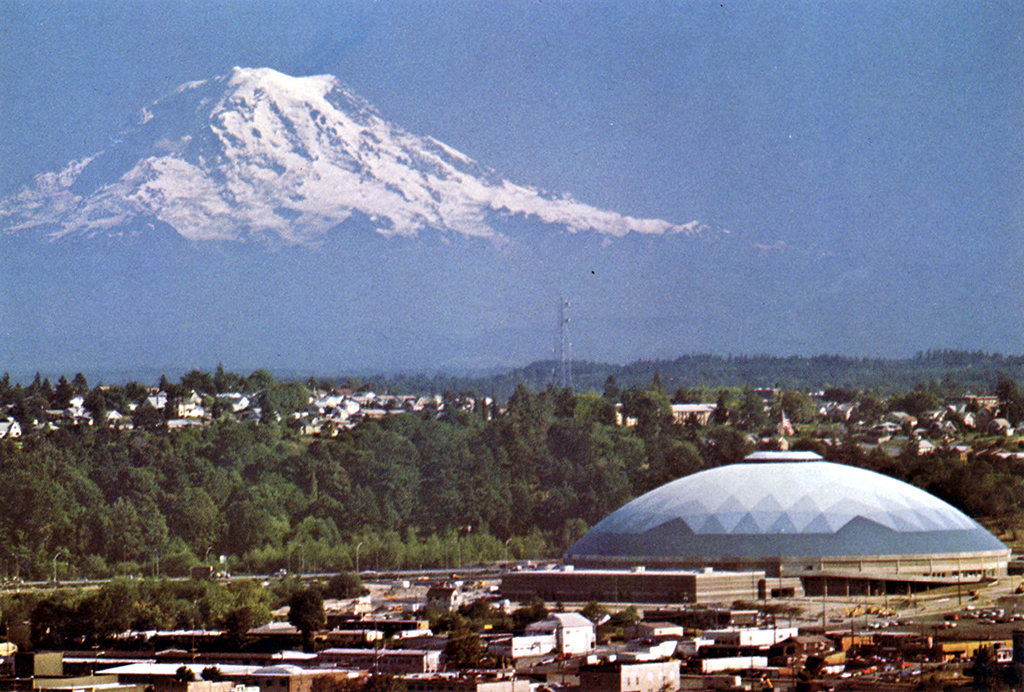
The Tacoma dome circa 1983-84

I can’t say for sure what inspired buying tickets for Billy Joel except that we both liked his music, me probably more than the hubby.

We drove from West Seattle to the Tacoma on Tuesday, May 8th, and joined thousands of our closest friends at the less than one year old Tacoma Dome (Billy Joel was the 9th artist to play there!). When the lights dimmed the arena went silent. In the dark we could see a grand piano slowly turning to the front of the stage, a lone performer sitting at the keyboard.

And then a single chord from the piano in the dark, instantly recognizable as the opening salvo of Joel’s then hit song “Allentown.” The arena erupted in applause. A solo spotlight appeared and shone down on Joel and, in that moment, he captured the room.

For the next couple of hours, we were treated to an energetic concert of old favorites and up and coming hits. It was a magical night and a great first concert.

I felt it was a privilege to have experienced Billy Joel perform live.

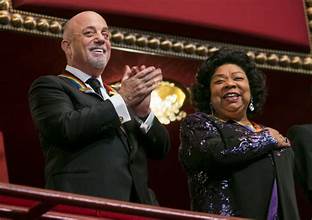
Joel was feted with the Kennedy Center honors in 2013. Pictured here with fellow honoree opera singer Martina Arroyo

Thank you, Billy Joel, for capturing the essence of the American experience through your incredible words and music.

There are soooo many links and so much more information I was not able to share in my self-imposed limited space. So here you go for some of the highlights including links to my three most favorite songs from Joel:

https://en.wikipedia.org/wiki/Billy_Joel

https://en.wikipedia.org/wiki/Piano_Man_(Billy_Joel_album)

https://en.wikipedia.org/wiki/The_Stranger_(album)

https://youtu.be/gxEPV4kolz0?si=TsMKJR-FE_lsLB4B (Piano Man)

https://youtu.be/GkuJJsApACc?si=J8-DxfhF7-e9ELU2 (Just The Way You Are)

https://youtu.be/izzM9LXqP-U?si=xlCLpepQV7n9nV7N (Scenes From an Italian Restaurant)

A Font of Fun? No Fooling!

April 1st

You’d pretty much have to be living on an island far from civilization to NOT know that today is April Fool’s Day. It’s celebrated each year on April 1st.

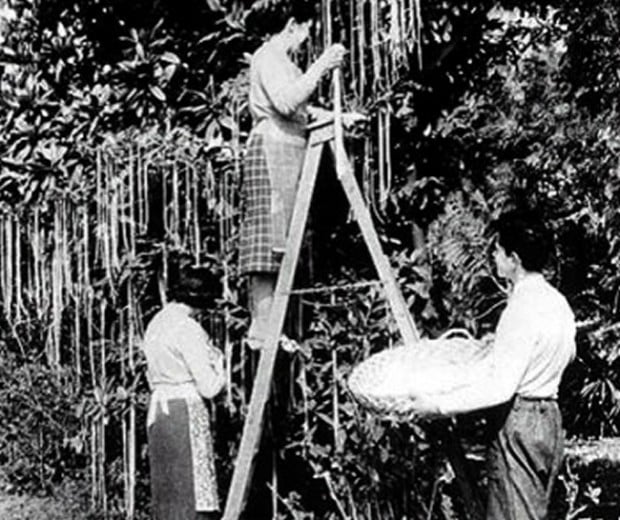
Considered by many as the greatest hoax of all time is this 1957 BBC documentary about harvesting spaghetti from trees. https://en.wikipedia.org/wiki/Spaghetti-tree_hoax

The day has murky beginnings which date back hundreds of years. Some say that Geoffrey Chaucer, in the unreadable ‘Canterbury Tales’, makes reference to the day. But that’s disputed. In 1508 some obscure French poet I’ve never heard of wrote about ‘poisson d’avril’ – translated ‘April’s Fish’ – which apparently doesn’t mean fish but ‘fool.’ Yet another theory is that at one time the new year was marked as being on March 25th but was then changed to January 1st (Actually March 25th makes more sense what with spring, birth, and renewal, but whatever). Those who clung to their old traditions were derided as Fool’s and I guess it took 6 days of their protests against moving New Years before someone decided to take any action.

The previous paragraph is, however, as in depth as I plan to go regarding the origins as, quite honestly, it’s a bit boring for this day devoted to mirth and mischief. Sadly, I found the Infallible Wikipedia article to be deadly serious and who wants that?

Anyway, I had soon climbed down the rabbit hole that is the internet and found a website truly worthy of April Fool’s Day: The Museum of Hoaxes. OMG. I knew I could spend hours reading about all the clever things people have conjured up to fool others. Decisions, decisions. WHICH of the hundreds of hoaxes was worthy of Tuesday Newsday fame? It was a weighty decision.

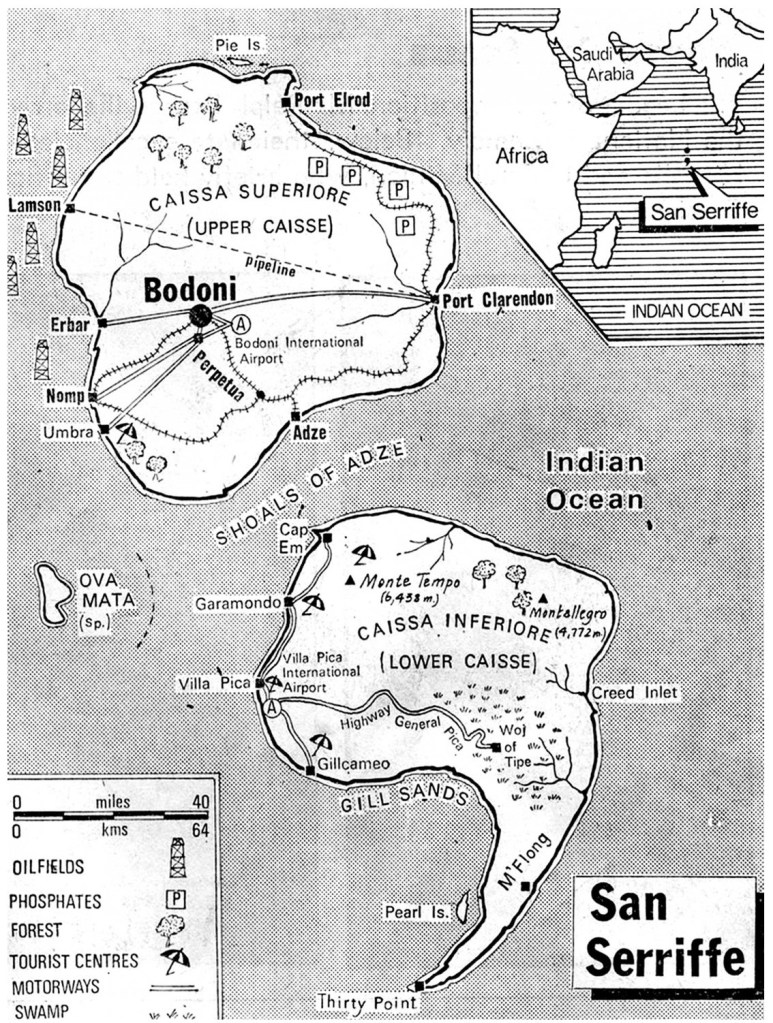
The islands of San Serriffe are a Perpetua(l) delight

Presenting the Island of San Serriffe!

As a writer, word nerd, and someone whose earliest childhood goal was to be able to create programs, newsletters, flyers, etc., the name San Serriffe resonated.

The year was 1977 and the British newspaper, The Guardian, was looking for something fun as a joke for their April Fool’s Day edition. Brainstorming occurred and the results were hilarious. From the hoaxes.org website:

“On April 1, 1977 the British newspaper The Guardian published a seven-page ‘special report’ about San Serriffe, a small republic located in the Indian Ocean consisting of several semi-colon-shaped islands. A series of articles described the geography and culture of this obscure nation.

The report generated a huge response. The Guardian‘s phones rang all day as readers sought more information about the idyllic holiday spot. However, San Serriffe did not actually exist. The report was an elaborate April Fool’s Day joke — one with a typographical twist, since numerous details about the island (such as its name) alluded to printer’s terminology.

The success of this hoax is widely credited with inspiring the British media’s enthusiasm for April Foolery in subsequent years.”

The best part of this story is, for me, the map. These people had waaaaaay too much time on their hands apparently.

The capital of San Serriffe: Bodoni; There’s Monte Tempo and Montallegro; Creed Inlet and Thirty Point; Villa Pica International airport and a beach town named Garamondo. Truly, the map is a font of fun.

I’m a bit sad that it took me over 40 years to learn about San Serriffe since, in 1977, I was heavily involved in the world of publishing. I was one of three editors for the weekly Yakima Valley Community College “Galaxy” and also the youth editor of the Washington Idaho Rainbow Girls newsletter titled “The Confidential Observer.”

I was hungry to learn everything there was about journalism, writing, and layout. One of my big passions was experimenting with new fonts. I could not get enough of them!

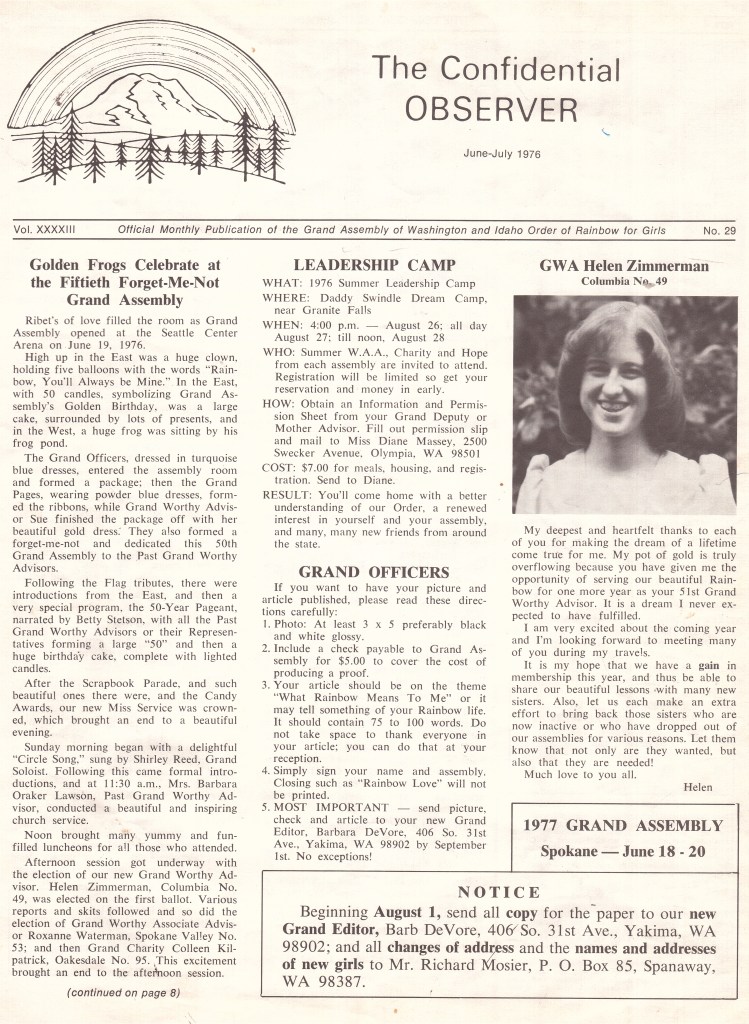
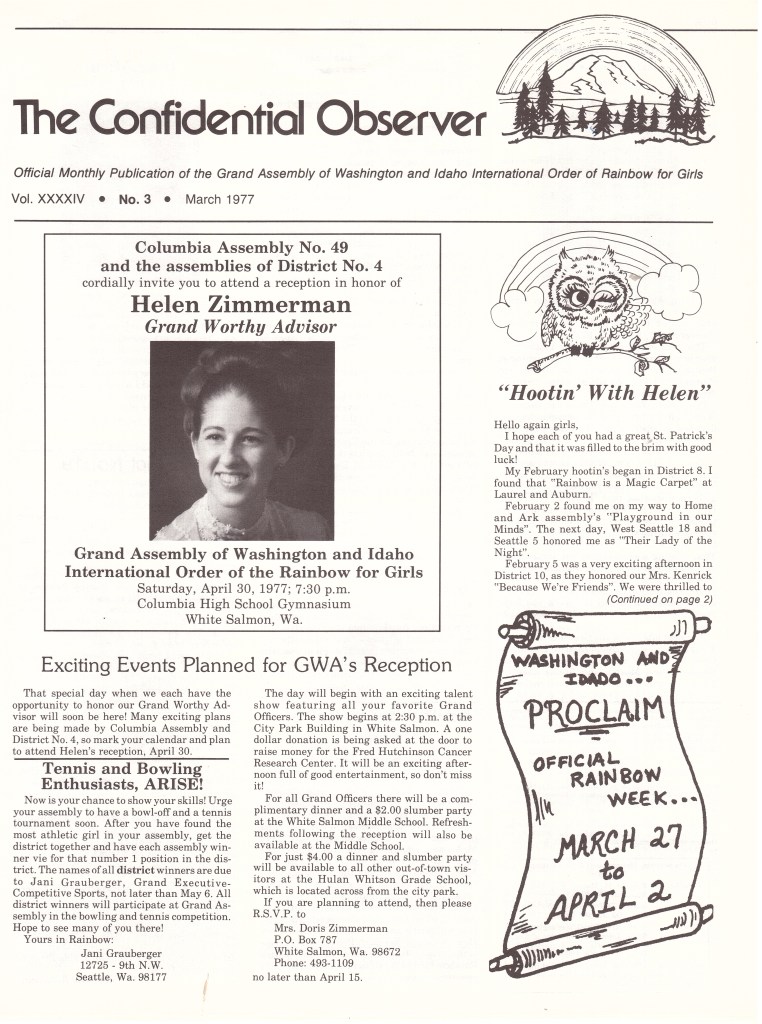
The adult advisors for the Rainbow Girls publication, I’m certain, had no idea what hit them that year as I shook things up, at least in the world of Fonts. Well, and layout and artwork and, pretty much everything I was capable of changing. The fonts went from Helvetica and Times New Roman to Garamond and Bodoni to name a couple of them.

I changed the mast head; I varied the font sizes; I used boxes around things to emphasize and tried to make it more aesthetically pleasing.

Two versions of the front page of the Rainbow Girls paper. Top is how it looked the issue before I started changing things. Bottom is how it looked six months later.

Now, way back in the dark ages, publication was not a simple thing. First I had to get articles from people from all over the states of Washington and Idaho who mailed them in envelopes. Some of these came handwritten on notebook paper, full of spelling and grammatical errors. I often had to retype and all had to be edited. When that was done I would mail it all from where I lived in Yakima to the printers in Tacoma, who then retyped it (with the fonts I’d chosen) and created galleys to fit our three-column format. These were then returned to me via mail. I would cut – with an exacto knife – the galley articles and glue the proofs on to paper in the correct configuration with everything marked as to where it was supposed to go and then would cross my fingers that they did it right. Spoiler: not always.

It was the fall of 1976 and the artwork that was to top the column for our state president that year had gotten lost by them. I sent in my package a hastily drawn picture (I’m no artist!) with a note attached saying “this is sort of what the artwork looks like that’s missing” and asking them to look around for it. Instead of reaching out, however, they ‘published’ what I had sent. It was awful and upsetting and bothers me to this day. Eventually, they found the missing clipart.

To this day I cannot fathom any professional printer looking at the owl on the left and thinking that’s what they should print…

With the introduction of the Apple Macintosh and their GUI (Graphical User Interface) layout in the mid-1980’s, I was finally able to create a newsletter on a computer and print it out. It was then I got my first laser printer. It was still a clunky process and the clipart was lacking, but it moved me forward.

Over the years as the GUI technology has improved, my ability to create has expanded. Artificial Intelligence has made it even easier.

So hats off to San Serriffe Island. I found the above picture of the island through an easy Google search, saved it as a jpg, and then printed it on my less than $200 Epson printer. I’m sticking it in a frame and hanging it in my office and will look at it often and cheer the fun of April Fool’s Day and 1977, the year of San Seriffe’s creation.

As always a few links:

https://hoaxes.org/archive/permalink/san_serriffe

https://hoaxes.org/af_database/display/category/guardian

https://en.wikipedia.org/wiki/April_Fools’_Day