Tag Archive | Windstorm

Tacoma Narrows Bridge

The rise and fall of Galloping Gertie

November 7, 2023

A Tuesday Newsday Classic

Galloping Gertie just before the collapse on November 7, 1940

Last week we explored the world of horseracing and author Dick Francis. This week we will be discussing galloping. But unlike how a horse gallops, this galloping took place on November 7, 1940 and has since become a text-book example of what NOT to do when building a bridge.

It was on this date when the Tacoma Narrows Bridge collapsed and sank. It was dubbed ‘Galloping Gertie’ as even the most gentle of breezes would cause the roadway to sway. I can only imagine the feeling of unease one had when driving over the structure.

For a local newsman it proved terrifying. From the Infallible Wikipedia:

“Leonard Coatsworth, a Tacoma News Tribune editor, was the last person to drive on the bridge:

‘Around me I could hear concrete cracking. I started back to the car to get the dog, but was thrown before I could reach it. The car itself began to slide from side to side on the roadway. I decided the bridge was breaking up and my only hope was to get back to shore.

‘On hands and knees most of the time, I crawled 500 yards or more to the towers… My breath was coming in gasps; my knees were raw and bleeding, my hands bruised and swollen from gripping the concrete curb… Toward the last, I risked rising to my feet and running a few yards at a time… Safely back at the toll plaza, I saw the bridge in its final collapse and saw my car plunge into the Narrows.’”

The bridge had opened only four months earlier! In reading about everything that went wrong the biggest mistake seemed to have been that in a desire to save money on what was perceived as a bridge which would be lightly used, the design was flawed from the beginning.

Ultimately they determined the bridge failure was due to ‘aeroelastic flutter’. Unless, of course, you are an engineer the term means little. The film of the event for us laypeople, however, reveals a structure bucking like an unbroken stallion during its first ride.

The Hood Canal bridge after it sank in February 1979

Although I was not around in 1940, I was attending college in Tacoma on February 13, 1979 when another bridge met the same fate as Galloping Gertie. It was on this day when I truly grasped the power of a Pacific Northwest windstorm. During the night prior to its sinking, sustained winds of 85 mph buffeted the Hood Canal floating bridge. They estimated gusts up to 120 mph (called a ‘hurricane’ most any place else as any sustained wind over 72 mph is classified as such) had occurred. The structure was swamped and at 7 a.m. that dark, windy and rainy morning, the bridge sank.

Fast forward to November of 1990 and yet a third Washington state bridge met a similar doom. We watched in fascinated horror live TV news on the morning of November 25th as the floating bridge – being resurfaced to continue carrying traffic while a new span was constructed – which connected Mercer Island to Seattle was inundated. As my husband no doubt said at the time: “surf’s up!”

In the 30 plus years I’ve lived in Western Washington there are a couple rules you can count on me following. First, I will do anything I can to avoid driving in a windstorm. I’ll drive in rain, snow, sleet, and dark of night but the wind stops me. I’m not talking about a bit of wind but sustained winds over 40 mph.

The I-90 bridge between Mercer Island and Seattle as it sank in November 1990

 Second, I will move to the northeast corner of any structure, especially one with nearby cedar trees. The worst PNW winds almost always blow from the southwest; if a tree is going to come down it will fall from that direction. Plus, cedar trees have very shallow roots and, unless there’s a cluster of them with an intertwined root system, tend to be the trees which come down during the storms. When we lived in Kirkland, my family knew that a heavy wind meant ‘going to the mattresses’ and sleeping on the floor of the living room as far from the trees as possible.

November is definitely the start of windstorm ‘season’ so remember to batten your hatches when the wind blows…and you just might want to avoid driving on bridges.

As always some interesting links PLUS a video from the Washington State History museum which tells the entire Galloping Gertie story.

https://en.wikipedia.org/wiki/Tacoma_Narrows_Bridge_(1940)

https://en.wikipedia.org/wiki/Pacific_Northwest_windstorm

http://www.wsdot.wa.gov/TNBhistory/Connections/connections3.htm
The Big Blow

Storm of the 20th Century?

October 12, 2021

While many may think of the Pacific Northwest as having benign weather – albeit rainy and drizzly for months at a time – it does get occasional severe weather.

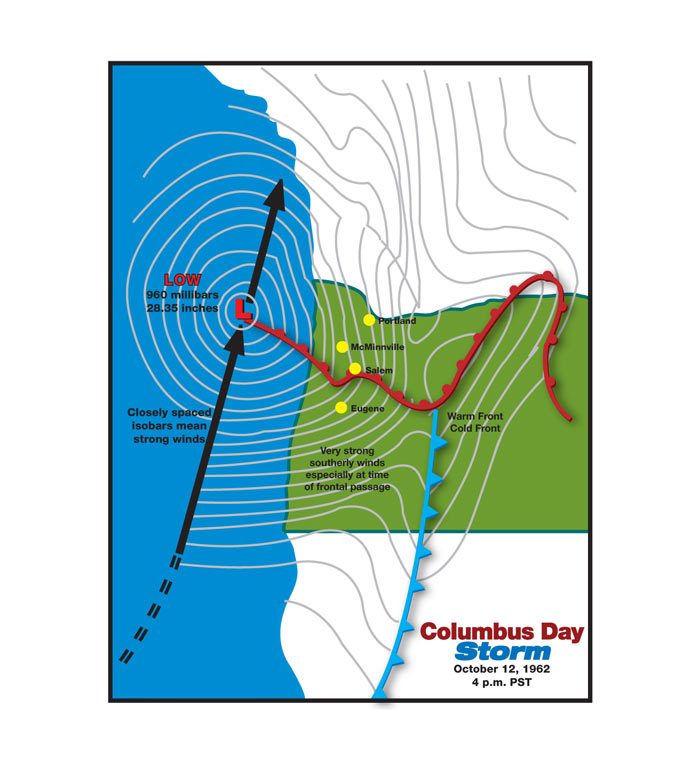
One such event occurred on Friday, October 12, 1962. Dubbed the Columbus Day Storm or, by some, as the Big Blow, it has become the ‘standard’ by which all other PNW wind storms are judged.

Yes, there IS an Infallible Wikipedia entry for the event:

“The Columbus Day Storm of 1962 (also known as the Big Blow, and originally as Typhoon Freda) was a Pacific Northwest windstorm that struck the West Coast of Canada and the Pacific Northwest coast of the United States on October 12, 1962. It is considered the benchmark of extratropical wind storms. The storm ranks among the most intense to strike the region since at least 1948, likely since the January 9, 1880 ‘Great Gale’ and snowstorm. The storm is a contender for the title of most powerful extratropical cyclone recorded in the U.S. in the 20th century; with respect to wind velocity, it is unmatched by the March 1993 ‘Storm of the Century’ and the ‘1991 Halloween Nor’easter’ (‘The Perfect Storm’). The system brought strong winds to the Pacific Northwest and southwest Canada, and was linked to 46 fatalities in the northwest and Northern California resulting from heavy rains and mudslides.”

For weather geeks, there are all sorts of statistics which confirm the magnitude of the event. The highest sustained wind speed recorded during the storm was 115 mph. For comparison, the Saffir-Simpson Hurricane Wind Scale would place that in the category of a major hurricane. The highest wind gusts registered were in the 170 mph range. The gusts – mostly along the northern Oregon and southern Washington coasts – were so strong that weather station anemometers were taken out by the wind.

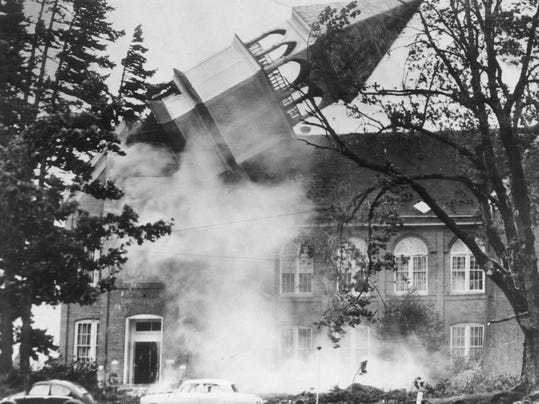
A church steeple is toppled in the wind

When all was said and done, many records were broken that day and the storm continues to be studied and used as a textbook example of an extratropical cyclone.

Although I did not live in Western Washington at that time, the hubby’s family did. I asked my mother in law if she recalled that day and her recollection involved two things: one, it was her oldest son’s 10th birthday and he loved the fact that his birthday fell on a national holiday; and, two, was that she had taken a group of girls to a Campfire Girls camp for a cleanup event. And, yes, the day was stormy.

As we move into fall and winter, I ponder the possibility of another big storm. They do not happen every year, but when they do they make an impression. In 1993 when the January 20th Inauguration Day storm hit, I was at home in Sammamish with a three year old and was 7 months pregnant. The power went out around nine that morning and my son and I moved our location to the living room. It got so intense at one point that I distinctly recall us sitting on the couch looking out the east facing window and watching the lids of garbage cans fly through the air like giant Frisbees. The huge cedar trees behind the houses across the street were whipped by the wind, swaying wildly.

A house is crushed by a fallen tree in Clark County

It was only later, after the storm, that I heard the most harrowing account of the day.

On the next street east, which was down the hill from our house, lived another young family. And like me, she had a pre-schooler. The big difference was that she was not pregnant but instead had a less than 3 month old baby.

That morning she had been in their family room/kitchen area, the baby lying on a blanket, her preschooler playing. Around 10 a.m., she picked up the baby and the trio went upstairs. It was a fortuitous decision. Within a couple of minutes of that change of venue, a seventy foot cedar tree crashed through the roof, smashing into the family room… exactly where the baby had been minutes earlier. Someone was watching over that family that day.

When the wind died down later that afternoon, neighbors emerged from their houses to assess the damage. We had some trees down in our back yard, but for the most part escaped without loss.

So consider this your PSA for this year. When a big storm blows in to Seattle and the Puget Sound, you can be pretty assured that it will come from the southwest. Stay home or at your office – I personally don’t drive in windstorms – and look to see where the big trees are. If possible, seek out the northeast corner of the structure.  And remember, it probably won’t be as bad as the Columbus Day storm of 1962… but then again records do have a way of getting broken.

The links:

https://en.wikipedia.org/wiki/Columbus_Day_Storm_of_1962

https://www.nhc.noaa.gov/aboutsshws.php

https://climate.washington.edu/stormking/January1993.html