Tag Archive | sorority life

You Light Up My Life

A mega hit for Debbie Boone

November 19, 2024

A Tuesday Newsday Classic updated
On November 19, 1977, this song was in the middle of a 10 week run as the number one song in America. You Light Up My Life was the one and only Top 40 hit from Debbie Boone, daughter of 50’s teen idol Pat Boone. It reached number one on October 15 and stayed in that position through December 23, making it – at the time – the only recording to stay that long in the top spot in Billboard history.

According to the Infallible Wikipedia:

“Besting her chart performance in Billboard, Boone’s ‘You Light Up My Life’ single topped Record World’s Top 100 Singles Chart for an unbroken record of 13 weeks. On Billboard’s chart, Boone was unseated from #1 by the Bee Gees, with ‘How Deep Is Your Love,’ the first of three #1 singles from the ‘Saturday Night Fever’ soundtrack. On Record World’s chart, Boone kept the Bee Gees out of the number-one spot. In Cash Box Magazine, ‘You Light Up My Life’ managed only an eight-week stay at the top of the chart, before being dethroned by Crystal Gayle’s ‘Don’t It Make My Brown Eyes Blue’.

The single, which was certified Platinum by the Recording Industry Association of America (RIAA), also hit #1 on the Adult Contemporary chart and reached #4 on the Country chart. The single peaked at #48 I’m the UK Singles Chart. Boone’s hit single led to her winning the 1978 Grammy Award for Best New Artist, with additional Grammy nominations for Best Pop Vocal Performance, Female and Record of the Year. Boone also won the 1977 American Music Award for Favorite Pop Single.

Decades after its release, the Debby Boone version is still considered one of the top ten Billboard Hot 100 songs of all time. In 2008, it was ranked at #7 on Billboard’s ’Hot 100 All-Time Top Songs’ list (August 1958 – July 2008). An updated version of the all-time list in 2013 ranked the song at #9.

Although it was written by (Joe) Brooks as a love song, the devout Boone interpreted it as inspirational and proclaimed that it was instead God who ‘lit up her life.’”

The song was tainted by controversy, however, as songwriter Brooks apparently did not want to pay the agreed upon amount owed Kasey Cisyk, the artist who sang it for the movie of the same name, and whose version is included on the 1977 soundtrack.

Boone was told, when recording the song for release as a single, exactly how to sing it and her vocals were dubbed onto the original orchestral track.

At the time, I recall that Boone received much derision and the song was labeled as saccharin. In reading what occurred, however, I feel bad for both the women caught up in the controversy. Perhaps Cisyk was denied her shot at a Top 40 career and, perhaps, Boone was lulled into a sense of inevitability that she would become a star like her father. Although in listening to both versions, I think Boone’s is better.

Boone released additional songs into the pop market, but none ever came close to the success of “You Light Up My Life.” Her career eventually led her back to country music – where she had started – and then to work in the Christian music world.

In the fall of 1977, you simply could not avoid the song. It was played hour after hour on the radio. That autumn was one of the most memorable in my life: I was living away from my parents for the first time, having joined the Alpha Phi sorority at the University of Puget Sound. While I did study, I don’t think I was quite as diligent as I should have been. Instead, I was fraternizing with the fraternity boys most every weekend at mixers, and going on dates! I had never in my life garnered quite so much attention from the males of the species.

There was one particularly memorable November day when, literally, I had calls or visits from five guys all of whom I had been on a date with in recent weeks. That day, I could not say for sure the exact date, I had been headed down to the ‘tunnels’ to get my dinner and I decided it was a good idea to jump down the two steps from the door. I jumped a wee bit too high and… nearly gave myself a concussion.
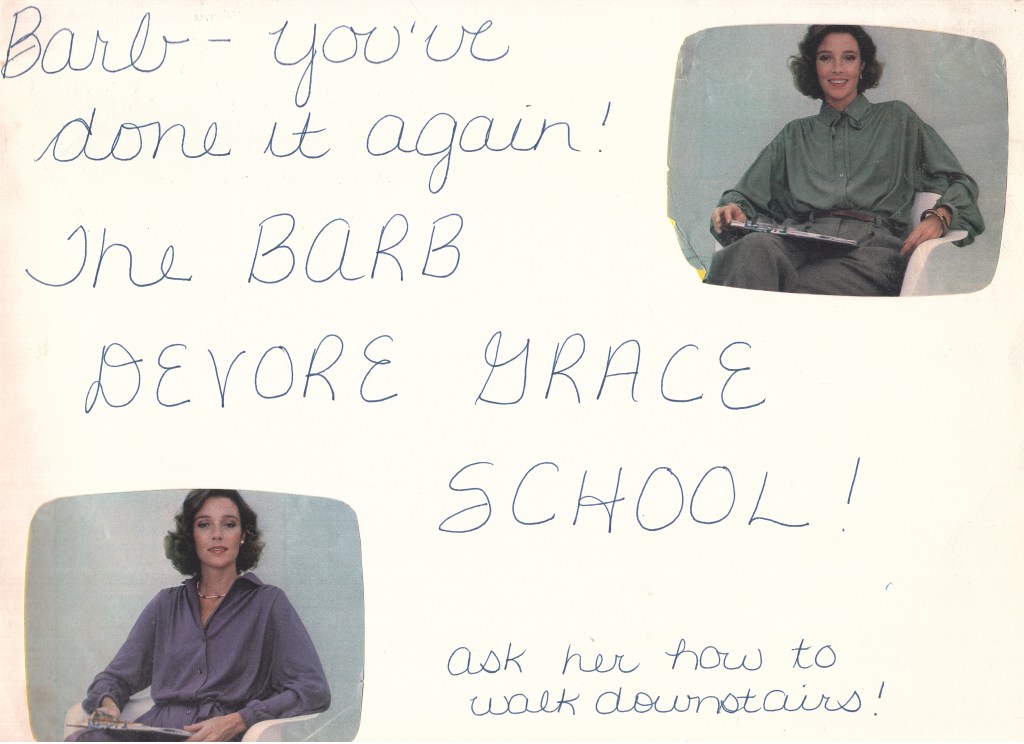
The ‘award’ I was given for my epic self inflicted concussion

The next Monday at our weekly sorority chapter meeting, I was recognized for my grace (for the stairs) and my charm (for the plethora of phone calls and visits I had). It was what I came to be known for and received endless ribbing about it. Good times.

That era in my life was punctuated by music and whenever I hear “You Light Up My Life” I’m back in the Alpha Phi house and it’s the fall of 1977. There were a few other songs which, in my opinion, were equally as deserving of that number one spot.

These included Billy Joel’s Just The Way You Are – an infinitely better song; Rita Coolidge’s version of We’re All Alone; Carly Simon’s Nobody Does It Better; and Don’t It Make My Brown Eyes Blue by Crystal Gayle. The list of great songs from that year also included big hits – but never number ones – from a whole lot of great bands: Foreigner, Heart, Fleetwood Mac, Styx, Supertramp, and Steely Dan, among others.

And in case you’d like to hear the Casey Cisyk version and really get the worm stuck in your head (it’s been in mine since I wrote this!) here’s that video also. Note that you are seeing Didi Conn on screen – she is doing a lip-sync to Cisyk’s vocals. Enjoy!

The links:

Instant Ramen: A College Staple and Cultural Phenomenon

A once banned food now a beloved Japanese favorite

August 25th

According to one Japanese poll, this food was named as the greatest invention of the 20th century.  Since a package of this costs between 50 cents and a dollar, it’s not only inexpensive, but it is easily one of the most adaptable instant foods you can purchase. Yes, I’m talking about the staple of college dorms everywhere: instant ramen noodles.

It was on August 25, 1958, when the first packages of the instant noodles were sold. But the history of ramen began much earlier.

How the first ramen was packaged, 1958

According to the Infallible Wikipedia:

“Ramen is a Japanese adaptation of Chinese wheat noodles. One theory says that ramen was first introduced to Japan during the 1660s by the Chinese neo-Confucian scholar Zhu Shunsui who served as an advisor to Tokugawa Mitsukuni after he became a refugee in Japan to escape Manchu rule and Mitsukuni became the first Japanese person to eat ramen, although most historians reject this theory as a myth created by the Japanese to embellish the origins of ramen. The more plausible theory is that ramen was introduced by Chinese immigrants in the late 19th or early 20th century at Yokohama Chinatown. According to the record of the Yokohama Ramen Museum, ramen originated in China and made its way over to Japan in 1859. Early versions were wheat noodles in broth topped with Chinese-style roast pork.”

Interestingly, it was in post WWII Japan, when the product really took off. Faced with rice shortages and a disrupted food supply line, inventive Japanese food vendors began making the noodles with cheap wheat purchased on the black market. Despite government attempts to keep vendors from making and selling the dish – they arrested thousands for doing so – it was one of the few things people could find to eat inexpensively. By 1950, the Japanese government relented, thus allowing the wheat noodles to find a place in the rice dominated culture.

In 1958,  Momofuku Ando – the founder of Nissan foods – developed a method by which the noodles were flash cooked, dried, and then sold in small blocks.

Also from the Infallible Wikipedia:

“Instant ramen allowed anyone to make an approximation of this dish simply by adding boiling water.

Beginning in the 1980s, ramen became a Japanese cultural icon and was studied around the world from many perspectives. At the same time, local varieties of ramen were hitting the national market and could even be ordered by their regional names. A ramen museum opened in Yokohama in 1994.

Who wouldn’t want to visit the Ramen museum just to see this giant bowl?

Today ramen is arguably one of Japan’s most popular foods, with Tokyo alone containing around 5,000 ramen shops, and more than 24,000 ramen shops across Japan.”

I became intimately acquainted with ramen soon after setting foot on the campus at the University of Puget Sound in 1977. Every member of my sorority, it seemed, had a small kettle and a stock of ramen packages in a desk drawer. It was one of two foods that seemed to dominate evening study time, the other being popcorn.

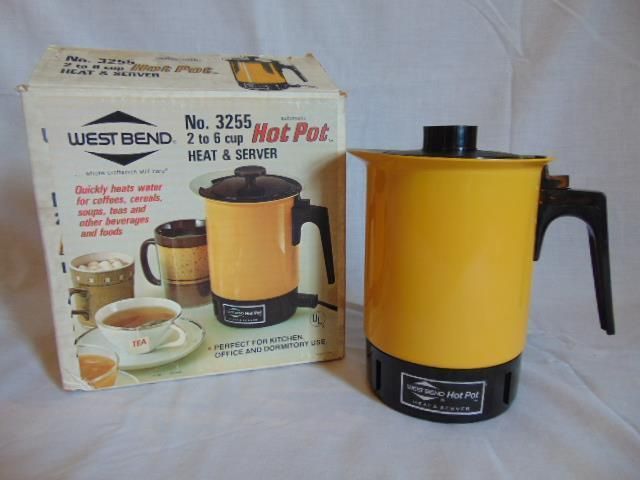
Soon, I too owned a West Bend electric teapot and a stock of ramen packets. I found one ad from 1979 where you could purchase it for a quarter a packet, but I do recall finding the coveted 10 for a dollar sales even into the 1990’s.

I think my pot was green but it might have been this lovely yellow

In my early ramen eating years, I was a purist; I’d boil my water, then drop the dried noodles into the pot and cook until they softened, finally adding the sodium laced flavoring.

After I met the man who would become my hubby, I learned that ramen could be so much more. He elevated ramen to an art form.

In Japan, the traditional way is as a soup of ramen and pork. But in our household, ramen is a vehicle for serving every sort of leftover. All meats can be added to it; stir in an egg for poor man’s egg flower soup. Tomatoes, celery, carrots, onions? All good in ramen. Perhaps the hubby’s favorite thing to add would be canned ‘Vienna’ sausages or hot dogs.

He recalls one college incident which revolved around ramen. Senior year he and two friends rented an apartment; one evening he was making a ramen concoction for his dinner. One of his roomie’s parents arrived on the scene to take their son to dinner. The roomie’s mom – upon seeing the ramen feast being prepared – was so horrified at this being my hubby’s dinner, insisted on taking him to dinner also.

The family ramen legacy was eventually passed to the next generation. Our daughter discovered the joys of ramen when she was an always hungry pre-teen and teen. Instead of asking Mom what was to eat, she learned early that she could fix it herself and probably consumed at least one package of it daily for many years. Cooked or dry did not matter. She loved it either way.

As an adult advisor for the Rainbow Girls, there was a parade of youth who showed up at our house regularly during those years. One girl was such a fixture that she knew exactly where the ramen was kept. Her arrival often meant that her first stop was the pantry where the Costco box of ramen occupied one end of the shelf. A few minutes later, the ramen cooked, we would settle around the table to chat. To this day she claims this as one of her favorite memories of our house.

The ubiquitous Costco 48 pack

The days of teens raiding the cupboards behind us, and my husbands ramen consumption reduced, the last Costco case of the stuff (48 packets – half beef, half chicken) is now gone. In fact, for the first time in the 40 years we’ve been married, there’s not a single package of ramen in the household.

When I inquired as to why, the hubby explained that he intended to get a ‘few’ packages at the grocery store instead of the industrial size Costco case. And there’s that pesky salt thing. One package of ramen is 1600 mg, a whopping 69 percent of the recommended daily salt intake.

Even so, it doesn’t seem right for us not to have a few packets of ramen just in case. Earthquake… Wind Storm… Pandemic…all good reasons to keep some on hand. Adding it to the grocery list. Who am I to argue with those who claim it to be the greatest invention of the 20th Century?

Costco’s supply of ramen takes up almost as much space as the Ramen museum

Yes, there really is a page on Ramen on the Infallible Wikipedia.:

https://en.wikipedia.org/wiki/Ramen