Tag Archive | Selah Washington

Cherries!

One of summer’s best fruits

July 2, 2024

A Tuesday Newsday Classic Updated
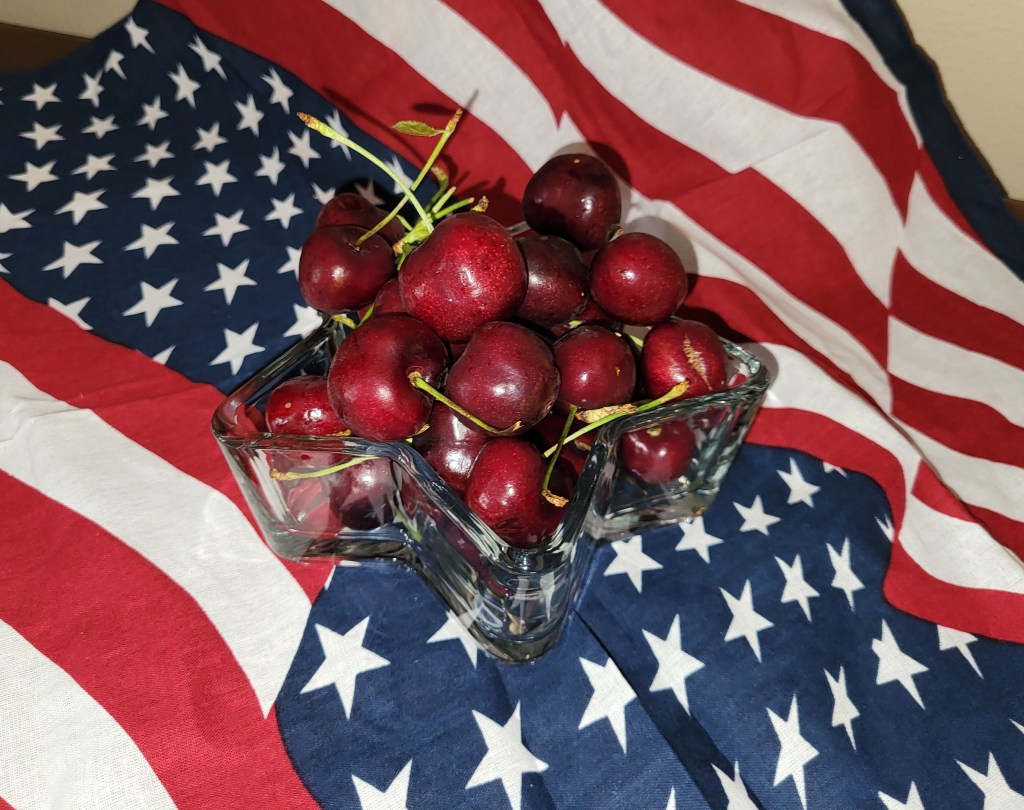
A few cherries purchased, not picked, at Fred Meyer.

The item which caught my attention for this week’s blog is the amusing ‘contest’ of cherry pit spitting. Yes, it’s a thing.

Held annually in Eau Claire, Michigan since 1974, the record ‘spit’ of a cherry pit is 93 ft 6.5 inches. The competition has been dominated by one family with the patriarch, Rick Krause, holding the record for longest spit (over 72 feet) until 1993. Since then, his son, Brian ‘Pellet Gun’ Krause has won 10 times with his record breaking discharge occurring the first week of July in 2003. In recent years Brian’s sons have also competed.

Others have stepped up to put their spitting skills to the test, but the Krause family continues to dominate.

Cherry pit spitter-champion Brian ‘Pellet Gun’ Krause

It is appropriate, therefore, as we celebrate all things red, white, and blue this week, to pay tribute to one of my favorite red things: the cherry.

Every July I can hardly wait for the harvest of this fruit to begin in the Yakima Valley. For there is truly nothing better than picking a cluster of the ruby orbs and (after they’re washed off) biting into the soft, juicy flesh. As a fan of the sweet varieties such as Bing and Sweetheart, an explosion of flavor reminds me how much I’ve missed them since the previous year.

The cherry has a long history of cultivation with evidence that the fruit has been grown since prehistoric times. From the Infallible Wikipedia:

“The English word cherry derives from Old Northern French or Norman cherise from the Latin cerasum, referring to an ancient Greek region, Kerasous (Κερασοῦς) near Giresun, Turkey, from which cherries were first thought to be exported to Europe. The indigenous range of the sweet cherry extends through most of Europe, western Asia, and parts of northern Africa, and the fruit has been consumed throughout its range since prehistoric times. A cultivated cherry is recorded as having been brought to Rome by Lucius Licinius Lucullus from northeastern Anatolia, also known as the Pontus region, in 72 BC.

Cherries were introduced into England at Teynham, near Sittingbourne in Kent, by order of Henry VIII, who had tasted them in Flanders.

Cherries arrived in North America early in the settlement of Brooklyn, New York (then called ‘New Netherland’) when the region was under Dutch sovereignty.”

In the United States, the first record of cherry trees being planted was 1639.

Sweet cherries are grown most successfully in Washington, Oregon, California, Wisconsin, and Michigan (hence the location of the cherry pit spitting contest). Most sour cherry varieties are grown in Michigan, Utah, New York and Washington.

To successfully grow cherries, the climate must have cold winters although varieties have been developed recently which have allowed California to compete in cherry production.

My relationship with the cherry has not always been an enjoyable one. In the 1970’s, my grandfather divested his properties to his two daughters and my father took over managing a cherry orchard. The orchard was repayment to my grandfather – a banker – from a loan gone bad some years earlier.

My Dad had never been a farmer but during the summer – when not a Junior High School history teacher – he was a hands on orchardist. It was natural, then, that my first summer ‘job’ as a teenager was picking cherries.
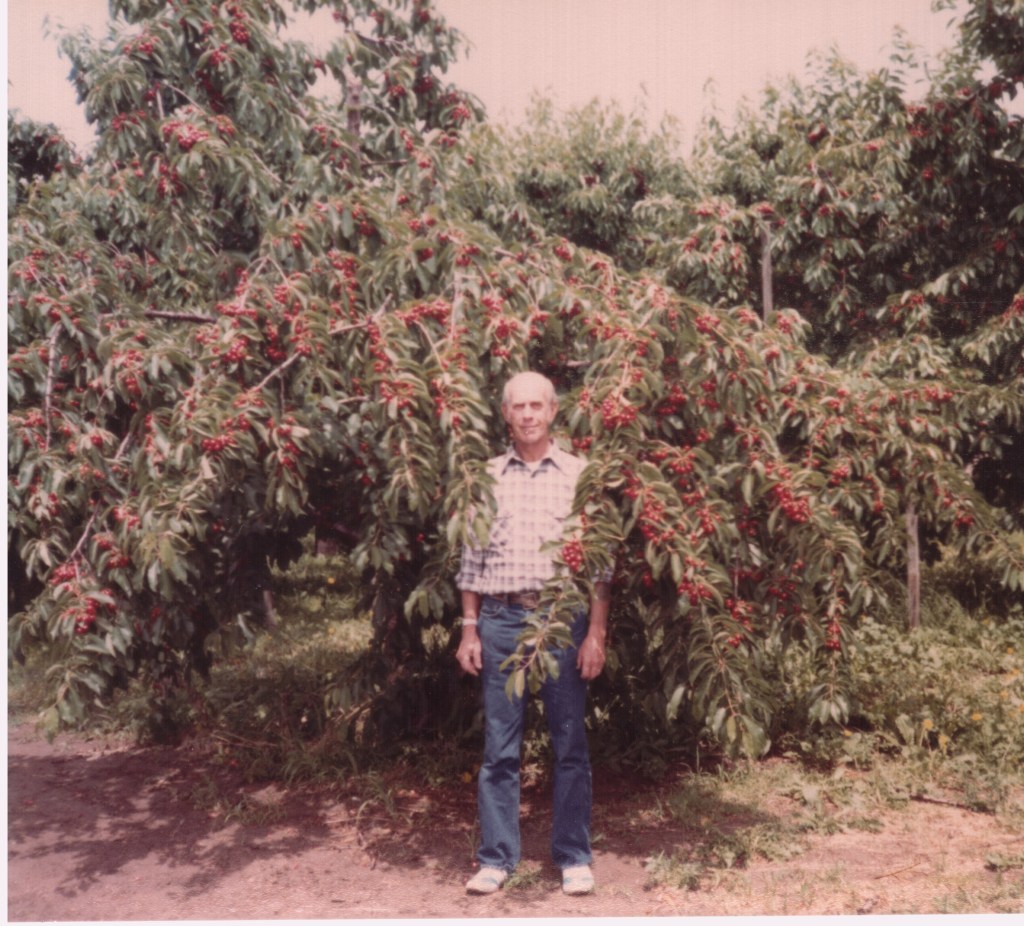
My Dad – schoolteacher turned orchardist – caught by a loaded cherry tree in Selah, Washington, circa 1980.

By early July in Yakima, summer is in full force and the weather usually turns quite warm. It is common for there to be a spate of days when the thermometer inches into the upper 90’s and low 100’s.  It’s then that the cherries ripen and harvest begins. For the pickers, work commences shortly after daybreak while the orchard is still cool.

One early July morning, with my then boyfriend and his younger sister, I arrived – along with all the migrant workers – to begin my job. Each person was assigned a tree, given a ladder and a bucket. Now when I say bucket, we are not talking about a pail like those favored by children at the beach. Nope. The metal buckets I knew held a lot of cherries, some four and half gallons worth. It took FOREVER to fill one up.

Different fruits require being harvested in certain ways. Picking cherries, it turns out, is quite the delicate operation. You must grasp the fruit at the very top of the stem where it is attached to the branch and gently twist so that the stem is removed from the branch without pulling the ‘spur’ off the tree. Then you place – never drop – the fruit into the bucket. Lather, rinse, repeat. My rough estimates are thus: a gallon is about 80 cherries. Multiply 4.5 gallons times 80 which is about 360 cherries for one bucket. For those who have never picked said cherries, it takes a long time to pick 360 cherries. Then there’s the ‘tree’. While about half of the first bucket can be picked while standing under it eventually you have to climb up a ladder – up to heights between 12 to 15 feet – while balancing your bucket of heavy fruit and reaching for the cherries.
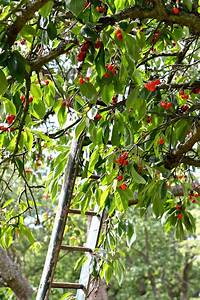
A requirement to pick cherries – a tall ladder.

Now what, you may ask, is ‘the spur’?” It’s a flexible knobby growth at the end of a branch or stem and if it’s pulled off, that spot will not produce cherries the next year. My father the orchardist was rather persnickety about those spurs being preserved, so I was careful. And slow.

By noon time – now having been there working since 5 a.m. – the heat would have arrived and I would have picked… drum roll please – seven whole buckets of fruit. That’s 2,420 cherries each day of harvest… and be paid seven whole dollars. So one dollar for a bucket of cherries. Some of the seasonal migrant workers could pick up to 200 buckets a day. I’ve never figured out how.

Yes, the job truly sucked. Although seven bucks went farther in nineteen seventy something than it does today. But it wasn’t a lot of money even then. I was lucky if I could pick for six or seven days and earn in the vicinity of $50.

I will say that a couple of summers as a cherry picker made me appreciate the delicious fruit even more. In the early 1990’s, my sister and her husband took over the reigns of the orchard which meant that each year there were delicious cherries to be had. More than once she brought a bag of the freshly picked delights to me.

A few days ago I broke down and purchased a bag at my local Freddies as I was not willing to wait until a visit to Yakima in a couple of weeks. I jealously guard my cherries, making the bounty last until late July or even early August. As luck would have it they are not the hubby’s favorite fruit.

By the time August rolls around I will have satisfied my craving for the fleshy fruit for another year. Maybe.

But the best part? I didn’t have to pick them!

A couple of links for you:

https://en.wikipedia.org/wiki/Cherry

http://memory.loc.gov/diglib/legacies/loc.afc.afc-legacies.200003151/default.html

A Rainbow Encounter

Have YOU ever driven through a Rainbow?

November 30, 2021

When I was in fifth grade, my teacher Miss Crosslin, loved to teach us science. It was in her classroom one day when she darkened the room and then shone a light through a prism. A rainbow leaped across the space, my attention riveted on this amazing phenomenon.

Rainbows are created when light is refracted through prisms

I learned that a natural rainbow is the result of light being refracted through millions of droplets of water. The Infallible Wikipedia informs:

“When sunlight encounters a raindrop, part of the light is reflected and the rest enters the raindrop. The light is refracted at the surface of the raindrop. When this light hits the back of the raindrop, some of it is reflected off the back. When the internally reflected light reaches the surface again, once more some is internally reflected and some is refracted as it exits the drop. (The light that reflects off the drop, exits from the back, or continues to bounce around inside the drop after the second encounter with the surface, is not relevant to the formation of the primary rainbow.) The overall effect is that part of the incoming light is reflected back over the range of 0° to 42°, with the most intense light at 42°. This angle is independent of the size of the drop, but does depend on its refractive index. Seawater has a higher refractive index than rain water, so the radius of a ‘rainbow’ in sea spray is smaller than a true rainbow. This is visible to the naked eye by a misalignment of these bows.”

While the scientific explanation provides the why and how, the rest of the equation has to do with the human response. It is, perhaps, the most noticed phenomenon in nature and one which causes people everywhere to stop and notice.

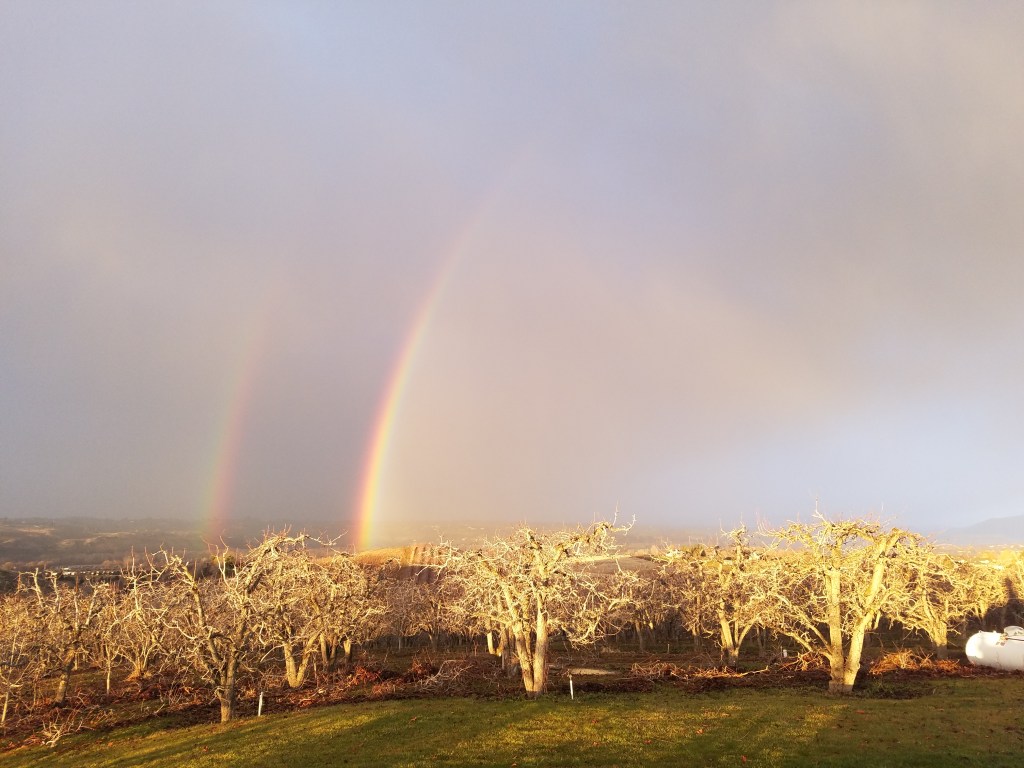
A double Rainbow which appeared the morning of January 1, 2020. The photo is looking west from my sister’s home in Selah, Washington. The hubby and I were headed home that morning, and we saw multiple Rainbows as we traveled.

I chose today to discuss rainbows since it was on this date in 2017 when a single rainbow was observed for nearly nine hours! The Guinness Book of World records shares:

“The longest lasting rainbow observation is 8 hours and 58 minutes and was achieved by Chinese Culture University (Chinese Taipei) at Yangmingshan, Taipei, Chinese Taipei, on 30 November 2017.”

The world record rainbow in Taipei on November 30, 2017. Not only was it the longest but several different Rainbow phenomena were present that day.

Rainbows have been referenced throughout human history. I imagine that most Americans are familiar with, for example, the story of Noah and the appearance of the ‘bow in the clouds’ as a sign from God that he will never again destroy the world. The rainbow has been a sign of hope, and used as such, throughout history. A myriad of organizations, businesses, and movements have adopted the rainbow as their symbol. All of which speaks to the universal experience of seeing one.

In addition to a regular rainbow, they’ve been observed with double arcs, and full circle rainbows have been seen from planes. There are also twinned, supernumerary, reflection, and monochrome rainbows.

One thing the Infallible Wikipedia did NOT cover was something I experienced and posted on Facebook a few years ago:

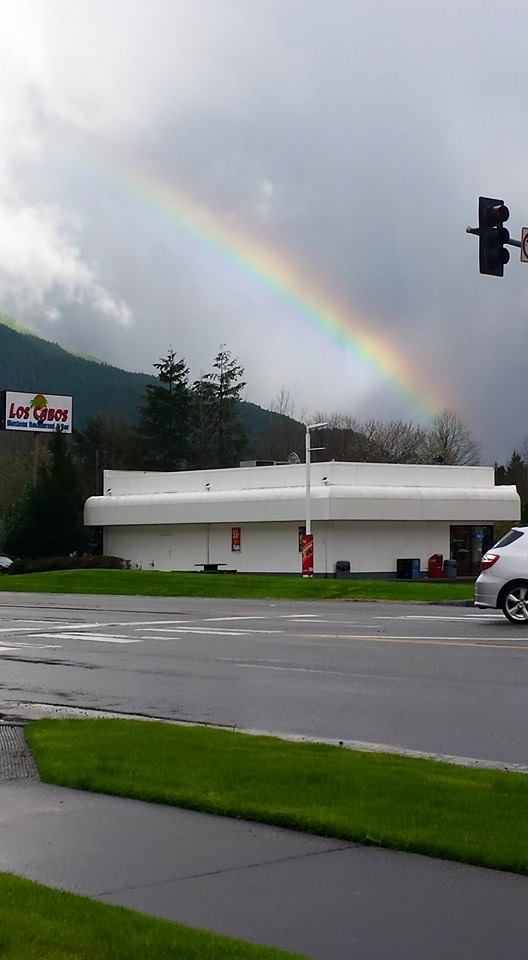
Photo I took of a rainbow in North Bend, Washington, March 2016. About 15 minutes later I ‘drove’ through it.

“Have you ever driven through a rainbow? I’ve done it twice. It’s an incredibly intense experience. The first time was in September 2005 as I was driving a van load of girls back from a trip to the beach. The second time was a year ago March on my way to Yakima. Here’s what happens. The sun is behind you creating the rainbow through the prism of raindrops. As you get closer and closer the light and the colors get more intense until, at last the two merge together in brilliance. A moment later you are enveloped by the sky which has turned dark and gray. The legend is that the rainbow vanishes as the searcher approaches. .. I think that more accurately it vanishes behind you. Here’s the rainbow I drove through about 15 minutes after this photo was taken in North Bend in March 2016.”

I will elaborate a bit further. I was headed southeast and up the hill out of North Bend, Washington, heading across Snoqualmie Pass to Yakima. The rainbow, ever present, shifted from my left side and was now directly in front of me. It grew larger and larger; the rain poured down. I could sense that at some point the rain was going to win out against the sun which was now shining directly from behind me. At the instant it happened, the world was bathed with intense color – red mostly – and a moment later the brilliance evaporated, leaving only a monotone world of grays as if someone had switched off the color.

I think that the automobile is what makes this phenomenon possible as you can travel at a speed which allows you to move out of the sunlight. Even a hundred years ago I doubt it occurred. I can find no recorded accounts (besides my own) of this sort of event happening. My wish for everyone is to experience it once. It truly was one of the most memorable things I’ve ever encountered.

The links:

https://en.wikipedia.org/wiki/Rainbow

https://www.guinnessworldrecords.com/world-records/66553-longest-lasting-rainbow

https://www.guinnessworldrecords.com/news/2018/4/record-confirmed-for-stunning-taipei-rainbow-that-lasted-for-almost-9-hours-520704

Who Shot J.R.?

It was the question everyone was asking

March 21, 2017

It was on March 21, 1980 when the whole world was left asking the question “Who shot J.R.?”

Need I explain further? I doubt it because – unless one was living beneath a rock – the buzz around the water cooler for the next 8 months centered on this popular cultural phenomenon.who shot J.R.

They took bets in Vegas, speculated on radio and TV programs, sold “Who Shot J.R.?” T-shirts, sponsored guessing contests and created a publicity hype never before seen.  Some 83 million people viewed the follow up episode in November that year, more people than voted in the 1980 presidential election! At the time ‘Who done it’ (the reveal) was the most watched TV program in history, only being topped in 1983 by the final episode of MASH.

“In the final scene of the 1979–80 season, J.R. Ewing (Larry Hagman) hears a noise outside his office, walks out to the corridor to look, and is shot twice by an unseen assailant. The episode, titled “A House Divided”, was broadcast on March 20, 1980. Viewers had to wait all summer to learn whether J.R. would survive, and which of his many enemies was responsible.

Ultimately, the person who pulled the trigger was revealed to be Kristin Shepard (Mary Crosby) in the “Who Done It?” episode which aired on November 21, 1980. Kristin was J.R.’s scheming sister-in-law and mistress, who shot him in a fit of anger. J.R. did not press charges, as Kristin claimed she was pregnant with his child as a result of their affair.”

The Infallible Wikipedia – as it is wont to do – has an exhaustive account of the series:

“With its 357 episodes, Dallas remains one of the longest lasting full-hour prime time dramas in American TV history, behind Gunsmoke (635 episodes), Law & Order: Special Victims Unit (525 episodes as of December 2022), Law & Order (475 episodes as of December 2022), Bonanza (430 episodes), and Grey’s Anatomy (406 episodes as of November 2022). Dallas also spawned spin-off series Knots Landing in 1979, which also lasted 14 seasons and a total of 344 episodes.

In 2007, Dallas was included in Time magazine’s list of ‘100 Best TV Shows of All-Time.”

Dallas was ‘must see’ TV in my family’s household and my mother rarely missed an episode. I’d call it a guilty pleasure. When the show premiered in April 1978 I was at the University of Puget Sound. It’s likely that my first exposure was the next month when I returned home for the summer.

It was discussed around the dinner table and my dad liked the idea of being Yakima’s “J.R. Ewing,” managing land holdings and running an oil business. This idea was not without a hint of reality. Property which my grandfather owned and had been gifted to my parents a few years earlier had been of interest to a Canadian Oil company. My dad was already managing the family fruit orchards; when the oil company arrived on the scene, my parents entered into negotiations to give the company drilling rights and a contract was signed. Ultimately their explorations determined that any oil which was there as being too difficult and expensive to extract; our family’s vision of being the next Ewing family evaporated faster than a summer rain squall in Texas. Personally I had a hard time imagining living on a piece of sagebrush covered, rattlesnake inhabited land. But I imagine it would have made for compelling story lines.

As always, you can read more about J.R., Dallas and the reverberations from this seismic TV event on the Infallible Wikipedia. https://en.wikipedia.org/wiki/Who_shot_J.R.%3F

The property near Yakima which had my dad dreaming of being a real life J.R. Ewing