His Life Was Like A Novel
June 13, 2023
A Tuesday Newsday Classic from June 13, 2017
“Let us go forth, the tellers of tales, and seize whatever prey the heart long for, and have no fear. Everything exists, everything is true, and the earth is only a little dust under our feet.”
Awarded the Pulitzer Prize for literature in 1923, William Butler Yeats interpreted the honor as belonging to his beloved Ireland. The poet was born on June 13, 1865 and, despite a number of years in England, his writing and politics were inspired by his early life on the Emerald Isle.
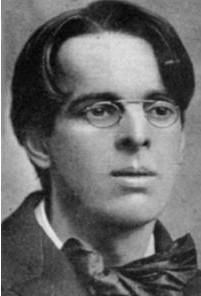
His poetry should be read through the lens of Yeats fascination with the occult. From the Infallible Wikipedia:
“Yeats had a life-long interest in mysticism, spiritualism, occultism and astrology. He read extensively on the subjects throughout his life, became a member of the paranormal research organisation “The Ghost Club” (in 1911) and was especially influenced by the writings of Emanuel Swedenborg. As early as 1892, he wrote: “If I had not made magic my constant study I could not have written a single word of my Blake book, nor would The Countess Kathleen ever have come to exist. The mystical life is the centre of all that I do and all that I think and all that I write.”
Personally, I find his own life’s story even more implausible than his writing. He met Maud Gonne, the woman who most inspired him, when he was 24 years old. Thus began a relationship which spanned over 30 years, involved four marriage proposals and four rejections AND a fifth proposal to Maud’s 21 year old daughter. Maud’s own story is book worthy and she must have been one heck of a woman!
In fairness to Yeats – who seemed to have some warped code of honor – the fourth proposal to her involved terms and conditions which he hoped she would find unacceptable. Once that final offer was rejected he sought out a younger woman (he was 51 by then) who could produce an heir. Since Maud’s daughter, who at the age of 15 had herself proposed to him, upon his proposal said no he found another woman:
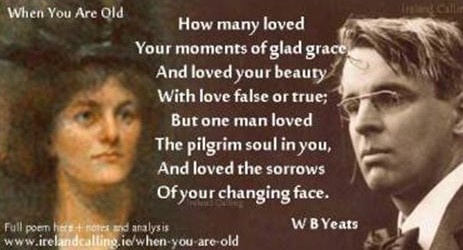
“That September, Yeats proposed to 25-year-old Georgie Hyde-Lees (1892–1968), known as George, whom he had met through Olivia Shakespear. Despite warnings from her friends—‘George … you can’t. He must be dead’—Hyde-Lees accepted, and the two were married on 20 October. Their marriage was a success, in spite of the age difference, and in spite of Yeats’ feelings of remorse and regret during their honeymoon. The couple went on to have two children, Anne and Michael. Although in later years he had romantic relationships with other women, Georgie herself wrote to her husband ‘When you are dead, people will talk about your love affairs, but I shall say nothing, for I will remember how proud you were.’”
Truly any fiction writer could not conceive of a plot line as convoluted as the true life of WB Yeats. Multiple proposals, unrequited love, political intrigue, and the execution of his romantic and political rival, connect the pieces of the tale!
One of the challenges in being a writer is deciding which of the myriad of ideas which populate my brain to bring to the page, so to speak. When I first read of Yeats life I thought, ‘now that would be interesting to research and write a fictionalized account of his life’.
But for anyone who has ever attempted – and completed – a novel, you know that it’s not enough to simply be interested. You have to be passionate about your topic.
The average mainstream fiction novel is between 75,000 and 90,000 words. To put that in perspective, I am capable – on my most prolific days – of writing about 2,500 words. It would take 36 days of doing that to get a 90,000 word novel written. Realistically, about 1,600 words per day are how many words I write before my brain starts getting lazy. Now it’s up to 56 days. As you can see, based on the amount of time you will spend with the story and the characters, you need to really love your story.
It is said that there are two types of writers: ‘plotters’ and ‘pantsters.’
The first, the plotter, is someone who maps out their entire novel, chapter by chapter, and writes little summaries of what’s going to happen.
The second is the author who writes by the ‘seat of their pants’, usually with a general idea of where they intend to go but it’s as much a mystery to them as it might be to someone who reads their work.
I discovered early on that I am firmly in the second category!
For every one of the seven novels I’ve completed, (For those keeping score at home I would say I land at about 85,000 words per novel, so I’ve written and KEPT 595,000 words) I’ve only ever had a concept of the story, not knowing where it would take me. For the plotters out there reading this you are, no doubt, running away in terror just about now.
But hear me out. I was about 30,000 words into one particular novel when I hit the dreaded sagging middle. For the non-novelist, this is the spot in the book when you run out of steam and ideas and your plot comes to a grinding halt. What to do?
The answer, almost always, is to introduce a new character.

So I was standing at my kitchen sink this one morning doing the dishes and contemplating how to get through the sagging middle. All of the sudden a voice – it was a man’s voice – says to me “Put me in the story.”
There is not anyone else in the house or the kitchen. But I knew who was talking to me. It was a character, introduced as a baby in the first book of the series I was writing, and he was definite about the request. He should be in the story.
And he was right. To this day, he’s one of my most favorite characters in, arguably, my favorite book which I’ve written, and his personality arrived fully formed and known.
So, despite knowing that someone could take Yeats story and write one heck of a fiction story based on his life, it won’t be me. I have too many characters living in my head that are waiting for their turn to help me do the dishes and convince me they need a voice.
 barbaradevore.com