Tag Archive | Nostalgia

Same Old Lang Syne

The Iconic song with a twist

December 28th

The end of December is, traditionally, a time to reflect on the year just past. No song is more associated with the ending of the year and the start of a new one than Auld Lang Syne.
It somehow seems appropriate that the origins of this poem and song are steeped in the mysteries of time. It was plucked from obscurity by Scottish poet, Robert Burns, in 1788. He set it to music and added verses which most closely approximate the song familiar to all.

The Infallible Wikipedia shares, of course, a plethora of information:

“Robert Burns sent a copy of the original song to the Scots Musical Museum in 1788 with the remark, ‘The following song, an old song, of the olden times, and which has never been in print, nor even in manuscript until I took it down from an old man.’ Some of the lyrics were indeed ‘collected’ rather than composed by the poet; the ballad ‘Old Long Syne’ printed in 1711 by James Watson shows considerable similarity in the first verse and the chorus to Burns’ later poem, and is almost certainly derived from the same ‘old song’. To quote from the first stanza of the James Watson ballad:

Scottish Poet Robert Burns

Should Old Acquaintance be forgot,
and never thought upon;
The flames of Love extinguished,
and fully past and gone:
Is thy sweet Heart now grown so cold,
that loving Breast of thine;
That thou canst never once reflect
On old long syne.

Chorus:
On old long syne my Jo,
On old long syne,
That thou canst never once reflect,
On old long syne.

It is a fair supposition to attribute the rest of the poem to Burns himself.

There is some doubt as to whether the melody used today is the same one Burns originally intended, but it is widely used in Scotland and in the rest of the world.

Singing the song on Hogmanay or New Year’s Eve very quickly became a Scots custom that soon spread to other parts of the British Isles. As Scots (not to mention English, Welsh and Irish people) emigrated around the world, they took the song with them.”

The song was popularized in the United States by Guy Lombardo who “is remembered for almost a half-century of New Year’s Eve big band remotes, first on radio, then on television. His orchestra played at the Roosevelt Grill in the Roosevelt Hotel in New York City from 1929 (snip) to 1959, and from then until 1976 at the Waldorf Astoria Hotel. Live broadcasts (and later telecasts) of their performances were a large part of New Year’s celebrations across North America; millions of people watched the show with friends at house parties. Because of this popularity, Lombardo was called ‘Mr. New Year’s Eve.’”

You would have had to have been born in a cave and lived in the wilderness your entire life to never have heard the song. In December 1980, another artist came along who wrote an autobiographical song which succeeded in connecting yet another generation to the concept of remembering, with a wistful nostalgia, days and people since gone.

Dan Fogelberg’s addition came about following a chance encounter with an ex-girlfriend on Christmas Eve in 1975. They run in to each other in the grocery store and then proceed to share a six pack of beer while sitting in her car at a mini-mart. It is, I think, the very ordinariness of the encounter which juxtaposes so very well with the emotions just under the surface.

Cover for the 1980 single

Somehow Fogelberg – who claimed to have begun the song more as a joke – ended up transforming the opening music from the 1812 Overture into a nostalgia filled classic that ends with Auld Lang Syne.

Perhaps the thing that makes the song resonate with so many people is that one recognizes – as one matures – that life is a series of binary choices. A first love, for example, is just that. A young person simply does not have the advantage of time and experience to understand that once a relationship is over it is likely to stay that way.

Fogelberg – in his song – encapsulates that moment of recognition and the emotion which comes with it:

We drank a toast to innocence

We drank a toast to now

And tried to reach beyond the emptiness

But neither one knew how

We drank a toast to innocence

We drank a toast to time

Reliving in our eloquence

Another ‘auld lang syne’

It is, though, the final few bars of the song which stops the listener and creates the ennui associated with endings… he leaves the car to walk back to his parents’ home and the ‘snow turns in to rain.’ It is at this moment when Fogelberg uses Auld Lang Syne to such devastating effect through a soulful, blues filled saxophone rendition.

Although many regard the song as a Christmas one due to its taking place on December 24th, I’ve always thought it belonged to the last week of December when, as we take down our calendars and put up the new ones, we reflect on the year just past and remember those who are no longer with us.

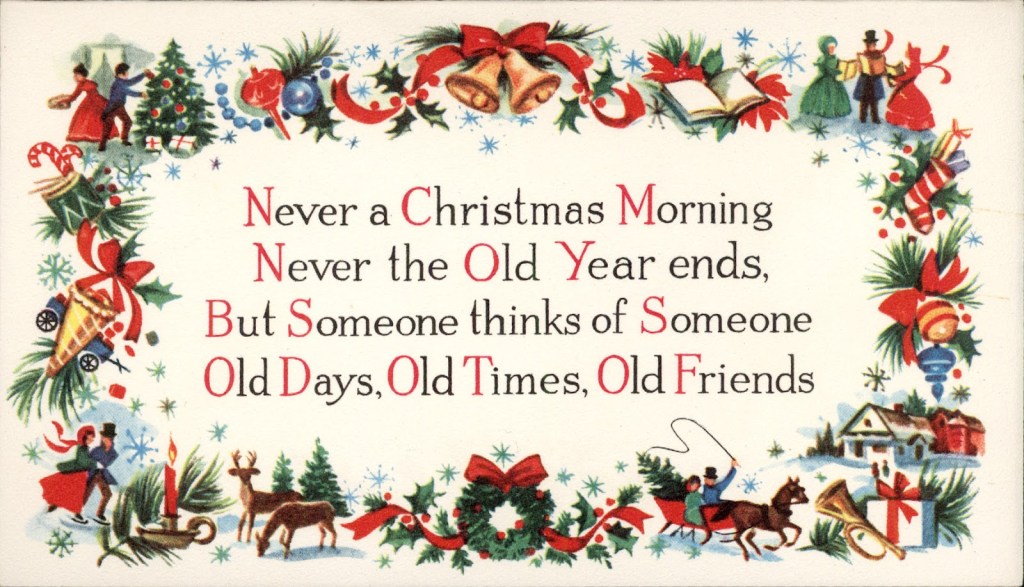
So here’s a toast to Auld Lang Syne with a short verse which is one of my favorites:
https://en.wikipedia.org/wiki/Auld_Lang_Syne

https://en.wikipedia.org/wiki/Same_Old_Lang_Syne

Discovering Dad’s Mustang: A Heartfelt Reunion

EEE 161 Rides Again

March 9th

A Tuesday Newsday Classic

It was on March 9, 1964 when the first Mustang automobile rolled off the assembly line at Ford Motor company’s Dearborn, Michigan plant. Today, the Mustang continues as one of the best selling and most popular cars ever produced by Ford.

For those who have been reading my blog for several years, you may recall that three years ago I posted about the 1965 Mustang here: https://barbaradevore.com/2018/04/17/1965-ford-mustang/

Today’s Tuesday Newsday is going to be a bit of a departure, as I have nothing particularly new from the Infallible Wikipedia to share on this topic. You can, of course, go there and read up on everything you might hope to learn about the Mustang.

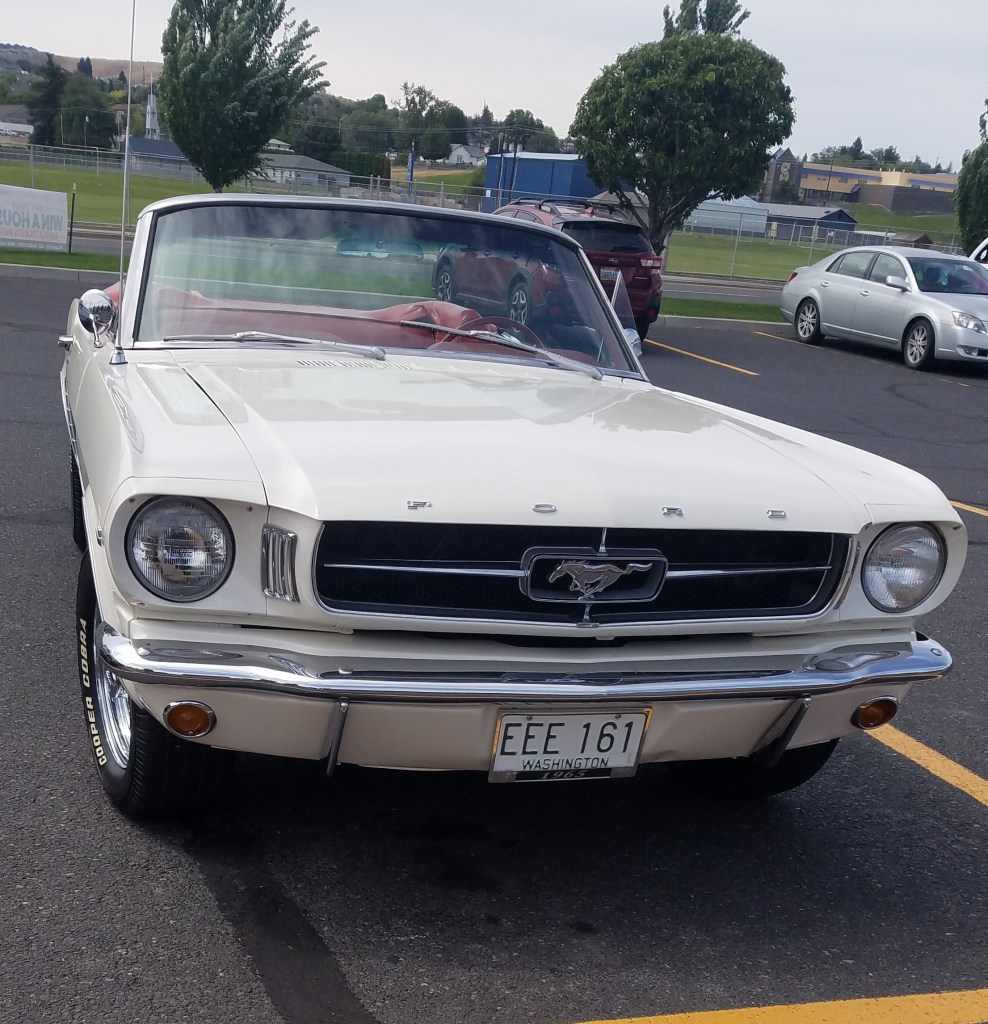
My Dad’s 1965 White Mustang convertible

What I do know is that the Mustang was a huge hit from the day it launched and has spawned clubs for owners, like the Mustang Club of America, matchbox cars, models, and an almost cult like following for the distinctively designed vehicle.

As with the Volkswagen beetle, or the Porsche, or the Corvette, the Mustang’s of the 1960’s are instantly recognizable and highly collectible.

While the majority of the early Mustangs have ended up in junk yards and recycled, some have been lucky enough to survive down through the years. This is the story of one such Mustang.

We pick up the story of the Mustang my Dad purchased slightly used circa 1966. It is now July 11, 2020 and my father has been gone just over 10 months. Despite being in the middle of the Covid Pandemic, I have estate business to tend to and have traveled to Yakima and am staying with my sister. Her home is situated in the middle of apple, cherry, and pear orchards just west of Selah – a smaller city four miles north of Yakima. Yakima County boasts a population of just under 250,000 people so it is not huge, but is certainly not small either.

On this particular Saturday it’s sunny and warm with a high in the low 90’s. In the mid-afternoon the two of us drive down into Selah in my sisters Honda with a load of items to be donated to Goodwill. From there we head south to a Safeway store in Yakima for a few dinner items. Our intended route is actually a big circle as we head to her place via the ‘back’ way which is to travel west on highway 12, then north on Old Naches Highway, and finally head east up Mapleway Road.

My sister is driving and we are, as is our nature, chatting away. Just as we reach the crest the hill I notice a white convertible about 500 yards ahead of us. It’s distinctive Mustang back end causes me to blurt out, “Look, it’s Dad’s car.”

A wave of nostalgia washes over me. Oh those summers when we drove around with that black rag top down, flirting with boys during forbidden runs up and down Yakima Avenue, not a care in the world with real life still a few years away.

A moment in time. It’s Memorial Day weekend 1973. We are getting the car ready so that the Yakima Rainbow Girls can ride in the convertible for the parade. In the photo are my Mom supervising (in her bathrobe!), my Dad and sister securing the red leather seatback cover, and my best friend Pam standing in the open car.

Of course, I didn’t really think it WAS my dad’s car. After all, he had sold the car in the 1980’s and the family lost track of it over the years. Realistically, what were the chances the car still existed? Even so, I urged my sister to get a little closer so we could at least see the license plate. She obliged and I strained my eyes to make out the letters and numbers.

EEE 161.*

“It IS dad’s car!” I exclaim. “Follow him!”

The Mustang, now at a stop sign where the main road goes right, turns. A minute later we are at the same spot and also turn right. A minute after that, we sail past the road which leads to my sister’s house and are headed back down into Selah, retracing our route from earlier.

On we go, now in hot pursuit of Dad’s car.

“I want to talk to him,” I tell her. From behind we can tell it’s a middle aged man sporting a baseball cap driving the car.

We travel past the school, city hall, the bank, the telephone company, and turn north on Wenas Road. My eyes are fixed on the Mustang wondering just how far he’s going to drive. From my perspective, it didn’t matter. Catching up with him was my goal; being with the car once again important somehow.

My sister pulls into the left lane to try and get up next to the car but then the driver signals a right turn into the parking lot of the True Value hardware store. We sail past.

It takes us several minutes to get turned around but at last we pull up next to the parked – and now empty – car and wait for the driver to return.

Not wanting to be creepy or draw suspicion, I force myself to sit and wait. And wait. And, after five interminable minutes our quarry emerges from the store headed to his car which was once my Dad’s car.

I climb out of the passenger seat of my sister’s vehicle and step forward, catching his attention.

“This will be the weirdest conversation you’ve had all week,” I say and then continue, “But this was my Dad’s car.”

“Really? He must have sold it to my Mom back in the early 1980’s. What was his name?”

“Vincent DeVore. I’ve never forgiven him for selling it.”

This elicits a chuckle. I forge on. “Unfortunately my dad passed at the end of October. But I think it would please him to see what great shape the Mustang is in.”

“I’m sorry about your Dad. My mom died in December. The car was stored in her garage until January when it came to me.  She had the leather seats recovered and the whole thing has been repainted. She used to take it to the classic car shows. She loved this car.”

“It looks amazing,” I say and mean it.

“Yeah. I learned to drive in this car,” he says and to which I reply, “So did I! It was the best.”

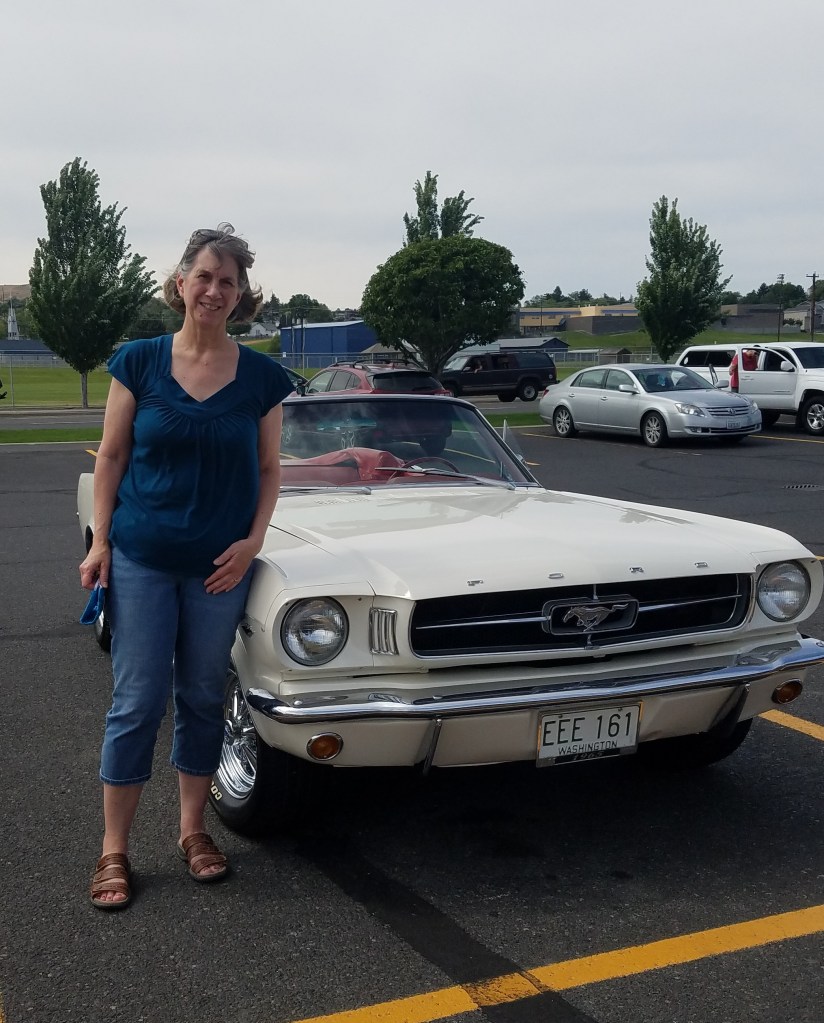
What then followed was the snapping of a couple of photos of both my sister and I with the car. We also learned that he lives less than a mile from my sister and is the neighbor of my brother-in-law’s best friend. And that day was the first day he’d had the car out and driving around with the top down, reliving just for a short time, his sweet teenage memories in the car of his – and my youth.

My sister enjoying being reunited with EEE 161.
Maybe next time I’ll get to sit in the car once again

As for me, it was only one of several surreal events following my Dad’s death. In a way I found it comforting and, every once in a while, am reminded that even though Dad is gone, his spirit lives on.

*In 1958, license plates in Washington were assigned by county. All plates in Yakima County started with the letter “E.” The Mustang’s plate was likely issued new with the car in 1965. Visit this website for how this all worked. http://staff.washington.edu/islade/counties/index.htm

https://en.wikipedia.org/wiki/Ford_Mustang

Funny how a Melody…

… Sounds like a Memory

June 23, 2020

20160802_203234Of all the seasons, summer is the one which seems to take us back to our youth. That sentiment is related, perhaps, to the provenance of children, whose best days happen when that school bell rings on the last day of classes. Ahead stretches a glorious few months of getting to play all day and curfews that seem to follow the long arc of light as it stretches into twilight.
For these reasons, I suppose, the summer solstice is an occasion to wax a bit nostalgic as we recall those childhood evenings playing kick the can until Dad yelled from the front door to come home. It was also the season for teenagers when evenings were spent with friends and, if one was lucky, perhaps a bit of romance was discovered.

Many a musical artist has captured that nostalgia but none, in my opinion, quite as effectively as Eric Church with his number one country hit “Springsteen” which topped that chart on June 23, 2012.

As always, the Infallible Wikipedia shares a bit of information:

“ ‘Springsteen’ received critical acclaim from many music critics. Billy Dukes of Taste of Country gave the song five stars out of five, calling it ‘the best song from one of 2011’s top country albums.’ Matt Bjorke of Roughstock also gave the song five stars of five, writing that ‘the strong, sing-a-long lyrics and driving, percussive melody brings Eric Church to an accessibility that he’s previously never had.’ Noah Eaton of Country Universe gave it an A-, saying that it is ‘a gorgeous, bittersweet anthem-to-be that will likely leave even some more hardened hearts simultaneously smile and cry listening.’  Eaton went on further to say that this song would propel Church’s career to the next level. American Songwriter chose the song for its Lyric of the Week feature, for the week of June 11, 2012.  The song was nominated for two Grammy Awards – Best Country Solo Performance and Best Country Song – on December 12, 2012, but failed to win any of the awards at the ceremony in 2013.

Thom Jerek of AllMusic said the song had ‘a clever, if somewhat cloying, tune, but it gets the feeling across in spades.’  The A.V. Club reviewer Steven Hyden claims that Church ‘is just as effective on slower, more thoughtful songs like ‘Springsteen’ and that the song ‘[reflects] reflecting on music’s power to revive forgotten emotions from the past.’

Bruce Springsteen himself took note of Church’s music, specifically the song ‘Springsteen’, and wrote Church a note on the back of a setlist. Church received the letter from Springsteen after a show on August 19, 2012. In the note, Springsteen explained his and his family’s love of the song and that he hoped to have their paths cross at some point. Church was surprised when receiving the note and said that ‘it’s a long note, takes up the entire back page of this setlist for a show that lasted three hours and 47 minutes.’”

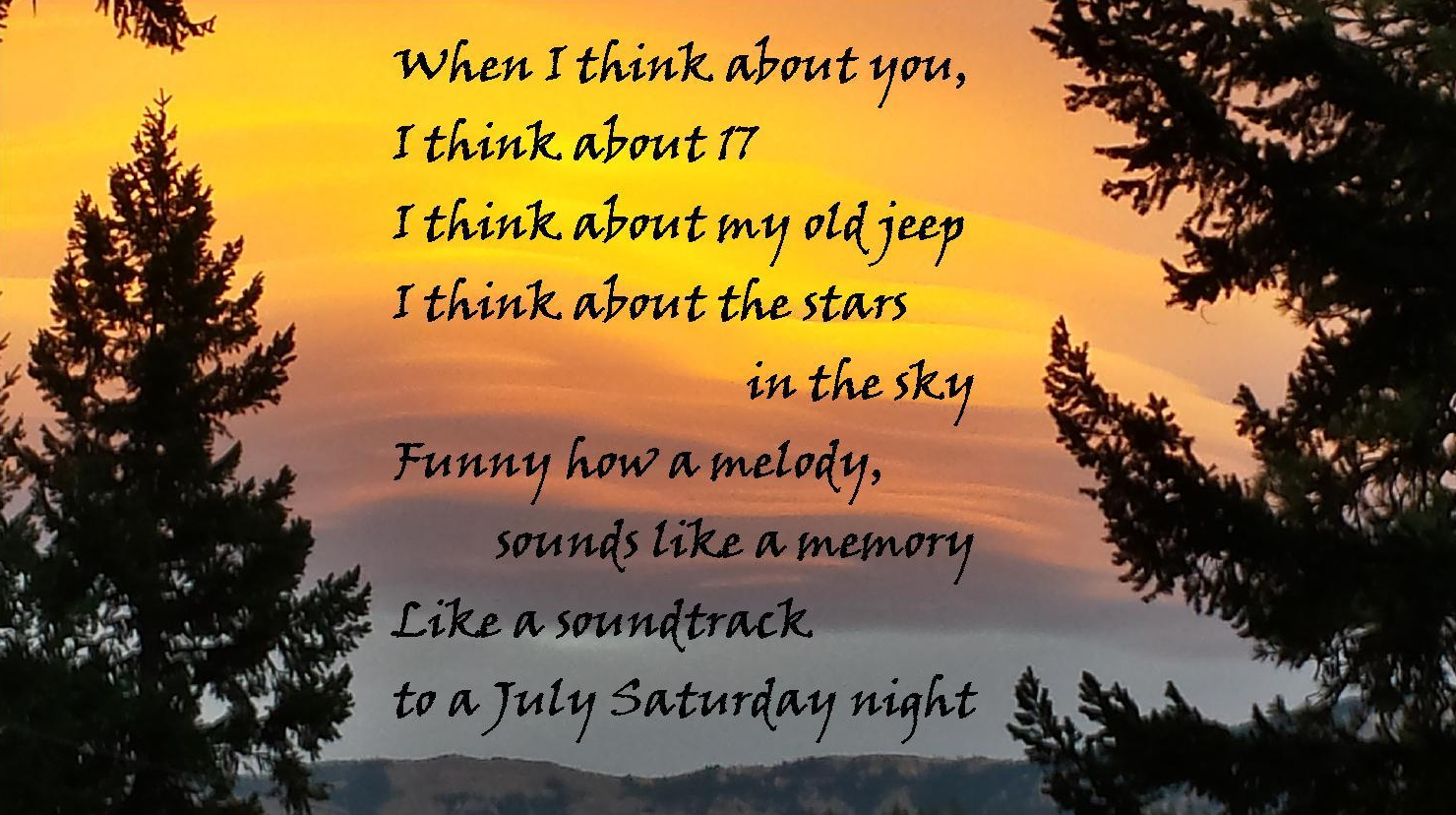
Between the ennui inducing lyrics and the memorable tune, Church’s song sounds as fresh as it did twelve years ago. He nailed it in the refrain with these lyrics:

Springsteen lyrics meme

Church, like so many great songwriters, based his song on a relationship he had. It wasn’t a Springsteen song which provided the actual music, however. That, to the best of my knowledge, is a well kept secret. From the SongFacts website:

“Church told Reuters this is his favorite song from Chief (his third album). He explained: ‘I lived that song. I was 15 years-old and she was 16. We had that love affair where you connect with someone, and the artist that was playing becomes a soundtrack to your relationship. We didn’t stay together, but to this day, when I hear Bruce Springsteen, I think of her and I hope she thinks of me.’”

A few weeks ago, my blog was about the radio (https://barbaradevore.com/2020/06/02/like-a-song-on-the-radio) and how important that was to the teenagers of my era. We listened for many an hour in hopes of hearing our favorite songs over and over and over. It was inevitable, then, that there are songs which instantly transport us back to another place and time; songs which are associated with events and the people who were significant to us then.

When you walk outside some evening this summer – and look up at the lingering colors in the fading light – perhaps you, too, will recall a melody which sounds like a memory to you, like a soundtrack from a July Saturday night.

And a couple of links:

https://en.wikipedia.org/wiki/Springsteen_(song)

https://www.songfacts.com/facts/eric-church/springsteen