Tag Archive | Costco

Hedonic Escalation

What is the magic combination?

March 19, 2024

A Tuesday Newsday Classic updated

I can think of nothing which tastes better and scientific study now backs up my claim.
Salted caramel is the number one food that people can’t seem to stop eating.

Termed ‘hedonic escalation’ the research confirms what people experience when they are unable to stop eating a particular food. This article from the UK Independent – and  not from the Infallible Wikipedia – draws its conclusions from a test conducted at the University of Florida a few years ago:

“Marketing analysts Dr. Cammy Crolic and Professor Chris Janiszewski revealed that eating it actually causes a rare phenomenon called ‘hedonic escalation.’

Here, our instinctive brains keep craving more and more with every mouthful as it detects new flavours with each bite.

By contrast, with other foods we tend to experience ‘hedonic adaptation’ – the point where your appetite says you’ve had enough.

‘Hedonic escalation is more likely to occur when a palatable food consists of a complex combination of flavours, and a person is motivated to taste additional flavours on each successive bite,’ the researchers write. ‘Hedonic escalation can also increase consumption and influence food choice.’”

So what is this mystery food?

Salted Caramel.

Today, March 19th, is National Chocolate Caramel day, the perfect day to enjoy two perfect foods together.

I’ve noticed more and more foods touting the substance in recent years. In December 2018, during a pre-Christmas shopping trip to Costco, I happened upon a jar of Dark Chocolate Sea Salt caramels. Over the past several years I have found that when, given a choice of chocolates, I tended to seek out the dark ones with caramel. So when I saw this large jar AND it was dark chocolate, I had to have them.
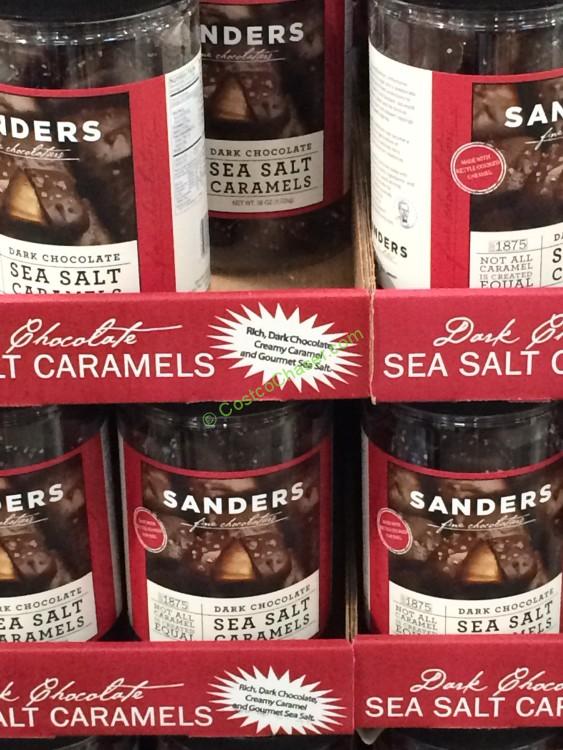
A palette of delight awaits at Costco. You can also now buy them online.

Once home, I selected a morsel from the jar and took a bite. The first taste was wonderful, the second was heaven, and by the time the morsel was consumed I was addicted.  Fortunately for me I have pretty good discipline when it comes to eating. So I was good and did not eat the entire jar.

Over the next couple months I showed, in my opinion, amazing restraint.  Each day I would have one; at most. Soon Christmas gave way to January but the jar of deliciousness remained. Committed to the ‘only one a day’ program – and sometimes none – the supply lasted. By the time early March rolled around, however, one day I stared forlornly at the nearly empty vessel

I knew I would miss my Dark Chocolate Sea Salt Caramels because, Costco being Costco they were, no doubt, only available for the holiday season.

Then a couple of days later a miracle occurred. The hubby and I were at Costco (one or the other of us seems to be there at least once a week…) and on a whim I haul him over to the candy and chocolate aisle to see if there was anything else which might fill the void in my life.

 And then I spied them!

A glorious Costco size stack of jar after jar after jar of Sanders Dark Chocolate Sea Salt Caramels beckoned to me. Oh, sweet mysteries of life!

Being that I was obsessed, I shared far and wide – with anyone who would listen about the wonders of this perfect food –  of the joys of hedonic escalation. When I first published this article in March 2019 I imagine I snagged at least a few folks who went in search themselves.

Even so, my biggest fear since 2018 has been that Costco will run out (Regular price is about $18 but you can get your own 36 ounces of wonder for about $14 on sale) or cease to carry this product. Thus far, it has been a perennial selection all seasons of the year. More than a few of my friends and families now also keep it on hand.
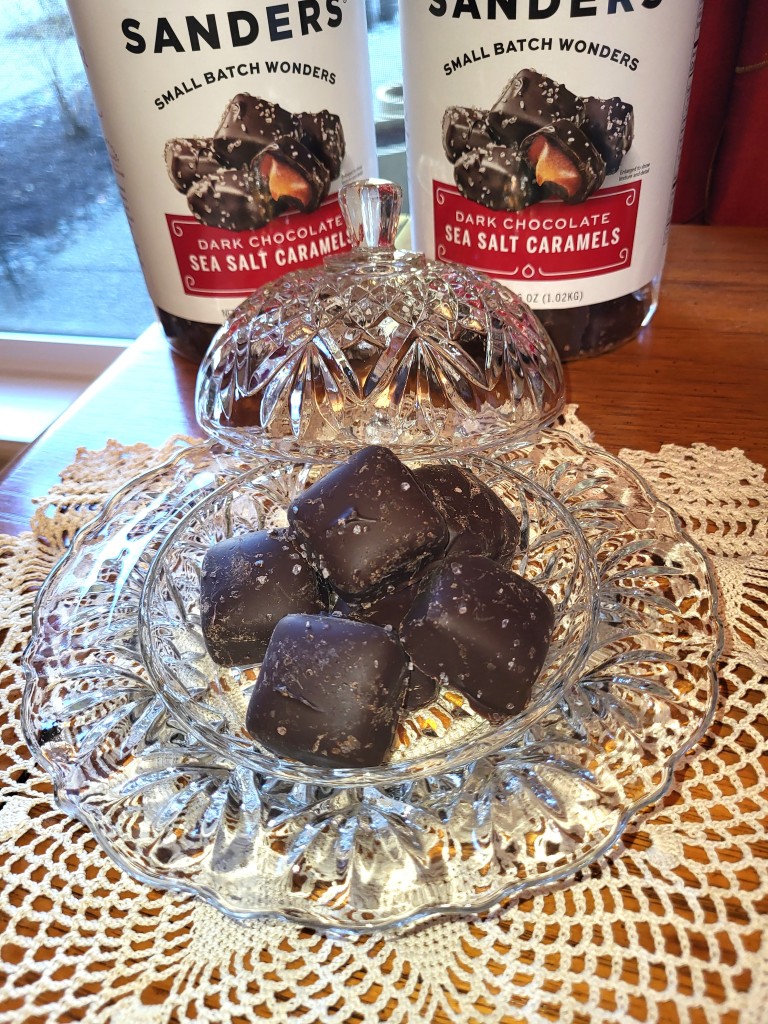
My current supply of Sanders Dark Chocolate Sea Salt Caramels. Thanks to the hubby there are two full jars waiting for me when the last of the current jar are gone (sometime this week likely)

But this article is a call to action. What I urge everyone who reads my blog to do is this: go to Costco today and buy at least one jar. It’s the least you can do to properly celebrate National Chocolate Caramel day. Plus, if I know anything about Costco, the more they sell, the higher the likelihood they will keep them on the shelves forever. Do it for you. Do it for me. Do it for all of America.

A couple of important links:

On Hedonic Escalation:

https://academic.oup.com/jcr/article-abstract/43/3/388/2199201?redirectedFrom=fulltext

https://www.independent.co.uk/life-style/salted-caramel-not-stop-eating-science-university-florida-hedonic-sugar-fat-a8078296.html

You don’t even have to leave home! If Amazon or some other retailer is your preferred dealer, a quick internet search reveals many who now sell this product.

https://www.costco.com/Sanders-Dark-Chocolate-Sea-Salt-Caramels-36-oz.%2c-2-pack.product.100321779.html

p.s. – I considered writing about the history of chocolate and caramel but tossed that out the window. For those who do not know, Chocolate’s origins can be traced to MesoAmerica some 1500 years ago.

And Caramel? It’s simply cooked sugar! What’s not to like?

Instant Ramen: A College Staple and Cultural Phenomenon

A once banned food now a beloved Japanese favorite

August 25th

According to one Japanese poll, this food was named as the greatest invention of the 20th century.  Since a package of this costs between 50 cents and a dollar, it’s not only inexpensive, but it is easily one of the most adaptable instant foods you can purchase. Yes, I’m talking about the staple of college dorms everywhere: instant ramen noodles.

It was on August 25, 1958, when the first packages of the instant noodles were sold. But the history of ramen began much earlier.

How the first ramen was packaged, 1958

According to the Infallible Wikipedia:

“Ramen is a Japanese adaptation of Chinese wheat noodles. One theory says that ramen was first introduced to Japan during the 1660s by the Chinese neo-Confucian scholar Zhu Shunsui who served as an advisor to Tokugawa Mitsukuni after he became a refugee in Japan to escape Manchu rule and Mitsukuni became the first Japanese person to eat ramen, although most historians reject this theory as a myth created by the Japanese to embellish the origins of ramen. The more plausible theory is that ramen was introduced by Chinese immigrants in the late 19th or early 20th century at Yokohama Chinatown. According to the record of the Yokohama Ramen Museum, ramen originated in China and made its way over to Japan in 1859. Early versions were wheat noodles in broth topped with Chinese-style roast pork.”

Interestingly, it was in post WWII Japan, when the product really took off. Faced with rice shortages and a disrupted food supply line, inventive Japanese food vendors began making the noodles with cheap wheat purchased on the black market. Despite government attempts to keep vendors from making and selling the dish – they arrested thousands for doing so – it was one of the few things people could find to eat inexpensively. By 1950, the Japanese government relented, thus allowing the wheat noodles to find a place in the rice dominated culture.

In 1958,  Momofuku Ando – the founder of Nissan foods – developed a method by which the noodles were flash cooked, dried, and then sold in small blocks.

Also from the Infallible Wikipedia:

“Instant ramen allowed anyone to make an approximation of this dish simply by adding boiling water.

Beginning in the 1980s, ramen became a Japanese cultural icon and was studied around the world from many perspectives. At the same time, local varieties of ramen were hitting the national market and could even be ordered by their regional names. A ramen museum opened in Yokohama in 1994.

Who wouldn’t want to visit the Ramen museum just to see this giant bowl?

Today ramen is arguably one of Japan’s most popular foods, with Tokyo alone containing around 5,000 ramen shops, and more than 24,000 ramen shops across Japan.”

I became intimately acquainted with ramen soon after setting foot on the campus at the University of Puget Sound in 1977. Every member of my sorority, it seemed, had a small kettle and a stock of ramen packages in a desk drawer. It was one of two foods that seemed to dominate evening study time, the other being popcorn.

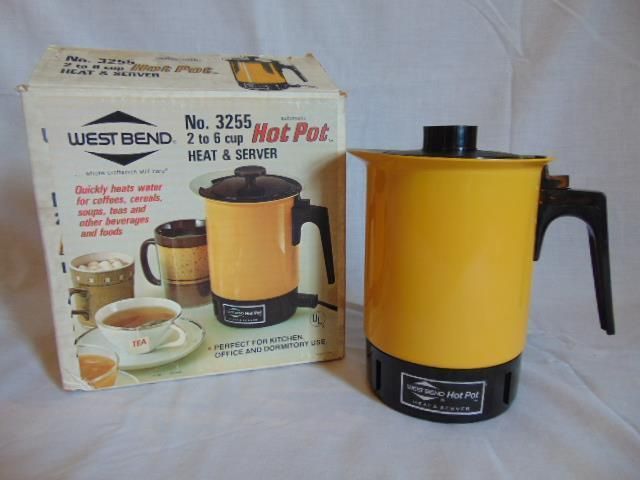
Soon, I too owned a West Bend electric teapot and a stock of ramen packets. I found one ad from 1979 where you could purchase it for a quarter a packet, but I do recall finding the coveted 10 for a dollar sales even into the 1990’s.

I think my pot was green but it might have been this lovely yellow

In my early ramen eating years, I was a purist; I’d boil my water, then drop the dried noodles into the pot and cook until they softened, finally adding the sodium laced flavoring.

After I met the man who would become my hubby, I learned that ramen could be so much more. He elevated ramen to an art form.

In Japan, the traditional way is as a soup of ramen and pork. But in our household, ramen is a vehicle for serving every sort of leftover. All meats can be added to it; stir in an egg for poor man’s egg flower soup. Tomatoes, celery, carrots, onions? All good in ramen. Perhaps the hubby’s favorite thing to add would be canned ‘Vienna’ sausages or hot dogs.

He recalls one college incident which revolved around ramen. Senior year he and two friends rented an apartment; one evening he was making a ramen concoction for his dinner. One of his roomie’s parents arrived on the scene to take their son to dinner. The roomie’s mom – upon seeing the ramen feast being prepared – was so horrified at this being my hubby’s dinner, insisted on taking him to dinner also.

The family ramen legacy was eventually passed to the next generation. Our daughter discovered the joys of ramen when she was an always hungry pre-teen and teen. Instead of asking Mom what was to eat, she learned early that she could fix it herself and probably consumed at least one package of it daily for many years. Cooked or dry did not matter. She loved it either way.

As an adult advisor for the Rainbow Girls, there was a parade of youth who showed up at our house regularly during those years. One girl was such a fixture that she knew exactly where the ramen was kept. Her arrival often meant that her first stop was the pantry where the Costco box of ramen occupied one end of the shelf. A few minutes later, the ramen cooked, we would settle around the table to chat. To this day she claims this as one of her favorite memories of our house.

The ubiquitous Costco 48 pack

The days of teens raiding the cupboards behind us, and my husbands ramen consumption reduced, the last Costco case of the stuff (48 packets – half beef, half chicken) is now gone. In fact, for the first time in the 40 years we’ve been married, there’s not a single package of ramen in the household.

When I inquired as to why, the hubby explained that he intended to get a ‘few’ packages at the grocery store instead of the industrial size Costco case. And there’s that pesky salt thing. One package of ramen is 1600 mg, a whopping 69 percent of the recommended daily salt intake.

Even so, it doesn’t seem right for us not to have a few packets of ramen just in case. Earthquake… Wind Storm… Pandemic…all good reasons to keep some on hand. Adding it to the grocery list. Who am I to argue with those who claim it to be the greatest invention of the 20th Century?

Costco’s supply of ramen takes up almost as much space as the Ramen museum

Yes, there really is a page on Ramen on the Infallible Wikipedia.:

https://en.wikipedia.org/wiki/Ramen