Tag Archive | Clarkston Washington

The Colorful Tradition of Dyeing Easter Eggs

A favorite family activity

April 22

When I typed the word ‘egg’ into the Infallible Wikipedia, it returned Egg, Eggplant, Eggs as Food, Egg decorating in Slavic Culture, Egg Harbor Township in New Jersey, and Eggnog.
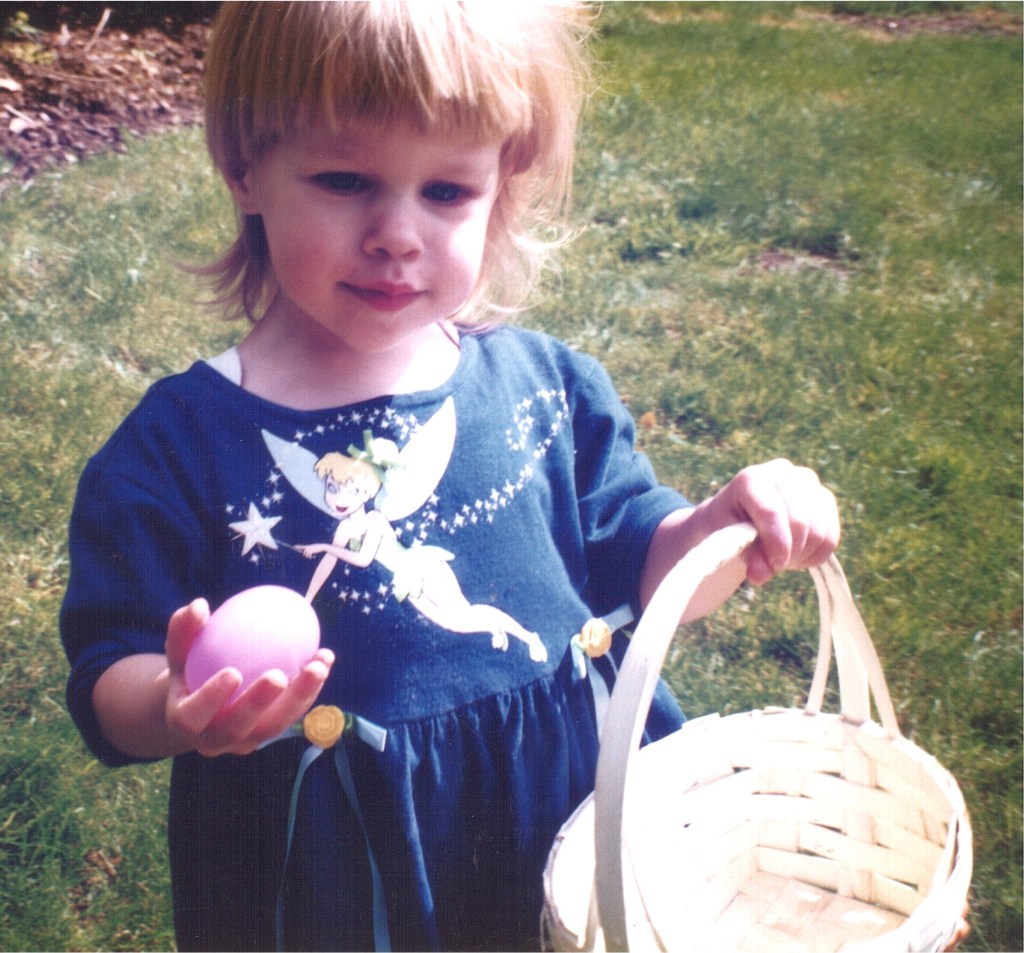
My daughter finding Easter Eggs. April 16, 1995.

While most people likely give little thought to eggs, they have – over the past couple of months – become one of the most talked about things in the United States. I’ve seen posts on Facebook and other social media with people complaining about the egg shortages which have swept the country and, of course, the skyrocketing price of eggs. About a month ago, I even overheard someone asking a Costco employee when they would be getting eggs again (since they were out of eggs that Saturday afternoon).

“Monday morning at ten will be the next delivery.” Guess where I was at ten that Monday morning?

But the egg shortage didn’t hold my interest. Instead, it’s the tradition of dyeing eggs for Easter.

Narrowing my search, I typed in “Easter Eggs.” It returned the one I wanted and yet another set of egg related pages including Easter Eggs in media, an Easter Egg tree, and – I kid you not – an “Easter Egger” – a breed of chicken. Eggs are, it turns out, a very popular topic.
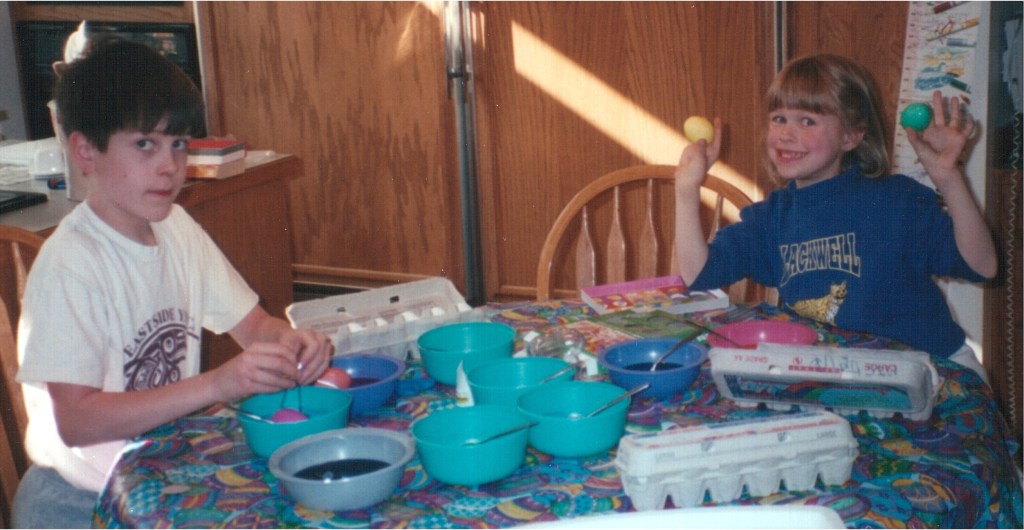
The dyeing of Easter eggs was a big deal for my kids. 1999.

But back to the Easter Egg. The dyeing and decorating of them is a tradition which goes back nearly two thousand years, begun by early Christians in Nicaea around 325 A.D. According to the aforementioned Infallible Wikipedia:

“Eggs in Christianity carry a Trinitarian symbolism as shell, yolk, and albumen are three parts of one egg. According to many sources, the Christian custom of Easter eggs started among the early Christians of Mesopotamia, who stained them with red colouring ‘in memory of the blood of Christ, shed at His crucifixion’. The Christian Church officially adopted the custom, regarding the eggs as a symbol of the resurrection of Jesus, with the Roman Ritual, the first edition of which was published in 1610 but which has texts of much older date, containing among the Easter Blessings of Food, one for eggs, along with those for lamb, bread, and new produce.”
The DeVore siblings showing off their eggs, Easter 1961. (taken from a Super8 movie reel)
The author with her bounty of eggs. Age 3.

While every holiday has something to recommend it, I think the dyeing and hiding of Easter Eggs makes this holiday one of my favorites. There are home movies from when I’m three showing off my Easter eggs at the family home in Clarkston, Washington.  And, again, at various ages after we moved to Yakima. For a few years, we would join our cousins at my grandparent’s cabin up at Rimrock Lake and one year my grandmother hid eight dozen eggs. Yes, that’s right. She hid 96 eggs out in the long grasses. Not all 96 were found. The next year Easter was in late March and as it was too cold to hide them outside, she squirreled the nearly 100 eggs into every nook and cranny of the 1000 square feet available. I’m thinking all eight of us grandchildren were sent upstairs to the sleeping loft while the six adults remained on the first level. Not all of those were found either. At least not until later that spring when the missing eggs started to smell according to family lore.
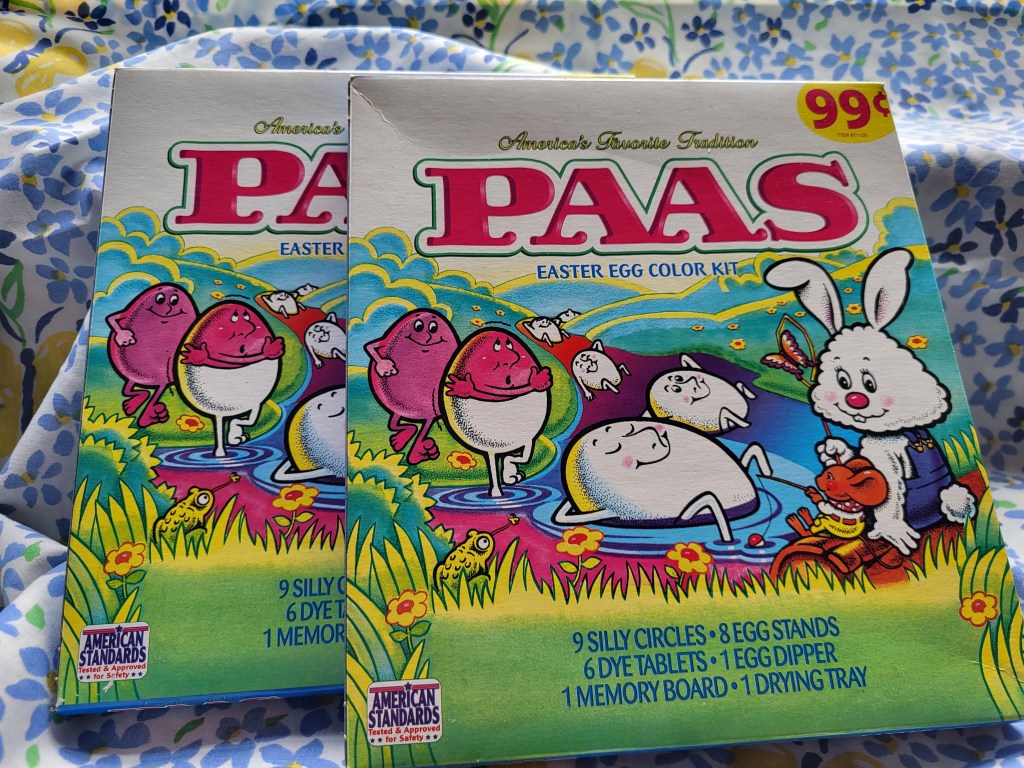
Alas, I grew up and quit dyeing Easter eggs. That was until I had kids of my own. And then it was full steam ahead! Every year I’d buy the PAAS egg tabs and soon had vinegar-based dyes in blue, green, yellow, red, orange, and purple. For a few hours I was transported back to my own childhood and the fun of coloring eggs; passing on the colorful tradition to my own children.

It was always fun to watch their brains at work. How many green ones? How many blue? How do you create one with every color on it? One year I think my son dyed all his eggs some shade of blue, while my daughter wanted the entire rainbow on every one of hers.
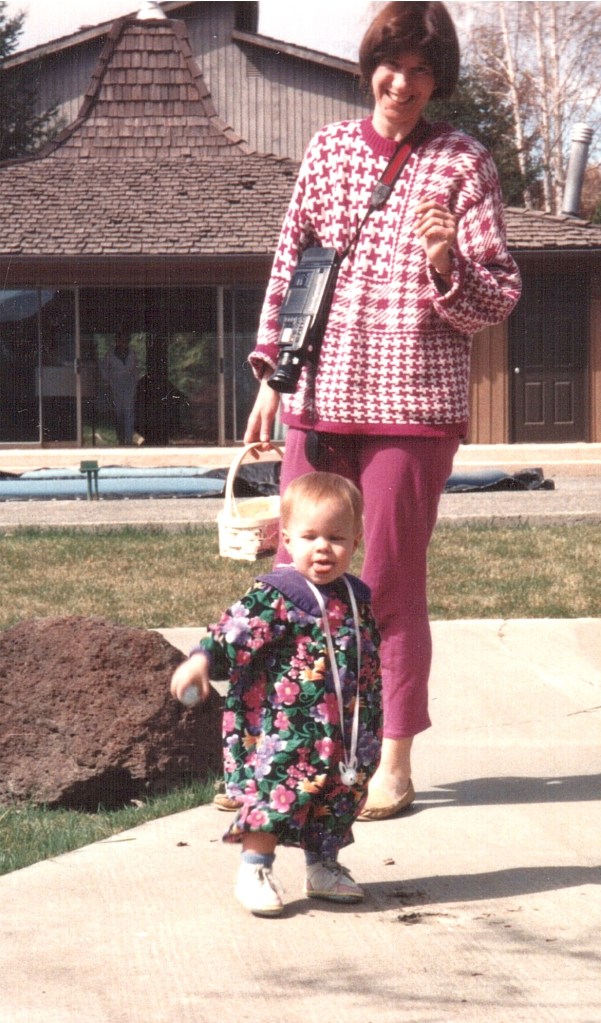
My just turned one year old daughter – under close supervision by me – with her first found Easter egg. 1994
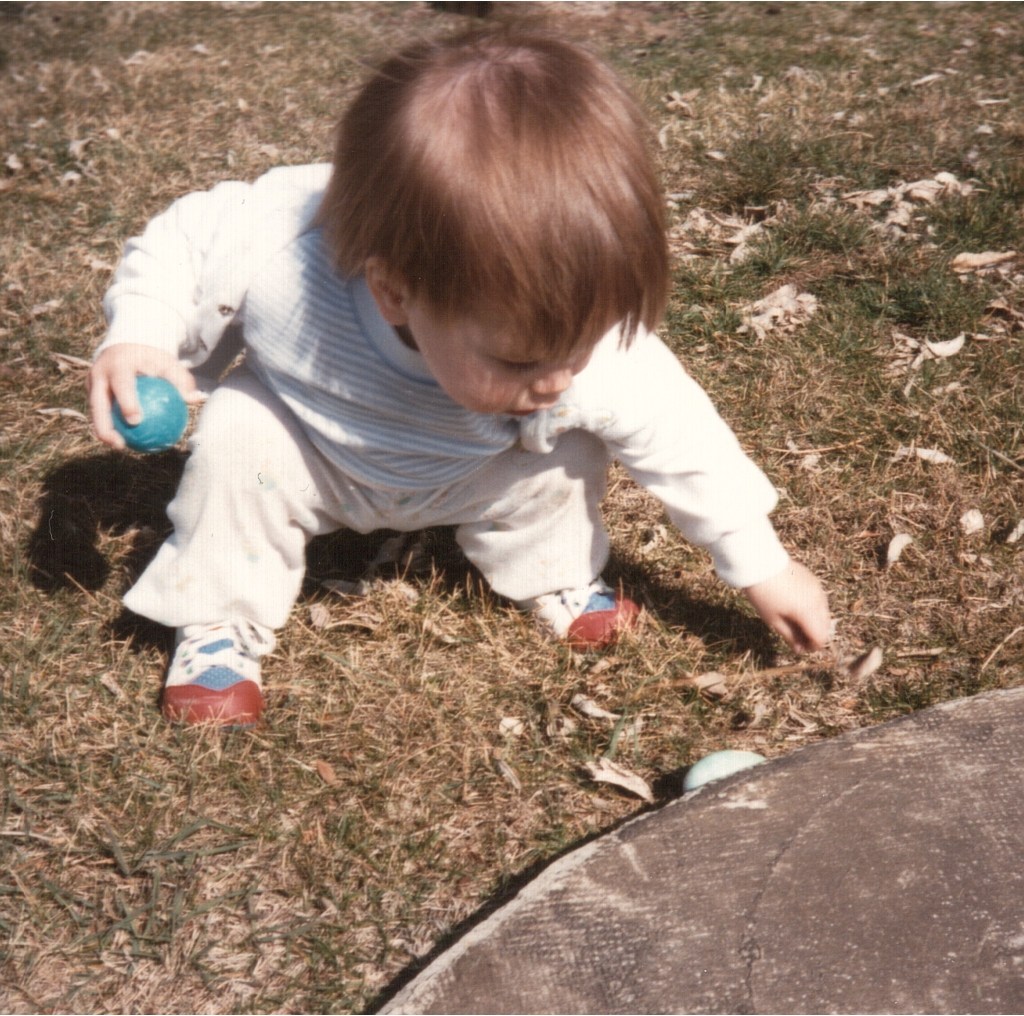
My son, 14 months old, at his first Easter egg hunt. 1991.

As a child, I was much more regimented, making sure that there were two of each color, just in a darker or lighter shade. My mother would indulge me over the weekend, and let me get my box of eggs out of the refrigerator and admire them. At least until Sunday afternoon on Easter day. It was then the first eggs would get peeled, soon to be incorporated into potato salad and devilled eggs. To this day I still love hard boiled eggs and whenever I eat them I am pulled back, for a moment, to my childhood Easters.

But back to the egg hunt. As an adult, I was always able to recall where I had hidden my children’s eggs… well, except for that time when I snuck outside before breakfast to nestle them among the flora only to discover during the course of the hunt forty-five minutes later that the fauna – particularly slugs – love hard boiled eggs too. Who knew?

The links:

https://en.wikipedia.org/wiki/Easter_egg

https://paaseastereggs.com/

Coddiwomple

Traveling in a purposeful direction

January 9, 2024

The author’s collection of dictionaries. The Webster’s New World Dictionary, third from the left, was often used for playing ‘Dictionary.’

Back in the early 1980’s I was introduced to a game my hubby and his family loved to play. There was no game board or markers to move around. Instead it required a dictionary, a piece of paper for each player, and a pen. They called the game Dictionary.

A search of the internet reveals, from the Infallible Wikipedia, that the genre is more commonly known by another name: Fictionary. In the years since being introduced to this delightful pastime there have been actual games developed and sold. As noted by the Infallible Wikipedia:

“The board games BalderdashDictionary DabbleFlummoxed, and Weird Wordz are based on Fictionary. In one round of the board game Derivation, players describe or fabricate a word’s etymology; players who provide a correct etymology receive one point for doing so, but their entries are then removed from play, and they lose their chance to receive multiple points by drawing multiple votes from other players. Similarly, in the board game Wise and Otherwise, the Picker randomly chooses a quotation and reads the beginning, and other players try to create realistic endings to the quotation.”

It’s amazing what interesting words one can find when perusing a dictionary.

While these games have been successful, I rather like how we played it: Get a group of people together (the more the better) and then pick one person each round who looks through the dictionary until they find a sufficiently obscure word. They then announce the word to the group and each person has to come up with a definition for that word. The chooser writes down the REAL definition.

Once everyone has written his or her definition, the papers are passed to the person who picked the word and they read each entry aloud, being sure to hide the papers from others. Each participant then decides which might be the real meaning of the word. Those who guess correctly get one point. The chooser gets one point for every incorrect guess.

Now, I’m sure you are wondering what this has to do with the title of this week’s Tuesday Newsday, Coddiwomple. Up until the hubby and I were driving home from Yakima on New Year’s Day this year I had never heard of Coddiwomple. But it immediately made me think of playing Dictionary and probably the most favorite word I ever found and used which is ‘gardyloo.’

The hubby had read an article on the term Coddiwomple and shared it with me. What I learned, from author and philosopher David Marlowe – who coined the term – is this:

I was immediately struck by the rhythm of the word and how it seems to fit its definition. Of course the purpose of the word is to help people stop and contemplate what, exactly, they are each trying to accomplish in life.

It was exactly seven years ago today when I wrote my first Tuesday Newsday. At that time I had no idea where I was going with it; only that, via a very decidedly Coddiwomple experience, I had been nudged to take the path of starting a website for ‘someday.’

That ‘someday’ was aimed for that moment, in the murky future, when I would have a book published and be able to share it on my website.

And thus began a Coddiwomple journey toward a vague destination. My first Tuesday Newsday was all about one of my favorite musical artists, Jim Croce.

Of course I screwed it up a bit on that first go round – being unfamiliar with WordPress and how it all worked – and accidently posted it on Wednesday, January 10th instead of that Tuesday, January 9th. So I ended up with TWO articles about Jim Croce a year apart, with the other one on January 11th the following year. (here’s the link to both which I combined into one for ONLY January 10th): https://barbaradevore.com/2017/01/10/jim-croce/)

But that was okay because, well, Jim Croce. One of his best… and so bittersweet.

What I did know after that first post is that in addition to the fiction stories which invade my brain and compel me to write, I had a whole lot of personal stories which came pouring forth.

Some have been funny, some philosophical; they range from recounting early childhood memories to recent impactful events. They cover music, TV, movies, nature, history, geeky musings, and cultural references. War and politics are never included.

But what do any of these ramblings have to do with traveling purposefully toward a vague destination?

For me, no matter what think I chose to do, it is the desire to fully embrace each experience in life. New opportunities frequently present themselves and, as someone who probably has undiagnosed ADD, I am often distracted by such shiny objects.

Yet, as I have matured, I’ve come to understand a universal truth: our most precious commodity is TIME. I’ve become quite protective of my time. And the one thing in life which is elemental to who I am and where I want to spend my time is writing. It’s been that way since I first put a piece of chalk to a chalkboard desk I received as a Christmas present at age three when my family still lived in Clarkston, Washington.

The author, age 3, with her chalk board. Captured with a cell phone camera from the home movies my dad took.

So now I begin year eight of my blog in basically the same way as I did in 2017, traveling in a purposeful manner toward a vague destination. Coddiwomple.

Now, if you’ll excuse me I need to go write Nicole out of the entanglement in which she finds herself. Who will she choose: Nathan, Sam, or ???. And how will her parents react? I’m not sure she has quite embraced Coddiwomple but then again she’s only 21 and has a lifetime ahead of her.

Finally, for those who have read all the way to the bottom, here’s your reward. Gardyloo is, according to Dictionary.com, “a cry formerly used in Scotland to warn pedestrians when slops were about to be thrown from an upstairs window.” Oh those crazy Scots. You’re welcome. Of course if you looked closely at the photos, you already knew the definition.

The links:

David Marlowe’s substack: https://ikiquest.substack.com/p/coddiwomple

The Infallible Wikipedia never lets me down: https://en.wikipedia.org/wiki/Fictionary

The Wizard of Oz

Striking terror into the souls of young children since 1939

August 15, 2017

A Tuesday Newsday Classic Updated

Good advice…

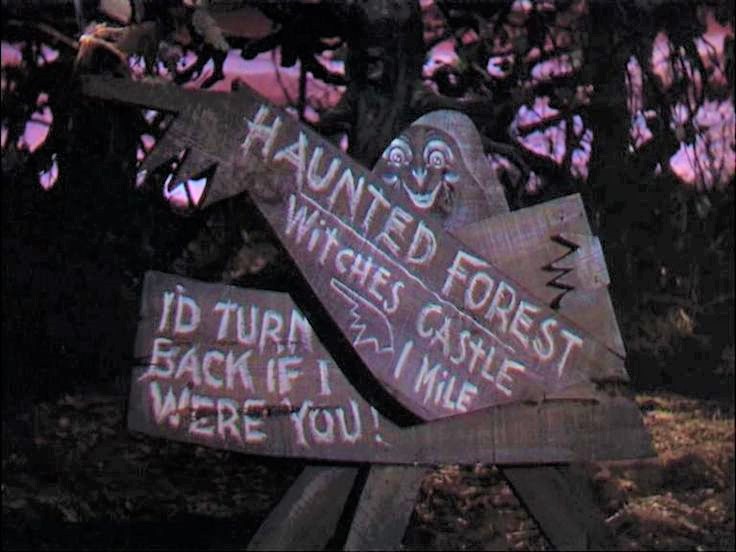
 “I’d turn back if I were you!” – the message printed on the sign of the Haunted Forest in the classic film “The Wizard of Oz” – was, in my opinion, a wise suggestion. More on that in a bit.

It was August 15, 1939 when “The Wizard of Oz” premiered and, despite costing more to produce than it took in during its theatre run, has become a beloved American classic. In fact, it was named by the American Film Institute as the number one fantasy film ever made.

Nominated for six Academy Awards it lost out to “Gone With The Wind” for best picture. It did win two other awards, however, including best song for the instantly recognizable “Over The Rainbow” and for the best Musical score.

One of the iconic scenes from the film “Over The Rainbow.”

The film was heralded from the very beginning. From the Infallible Wikipedia:

“The film received much acclaim upon its release. Frank Nugent considered the film a ‘delightful piece of wonder-working which had the youngsters’ eyes shining and brought a quietly amused gleam to the wiser ones of the oldsters. Not since Disney’s Snow White and the Seven Dwarfs has anything quite so fantastic succeeded half so well.’ Nugent had issues with some of the film’s special effects, writing, ‘with the best of will and ingenuity, they cannot make a Munchkin or a Flying Monkey that will not still suggest, however vaguely, a Singer’s Midget in a Jack Dawn masquerade. Nor can they, without a few betraying jolts and split-screen overlappings, bring down from the sky the great soap bubble in which Glinda rides and roll it smoothly into place.’ According to Nugent, ‘Judy Garland’s Dorothy is a pert and fresh-faced miss with the wonder-lit eyes of a believer in fairy tales, but the Baum fantasy is at its best when the Scarecrow, the Tin Man, and the Lion are on the move.’”

One of my earliest memories is when the film was broadcast just once a year on TV. My family lived in Clarkston, Washington the year I was four and it may have been the first year we had a TV in the house.

While my memories from that young age are limited, I do know that my dad made popcorn and that watching the movie was a highly anticipated and exciting family event. Some of the rest of the activities of that day are fuzzy but it was talked about in subsequent years. Having a TV in your home in 1961was a big deal. In fact, in 1954 about 55 percent of households had a TV. In 1962 that number jumped to 90 percent. So my thinking that it was the early 1960’s when our family got our first television is likely accurate.

“Now Fly! Fly! Fly!

But not every family had a television including one set of our neighbors. The day of “The Wizard of Oz” showing, the two oldest daughters of that family showed up at our door with hopes of getting to watch the film. My dad, however, had to turn them away as their parents did not approve of TV and they were not allowed to watch TV. Ever. I know my dad always felt bad about that since he would have welcomed all the neighborhood kids in to watch.

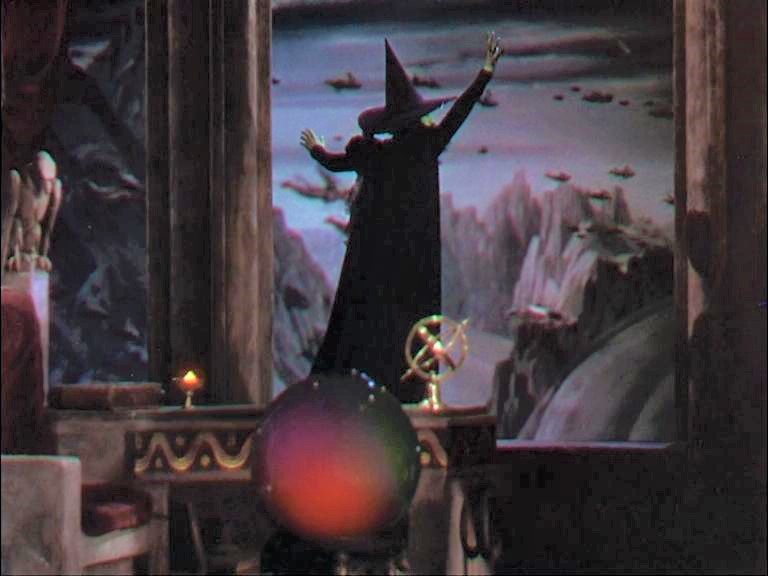
But back to four year old me. I was enthralled by the story of a farm girl who gets carried away by a tornado eventually landing in a magical world. Everything went pretty well right up to the point that Dorothy and her entourage enter the Haunted Forest and they encounter the sign which advises, “I’d turn back if I were you.” When, a minute and a half later, the Wicked Witch of the West is standing silhouette in her castle window and screaming “Fly! Fly! Fly!” to her army of flying monkeys I took that advice.

I was so afraid I left the room and didn’t return for the rest of the movie! Of course I did eventually see the entire film many, many times and loved our family’s annual tradition to watch it. I even shared it with my own children despite my fear that they, too, would be traumatized.

Even now, watching the clip of that scene evokes memories of my childhood terror. As a general rule I will not watch Horror* movies… in fact when the movie “Alien” was shown on TV in the early 1980’s, the scene where the Alien is stalking its victims sent me scurrying to the kitchen to make popcorn for those watching. But I never returned. Some things never change.

I’m off to see the wizard!

The whole story of how the movie was made is a good read. https://en.wikipedia.org/wiki/The_Wizard_of_Oz_(1939_film)

*Some folks claim ‘Alien’ is a Sci-Fi film… but when one does a search of the Best Horror films, it’s on the list.