Tag Archive | April Fools Day

A Font of Fun? No Fooling!

April 1st

You’d pretty much have to be living on an island far from civilization to NOT know that today is April Fool’s Day. It’s celebrated each year on April 1st.
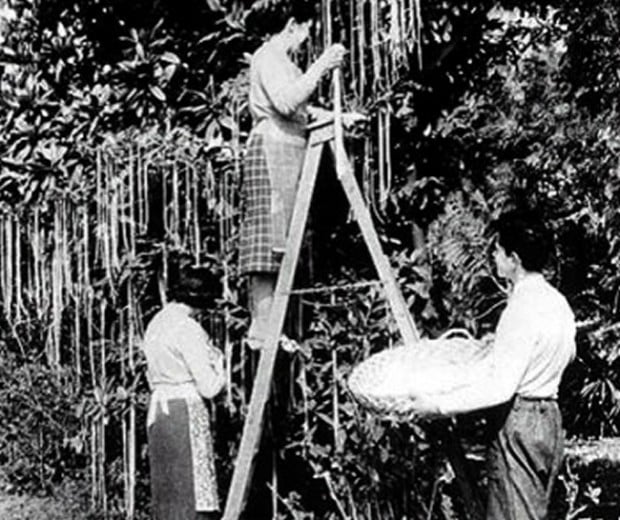
Considered by many as the greatest hoax of all time is this 1957 BBC documentary about harvesting spaghetti from trees. https://en.wikipedia.org/wiki/Spaghetti-tree_hoax

The day has murky beginnings which date back hundreds of years. Some say that Geoffrey Chaucer, in the unreadable ‘Canterbury Tales’, makes reference to the day. But that’s disputed. In 1508 some obscure French poet I’ve never heard of wrote about ‘poisson d’avril’ – translated ‘April’s Fish’ – which apparently doesn’t mean fish but ‘fool.’ Yet another theory is that at one time the new year was marked as being on March 25th but was then changed to January 1st (Actually March 25th makes more sense what with spring, birth, and renewal, but whatever). Those who clung to their old traditions were derided as Fool’s and I guess it took 6 days of their protests against moving New Years before someone decided to take any action.

The previous paragraph is, however, as in depth as I plan to go regarding the origins as, quite honestly, it’s a bit boring for this day devoted to mirth and mischief. Sadly, I found the Infallible Wikipedia article to be deadly serious and who wants that?

Anyway, I had soon climbed down the rabbit hole that is the internet and found a website truly worthy of April Fool’s Day: The Museum of Hoaxes. OMG. I knew I could spend hours reading about all the clever things people have conjured up to fool others. Decisions, decisions. WHICH of the hundreds of hoaxes was worthy of Tuesday Newsday fame? It was a weighty decision.
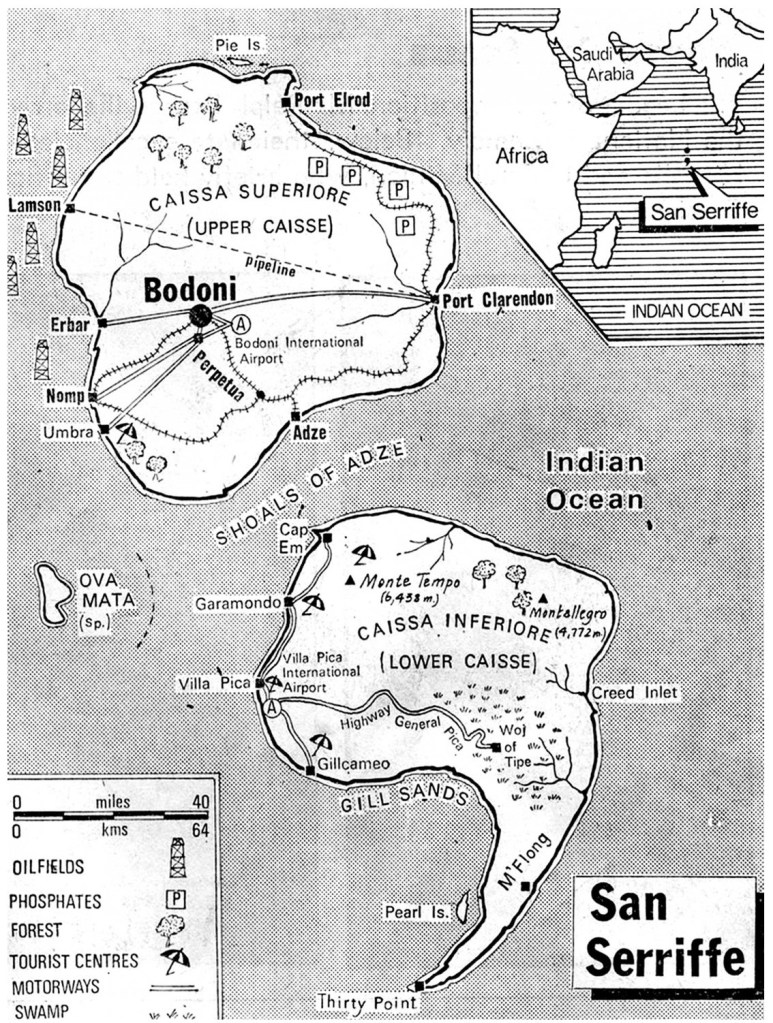
The islands of San Serriffe are a Perpetua(l) delight

Presenting the Island of San Serriffe!

As a writer, word nerd, and someone whose earliest childhood goal was to be able to create programs, newsletters, flyers, etc., the name San Serriffe resonated.

The year was 1977 and the British newspaper, The Guardian, was looking for something fun as a joke for their April Fool’s Day edition. Brainstorming occurred and the results were hilarious. From the hoaxes.org website:

“On April 1, 1977 the British newspaper The Guardian published a seven-page ‘special report’ about San Serriffe, a small republic located in the Indian Ocean consisting of several semi-colon-shaped islands. A series of articles described the geography and culture of this obscure nation.

The report generated a huge response. The Guardian‘s phones rang all day as readers sought more information about the idyllic holiday spot. However, San Serriffe did not actually exist. The report was an elaborate April Fool’s Day joke — one with a typographical twist, since numerous details about the island (such as its name) alluded to printer’s terminology.

The success of this hoax is widely credited with inspiring the British media’s enthusiasm for April Foolery in subsequent years.”

The best part of this story is, for me, the map. These people had waaaaaay too much time on their hands apparently.

The capital of San Serriffe: Bodoni; There’s Monte Tempo and Montallegro; Creed Inlet and Thirty Point; Villa Pica International airport and a beach town named Garamondo. Truly, the map is a font of fun.

I’m a bit sad that it took me over 40 years to learn about San Serriffe since, in 1977, I was heavily involved in the world of publishing. I was one of three editors for the weekly Yakima Valley Community College “Galaxy” and also the youth editor of the Washington Idaho Rainbow Girls newsletter titled “The Confidential Observer.”
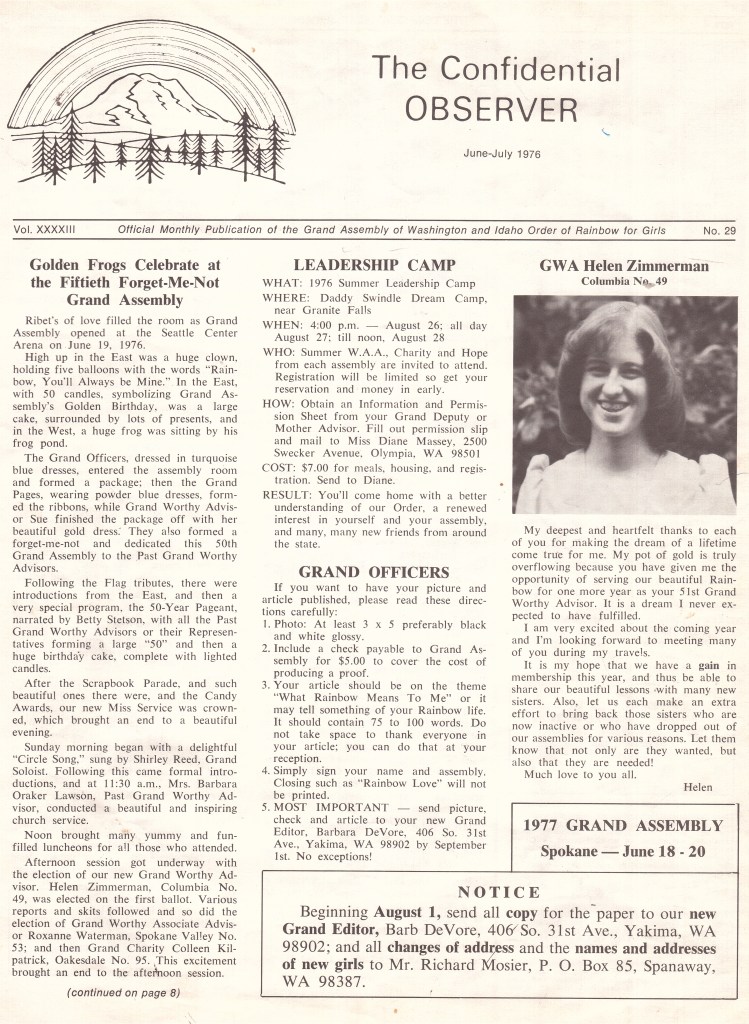
I was hungry to learn everything there was about journalism, writing, and layout. One of my big passions was experimenting with new fonts. I could not get enough of them!

The adult advisors for the Rainbow Girls publication, I’m certain, had no idea what hit them that year as I shook things up, at least in the world of Fonts. Well, and layout and artwork and, pretty much everything I was capable of changing. The fonts went from Helvetica and Times New Roman to Garamond and Bodoni to name a couple of them.

I changed the mast head; I varied the font sizes; I used boxes around things to emphasize and tried to make it more aesthetically pleasing.

Two versions of the front page of the Rainbow Girls paper. Top is how it looked the issue before I started changing things. Bottom is how it looked six months later.

Now, way back in the dark ages, publication was not a simple thing. First I had to get articles from people from all over the states of Washington and Idaho who mailed them in envelopes. Some of these came handwritten on notebook paper, full of spelling and grammatical errors. I often had to retype and all had to be edited. When that was done I would mail it all from where I lived in Yakima to the printers in Tacoma, who then retyped it (with the fonts I’d chosen) and created galleys to fit our three-column format. These were then returned to me via mail. I would cut – with an exacto knife – the galley articles and glue the proofs on to paper in the correct configuration with everything marked as to where it was supposed to go and then would cross my fingers that they did it right. Spoiler: not always.

It was the fall of 1976 and the artwork that was to top the column for our state president that year had gotten lost by them. I sent in my package a hastily drawn picture (I’m no artist!) with a note attached saying “this is sort of what the artwork looks like that’s missing” and asking them to look around for it. Instead of reaching out, however, they ‘published’ what I had sent. It was awful and upsetting and bothers me to this day. Eventually, they found the missing clipart.
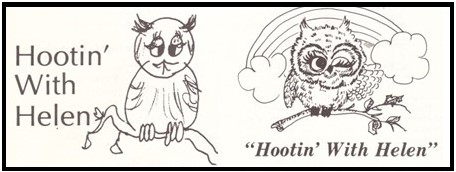
To this day I cannot fathom any professional printer looking at the owl on the left and thinking that’s what they should print…

With the introduction of the Apple Macintosh and their GUI (Graphical User Interface) layout in the mid-1980’s, I was finally able to create a newsletter on a computer and print it out. It was then I got my first laser printer. It was still a clunky process and the clipart was lacking, but it moved me forward.

Over the years as the GUI technology has improved, my ability to create has expanded. Artificial Intelligence has made it even easier.

So hats off to San Serriffe Island. I found the above picture of the island through an easy Google search, saved it as a jpg, and then printed it on my less than $200 Epson printer. I’m sticking it in a frame and hanging it in my office and will look at it often and cheer the fun of April Fool’s Day and 1977, the year of San Seriffe’s creation.

As always a few links:

https://hoaxes.org/archive/permalink/san_serriffe

https://hoaxes.org/af_database/display/category/guardian

https://en.wikipedia.org/wiki/April_Fools’_Day
The Artichoke

A culinary delight consumed for centuries

May 28, 2024

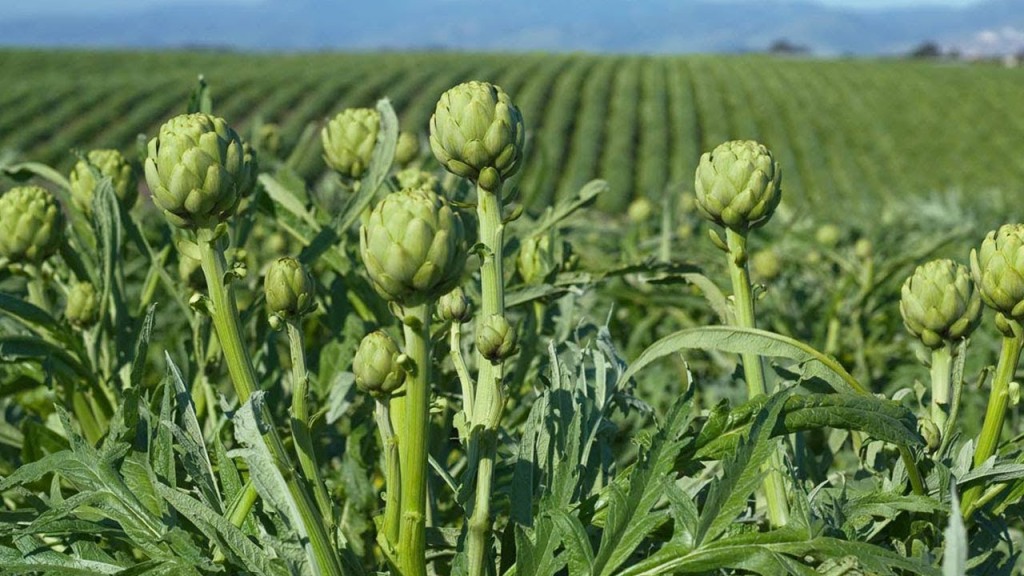
When I think about improbable foods, the artichoke is at the top of my list. Afterall, who would have looked at this thistle and thought, “I wonder if I can eat that without poking holes in my mouth?”

A field of artichokes

Yet, artichokes have been grown and cultivated since at least the eighth century BC.

The Infallible Wikipedia helpfully tells us:

“The (globe) artichoke is a domesticated variety of the wild cardoon (Cynara cardunculus), which is native to the Mediterranean area. There was debate over whether the artichoke was a food among the ancient Greeks and Romans, or whether that cultivar was developed later, with Classical sources referring instead to the wild cardoon. The cardoon is mentioned as a garden plant in the eighth century BCE by Homer and Hesiod.”

Based on further information in the Infallible Wikipedia, I came to the conclusion that the plant was, for centuries, considered a luxury food for royalty and the wealthy. It also developed a reputation as having aphrodisiac qualities.

It was the Dutch who brought them to England where they were successfully grown in Henry VIII’s palace garden in 1530. In the 19th century, immigrants transported the plant to the new world: Louisiana by the French and California by the Spanish.

Despite Henry VIII’s garden, until recently, the artichoke has only been successfully grown in warmer climates. If you look at a latitude map of the world which shows the areas where they cultivated, most are found in about a 350 mile wide band between the 30th and 37th parallels both north and south. Heartier varieties of the plant are being developed with promise of being able to be grown in northern climates.

Also from the Infallible Wikipedia:

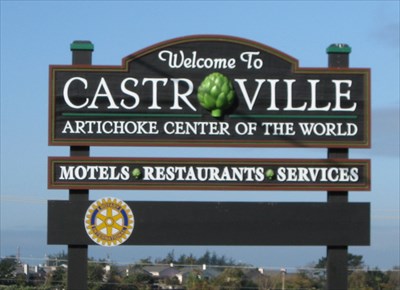
“Cultivation of the globe artichoke is concentrated in the Americas and the countries bordering the Mediterranean basin. The main European producers are Italy, Spain, and France and the main American producers are Argentina, Peru and the United States. In the United States, California provides nearly 100% of the U.S. crop, with about 80% of that being grown in Monterey County; there, Castroville proclaims itself to be “The Artichoke Center of the World” and holds the annual Castroville Artichoke Festival.”

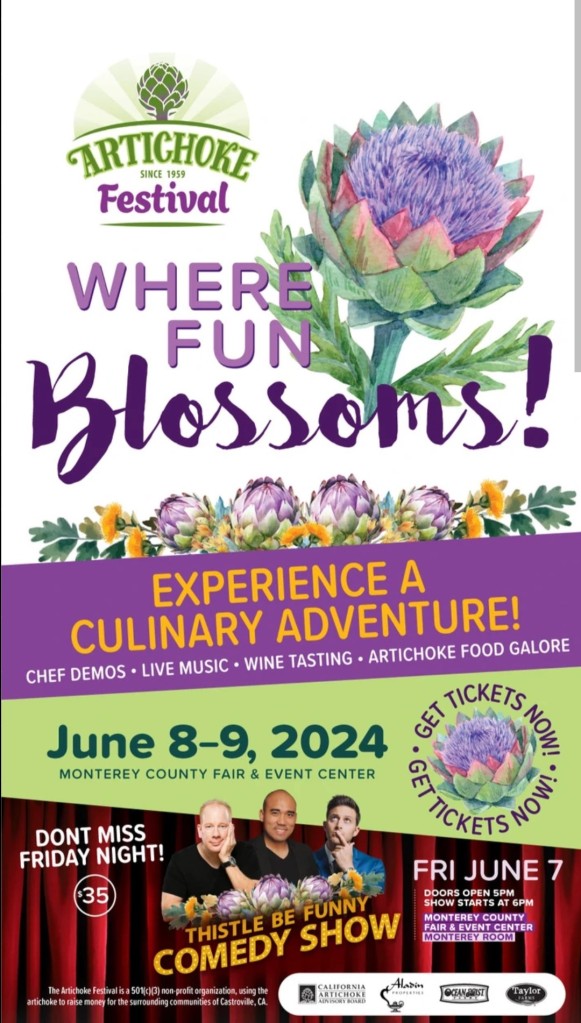
The 2024 poster for the Castroville Artichoke Festival on June 8-9

I’m making a mental note to take in the Artichoke Festival which, apparently, is held the second weekend in June each year. This makes sense since artichoke ‘season’ is from March until June.

My first memory of artichokes is from when I was about six years old. One night when the family (Two parents and four kids ages 6, 8, 10, 15) sat down to dinner and in bowls at my parents’ places – and perhaps my oldest brother’s – were these green vegetable things with prickly ends and tough looking leaves.

Of course it begged the question “What are those?”

“Artichokes,” my mother replied, “but I don’t think you’d like them.”

Now anyone who understands reverse psychology would know that IF she wanted to save money she would have made artichokes for all and forced us to eat them. It likely would have been a one and done. But no. Instead the verbal gauntlet was tossed on the table like an, er, discarded artichoke leaf, and we begged to try the vegetable.

Every one of us liked them. A lot. That might have had something to do with the fact that we were allowed to dip the soft leaf ends in mayonnaise and smother the heart in whatever was left.

Over the years artichokes were a springtime treat for the family. And they still are. I continue to prepare them like my mom did, steamed for up to 40 minutes but instead of mayo, we dip the soft ends and the heart in melted butter.

I also love, love, love, pretty much anything that includes artichokes as an ingredient. Artichokes on pizza, artichokes in dips, or even artichokes preserved in olive oil eaten plain are all favorites.

There was, however, one thing artichoke which wasn’t so great. Back in the 1980’s the hubby and I hosted, for several years, an April Fool’s Day party. We invited family and friends and one main feature of the party was the opportunity for attendees to tell their best joke in hopes of winning the prize.

At the end of the joke telling the judges (that would be me and hubby) would decide – usually based on the groans and reactions from the crowd – as to who had told the ‘best’ joke and who told the ‘worst’ joke. But there was a twist. Since it was April Fool’s Day, the winner of the ‘best’ joke got the worst prize and vice versa.

The competition (it was either 1985 or 1986) was particularly hot this one year and Tom, the younger brother of Paul – who I worked with – came loaded with jokes. Tom told bad joke after bad joke and pretty much earned a lifetime achievement award for his repertoire and the judges decided he was the ‘best’ that night.

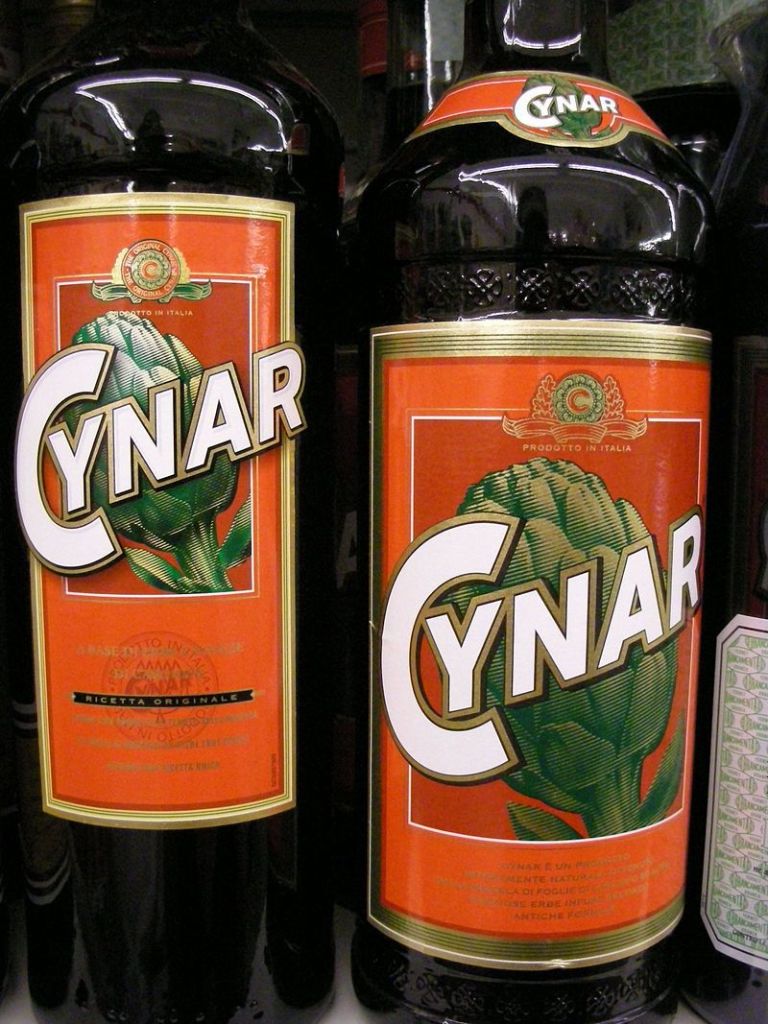
Yes, it really exists…

Winner of the worst joke earned a bottle of scotch. Winner of the best joke? A bottle of this exotic liqueur I found called Cynar. For those paying attention you may have seen the word ‘Cynar’ a bit earlier in this article… Cynara cardunculus. Otherwise known as the globe artichoke.

Tom was thrilled to have won and opened his bottle there and then to savor his sweet win. We provided a shot glass and he took a sip… and nearly spit it out. So older brother Paul also tried it, as did several others. All with the same result. Having seen enough I passed on trying Cynar – the artichoke liqueur – and, thankfully, the bottle went home with Tom that night.

When talking with Paul over this past weekend, he reminded me of what happened after. For a time Paul and Tom were roommates and whenever a new, unsuspecting friend would come to their apartment, out would come the bottle of Cynar and they’d lay it on thick. They’d expound on how great it was and they would invite the ‘new guy’ to have some with them. Everyone would get a small glass and then Paul and Tom – and any others who had been previous victims – would raise their glass to drink. But none of them ever did, instead watching the ‘new guy’ take a slug and… nearly spit it out. This was followed with raucous laughter and telling the story of they came to possess the Cynar.

What prompted Paul to share this story with me (He’d shared it years before, but it never gets old) was that he was on a business trip and sitting at a bar recently and happened to look up at the shelf behind the bartender and, lo and behold, there was a bottle of Cynar. I asked him if he ordered a shot but he said he hadn’t. Can’t imagine why.

I suppose one of these days I really should try Cynar. But I think I will look up how, exactly, it should be consumed first. Probably with a whole lot of orange juice or used sparingly in some fruity cocktail.

In honor of the artichoke this week, however, I skipped the Cynar and instead bought a raw one at Freddies for the hubby and me for dinner last night.

As I began preparing it, I thought of my mother and, as I have done hundreds of times, copied how she cooked them: cut them in half, then remove the tiny ‘hairs’ that grow from the heart. I rinsed between the leaves, spreading them out just a bit, then started them to steam in my double boiler pan. Later, as I dipped the tender pieces in butter I gave a salute to the wonderful globe artichoke, always a treat.

And when you are in Castroville be sure to visit the Giant Artichoke…

The links:

https://en.wikipedia.org/wiki/Artichoke

https://en.wikipedia.org/wiki/Castroville,_California

https://en.wikipedia.org/wiki/Cynar

https://www.foodandwine.com/what-is-cynar-6503431