Tag Archive | Ancestry.com

Peak DeVore

Who Am I and Where do I come from?

August 6, 2024

A Tuesday Newsday Classic Updated

As someone born into a family with an uncommon last name, I notice whenever I see that name. Several years ago I wrote about my ignorance of Washington State geology when I admitted I did not realize Glacier Peak was this state’s ‘fifth’ volcano. (You can read all about it at https://barbaradevore.com/2018/06/12/glacier-peak-washington/)

DeVore Peak – Glacier Peak Wilderness, North Cascades, Washington State

Fast forward to August 3, 2019… when I receive the following text from the hubby:

“Just saw on King 5 there is a Devore Creek fire near Stehiken. Comes down from Devore Peak.”

What!?

How is it I never knew of this Devore Peak or Creek? Yet, here it has been, hiding out 20 miles northeast of Glacier Peak, undoubtedly since the time the first settlers imparted their names on things.

From the Infallible Wikipedia:

“Devore Peak is an 8,360+ ft (2,550+ m) mountain summit located in the Glacier Peak Wilderness of the North Cascades in Washington State. The mountain is situated in Chelan County, on land managed by Wenatchee National Forest. Its nearest higher peak is Martin Peak, 3.36 mi (5.41 km) to the southwest, and Tupshin Peak lies 1.55 mi (2.49 km) to the north-northeast. Precipitation runoff from the peak drains to nearby Lake Chelan via tributaries of the Stehekin River.”
So it got me thinking… where else are things named Devore (or DeVore as my family spells it) that I do not know about?

Of course I know about DeVore, California although I’ve never been there. The town was a stop on historic Route 66. It has since been incorporated into sprawling, 81 square mile, San Bernardino. Much of the DeVore neighborhood was leveled by a wildfire in 2003, with 904 homes destroyed.

If you travel 1,723 miles to the east you will find a dot-on-the-road community in Indiana also named Devore. Originally named Mill Creek, some interloper relative of mine got a post office located there and probably named it after himself.

Lovely little falls in Devore, Indiana

But back to Devore Peak. Despite my extensive internet research, I cannot find any ancestor or relative after whom the mountain is named although I suppose it could be the Reverend John DeVore. He was the first minister to establish a church north of the Columbia River in Steilacoom. From the Washington State History link site:

Monument in Steilacoom, Washington to Reverend John DeVore and the Methodist Church

“(Lafayette)Balch (Steilacoom’s founder) persuaded Reverend John F. DeVore (1817-1889) and his wife Jane Devore (d. 1860) to relocate to Steilacoom in 1853. DeVore built a two-story Methodist Episcopal church that also served as a school and meeting hall. When the church bell, ordered from the East, arrived with a balance due, residents took up a collection. Afterward the bell became town property, used to signal emergencies and public meetings along with the call to worship.”

When a college student, I drove down there one day from nearby University of Puget Sound (which was founded as a Methodist college) and located the marker for Reverend DeVore. Alas, the Reverend is not a direct ancestor and I was never able to establish any relationship.

But it does make one wonder – unless you have a very common last name – how many others share yours?

I found the following information on https://www.mynamestats.com/Last-Names:

  • DEVORE is ranked as the 3,242nd most popular family name in the United States with an estimated population of 12,319.
  • This name is in the 99th percentile, this means that nearly 0% of all the last names are more popular.
  • There are 3.86 people named DEVORE for every 100,000 Americans.
  • This name is most often used as a last name, 99% of the time.
  • Based on US Census Bureau data the estimated population of people named DEVORE is 13,030, the rank is 3,005 and the proportion per 100k Americans named DEVORE is 4.09.

When you consider that there are some 329 million in the country that’s only .004 percent of all people with the same last name. If I extrapolate that even further and Google both my first and last names, there are 128 other people named Barbara DeVore in the U.S. currently.

Growing up I knew of only one other person with the last name DeVore who was not related to our family. That would be the butcher who worked at the Safeway on 36th and Tieton Drive in Yakima. I was always so very amused when I would go to the store with my mother. If the shopping trip involved a visit to the meat counter inevitably the exchange would go something like this:

Butcher: “Good Afternoon, Mrs. DeVore.”

Mom: “Good Afternoon, Mr. Devoir.”

And then they both would laugh.

Yes, Mr. Devoir the butcher spelled it different. But the two of them obviously enjoyed the inside joke of having the ‘same’ last name.

As I was writing this article, I could not think of a single person I’ve met casually with the last name DeVore. Through my genealogy research and DNA matching, I’ve found quite a number of cousins and have enjoyed getting to know many of them on Facebook.

Occasionally I will have someone ask do you know ‘fill-in-the-blank’ DeVore? Often, I am able to say he/she is my second cousin, once removed. But mostly it doesn’t come up.

I rather like the unique name and the mystery of it all. According to a book about the DeVore families compiled by Betty DeVore Mann in 1992, the history of the name is this:

Chateau de Vore near Remalard, France

“There is a small, stately chateau in Normandy, near Alencon and 3 kilometers from Remalard, named Chateau de Vore. The de Vore family left in the 17th century. Several American Devores have interviewed the 2 remaining de Vores in Paris. They knew very little about their ancestry, because their grandfather was the illegitimate son of a wealthy family and he was sent away when he was very young. He carried his mother’s maiden-name. And so the story goes…”

She also adds “the Huguenot Society tells us that Devore is of Huguenot origin. The Huguenots were the French Protestants who were persecuted and made a mass exodus from France between 1550 and 1780.”

When I first submitted my DNA information it stated that I was 3 percent French. Ancestry, however, frequently updates their estimates based on new DNA submissions to see who matches who and my specific French connection has long since disappeared.

When I looked at my most recent results, it suggested that I was 22 percent from England and northwestern Europe. Curious, I located Chateau de Vore in Remalard, France. It is about 85 miles from the Eiffel tower. When I overlaid my DNA profile to the region included as “northwestern Europe” I discovered that Chateau de Vore was within my DNA range. It is not outside the realm of possibility that the family lore just might be right.

For those interested, I covered the topic of DNA for ancestor searches here: https://barbaradevore.com/2022/07/26/ancestor-hunting-dna/

While the DeVore family history will likely remain hidden in the mists of time, the pursuit of it has dogged me since I became old enough to ask “Who am I? And what am I doing here?”

Who knows, maybe there’s an historical novel in there, the intrigue of an illegitimate child who grows to a man. It is the story of a man who must disavow his country for his religion, never able to claim his true heritage, who must establish a new life in a distant land.

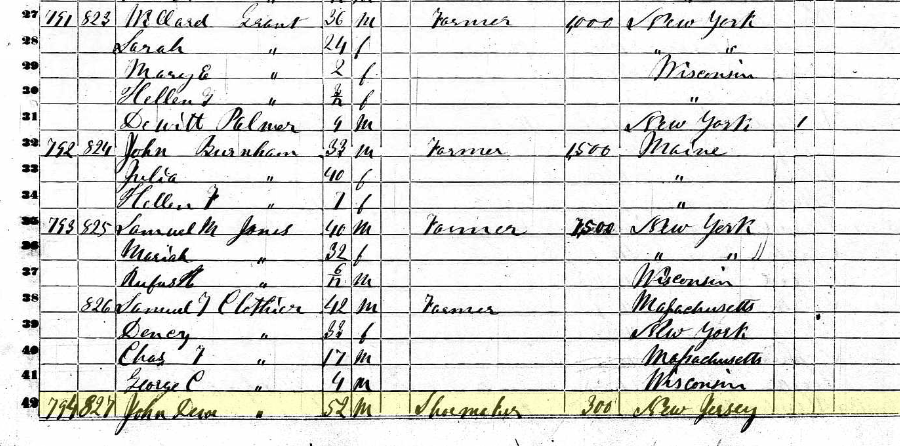
Perhaps not my family’s story… after all I do know that my great-great-great grandfather John DeVore was a shoemaker in Wisconsin in 1850. Not nearly as romantic as a swashbuckling Frenchman, right?
As always, links:

https://en.wikipedia.org/wiki/Devore_Peak

https://en.wikipedia.org/wiki/Devore,_California

https://en.wikipedia.org/wiki/Devore,_Indiana

Scituate, Massachusetts

What a Mann!

October 5, 2021

When one thinks of the earliest communities settled by the European immigrants, no doubt the word ‘Plymouth’ rolls off most people’s tongues.

New England was not, however, just that one community, but a whole network of towns and villages, dotting the east coast like sand dollars.

As someone who loves history and genealogy, I was thrilled to learn in my research that I can trace several of my family lines to some of the earliest settlements of the now northeast United States.

One of these places is a small town in Massachusetts named Scituate. The spelling alone is enough to cause most people to stop and say ‘how do you pronounce THAT!?’ So let’s get that out of the way. It’s pronounced ‘SIT – U- ATE.’ Just think of it as something you do at dinner each night.

It was on October 5, 1636 when the town was incorporated. Happy 385th birthday!

For those who don’t recall, Plymouth was settled in 1620 when the Pilgrims arrived. Following the success of the early settlers, no doubt word got back to England, and more people made the treacherous sea voyage seeking refuge in the new land.

The Infallible Wikipedia tells us this about Scituate:

“The Wampanoag and their neighbors have inhabited the lands Scituate now stands on for thousands of years. The name Scituate is derived from ‘satuit‘, the Wampanoag term for cold brook, which refers to a brook that runs to the inner harbor of the town. In 1710, several European colonizers emigrated to Rhode Island and founded Scituate, Rhode Island, naming it after their previous hometown.

European colonization brought a group of people from Plymouth about 1627, who were joined by colonizers from the county of Kent in England. They were initially governed by the General Court of Plymouth, but on October 5, 1636, the town incorporated as a separate entity.

The Scituate lighthouse at sunrise.

The Williams-Barker House, which still remains near the harbor, was built in 1634. Twelve homes and a sawmill were destroyed in King Phillip’s War in 1676.

In 1717, the western portion of the original land grant was separated and incorporated as the town of Hanover, and in 1788, a section of the town was ceded to Marshfield. In 1849, another western section became the town of South Scituate, which later changed its name to Norwell. Since then, the borders have remained essentially unchanged.

Fishing was a significant part of the local economy in the past, as was the sea mossing industry. The sea was historically an integral part of the town with occasional incidents such as that described February 13, 1894, in which eight men clinging to the vessel’s rigging on a schooner grounded off Third Cliff apparently died before a large crowd watching from shore ‘literally frozen to the ropes’ while unsuccessful rescue efforts continued through the day and their apparently lifeless bodies were covered by nightfall. A small fishing fleet is still based in Scituate Harbor, although today the town is mostly residential.”

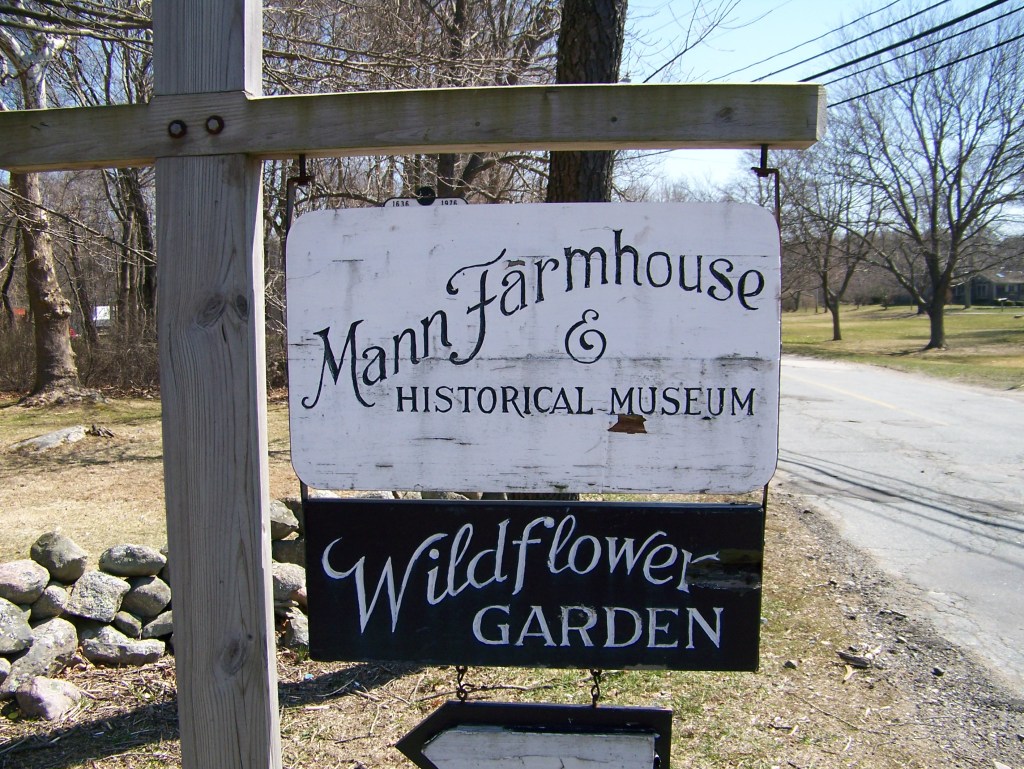
Sign outside the Mann house in Scituate. Photo taken by author 2008

In April 2008, the hubby, daughter, and I took a trip to Massachusetts. We spent two nights in Plymouth. Day three was designated as the day to drive north and stay in the greater Boston area. But something had started niggling at me. Didn’t I have ancestors who came from Massachusetts? I had done research some 10 years earlier and hit the genealogic jackpot when I was able to connect up with a whole string of people who zoomed the family line back from 1848 Wisconsin to Scituate and before that across the Atlantic to England. I now have the Mann’s traced back to 1457.

Although it was the days before Ancestry.com or 23andMe, there were programs on the internet where one could store their family trees. So I logged in and, low and behold, as I worked backwards I found Richard Mann, an early founder of Scituate.

Armed with this information I knew we HAD to go through Scituate! Once headed north, we soon found ourselves inching our way there. There were no interstate highways or tollways, just idyllic backroads decorated with budding deciduous trees and bright spring flowers dotting the landscape. The houses we passed were classic New England colonials and saltboxes. It was all very charming.

Scituate was, well, situated on the coast; still primarily a fishing village three hundred and seventy some years later.

And, of course, I was determined to find the home of great-great-great-great-great-great-great-great -grandpa Dick.

As it turns out, my direct ancestral line left Scituate sometime in the early 1700’s when one Abigail Mann married the (it turns out) scoundrel Simon Baxter, Sr. and moved to Connecticut. That didn’t work out so well for her in the long run as Simon got involved with another woman. Divorce, though rare, was granted in this case to great-great-great-great-great-great grandma Abby since Simon had engaged in “fornication with the widow Rebecca Berg” according to the documents of the day. Yikes.

My Mann ancestry

Fortunately for me, they had managed to produce a son, Simon Baxter, Jr. and HE had a daughter Prudence who fared much better than her grandmother and married one Aristides Huestis (my son is, no doubt, thankful I didn’t want to name him after Aristides). The Huestis family lived in Crown Point, New York. They were hardy people and produced a large gaggle of offspring including my great-great-great-great grandmother, Polly Huestis Noyes, who ended up being an early settler into the state of Wisconsin in 1848.

And on the western migration went clear to the other side of country in only 275 short years.

But I digress. Because there are moments in life when one takes a step back and says ‘this explains so much.’ The visit to Scituate was one of those times.

Poor grandma Abby didn’t have a chance, of course, since the way of the world was very patriarchal at the time. While she married scoundrel Simon and moved away, her brother stayed. And his eldest son, and the eldest son after that, and so on and so forth with a new male heir produced each generation. All the way to the 1970’s when the last direct male descendent of Richard Mann, Percy, died without offspring.

Oh dear. What to do with the house in Scituate? How about we make it a museum?

Which is exactly what they did.

This is a nice thing to do for ancestor hunters because much of the heritage of that particular family line has been preserved for all us ‘Mann’ descendents.

So we arrive at the Mann farmhouse on a cool, but sunny, April afternoon. The house (now the museum) is shut up tighter than a reticent New Englander’s mouth. But the gardens and property were open, so we wander about.

And then we find it – the prize which all genealogists want – that thing, that one thing which makes you say “Huh? So THAT’s where that trait comes from!”

Tucked away behind the house and far from the gardens is a tree… surrounded by a car. That’s not entirely accurate. This whitewashed account is from the Scituate Historical Society:

“After Percy Mann had a run-in with the town’s officials in the 1920’s, he decided that rather than pay vehicle registration fees, driver’s license fees, and car insurance, he would just drive his automobile into the back yard, park it and never drive it again. Over the course of time a tree grew up through the middle of the car, which remains where Percy left it almost a century ago.”

The remains of Percy Mann’s car in 2008

I still laugh when I imagine how this whole thing REALLY went down. Old Percy must have been as stubborn as a Nor’easter in November. No one, not even the town leaders, were going to tell him he had to pay fees and get a license to drive a car. “Ah, hell,” one imagines he railed, “I did fine with my horse and wagon and no one’s gonna force me to buy a g-damned license for it!”

So he did what any rational Mann man would do. He drove the car onto the property and never touched it again. That’ll show ‘em.

There is absolutely no doubt my DeVore family is related to the Mann’s, possessing that same stubborn New England Yankee obstinate spirit. It’s in the genes.

As always, a link or two:

https://en.wikipedia.org/wiki/Scituate%2C_Massachusetts

http://scituatehistoricalsociety.org/mann-house/

http://freepages.rootsweb.com/~dyer/genealogy/Mann/D1.htm