Tag Archive | AM Radio

Close To You

The first hit for the 1970’s duo “The Carpenters”

July 30, 2024

A Tuesday Newsday Classic Updated
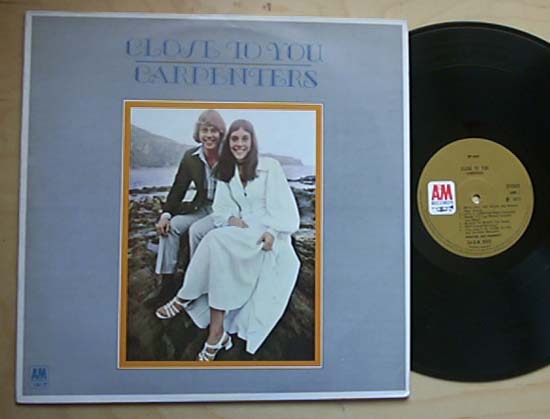
The Carpenters 1970 album “Close To You”

In the spring of 1970, there were approximately 17 million Americans between the ages of 12 and 16 and, of those, some 8.5 million were female. It was the height of the teenage Baby Boomer era when AM radio was king and the only place to hear the hits of the day.  It was also the dawn of a musical period dominated by a form of music known as soft rock.

According to the Infallible Wikipedia:

“The Hot 100 and Easy Listening charts became more similar again toward the end of the 1960s and into the early and mid-1970s, when the texture of much of the music played on Top 40 radio once more began to soften. The adult contemporary format began evolving into the sound that later defined it, with rock-oriented acts as ChicagoThe Eagles and Elton John becoming associated with the format. The Carpenters‘ hit version of ‘(They Long to Be) Close to You’ was released in the summer of 1970, followed by Bread‘s ‘Make It with You’, both early examples of a softer sound that was coming to dominate the charts.”

It was during the last week of July 1970 when Close To You topped the Billboard Hot 100 and held the number one position for four weeks. It marked the ascension of The Carpenters as one of the defining musical acts of the early 1970’s.
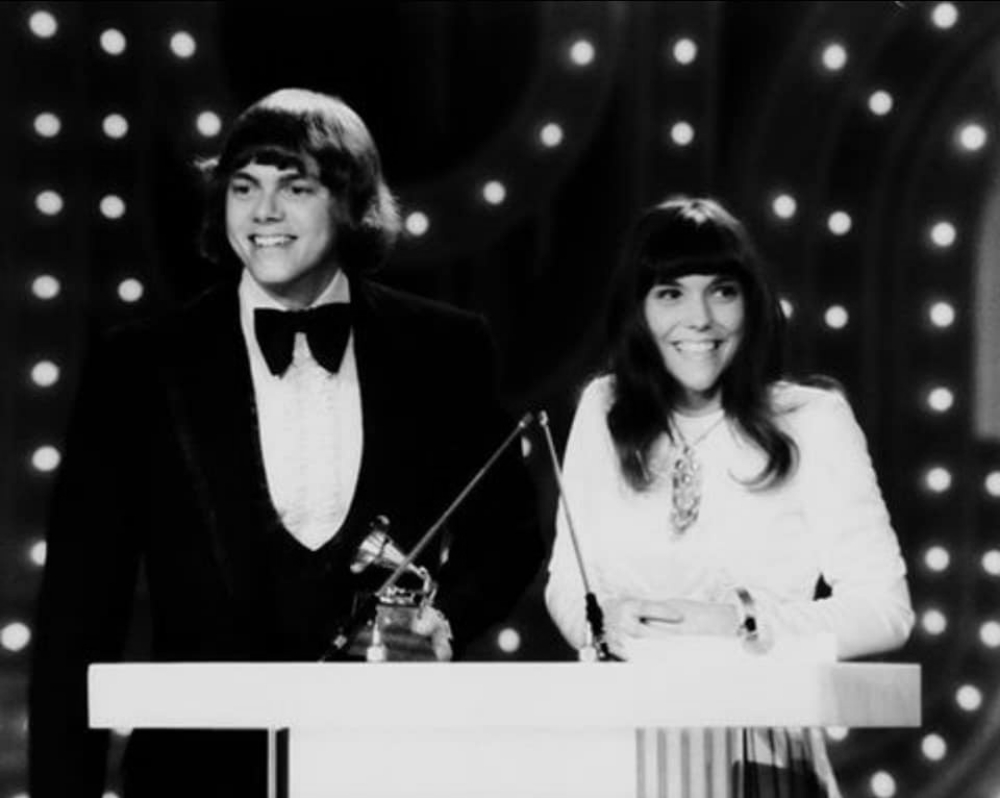
Close to You” was nominated for Record of the Year and Album of the Year at the 1971 Grammy awards. They won for Best New Artist and also for Best Contemporary Vocal Performance by a Duo, Group or Chorus.

Despite the group being derided as saccharin at the time, their musical success is undisputed. Much has been written about Karen Carpenter’s voice, her three-octave range, and soulful interpretations. The Carpenters would not, however, have been the Carpenters without older brother Richard who was the genius behind their ‘sound.’

Love ‘em or hate ‘em, The Carpenters’ style was original and Karen’s talent immense, the combination of which propelled them to the top of the pop charts. Also from the Infallible Wikipedia:

“They produced a distinct soft musical style, combining Karen’s contralto vocals with Richard’s arranging and composition skills. During their 14-year career, the Carpenters recorded ten albums, along with numerous singles and several television specials.”

From 1970 through 1973 they achieved their greatest success, appealing to a demographic who purchased their records and made The Carpenters a household name: females aged 13 to 18.

“Their career together ended in 1983 when Karen died from heart failure brought on by complications of anorexia. Extensive news coverage surrounding these circumstances increased public awareness of eating disorders. Though the Carpenters were criticized for their clean-cut and wholesome conservative image in the 1970s, their music has since been re-evaluated, attracting critical acclaim and continued commercial success.”

When I first published this post in 2019 I reserved the right to blog more about the Carpenters at a later date. Which I have on three more occasions (so far): https://barbaradevore.com/2020/02/04/goodbye-to-love/, https://barbaradevore.com/2021/08/31/wedding-woes/, https://barbaradevore.com/2023/12/05/top-of-the-world/.

No doubt they were the most influential musical group for me during my teen years. But this article is only to focus on their launch and the song Close To You. More than any other song, this one literally marks the moment I became a teenager. The start of its four weeks run on the charts coincided with my 13th birthday.

Back in the 1970’s there was really only one way to ‘blog’ – by keeping a diary. Although I couldn’t put my hands on my 1970 diary, I found a reference to this song at the end of my 1971 diary, noting when it was played on the radio.

I was so obsessed with the song that I would record it from the radio. I actually can still visualize my 13-year-old self sitting motionless and silent on my bed, cassette tape recorder on the bedside table, holding the microphone next to the radio’s speaker, while Close To You played and I captured it on tape. Kids today do NOT know how easy they have it!

Eventually I purchased the single and then the album of the same title. A much easier way to listen to it although I had to use my parents’ stereo system and my mother made me listen to my music via headphones.

My obsession even prompted me to think it was a good idea to do a lip-sync version for a competition where I needed a ‘talent.’ (Singing was out of the question and I really had no other performance talents, BTW) Taken from the pages of my 1971 diary on December 31st, I dutifully reported that “I am going to pantomime Close to You like I’m a chorus girl or something. I’m going to wear Sue’s blue velvet formal and silver shoes. If she’ll let me.”

Yes, my older sister did let me wear the dress and the shoes. Yes, it was a total embarrassment. It may have contributed to why I avoid karaoke and limit my singing to the shower and the car although my dance moves were okay.

What a blessing that Karen Carpenter – who suffered from stage fright – was able to overcome it enough to share her amazing voice with the world. But I’m not so sure the price she paid was worth it.

And a couple of links:

https://en.wikipedia.org/wiki/(They_Long_to_Be)_Close_to_You
https://en.wikipedia.org/wiki/Soft_rock

Like A Song on the Radio

Thank you, Mr. Marconi

June 2, 2020

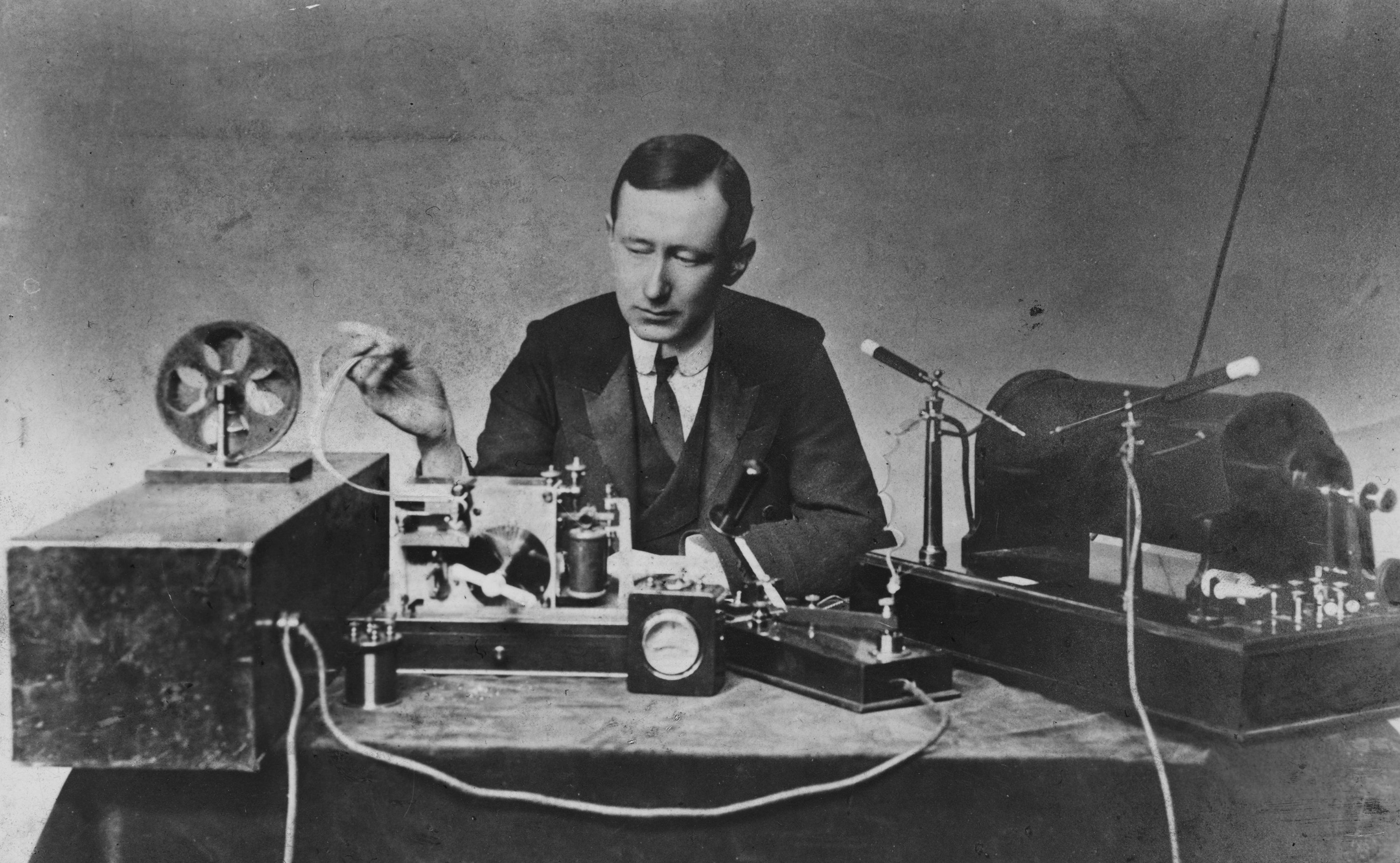
Marconi RadioThere is a saying that he who gets to the patent office first matters more than who invented it. This is likely true for the invention of radio. Guglielmo Marconi – first to the patent office – filed on June 2, 1896, eclipsing others also working on the budding technology.
The story begins decades earlier and, as is often the case, the Infallible Wikipedia sums it up:

“The idea of wireless communication predates the discovery of ‘radio’ with experiments in ‘wireless telegraphy’ via inductive and capacitive induction and transmission through the ground, water, and even train tracks from the 1830s on. James Clerk Maxwell showed in theoretical and mathematical form in 1864 that electromagnetic waves could propagate through free space. It is likely that the first intentional transmission of a signal by means of electromagnetic waves was performed in an experiment by David Edward Hughes around 1880, although this was considered to be induction at the time. In 1888 Heinrich Rudolf Hertz was able to conclusively prove transmitted airborne electromagnetic waves in an experiment confirming Maxwell’s theory of electromagnetism.”

Fascinated by the possibility of transmitting sounds via Hertzian (as radio waves were called at the time) waves, Marconi began experiments building the equipment needed in the attic of his home. He was only 20 years old.

“A breakthrough came in the summer of 1895, when Marconi found that much greater range could be achieved after he raised the height of his antenna and, borrowing from a technique used in wired telegraphy, grounded his transmitter and receiver. With these improvements, the system was capable of transmitting signals up to 2 miles (3.2 km) and over hills. The monopole antenna reduced the frequency of the waves compared to the dipole antennas used by Hertz, and radiated vertically polarized radio waves which could travel longer distances. By this point, he concluded that a device could become capable of spanning greater distances, with additional funding and research, and would prove valuable both commercially and militarily. Marconi’s experimental apparatus proved to be the first engineering-complete, commercially successful radio transmission system.”

Encouraged by his parents, he left Italy for England – his mother accompanied him – and was able to gain the interest of the British Government and, eventually, financial backing. While Marconi’s system was used primarily for short distance maritime communications at first, his company continued to experiment and expand the distance the radio waves traveled. It was Marconi’s system which made it possible for 700 passengers aboard the Titanic to be rescued.

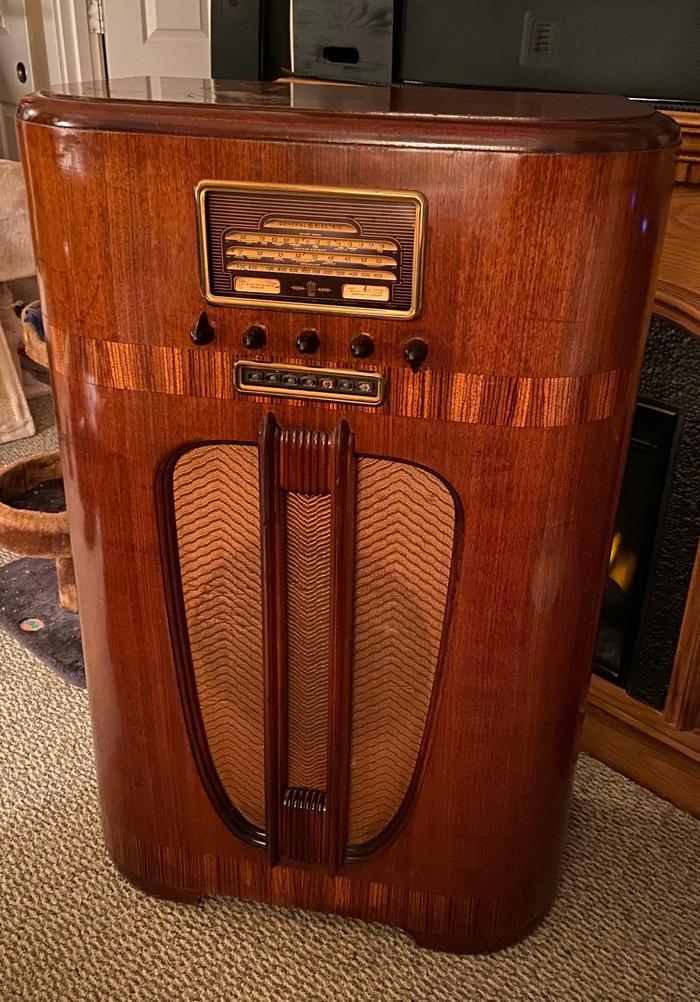
GE F-96

My brother had a radio like this one given to him by our grandparents. His is currently in a storage locker… this beauty belongs to someone who graciously posted it on the internet.

Innovation in radio proceeded at an amazing pace with the commercial side of it soon eclipsing the more mundane maritime uses. By 1938 four of every five homes had a radio. Families gathered around for favorite programs, whether they were music, ‘theater,’ or the news of the day. The radio became an essential part of society.

All of today’s wireless digital communications via phones, pads, and portable computers, began with the invention of the radio.

Marconi – along with Karl Braun – shared the 1909 Nobel Prize “for their contributions to the development of wireless telegraphy.”

transistor radio

My sister was the queen of the transistor radio with one nearly glued to her ear for several years.

By the 1960’s, despite the fairly recent addition of commercial television, radio was still king. Especially for teenagers. It was radio which helped foment the rock and roll revolution; it was radio which unified the baby boom generation. Every town seemed to have at least one radio station and the wise ones were spinning the popular teen records of the day.

In Yakima – where I grew up – there were three stations of note in the later 1960’s and early 1970’s. I remember my dad always wanting to listen to KIT. At 1280 on the dial it featured news and WWII era music. As a card-carrying teen that was not on my list of cool radio stations. There were, however, two stations I listened to: KMWX and KQOT.

Being that I kept a diary (note to my younger self – what you wrote about was mostly ridiculous) and that listening to the radio was so important, I recorded this gem from April 25, 1971:

“Today was Pete’s Birthday. He liked the Grippu Sue and I gave him.* We went on Daylight Savings, so it stays light till almost 8:30. That means KQOT stays on the air until 7:45 and on May 1st, they will stay on until 8:30. That means I get to hear Neal Gray all through the ‘Sommer.’ (Sommer? Get it? Bob Sommers D.J.) YEA!”

Three days later, I posted this entry:

“Today was an interesting day, you see, today was Patty Hooper’s dog’s birthday, so I told her I would dedicate “Me and You and a Dog named Boo” to her dog, Sairy, if I could get through… well I got through and dedicated it but it is really weird to hear Bob Sommer’s voice on the radio and telephone, then your own. Patty was listening and called right after the song was over. Command Performance is kind of fun.”

It was, apparently, about this time that I became radio obsessed, even going so far (Two days after that!) to try to figure out the trick for getting through to the D.J.’s. For one of my dialing adventures, it took me… 292 times to get through.

Scan_20200602

The author at age 14. Cassette recorder, radio (it was an older one my parents had). I’m not sure where the clock radio is… and you can see my blue 1972 diary off to the side. I was kinda messy.

The rest of the 1971 diary has occasional references to the two radio stations. What I do recall during those years is sitting on the bed in my room, listening to the radio and waiting for my favorite songs. I cannot recall what sort of radio it was, but it was my daily companion. I was given a cassette tape recorder for my 13th birthday, and a new clock radio for my 14th. Together they afforded me the opportunity to ‘record’ songs when they came on the air. Many a tape was filled with badly recorded favorite songs AND, often, the D.J.’s playing the live requests. Those tapes were played over and over.

In today’s world, the importance of radio for young people has faded. Kids pop in their earbuds and open their Spotify or Pandora** apps on their phones; in an instant their favorite songs begin to play. Somehow I think they are missing out on the experience of calling the radio station, requesting ‘the’ song, and then listening for hours to hear it.

I’ve included a video of Al Stewart’s ‘Song on the Radio’ as it seems to capture the spirit of the 1970’s

For those of us who grew up during AM radio’s golden age of rock and roll we did not realize at the time that it wouldn’t always be that way. No doubt there will be more amazing innovations for wireless digital communications and, one day, I imagine the teens of today will pine for the good ole days. It’s the way of the world.

*I have no idea what this thing was… in another entry I write that the gripper is ‘a big blow up plastic hand.’ Who knew?

**It’s highly likely that Spotify and Pandora are ‘last year’s’ hot apps. I await correction from those in the know.

A couple of links:

https://en.wikipedia.org/wiki/History_of_radio

https://en.wikipedia.org/wiki/Guglielmo_Marconi

KQOT operated as a ‘rock’ station from 1962 until 1979 and is now Christian station KYAK: https://en.wikipedia.org/wiki/KYAK