Tag Archive | Alpha Phi

You Light Up My Life

A mega hit for Debbie Boone

November 19, 2024

A Tuesday Newsday Classic updated
On November 19, 1977, this song was in the middle of a 10 week run as the number one song in America. You Light Up My Life was the one and only Top 40 hit from Debbie Boone, daughter of 50’s teen idol Pat Boone. It reached number one on October 15 and stayed in that position through December 23, making it – at the time – the only recording to stay that long in the top spot in Billboard history.

According to the Infallible Wikipedia:

“Besting her chart performance in Billboard, Boone’s ‘You Light Up My Life’ single topped Record World’s Top 100 Singles Chart for an unbroken record of 13 weeks. On Billboard’s chart, Boone was unseated from #1 by the Bee Gees, with ‘How Deep Is Your Love,’ the first of three #1 singles from the ‘Saturday Night Fever’ soundtrack. On Record World’s chart, Boone kept the Bee Gees out of the number-one spot. In Cash Box Magazine, ‘You Light Up My Life’ managed only an eight-week stay at the top of the chart, before being dethroned by Crystal Gayle’s ‘Don’t It Make My Brown Eyes Blue’.

The single, which was certified Platinum by the Recording Industry Association of America (RIAA), also hit #1 on the Adult Contemporary chart and reached #4 on the Country chart. The single peaked at #48 I’m the UK Singles Chart. Boone’s hit single led to her winning the 1978 Grammy Award for Best New Artist, with additional Grammy nominations for Best Pop Vocal Performance, Female and Record of the Year. Boone also won the 1977 American Music Award for Favorite Pop Single.

Decades after its release, the Debby Boone version is still considered one of the top ten Billboard Hot 100 songs of all time. In 2008, it was ranked at #7 on Billboard’s ’Hot 100 All-Time Top Songs’ list (August 1958 – July 2008). An updated version of the all-time list in 2013 ranked the song at #9.

Although it was written by (Joe) Brooks as a love song, the devout Boone interpreted it as inspirational and proclaimed that it was instead God who ‘lit up her life.’”

The song was tainted by controversy, however, as songwriter Brooks apparently did not want to pay the agreed upon amount owed Kasey Cisyk, the artist who sang it for the movie of the same name, and whose version is included on the 1977 soundtrack.

Boone was told, when recording the song for release as a single, exactly how to sing it and her vocals were dubbed onto the original orchestral track.

At the time, I recall that Boone received much derision and the song was labeled as saccharin. In reading what occurred, however, I feel bad for both the women caught up in the controversy. Perhaps Cisyk was denied her shot at a Top 40 career and, perhaps, Boone was lulled into a sense of inevitability that she would become a star like her father. Although in listening to both versions, I think Boone’s is better.

Boone released additional songs into the pop market, but none ever came close to the success of “You Light Up My Life.” Her career eventually led her back to country music – where she had started – and then to work in the Christian music world.

In the fall of 1977, you simply could not avoid the song. It was played hour after hour on the radio. That autumn was one of the most memorable in my life: I was living away from my parents for the first time, having joined the Alpha Phi sorority at the University of Puget Sound. While I did study, I don’t think I was quite as diligent as I should have been. Instead, I was fraternizing with the fraternity boys most every weekend at mixers, and going on dates! I had never in my life garnered quite so much attention from the males of the species.

There was one particularly memorable November day when, literally, I had calls or visits from five guys all of whom I had been on a date with in recent weeks. That day, I could not say for sure the exact date, I had been headed down to the ‘tunnels’ to get my dinner and I decided it was a good idea to jump down the two steps from the door. I jumped a wee bit too high and… nearly gave myself a concussion.
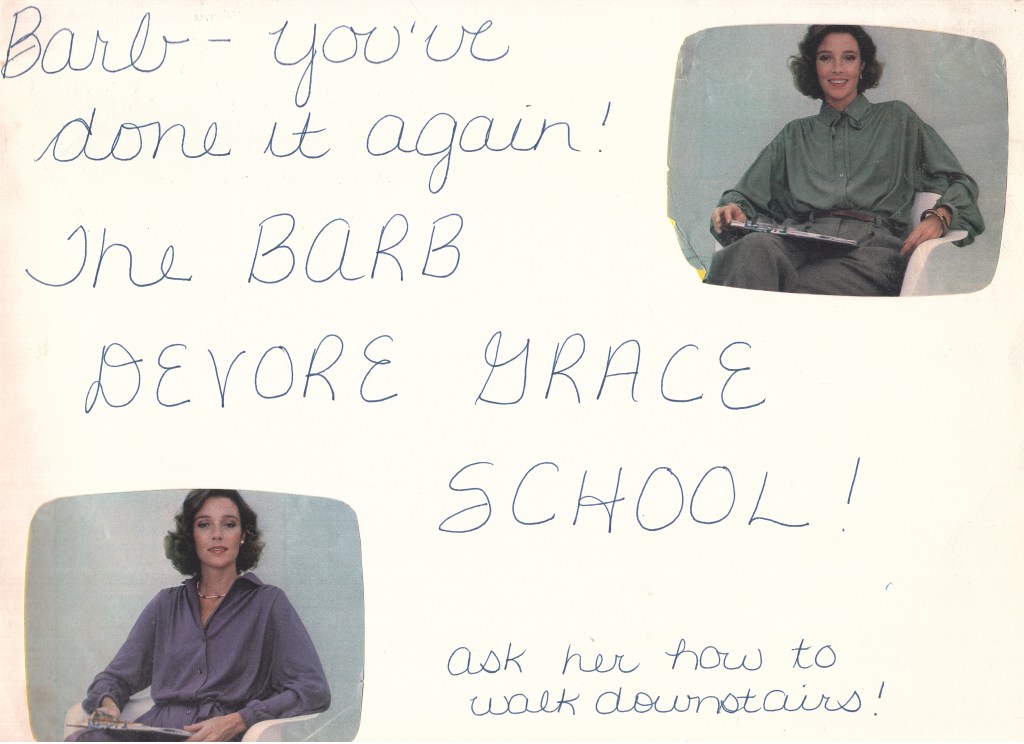
The ‘award’ I was given for my epic self inflicted concussion

The next Monday at our weekly sorority chapter meeting, I was recognized for my grace (for the stairs) and my charm (for the plethora of phone calls and visits I had). It was what I came to be known for and received endless ribbing about it. Good times.

That era in my life was punctuated by music and whenever I hear “You Light Up My Life” I’m back in the Alpha Phi house and it’s the fall of 1977. There were a few other songs which, in my opinion, were equally as deserving of that number one spot.

These included Billy Joel’s Just The Way You Are – an infinitely better song; Rita Coolidge’s version of We’re All Alone; Carly Simon’s Nobody Does It Better; and Don’t It Make My Brown Eyes Blue by Crystal Gayle. The list of great songs from that year also included big hits – but never number ones – from a whole lot of great bands: Foreigner, Heart, Fleetwood Mac, Styx, Supertramp, and Steely Dan, among others.

And in case you’d like to hear the Casey Cisyk version and really get the worm stuck in your head (it’s been in mine since I wrote this!) here’s that video also. Note that you are seeing Didi Conn on screen – she is doing a lip-sync to Cisyk’s vocals. Enjoy!

The links:
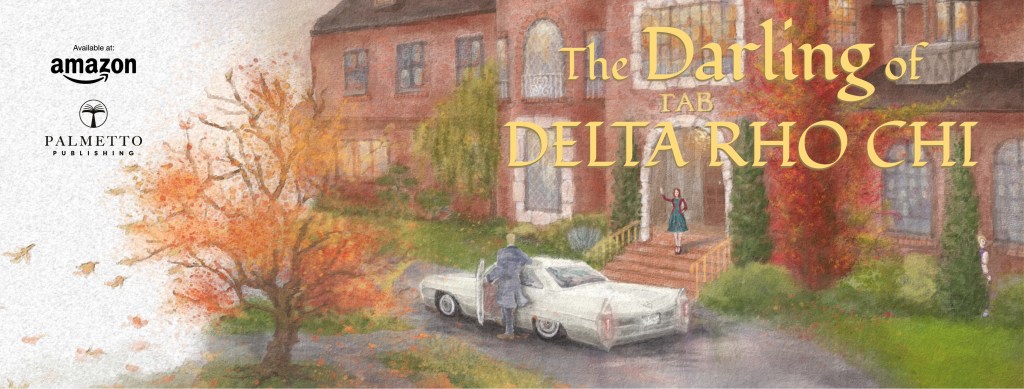
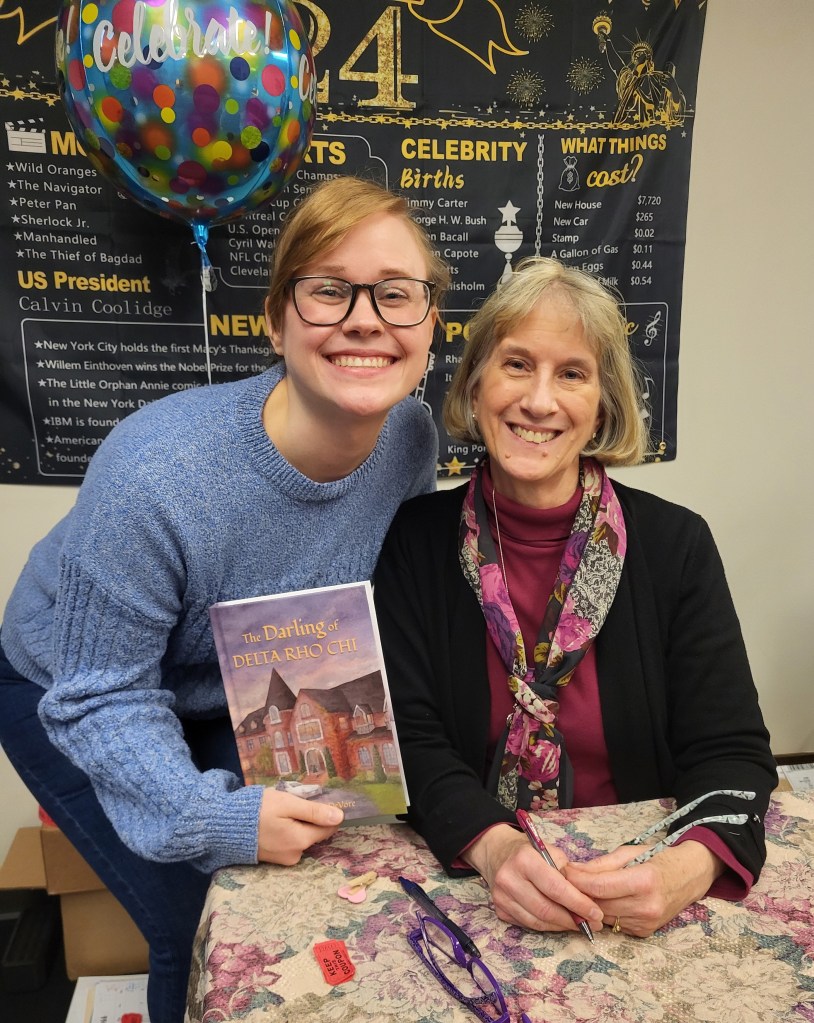
The Darling of Delta Rho Chi

October 27, 2024

There’s a bit of a thrill to do a search on both Amazon and Barnes & Noble and see one’s novel available for presale… it’s a dream a long time in the making! For more information and the links to both click here: https://barbaradevore.com/the-darling-of-delta-rho-chi/.

The first order of hardcover books!

November 25, 2024

The long awaited day has arrived! My shipment of hardcover books. One step closer to the launch party.

December 1, 2024

Hosted my Book Launch Party yesterday! Great success. Thank you to all who attended and shared in the celebration. Thank you to all who have purchased books and have left me reviews. My heart swells!

My most recent review on Amazon!

5.0 out of 5 stars Must readReviewed in the United States on November 28, 2024

I absolutely adored this two-for-one father/daughter book. It’s the story of Elise and her sorority troubles, as well as her father Jack finding his way to new love and dreams coming true for both. The characters are well developed, and I became invested in what happened to them. I fully appreciated the place and period accurate references to people and places I remember from living in the state. I felt the author nailed the social mores and values of the time period written about. I thoroughly enjoyed this book.”

January 27, 2025

First of all – thank you to EVERYONE who has ordered The Darling of Delta Rho Chi. I had no idea what this journey would look like. It’s been everything I hoped it would be and more. I’m especially appreciative of the conversations with friends who have sought me out to share with me their impressions of the novel.

A couple of favorite verbal comments:

It’s kinda spicy. I never expected that from you.”

“I stayed up until 2 a.m. finishing it. I never do that.”

“When is the next book coming out?”

And then there was this, the comment which truly floored me:

“Your writing reads a lot like Jodi Picoult.”

For those unfamiliar with Jodi Picoult, I think she is one of the best fiction writers I’ve ever read: carefully crafted characters, compelling story lines, crisp and clean scene setting and descriptions. To be included in the same sentence is humbling, flattering, and brought a lump to my throat.

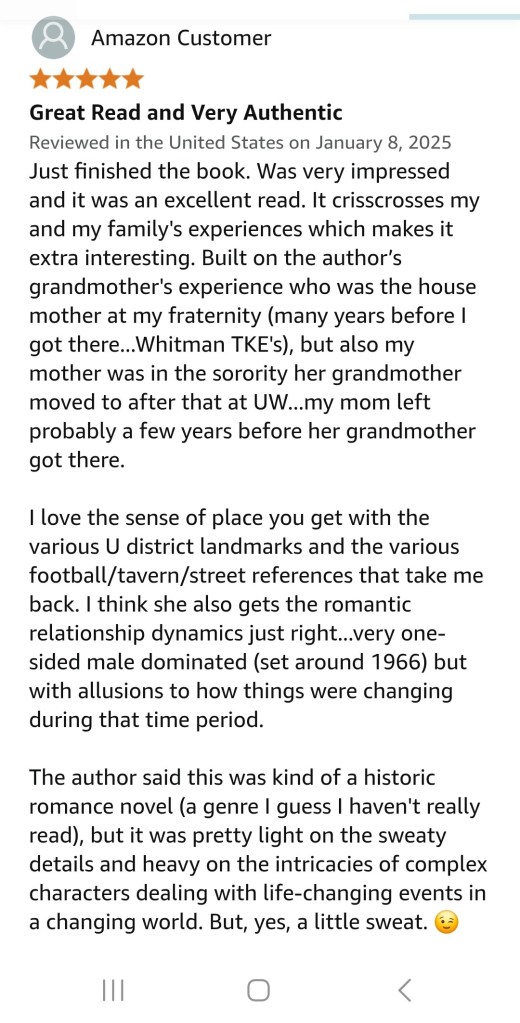
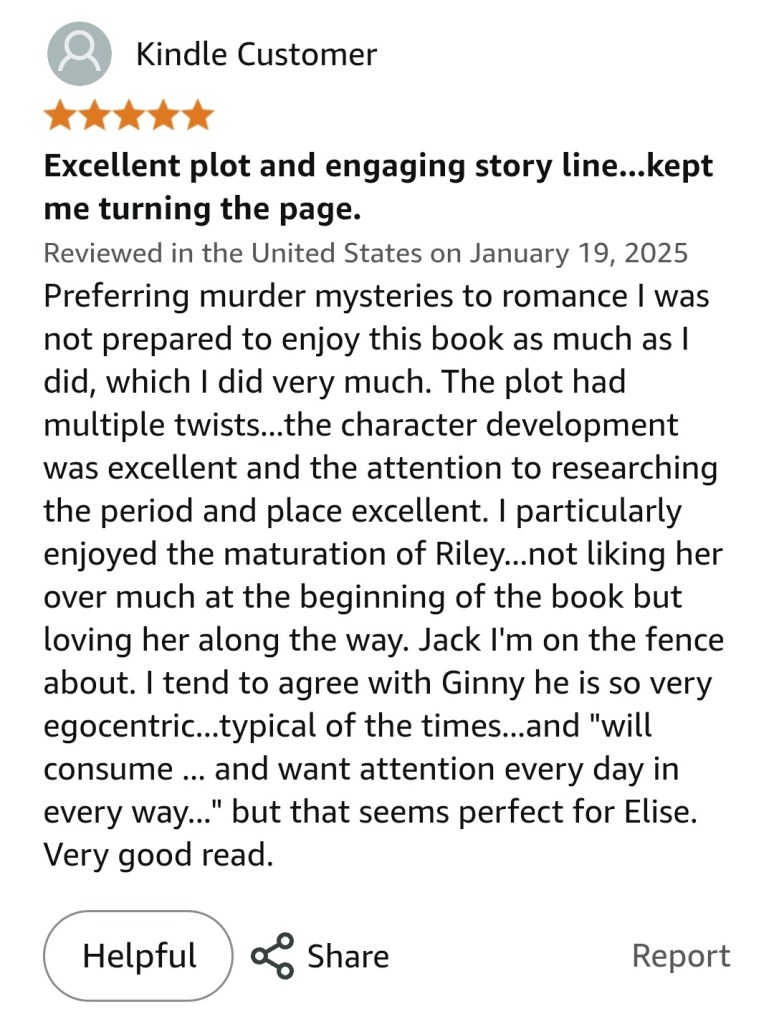
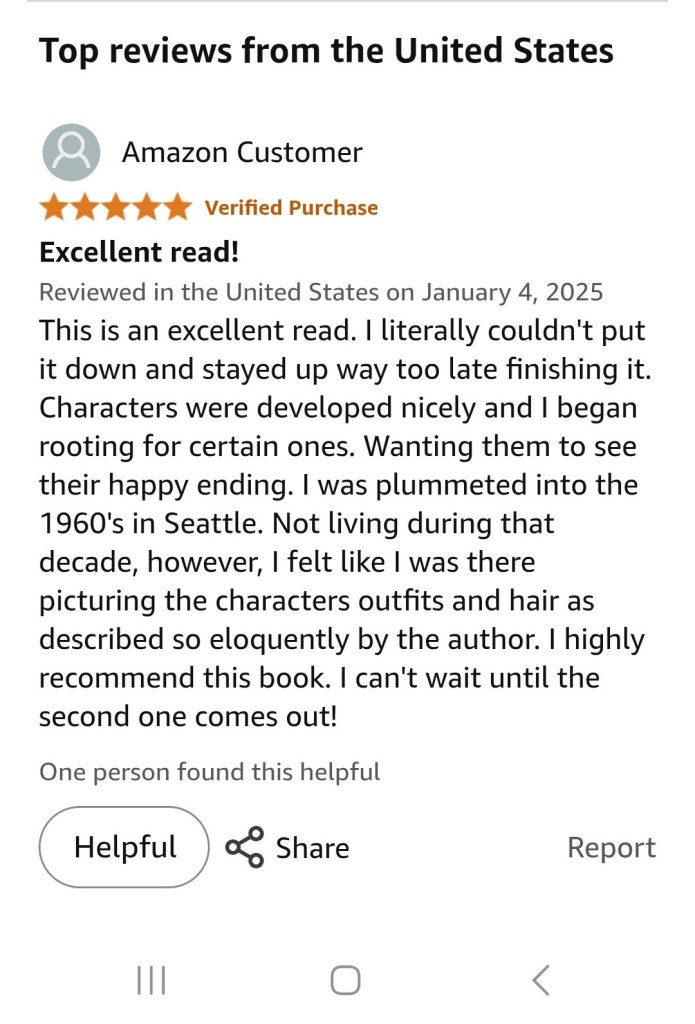
Heartfelt thanks to all who took the time to leave a review, send me a message, or seek me out to tell me what you thought. Here are three recent reviews on Amazon:

The TKE house at Whitman College

Alpha Phi

Celebrating 150 years of Sorority Life

September 13, 2022

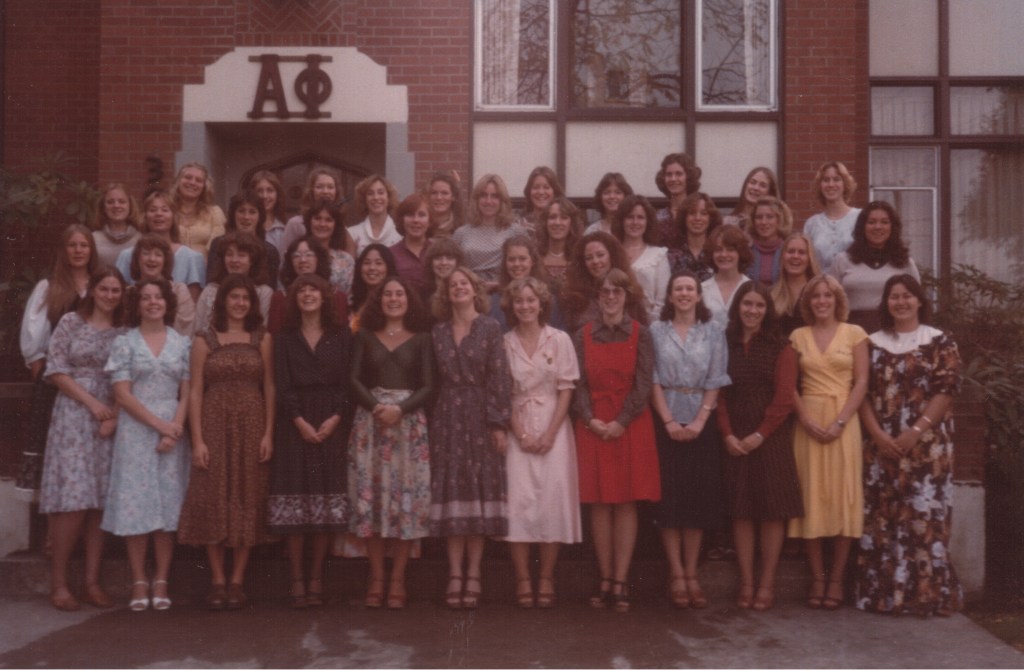
The front of my Alpha Phi Pledge book and a photo of our house at the University of Puget Sound. 1977

The formation of Greek letter societies on college campuses can be traced back to 1776. The idea behind the first such group – Phi Beta Kappa – was to provide a place for like minded individuals in the pursuit of academic excellence. Phi Beta Kappa continues today as a prestigious academic honor society.

Over the next century Fraternities, as they came to be called, were social groups formed for men. It wasn’t until 1870 when the first actual Greek letter group for women was established. That honor goes to Kappa Alpha Theta which was formed in January 1870 at Indiana’s DePauw University; close on their heels was Kappa Kappa Gamma founded in October of the same year at Monmouth College in Illinois.*

Third on that list was Alpha Phi Fraternity, established on September 18, 1872 at Syracuse University in Syracuse, New York.

The term Sorority had not yet been coined to represent the female version of a Fraternity which is why the first three such groups for women were formed as Fraternities.

When I pledged Alpha Phi at the University of Puget Sound in the fall of 1977, I knew little of the Greek organizations. Yes, my mother had been a member of Delta Delta Delta but had talked little of her time in the sorority.

I also knew that my grandmother had been a housemother for the Sigma Kappa sorority on the University of Washington campus in the early to mid-1960’s.

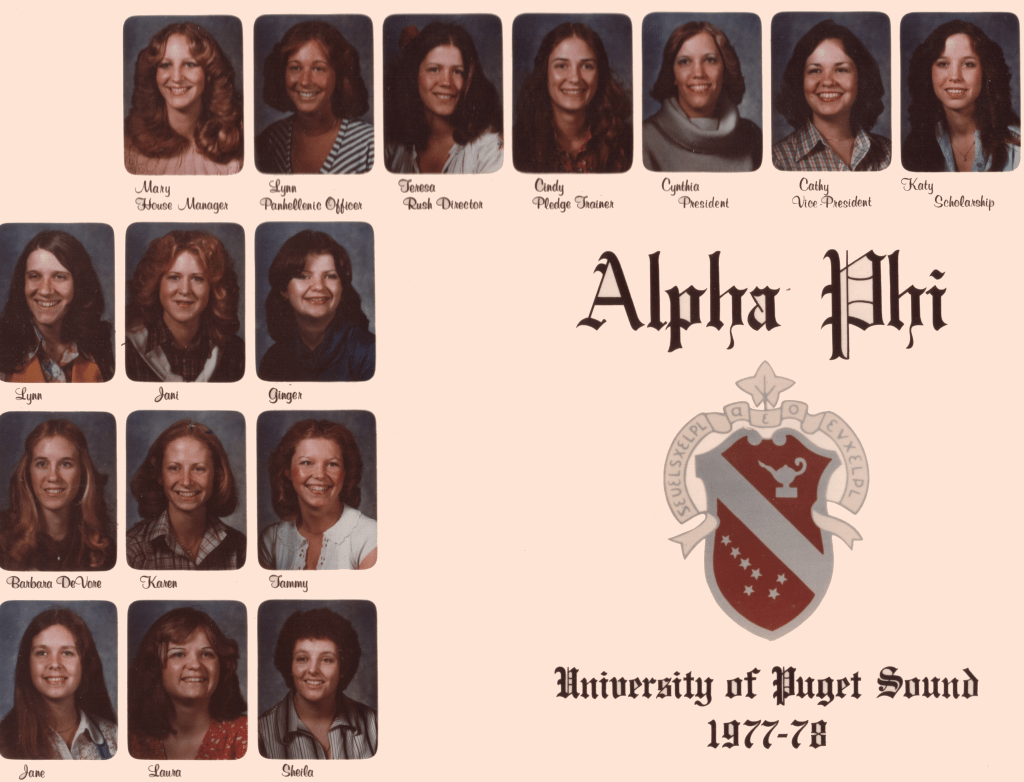
A few of my sorority sisters from the official composite of the members in 1977-78

Knowing this, and having stayed at the Sigma Kappa house a couple of times while my grandmother was there, I had long wished to join a sorority when I attended college. More on that in a bit.

First, the Infallible Wikipedia tells us this about Alpha Phi:

“At the time of the founding there were only 666 women attending Syracuse; ten of them eventually formed Alpha Phi to create an organization ‘on the principles of the promotion of growth in character; unity of feeling, sisterly affection, and social communion among the members.’ Although the actual founding date is September 18, 1872, Alpha Phi has been celebrating their Founders Day on October 10 since 1902, since many colleges and universities were not open for classes in mid-September at that time. Alpha Phi considers itself a women’s fraternity because its founding date predates the invention of the word ‘sorority.’ (snip)

Like many other women’s fraternities, Alpha Phi recognizes multiple types of symbols, with the Ivy Leaf as their primary symbol. The fraternity’s official colors are Bordeaux and silver. The colors were originally blue and gold; however, these colors were similar to those of Delta Upsilon Fraternity so they were changed. The official flowers are the Lily of the Valley and the Forget-me-not. Alpha Phi lists its ideals as ‘Sisterhood, Generosity, Innovation, and Character.’ Alpha Phi’s public motto is ‘union hand in hand’.”

My roomies from my first semester atop the bunk beds: Dee, Susie, and Connie.

All of these things I learned after becoming a pledge. A pledge is someone who commits to joining the organization once they have completed a probationary period. I successfully completed my probation and was initiated into Alpha Phi in January 1978.

The two years I was a member of Alpha Phi were, perhaps, the most influential and memorable times of my life. I loved everything about Sorority life. The Monday night chapter meetings; the Friday and Saturday night functions with the Fraternities; the crazy antics of my roomies; having roomies; living on Greek row.

Unlike most students, I was a junior when I arrived on the UPS campus. I had spent the previous two years at Yakima Valley College (YVC). I discovered, spring of my sophomore year at that institution, that I was a few credits short of what I needed for my AA degree. Having the AA was essential to avoid spending an extra year – and extra money – getting my BA degree.

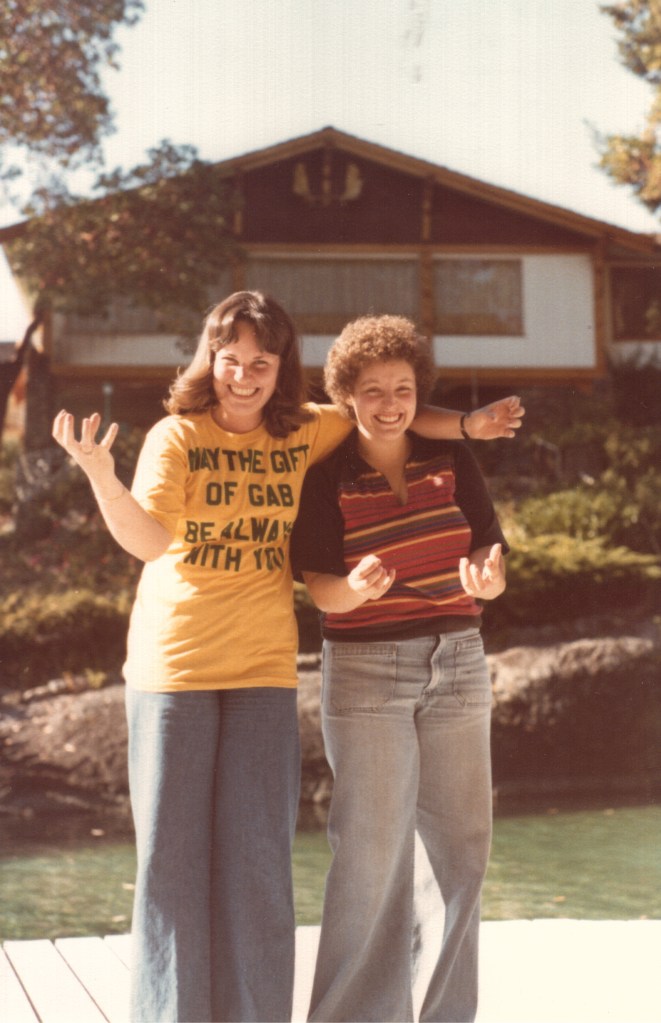
With Roomies Cathy and Sheila at Sheila’s home in Sooke, B.C., summer of 1978

The summer before UPS, I took a Spanish class at YVC to get those credits and ended up meeting a gal name Toni. Unbeknownst to me, Toni was a member of Alpha Phi at UPS and, due to her own issues getting her degree from UPS, had signed up for the YVC class also. I so appreciate Toni as she took the time and effort to write a recommendation for me, paving the way for my membership in Alpha Phi.

I assumed I would join Delta Delta Delta (Tri-Delta) as both my mother and my aunt had been members. There were rules regarding how a ‘legacy’ – someone who had a mother, sister, or grandmother who belonged to a particular sorority – was processed through ‘Rush.’ (Rush was a multi-day process where the Rushees would go, in groups of 25 to 30, to each and every sorority on campus. There you would meet and talk to members of a particular house before being ushered out and then herded to the next house.) Later, I came to understand, the members of each house would meet and decide ‘who’ to invite back the next day as they were limited in the number of young women they could choose.

Not knowing how Rush worked, I found out too late that having letters of reference were essential to receiving an invitation to return. For the second day of Rush, I was asked back to three of the seven Sororities on campus: Tri Delta, Alpha Phi, and Chi Omega. I did not have the recommendations needed for the others.

Undaunted, I show up at the appointed time at each and I think it’s gone pretty well. But, when the dust settled, the Tri-Delts had not invited me back to day three. I learned later that, as a Legacy, you were guaranteed an invite back for day two, but if they invited you back after that they were required to issue you an invitation to join. Being that I was a junior meant I would only be in the sorority for two – rather than four – years. The Tri-Delts were, I think, looking only for freshmen.

Ready for the alumni open house Fall 1978

Although disappointed, I crossed my fingers that the Alpha Phi’s would keep me to the end. While Toni had opened the first door, I was also helped along by Alpha Phi member I knew through the Rainbow Girls. I have no doubt that her influence was a deciding factor in the sorority inviting me to join. Thus I became a proud pledge of Alpha Phi, excited to have the sorority experience.

Alpha Phi’s dressed and ready for a cowboy function with one of the Fraternities

There’s little doubt in my mind that I probably would have been a more serious student had I NOT joined the sorority. But I also believe that one’s lessons in life come in many different forms. For me Alpha Phi was the perfect vehicle for transition from teenager to adult. It became my family. True it was a family of all sisters, but we looked out for each other; we were there to listen to tales of woe in regards to guys. We were there to give each other hugs of encouragement and dry the occasional tears. We had someone to walk to class with and there was always someone to eat a meal with. There were the after lunch TV sessions to watch All My Children and the weekend late night gatherings for Saturday Night Live. There were the runs to the “Pig” – aka Piggly Wiggly grocery store – for snacks; and the occasional pizza outings to Shakey’s. There were dances and social events with the Fraternities.

In the spring of 1979, with graduation looming, some of my sisters would say they couldn’t wait to be done. But not me. I knew I would miss everything about Sorority life and Alpha Phi.

But it wasn’t over; not really. The experiences live on in my memory and, perhaps, one or a dozen of those experiences may have become part of the book series I’m currently prepping for publication.

I owe it all to my sisters and the two magical years I spent with them as a member of the Gamma Zeta chapter of Alpha Phi at the University of Puget Sound.

A few links:

https://en.wikipedia.org/wiki/Alpha_Phi

https://en.wikipedia.org/wiki/Fraternities_and_sororities#Establishment_and_early_history

https://en.wikipedia.org/wiki/University_of_Puget_Sound

*Although both Pi Beta Phi (Pi Phi) and Alpha Delta Phi (ADPi) can claim earlier formation dates than the three listed, neither adopted Greek letter names when created. Pi Phi – originally called I.C. Sorosis – switched to a Greek letter name in 1888, and ADPi – originally the Adelphean Society – in 1905.

Popcorn!

February 22, 2022

There are topics which come to my attention from time to time that cause me to say: that just can’t be right.

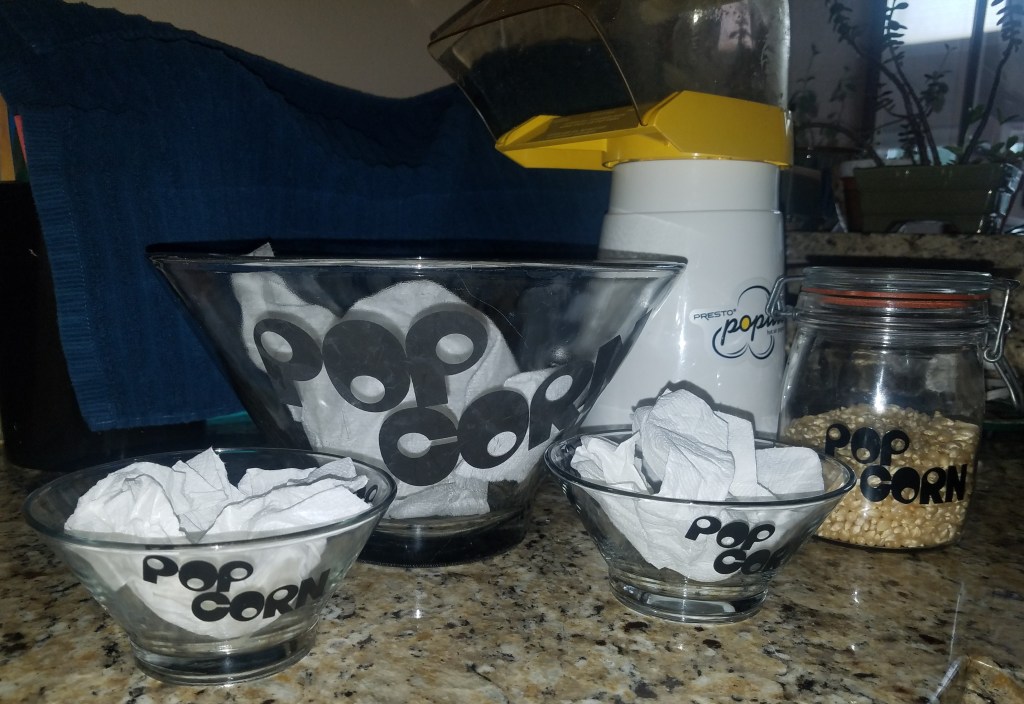
The hubby and I have had this same set of bowls for decades now… and still use them

According to a number of sources on the internet, it was on February 22, 1621, when a Native American by the name of Squanto, at the first Thanksgiving, showed the settlers how to make ‘popcorn’.

Hmmm… wasn’t the first Thanksgiving held in the fall and not February? And did the natives of that region really eat popcorn?

A little refresher. The Pilgrims landed in what is now Plymouth, Massachusetts in November of 1620. For the next year they struggled mightily, enduring hardships and starvation. There was no feast in February 1621. That did not occur until sometime between mid-September and early November 162.

Now on to the second question about the popcorn. According to History.com:

I feel confident that the two groups were not sitting around the campfire enjoying a batch of jiffy pop in February 1621.

Colorful dried corn

“It’s been said that popcorn was part of the first Thanksgiving feast, in Plymouth Colony in 1621. According to myth, Squanto himself taught the Pilgrims to raise and harvest corn, and pop the kernels for a delicious snack. Unfortunately, this story contains more hot air than a large bag of Jiffy Pop. While the early settlers at Plymouth did indeed grow corn, it was of the Northern Flint variety, with delicate kernels that are unsuitable for popping. No contemporary accounts reference eating or making popcorn in that area, and the first mention of popcorn at Thanksgiving doesn’t appear until a fictional work published in 1889, over 200 years later.”

But, the history of popped corn is interesting. A uniquely western hemisphere food, there is evidence that corn has existed and had been used as food for thousands of years.

While the Infallible Wikipedia was silent on the Pilgrims angle, it does share the following:

“Corn was domesticated about 10,000 years ago in what is now Mexico. Archaeologists discovered that people have known about popcorn for thousands of years. Fossil evidence from Peru suggests that corn was popped as early as 4700 BC.

Through the 19th century, popping of the kernels was achieved by hand on stove tops. Kernels were sold on the East Coast of the United States under names such as Pearls or Nonpareil. The term popped corn first appeared in John Russell Bartlett’s 1848 Dictionary of Americanisms. Popcorn is an ingredient in Cracker Jack and, in the early years of the product, it was popped by hand.

Charles Cretors with one of his popcorn machines

Popcorn’s accessibility increased rapidly in the 1890s with Charles Cretors’ invention of the popcorn maker. Cretors, a Chicago candy store owner, had created a number of steam-powered machines for roasting nuts and applied the technology to the corn kernels.

By the turn of the century, Cretors had created and deployed street carts equipped with steam-powered popcorn makers.”

It was, however, during the Great Depression when popcorn consumption really took off. With sugar in short supply and sweets largely unavailable, American’s discovered they could have an inexpensive salty, buttery snack instead. Soon popcorn was sold in movie theatres and people could pop it at home.

Popcorn popularity surged once again in the 1980’s  with the ability to cook the product in microwave ovens. It’s estimated that Americans today consume more than 17 billion quarts of popcorn annually!

Some of my earliest memories center around popcorn. My dad would pop a pan full on most Saturday nights of my childhood; a once a week treat while the family played cards.

My first popcorn popper was likely a Stir Crazy or similar. You poured a bit of oil on the base and heated it up, then added the popcorn kernels. It was fun to watch the popcorn fill the lid – which you turned over and it became the bowl.

When I went away to college at the University of Puget Sound, I brought with me two ‘appliances.’ One was a small electric kettle and the other was an all in one popcorn popper. Of course I was not the only girl to have one in the sorority, but one could be sure that the smell of the popping corn would be a siren call to others; soon the party would be in my room.

I associate popcorn with the hubby. Not only does he LOVE popcorn, it was the thing we were both eating on the night of our first ever phone call.

The hubby’s older brother, while we were on a waterski trip to Lake Tapps in 1981, decided the hubby was a good ‘target’ for getting popcorned.

In 1979 there were no cell phones. We did not have individual phones in our rooms either. Instead, there was a multi-line phone system in the Alpha Phi sorority where I lived,  and down the hall from my room was ‘the phone room.’ This was a closet size space with a small desk and chair, and the phone for the entire sorority was located there. Additional handsets were located on the second floor and another in the basement. Members took turns being on phone duty in the evenings, answering the calls and then, via intercom, paging those who had a call.

The evening of our first call, I had just finished making a batch of popcorn when the intercom near my room announced, “Call for Barbie D on line 2.” So, with a bowl of popcorn in hand, I made my way to one of the phones. As the conversation got going my new romantic interest and I discovered that we were both enjoying the same snack.

Our mutual love of popcorn has never wavered and we are in agreement that popcorn is best when it has butter drizzled over it and a few turns of the salt grinder on top of that. Sometimes the simplest things are the best.

The links:

https://en.wikipedia.org/wiki/Popcorn

https://www.history.com/news/a-history-of-popcorn

Probably our 4th or 5th popcorn popper. The bowl and popcorn canister we’ve had since the 1980’s. The average American consumes 58 quarts of popcorn a year!

Instant Ramen: A College Staple and Cultural Phenomenon

A once banned food now a beloved Japanese favorite

August 25th

According to one Japanese poll, this food was named as the greatest invention of the 20th century.  Since a package of this costs between 50 cents and a dollar, it’s not only inexpensive, but it is easily one of the most adaptable instant foods you can purchase. Yes, I’m talking about the staple of college dorms everywhere: instant ramen noodles.

It was on August 25, 1958, when the first packages of the instant noodles were sold. But the history of ramen began much earlier.

How the first ramen was packaged, 1958

According to the Infallible Wikipedia:

“Ramen is a Japanese adaptation of Chinese wheat noodles. One theory says that ramen was first introduced to Japan during the 1660s by the Chinese neo-Confucian scholar Zhu Shunsui who served as an advisor to Tokugawa Mitsukuni after he became a refugee in Japan to escape Manchu rule and Mitsukuni became the first Japanese person to eat ramen, although most historians reject this theory as a myth created by the Japanese to embellish the origins of ramen. The more plausible theory is that ramen was introduced by Chinese immigrants in the late 19th or early 20th century at Yokohama Chinatown. According to the record of the Yokohama Ramen Museum, ramen originated in China and made its way over to Japan in 1859. Early versions were wheat noodles in broth topped with Chinese-style roast pork.”

Interestingly, it was in post WWII Japan, when the product really took off. Faced with rice shortages and a disrupted food supply line, inventive Japanese food vendors began making the noodles with cheap wheat purchased on the black market. Despite government attempts to keep vendors from making and selling the dish – they arrested thousands for doing so – it was one of the few things people could find to eat inexpensively. By 1950, the Japanese government relented, thus allowing the wheat noodles to find a place in the rice dominated culture.

In 1958,  Momofuku Ando – the founder of Nissan foods – developed a method by which the noodles were flash cooked, dried, and then sold in small blocks.

Also from the Infallible Wikipedia:

“Instant ramen allowed anyone to make an approximation of this dish simply by adding boiling water.

Beginning in the 1980s, ramen became a Japanese cultural icon and was studied around the world from many perspectives. At the same time, local varieties of ramen were hitting the national market and could even be ordered by their regional names. A ramen museum opened in Yokohama in 1994.

Who wouldn’t want to visit the Ramen museum just to see this giant bowl?

Today ramen is arguably one of Japan’s most popular foods, with Tokyo alone containing around 5,000 ramen shops, and more than 24,000 ramen shops across Japan.”

I became intimately acquainted with ramen soon after setting foot on the campus at the University of Puget Sound in 1977. Every member of my sorority, it seemed, had a small kettle and a stock of ramen packages in a desk drawer. It was one of two foods that seemed to dominate evening study time, the other being popcorn.

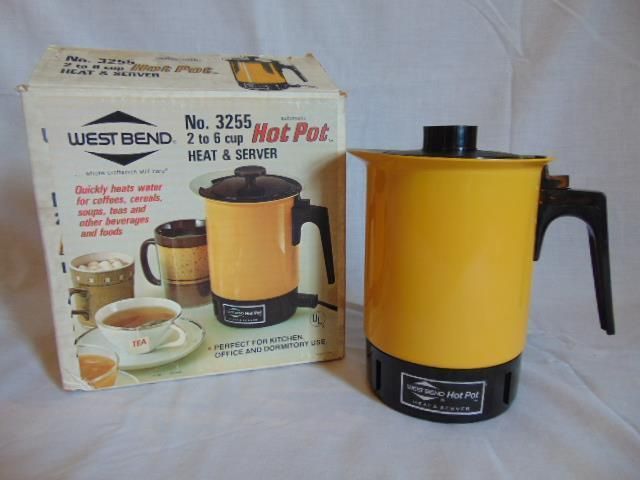
Soon, I too owned a West Bend electric teapot and a stock of ramen packets. I found one ad from 1979 where you could purchase it for a quarter a packet, but I do recall finding the coveted 10 for a dollar sales even into the 1990’s.

I think my pot was green but it might have been this lovely yellow

In my early ramen eating years, I was a purist; I’d boil my water, then drop the dried noodles into the pot and cook until they softened, finally adding the sodium laced flavoring.

After I met the man who would become my hubby, I learned that ramen could be so much more. He elevated ramen to an art form.

In Japan, the traditional way is as a soup of ramen and pork. But in our household, ramen is a vehicle for serving every sort of leftover. All meats can be added to it; stir in an egg for poor man’s egg flower soup. Tomatoes, celery, carrots, onions? All good in ramen. Perhaps the hubby’s favorite thing to add would be canned ‘Vienna’ sausages or hot dogs.

He recalls one college incident which revolved around ramen. Senior year he and two friends rented an apartment; one evening he was making a ramen concoction for his dinner. One of his roomie’s parents arrived on the scene to take their son to dinner. The roomie’s mom – upon seeing the ramen feast being prepared – was so horrified at this being my hubby’s dinner, insisted on taking him to dinner also.

The family ramen legacy was eventually passed to the next generation. Our daughter discovered the joys of ramen when she was an always hungry pre-teen and teen. Instead of asking Mom what was to eat, she learned early that she could fix it herself and probably consumed at least one package of it daily for many years. Cooked or dry did not matter. She loved it either way.

As an adult advisor for the Rainbow Girls, there was a parade of youth who showed up at our house regularly during those years. One girl was such a fixture that she knew exactly where the ramen was kept. Her arrival often meant that her first stop was the pantry where the Costco box of ramen occupied one end of the shelf. A few minutes later, the ramen cooked, we would settle around the table to chat. To this day she claims this as one of her favorite memories of our house.

The ubiquitous Costco 48 pack

The days of teens raiding the cupboards behind us, and my husbands ramen consumption reduced, the last Costco case of the stuff (48 packets – half beef, half chicken) is now gone. In fact, for the first time in the 40 years we’ve been married, there’s not a single package of ramen in the household.

When I inquired as to why, the hubby explained that he intended to get a ‘few’ packages at the grocery store instead of the industrial size Costco case. And there’s that pesky salt thing. One package of ramen is 1600 mg, a whopping 69 percent of the recommended daily salt intake.

Even so, it doesn’t seem right for us not to have a few packets of ramen just in case. Earthquake… Wind Storm… Pandemic…all good reasons to keep some on hand. Adding it to the grocery list. Who am I to argue with those who claim it to be the greatest invention of the 20th Century?

Costco’s supply of ramen takes up almost as much space as the Ramen museum

Yes, there really is a page on Ramen on the Infallible Wikipedia.:

https://en.wikipedia.org/wiki/Ramen

Disco Duck

October 16, 2018

In the world of one hit wonders this ‘song’ has quite the interesting history. It was written and recorded in the summer of 1976 by a Memphis disc jockey. And it was the impetus for him being fired from his job. Regardless, the satirical novelty piece went on to become the number one song on the Billboard Hot 100 on October 16 of that year. It’s name: Disco Duck.disco duck

Rick Dees was working at a Memphis radio station when he conceived the concept for the song. At the time, Disco music was just starting to emerge into the mainstream. Prior to then it had been primarily a sound associated with the Disco clubs popular in the northeast United States. By the time the movie ‘Saturday Night Fever’ was released, it was nearly impossible to not at least have heard the term ‘Disco.’

But back to Disco Duck. Dees was motivated to write it based on another novelty song from the 1960’s. According to the Infallible Wikipedia:

dees duck

‘Written by Dees, ‘Disco Duck’ was inspired by a 1960s novelty dance song called ‘The Duck,’ recorded by Jackie Lee (Earl Lee Nelson) in 1965. According to Dees, it took one day to write the song, but three months to convince anyone to perform it.

Combining orchestral disco styles with a Donald Duck–esque voice as the main plot point, the story within ‘Disco Duck’ centers around a man at a dance party who is overcome by the urge to get up and ‘get down’ in a duck-like manner. When the music stops, he sits down, but when he decides to get up and dance again, he finds that everyone in the room is now doing his dance.”

Radio being radio, Dees soon found himself unemployed due to management forbidding him to play the song on their station. Also from the Infallible Wikipedia:

” For all its success, ‘Disco Duck’ was shunned by radio stations where Dees was living in Memphis, including WMPS-AM, the station Dees worked for at the time. Station management forbade Dees from playing the song on his own show and rival stations in the city refused to play it for fear of promoting the competition. When Dees talked about (but did not play) the song on his show one morning, his boss fired him citing conflict of interest. After a brief mandatory hiatus, Dees was hired by station WHBQ-AM, WMPS’s primary competition in Memphis.”

Dees went on tour to promote the song, eventually gathered a group to play it live, and the song was featured in the 1977 hit movie ‘Saturday Night Fever.’

My own memory of this song dates to January of 1978 during the peak of the Disco craze. Disco was THE music of the year. Saturday Night Fever had been released in December 1977 and we were all learning how to dance Disco.

But it was during an annual event for the Greek system at the University of Puget Sound when Disco Duck was forever burned into my brain.

Each January the fraternities and sororities would have a weeklong event which culminated in the initiation of new members to their ranks. The sororities called this “Inspiration Week.” For the guys it was “Hell Week.”

I belonged to one of two sororities which, when the Greek system at UPS saw a decrease in numbers a few years earlier, moved into former fraternity houses smack dab in the middle of ALL the remaining frat’s. This turned out to be a mixed blessing. Unlike the other sororities on campus, we had an actual freestanding house rather than having to live in the dorms. The down side was that we had four frat’s which flanked our house and the boys were, one might say, creative.

Phi Delta ThetaThe frat which impacted us the most were the Phi Delta Theta’s – aka Phi Delt’s (their house pictured above) – whose members included most of the UPS football team as well as a fair number of the wild boys. And during Hell Week they did interesting things.

I cannot say from firsthand experience what exactly went on within their walls that week but we did hear gossip as to the activities. It was reported at the time that the soon to be initiated members all lived downstairs in their basement chapter room, sleeping on mattresses on the floor and being subjected to one particular song played over and over and over, night and day. Kind of a sleep deprivation torture.

That song in January 1978 was… Disco Duck.

This part I know to be true as we could hear it thumping through the walls of our sorority at all hours. We were subjected to Disco Duck for the entire week until, I’m certain, not only were THEY sick of the song, but so were all the women in my sorority.

Now all of you may be wondering, ‘Didn’t anyone have to go to classes?” And the answer is ‘no.’ UPS at the time had a month long program known as ‘Winterim’ where every student on campus did an immersion study of one single subject. When January was over there was a week off before the next semester started. It was during this week when the Greek’s had their activities prior to initiations… so the shenanigans were in high supply.

To the best of my knowledge everyone survived Hell week. As far as Disco Duck is concerned I will forever associate it with that place and time… and I will turn it off as soon as the first chords are played. But for all of you I will sacrifice my finer sensibilities. Because YOU need to hear Disco Duck to understand the song and, sort of, the genre which swept the country for a year and half back in the late 1970’s.

A couple of Wikipedia links:

https://en.wikipedia.org/wiki/Disco_Duck

https://en.wikipedia.org/wiki/Disco

The original “Duck” song from 1966:

https://youtu.be/Zu4lb6rXhnw