Tag Archive | 1976

The Kingdome

Years to build… 17 seconds to implode…

March 26, 2024

The era of professional football in the United States was ascendant in the 1950’s and into the early 1960’s. Pretty much every major city in the United States wanted to get in on the action.
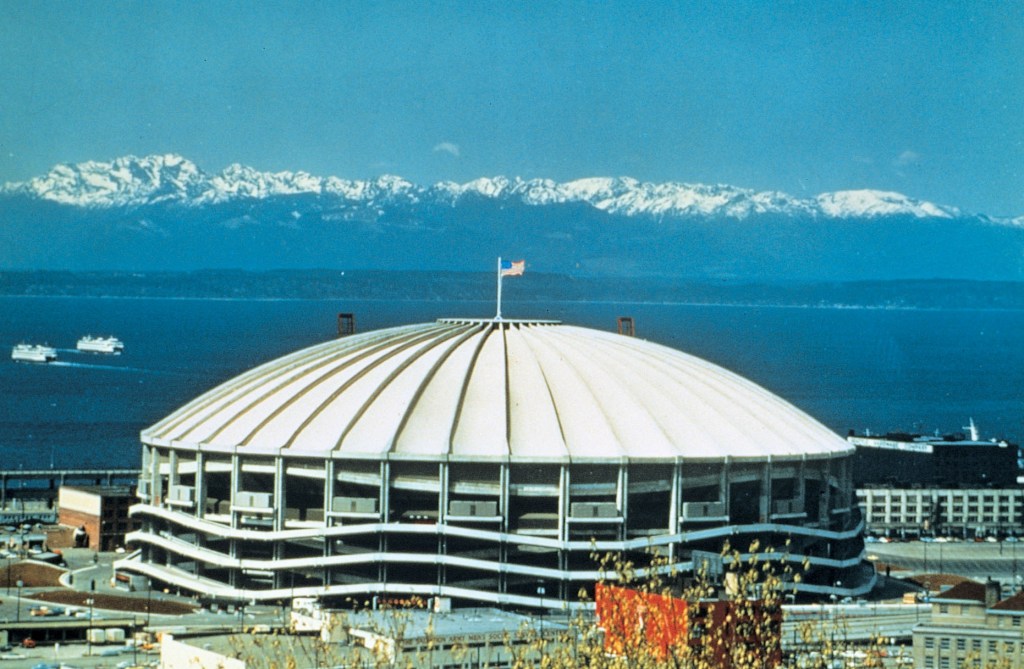
On the day of the Mariner’s last game in the building 1999.

But for many cities, weather was a limiting factor. After all, playing in a foot of snow, blistering heat, or constant rain, was not ideal for the players or the fans. In the 1950’s the dream of indoor stadiums took hold. It was in Houston, in the early 1960’s, when the first such venue – the Astrodome – became a reality. Others followed.

Many in Washington State longed to have a pro-football franchise and believed the rainy climate on the west side of the Cascade Mountains called for an indoor stadium. Thus began the quest to build what would eventually be named “The Kingdome.”

It was in 1959 when the idea was first proposed but it took until 1976 for the vision to become a reality. The Infallible Wikipedia tells us:

“The idea of constructing a covered stadium for a major league football or baseball team was first proposed to Seattle officials in 1959. Voters rejected separate measures to approve public funding for such a stadium in 1960 and 1966, but the outcome was different in 1968; King County voters approved the issue of $40 million in municipal bonds to construct the stadium.
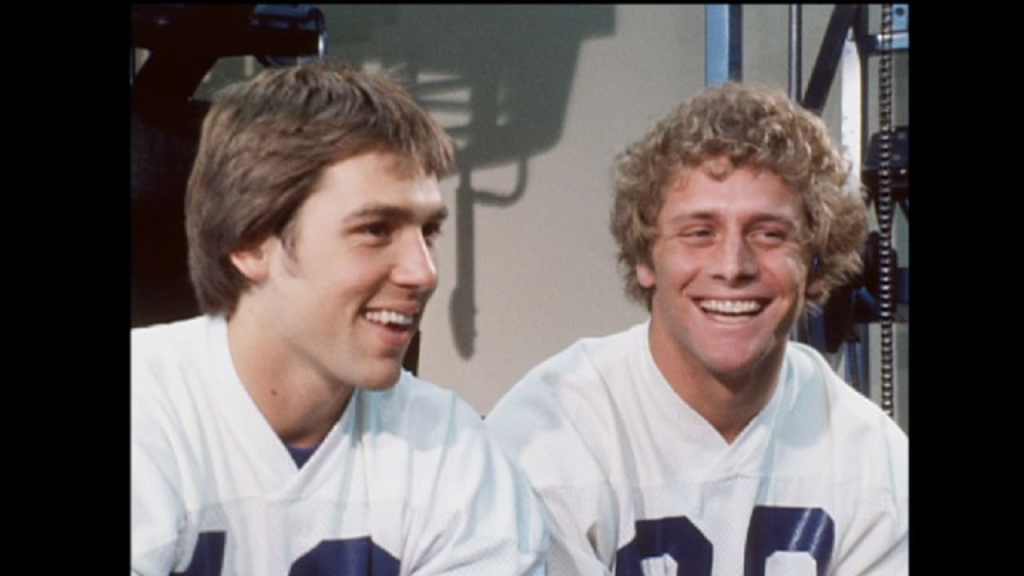
Jim Zorn and Steve Largent in the early days of the Seahawks franchise

Construction began in 1972 and the stadium opened in 1976 as the home of the Sounders and Seahawks. The Mariners moved in the following year, and the SuperSonics moved in the year after that, only to move back to the Seattle Center Coliseum in 1985.”

The Kingdome, named as such due to its location in King County, Washington, served the community as a venue not only for the Seahawks and other sports teams, but also as an event center to host large events such as the Seattle Home Show and the Seattle Boat Show as well as many rock concerts over the years.

“In the Seahawks’ heyday, the Kingdome was known as one of the loudest stadiums in the league. Opposing teams were known to practice with jet engine sounds blaring at full blast to prepare for the painfully high decibel levels typical of Seahawks games. It was where Seahawks fans, who were long called “the 12th Man” and led the Seahawks to retire the number 12 in honor of them in 1984, made their reputation as one of the most ravenous fan bases in the NFL, a reputation that has carried over to what is now Lumen Field. The Kingdome’s reputation contributed to the NFL’s 1989 vote in favor of enacting a rule penalizing home teams for excessive crowd noise.”
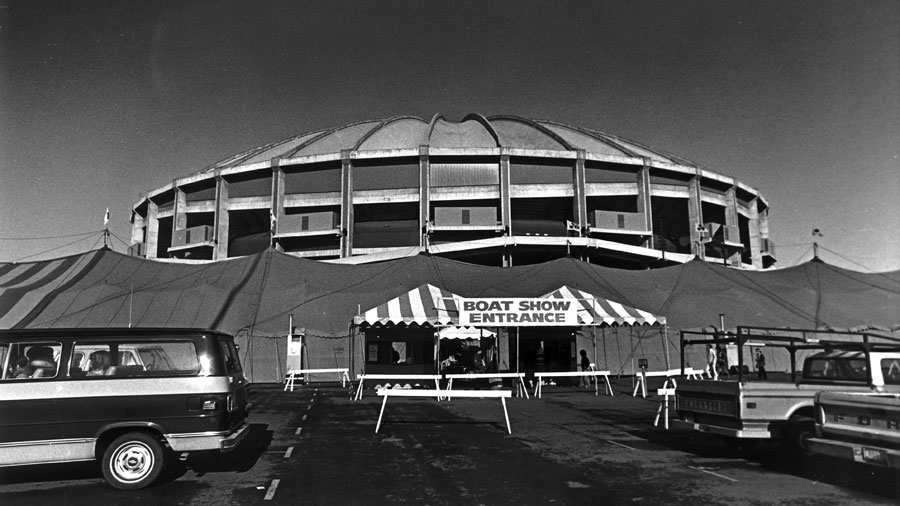
A view of the Kingdome during one of the Boat Shows

But, if there was one word to describe the Kingdome it would be ‘utilitarian.’ How else to explain the huge gray cement mushroom which lacked any aesthetic appeal? But it did the job and also became infamous among the indoor venues for the noise levels. Also from the Infallible Wikipedia:

By the 1990’s, the first iteration of domed stadiums had outlived their appeal and useful life. The Kingdome’s roof – problematic from the beginning – had a partial roof collapse in July 1994, and the venue was closed for repairs for nearly four months. But the problems did not end there, threats by then owner, Ken Behring, to move the team out of Seattle – and the Mariners insistence on a new baseball venue – eventually led to the decision to replace the Kingdome.

It was on Sunday, March 26, 2000, when the Kingdome was finally reduced to a pile of rubble, paving the way for the construction of the next generation of a football stadium in Seattle.
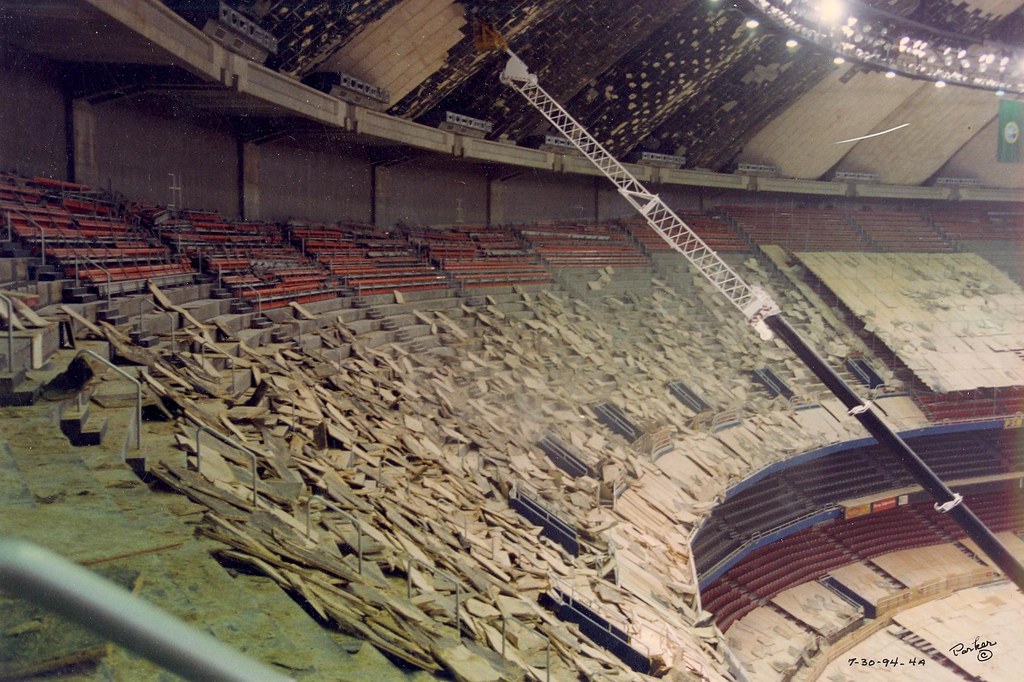
The interior of the Kingdome in 1994 during removal of the ceiling tiles.

It was a clear and pleasant day and, of course, all the local TV stations had been covering the story for months as everything from inside the building was removed leaving, at last, the concrete shell. For weeks – who knows maybe it was months – holes were drilled in the walls and a serpentine of detonating cord was laid. Eventually dynamite was inserted into the holes and it was all connected up in anticipation of the implosion which would take down the concrete beast.

At the time, my family was living on the eastside of Lake Sammamish, about 13 miles – as the crow flies – from the Kingdome. We gathered around the TV and watched live as the first sticks of dynamite on the roof sent streaks of sparks down the spines and the chain reaction encircled the building. It was over in a matter of seconds as clouds of dust obliterated the area. Me, the hubby, and our two kids – then ages 10 and 7 – once the main event was over, rushed out to our west facing deck and a few seconds later the sound waves of the Kingdome’s demise reached us.

A recap of King5’s coverage and a bit of history of the Kingdome. We were likely watching this channel that morning.

It was a surreal experience.

In some ways I miss the Kingdome and all it represented. It was Seattle – and Washington States’ – message to the world that we were ready to play with the big boys. The construction of the Kingdome represented a heady era in Seattle as we welcomed the Seahawk celebrities of the era: Jim Zorn, Steve Largent, and Sherman Smith to name a few. We were hometown proud of the Nordstrom family for owning the team and you could find no more loyal fans anywhere.

It was, truly, a bittersweet day when the Kingdome came down. It’s been gone for 24 years now but for those of us who lived in King County in that era, it won’t ever be forgotten.

https://en.wikipedia.org/wiki/Kingdome

https://youtu.be/Yt2ekbkDVv4?si=MPgKbrFeS3BCkCtZ – Issued on the 20th anniversary from the Seahawks is this recap of the implosion

https://www.concertarchives.org/venues/kingdome

https://en.wikipedia.org/wiki/Astrodome

https://www.historylink.org/File/2164

England Dan

One half of the 1970’s duo with John Ford Coley

February 8, 2022

For years I was never quite sure who, exactly, this artist was. He had an interesting name and together with his partner, topped out at number two on the Billboard Hot 100 charts with their song I’d Really Love To See You Tonight in 1976.

How the pair looked circa 1976. Dan Seals, left, and John Ford Coley, right

England Dan never had a last name in my orbit. But he and John Ford Coley enjoyed a few years riding the wave of soft rock which was so very popular in the era.

The duo met each other in high school and forged their musical reputation in Texas, playing with different cover bands, attracting the attention of record producers, and eventually finding success with Big Tree records.

But who, exactly, was “England” Dan and how did he get that name?

It turns out that he was the younger brother of Jim Seals of, ostensibly, the better known and more commercially successful duo Seals and Croft.

Danny Wayland Seals was born on February 8, 1948. The Infallible Wikipedia tells us of how his name came to be:

“Dan’s childhood nickname, given to him by his brother Jim, was ‘England Dan’ because he was a fan of English rock band The Beatles, and he occasionally adopted an affected English accent. John Colley’s last name was re-spelled ‘Coley’ for ease of pronunciation; ‘Ford’ was added as his middle name for flow purposes, thus England Dan and John Ford Coley.”

While their songs were quite popular on the adult contemporary charts, they did not have enough momentum for an ongoing profession and the duo parted ways in 1980 when Dan moved to Nashville to pursue a solo career.

Now, unless you are a big country fan, the chances are that you’ve never heard a single one of his songs in that genre. I know I have not. From the time they started keeping track of such things, Seals charted 11 number one songs. That’s more than the following ‘big’ names in country music: Trace Adkins (4), Jimmy Buffet (2), Patsy Cline (2), Miranda Lambert (5), and Taylor Swift (9).

In fact, his 11 is tied with Elvis Presley, Hank Williams, and Dierks Bentley. There are only 36 country artists with more number one hits since 1944.

More from the Infallible Wikipedia:

“Throughout the 1980s and into the early 1990s, he released 16 studio albums and charted more than 20 singles on the country charts. Eleven of his singles reached number one: ‘Meet Me in Montana’ (with Marie Osmond), ‘Bop’ (also a No. 42 pop hit), ‘Everything That Glitters (Is Not Gold)’, ‘You Still Move Me’, ‘I Will Be There’, ‘Three Time Loser’, ‘One Friend’, ‘Addicted’, ‘Big Wheels in the Moonlight’, ‘Love on Arrival’, and ‘Good Times’. Five more of his singles also reached top ten on the same chart.”

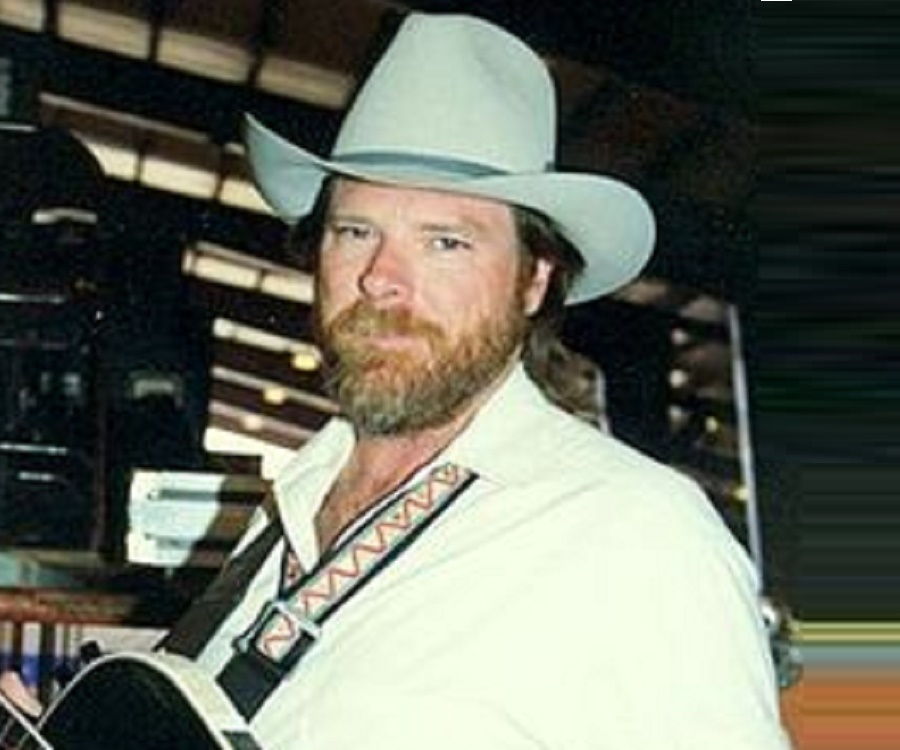
Seals during his years as a Country Music star

Sadly, Seals died of mantle cell lymphoma in 2009. He was only 61 years old.

For me, England Dan and John Ford Coley’s music was a part of the background to my experiences as a 19 year old. The, at times, haunting melodies and wistful longings served to feed the ennui of a time in life when one is trying to find their path. It was, I think, I’d Really Love To See You Tonight, which so eloquently captured young love found and then lost:

Hello, yeah, it’s been a while
Not much, how about you?
I’m not sure why I called
I guess I really just wanted to talk to you

And I was thinking maybe later on
We could get together for a while
It’s been such a long time
And I really do miss your smile

What’s genius about the song is that you never find out if the former lovers ever see each other again.

As a writer, I appreciate how well the musical story was told; it was partially responsible for prompting the question ‘what if’ when I started writing my first novel. “What if” the singer never acted on the thought but then an extraordinary circumstance brings them face to face years later? Well, the possibilities for a fiction writer are endless and the story could end any number of ways.

That song then led to finding and listening to more of their music and my feeling that Seals, especially, was underrated. His voice had a quality which soothed, instantly recognizable. In all he wrote or co-wrote 19 songs, and during his solo career had 36 singles, 13 studio albums, and six compilation albums. Along with John Ford Coley, he produced 10 albums and released 14 singles.

In my travels to Yakima during the 10 years of helping to care for my parents, I added the pair to my “hitchhikers” with their album The Very Best of England Dan and John Ford Coley. It was like discovering them for the first time. How was it I had never heard the wistful Lady, the soulful What Can I Do with This Broken Heart or the haunting Soldier In The Rain?

I discovered that I can listen to them over and over, and never tire of their voices or songs. Which is pretty high praise for any musical artist.

A few links:

https://en.wikipedia.org/wiki/Dan_Seals

https://en.wikipedia.org/wiki/England_Dan_%26_John_Ford_Coley

And links to the two other songs mentioned above:

https://youtu.be/CM8yoUGEWSA (Soldier In The Rain)

https://youtu.be/xdBUqp2a8Ow (What Can I Do with This Broken Heart)