Cornstarch

An indispensible addition for the kitchen cook

March 22, 2022

One thing my mother never taught me to do growing up was how to cook. Why, I’m not exactly sure. But my guess is that she found the whole process messy and, by adding kids into the mix, even messier.

So, except for a few basic things such as pancakes and eggs, everything I ever learned about cooking occurred as an adult. Needless to say, there were several attempts and fails.

I learned about the various basics needed in one’s kitchen and today, March 22, marks the date in 1841 when one Orlando Jones patented one of those basics which was a process for extracting alkali starch from plants. He then applied this technology to corn, creating a product cooks everywhere appreciate and use: cornstarch.
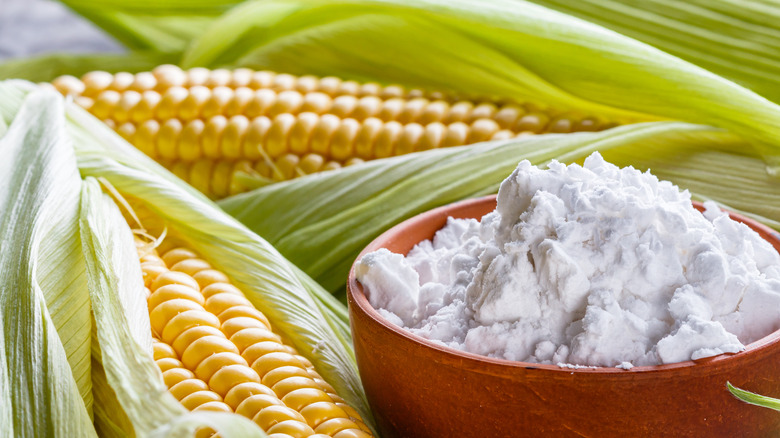
Cornstarch: and indispensable thickener

The Infallible Wikipedia tells us this:

“Corn starchmaize starch, or cornflour (British English) is the starch derived from corn (maize) grain. The starch is obtained from the endosperm of the kernel. Corn starch is a common food ingredient, often used to thicken sauces or soups, and to make corn syrup and other sugars. Corn starch is versatile, easily modified, and finds many uses in industry such as adhesives, in paper products, as an anti-sticking agent, and textile manufacturing. It has medical uses as well, such as to supply glucose for people with glycogen storage disease.

Like many products in dust form, it can be hazardous in large quantities due to its flammability—see dust explosion. When mixed with a fluid, corn starch can rearrange itself into a non-Newtonian fluid. For example, adding water transforms corn starch into a material commonly known as oobleck while adding oil transforms corn starch into an electrorheological (ER) fluid. The concept can be explained through the mixture termed ‘cornflour slime’.”

Okay, so that information is a bit more geeky than I usually share. Back to the use of it in cooking. It is an indispensible item in my kitchen and is used to thicken Asian stir fries, gravy’s, soups, and all sorts of things. It’s also essential for anyone who requires gluten free foods. Cornstarch provides a lighter consistency than another traditional thickener, a flour and water slurry.

I cannot recall when I learned about cornstarch. It was probably in conjunction with my first Chinese cookbook back in the early 1980’s. What I do know is that my kitchen is never without cornstarch; the small yellow box among the other staples: flour, sugar (white, brown, and confectioners), salt, and baking soda.

Keep this in mind as the story unfolds. Back in the 1980’s the hubby and I had a subscription for a program called “My Great Recipes.” Every month a handful of recipe cards would arrive in the mail. These would be dutifully filed into a rather large molded plastic holder. They were numbered and categorized and, if you finished the entire program, they filled the recipe box with meat dishes to desserts and everything in between. We found many great recipes through this program.

One day I decided to try a recipe which was named “Oriental Ham” or “Sweet and Sour Ham” or something along those lines. I’ll be darned if I can find the recipe now! It required leftover ham – which I had – and then pineapple, red and green peppers. Seemed doable.

Porsche, me and my brother nineteen eighty something. Apparently we were eating popcorn that night and NOT inedible baking soda stir fry.

At the time, besides the hubby and me, my brother and our cat, Porsche, lived with us. My brother was at work that evening when I got busy making dinner. I cut up the ham and vegetables. I started a pot of rice. I heated oil in the electric wok in preparation of the meal. All was going well. One more thing which was required was to take cornstarch and mix it with a couple tablespoons of water to create the thickener.

As the moment arrived to add the cornstarch water mix, I stirred it one last time and then dumped it into the wok and it promptly boiled up in the pan like a miniature volcano. Weird, I thought. That’s never happened before. It should have clued me in that something was wrong, but it did not.

Instead, I served the meal to the hubby and we each took a bite and promptly spit it out. It was inedible.

Not willing to admit that the dish belonged in the garbage, I took a piece of ham and gave it to the cat. He turned up his nose at it and walked away. So I put the food in the fridge thinking by the next day it might be better.

Porsche, who looked at me with ‘judge-y’ eyes like these more than once. No doubt the night of the baking soda fiasco he gave me this look.

Sometime later that evening my brother – who worked afternoons and evenings – arrives at the house and he finds the leftovers. Which he puts on a plate, heats up, takes one bite and then throws the rest out. Needless to say, ALL of it ended up in the garbage the next day.

I cannot recall what it was which finally solved the mystery for me. Perhaps it was a few days later when I went to pull out the cornstarch and realized I had, instead, grabbed the baking soda. The light bulb in my head suddenly illuminated. Cornstarch and Baking Soda are NOT interchangeable. One will thicken things and the other creates a salty mini-volcano.

Lesson learned. Or so I thought. Fast forward thirty years and I’m making a beef stir fry one evening. All is going well until the moment I add the ‘cornstarch’ slurry and – in a repeat of that infamous night – I watch in horror as the mixture erupts into the telltale volcano.

This time, however, I shout “Shoot” or some variation of that word, yank the wok from the stove, dump the beef into a colander and thrust it under the faucet. The meat now wet and cold I examine it and think it’s worth a try to add new spices and, instead of baking soda, cornstarch.

I’m happy to report that the quick rinse did eliminate the baking soda and, unlike that fateful night in the early 80’s, dinner was saved.
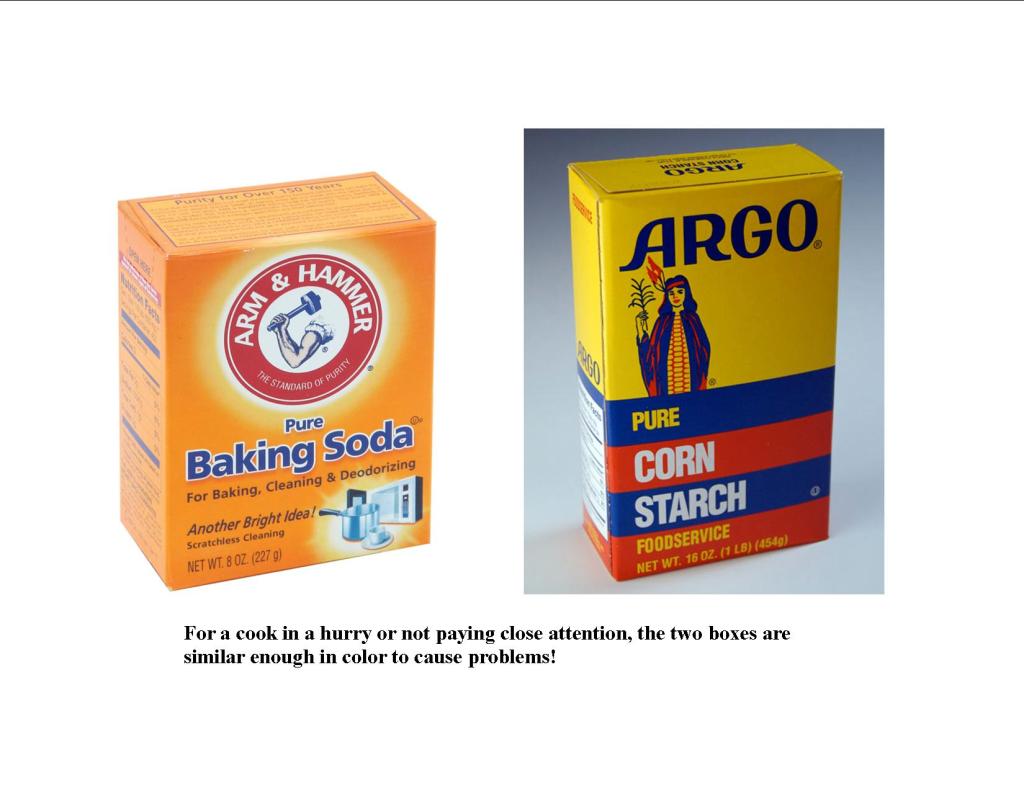
Now, in my defense, the manufacturers of cornstarch and baking soda seemed to choose packaging which made the two boxes easy to mix up. After the second incident I started buying my cornstarch from Costco so that the two containers will never again be confused. I might also have taken a black sharpie and written on the boxes in large letters what’s inside. One cannot, after all, be too careful when it comes to cornstarch.

https://en.wikipedia.org/wiki/Corn_starch

Serendipity. Coincidence. Synchronocity.

What Are The Chances?

March 15, 2022

I admit that I spent this morning searching for the right word to describe the following: when you end up at the exact same place and time as someone who you would not expect to see in that place or time.

The first word which came to mind was Serendipity. Dictionary.com provides the following meaning:  an aptitude for making desirable discoveries by accident.

So that is not the word which exactly fits the scenario. Then I started putting in all sorts of words to try and figure out exactly what I was trying to describe. Which led me down the rabbit hole.

People have, seemingly forever, been unable to accurately describe such circumstances. So here’s what happened to pique my interest.

A week ago Friday, March 4, the hubby and I had been in Spokane for a meeting the night before. That morning, before heading west, we decided to go to Manito Park to look for what’s known as a ‘Geocache’ (note to my readers, more on that is scheduled for May 3. Update: https://barbaradevore.com/2022/05/03/geocaching/).

So off we went to the park. At the first stop I noticed a pond and that it still had a partial layer of ice. Which triggered for me a memory of my Dad sharing stories of his childhood and how he would, in the winter, go ice skating at Manito Park.

For those who know me well, you also know that I’m always interested in genealogy: Mine, yours, does not matter. I love talking about genealogy. Several years ago I took a paid subscription to Ancestry.com.

Photo of my Dad and his brother (I think they are the two boys in the foreground on the right side) skating at Manito Park circa 1928-30.

Of course I knew my dad had grown up in Spokane. I just had never realized how close to Manito Park. And I knew exactly how to find the address of his house: the 1930 census. Which could be found on Ancestry.

Two minutes later, I had the address which – it turned out – was less than a half mile from the park and the pond.

So I say to the hubby that I want to go see the house. He agrees that we can – just as soon as we find his list of geocaches. So off we wander in the park, finding (or in one case, not finding) a few caches. Finally, at about 11:45, I put the address into my map application and we head east to find the house.

How pleased I was when we turned the corner and there, on South Sherman Street, was what I presumed was the house where my Dad, his brother, sister, and parents all lived in 1930.

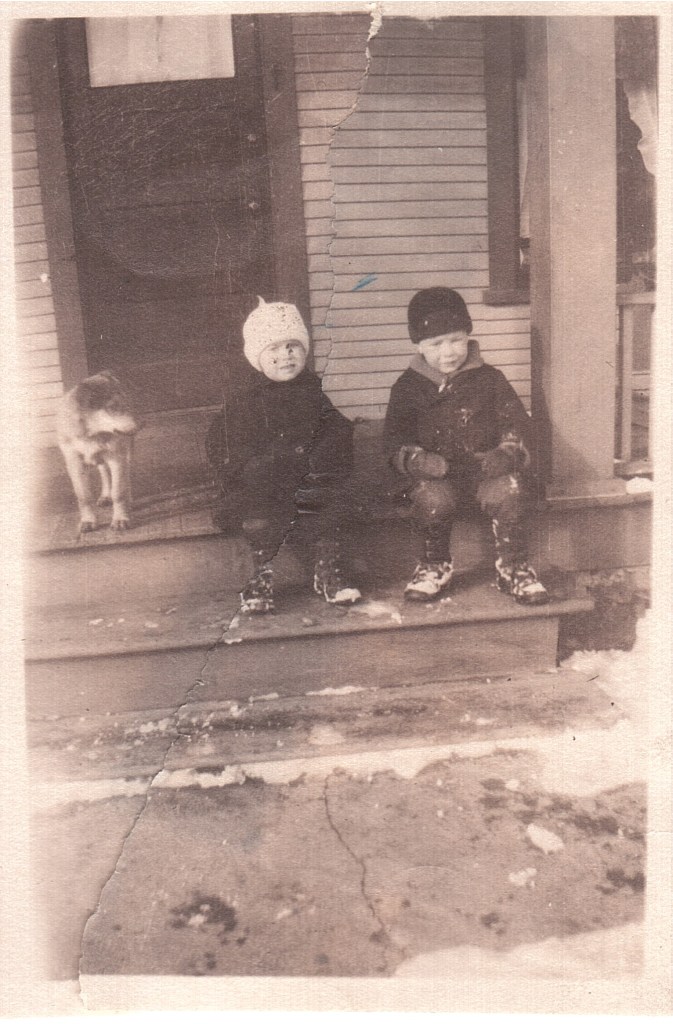
Dad with his older brother, Lyle, and dog, Buster, sometime in the mid-1920’s at the house. The photo was, unfortunately torn in half and taped together at some point.

I got out of the car and just as I was about to cross the street – which for the record was a side street where little traffic would ever travel – a car turns south from the corner of 17th and starts to drive by. I happened to look at the driver, who is staring gaped mouth at me. He then stops the car, backs it up, and is now staring gaped mouth at the hubby. I might add the hubby is staring back in a similar manner.

By this point, it’s obvious that the driver and the hubby know each other. A window is rolled down by the yet unknown to me driver, and the hubby steps from the car.

“What are you doing here?” The man exclaims.

“We were in Spokane for a meeting last night,” the hubby answers.

“Yes, but what are you doing HERE?” the man asks once again, then adds, “That’s my house.” And he points to the house next door to the one where my DeVore family lived.

“That’s house where my dad grew up!” I exclaim.

By this time, the hubby is introducing me to his friend, Roger, who he has done extensive volunteer work for a number of years with in the Washington Masonic and Scottish Rite organizations.

Roger, it turns out, was coming home that day as he had a Zoom meeting at noon. Five minutes earlier or later the chance meeting would not have happened. We are invited to visit Roger’s greenhouse and I’m given a gorgeous purple orchid. One of Roger’s hobbies is raising them. He gives us the name of the neighbor – who he has lived next to for 17 years – and encourages us to ring the bell and introduce ourselves.

Which we do. She is happy to oblige and we snap a few photos and discuss the house and my genealogy before heading on our way.

The author with the current owner of the house where my Dad grew up near Manito Park in Spokane

So, what are the chances that we would be on that street at exactly the same moment when he happened to be driving past to his house?

Certainly it was a coincidence. Even a bit of serendipitous luck. Perhaps the best word to describe it was coined as Syncronocity.

Of course we know that the Infallible Wikipedia has something to say:  Synchronicity is a concept first introduced by analytical psychologist Carl G. Jung “to describe circumstances that appear meaningfully related yet lack a causal connection.” In contemporary research, synchronicity experiences refer to a person’s subjective experience that coincidences between events in their mind and the outside world may be causally unrelated to each other yet have some other unknown connection.”

For me it was yet another odd occurrence in a string of odd occurrences related to my late Father. Like the incident with the 1965 Ford Mustang which I wrote about a year ago: (https://barbaradevore.com/2021/03/09/eee-161-rides-again/)

There have been others which I will eventually share here. For now, however, suffice it to say that it’s somehow oddly comforting to get these reminders of Dad, his larger than life personality still reverberating through my life. Coincidence? Serendipity? Synchronicity? Or, perhaps, a different term waiting to be coined.

The links:

https://en.wikipedia.org/wiki/Synchronicity

https://en.wikipedia.org/wiki/Manito_Park_and_Botanical_Gardens

www.ancestry.com

The Grizzly Bear

Ursus arctos horribilis

March 8, 2022

Ursus arctos horribilis, also known as the Grizzly Bear, is one of the most feared animals in the world. When the first explorers and fur trappers began to explore what would become the great American West, tales of a huge, ferocious bear soon made their way back east.

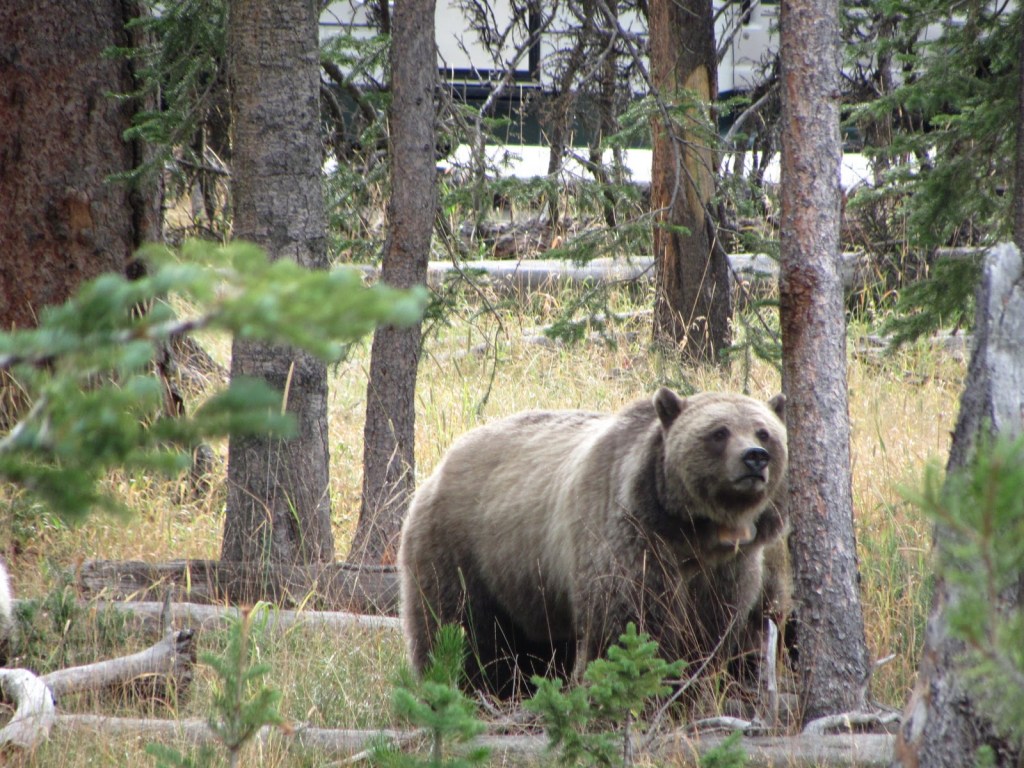
A grizzly bear at Yellowstone in 2010 from https://thegirlygirlcooks.blogspot.com/2010/10/yellowstone-national-park.html

It was that intrepid pair, Lewis and Clark, who gave the bear its name. From the Infallible Wikipedia:

“Meriwether Lewis and William Clark first described it as grisley, which could be interpreted as either ‘grizzly’ (i.e., ‘grizzled’—that is, with grey-tipped or silver-tipped hair) or ‘grisly’ (‘fear-inspiring’, now usually ‘gruesome’). The modern spelling supposes the former meaning; even so, naturalist George Ord formally classified it in 1815 as U. horribilis for its character.”

There was, of course, good reason to think of the animal as fear-inspiring. An adult male weighs between 400 and 790 pounds! Females are smaller with a weight range of 250 to 400 pounds. At an average of 6 ½ feet in length and 3 ½ feet tall, it would sort of be like having a pro basketball player combined with a sumo wrestler; a truly intimidating beast. Oh, and did I mention that its front claws are between 2 and 4 inches in length?

With the expansion of human civilization there has been a marked decrease in the grizzly population over the last 500 years. In 1850, grizzly bears were found in all of the western half of the US from the Canadian border to Mexico. Population in what would become the lower 48 states is estimated to be between 50,000 and 100,000 animals.

Their numbers have, however, decreased significantly. The Infallible Wikipedia shares:

“There are about 55,000 wild grizzly bears located throughout North America, 30,000 of which are found in Alaska. Only around 1,500 grizzlies remain in the lower 48 United States. Of these, around 1,000 are found in the Northern Continental Divide in northwestern Montana. About 600 more live in Wyoming, in the Yellowstone-Teton area. There are an estimated 70–100 grizzly bears living in northern and eastern Idaho. Its original range included much of the Great Plains and the southwestern states, but it has been extirpated in most of those areas. Combining Canada and the United States, grizzly bears inhabit approximately half the area of their historical range.”

In last week’s Tuesday Newsday, I shared information about the creation of Yellowstone National Park. In the 1950’s and 60’s, especially, Grizzly Bears and Yellowstone became synonymous. It was during this era, particularly, when the explosion of visitors, combined with an abundance of grizzly bears combing the park dumps and trash cans for a meal, collided.

What happened was an increase in bear and people encounters, similar to those often seen in movie footage of the time:

In the early 1970’s, policy changed with an all out effort to return bears to their natural ways.

Of course, I did not know all this when the hubby and I arrived at Yellowstone on September 1, 1980. As far as I knew bears roamed everywhere in the park and were around every turn. This is my mindset when, just after sunset – about 8:30 p.m. – the hubby has gone on foot to pay for our campsite.

There I sit, all by myself, the camp sites around us empty… when I hear it. The hum of an engine and the crackle of a loudspeaker, the words – at first – unintelligible.

I watch as a station wagon, bearing the National Park logo, rolls slowly into view, emerging from the dark forest. There are speakers mounted on the roof and someone from inside the safety of the car is, apparently, determined to scare any and all visitors half to death. The loud speaker cracks with sound and a solemnly intoned message blares into the quiet night to those foolish enough to camp there:

The author with a grizzly bear when visiting the University of Alaska Museum of the North at Fairbanks in March 2017

“This is bear country!” (static sounds follow) “Store all food securely in your vehicle” (more static)… “Fear… fear… fear…” (static). Okay, I made that last part up, but by now you have the picture. The message repeats as the car slowly disappears into the night. By now I am certain that grizzlies are going to emerge from the woods and make a meal of me, a certainty since all that would be between us and the 500 pound beast is a flimsy tent wall.

By the time the hubby arrives back in camp, I’m good and freaked out. Even so, we get a fire started, dinner fixed and eaten. And then I get really weird. I’m on my hands and knees, with flashlight, searching for that one kernel of corn I’m certain I dropped during the meal which, if smelled by a bear, will encourage them to rip into our tent and have us for a midnight snack.

My travel log entry reads as follows:

“I became almost fanatical in seeing that everything was securely locked away and bear proof. No bears tried to eat me during the night.”

My entry says ‘almost’ – there was no ‘almost’ about it. I was fanatical.

During two subsequent trips to Yellowstone, in 1982 and 1989, we became obsessed with trying to find a bear. It was during the latter trip that we did, finally, see one. It was about a half a mile away, across a valley, and it took a pair of binoculars to confirm. That was it. The only grizzly we ever saw in the wild.

Even so, bells tied to shoe laces do offer that extra bit of noise which is a good idea since you never, ever want to surprise a bear. Although we’ve seen grizzly in captivity a couple of times over the years, I think I’d rather not encounter one in the wild. A very horribilis idea.

As always, a link or two for those who want to know more:

https://en.wikipedia.org/wiki/Grizzly_bear

A pretty good documentary if you have 45 minutes:

Nat Geo Bears of Yellowstone:

Yellowstone National Park

One of the world’s most magical places

March 1, 2022

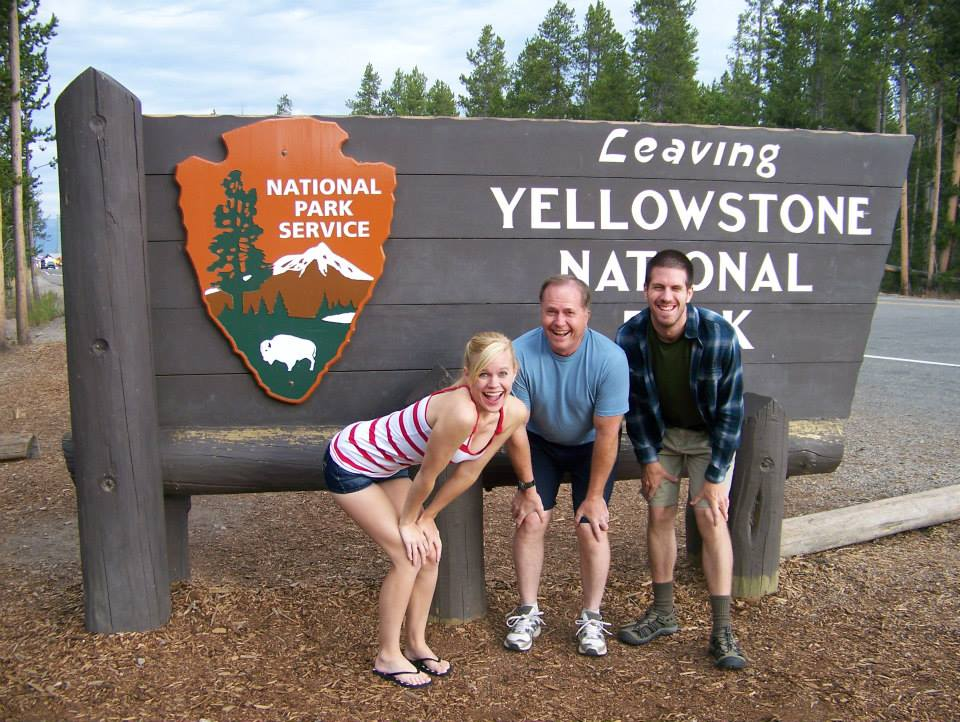
The family at the northern entrance to the park in 2013

There are only a few places in the world I consider to be magical. This site – which became America’s first National Park – is such a place.

Long before that event, however, stories of this fantastical spot were dismissed as the ravings of madmen. Yet, as more and more intrepid explorers ventured into the American west, the stories of superheated water shooting hundreds of feet into the air, boiling mud lakes, and running water in winter, could no longer be dismissed as pure fantasy. Eventually, the stories proved to be true and, on March 1, 1872, Yellowstone National Park was established. Today marks the 150th anniversary of that event.

As always, the Infallible Wikipedia, shares some of that history:

“In 1806, John Colter, a member of the Lewis and Clark Expedition, left to join a group of fur trappers. After splitting up with the other trappers in 1807, Colter passed through a portion of what later became the park, during the winter of 1807–1808. He observed at least one geothermal area in the northeastern section of the park, near Tower Fall.  After surviving wounds he suffered in a battle with members of the Crow and Blackfoot tribes in 1809, Colter described a place of ‘fire and brimstone’ that most people dismissed as delirium; the supposedly mystical place was nicknamed ‘Colter’s Hell’. Over the next 40 years, numerous reports from mountain men and trappers told of boiling mud, steaming rivers, and petrified trees, yet most of these reports were believed at the time to be myth.

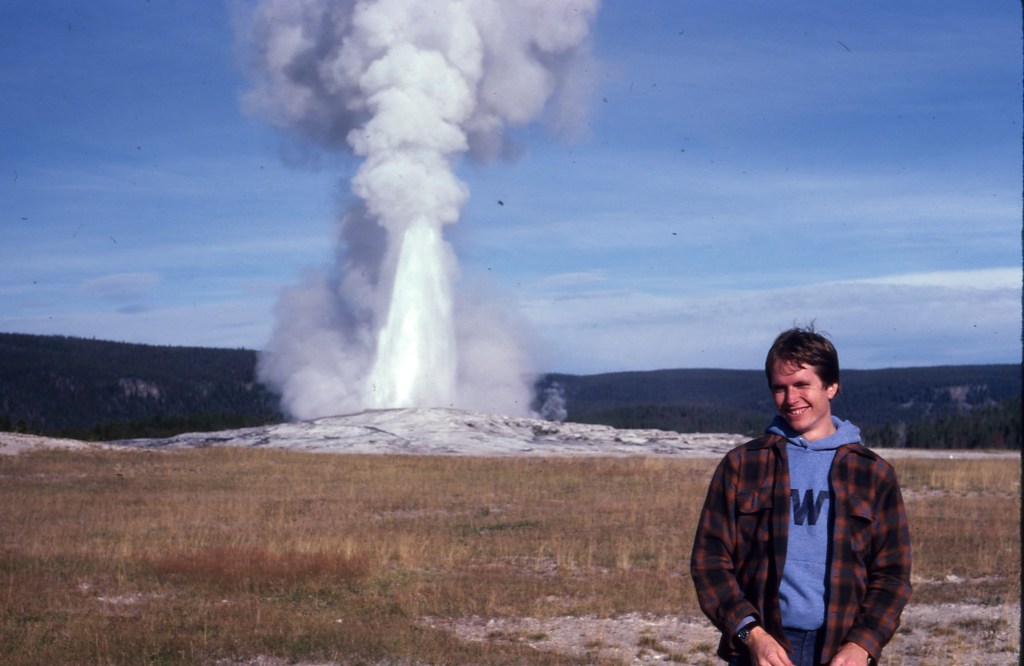
Honeymooner Hubby at Old Faithful September 2, 1980

After an 1856 exploration, mountain man Jim Bridger (also believed to be the first or second European American to have seen the Great Salt Lake) reported observing boiling springs, spouting water, and a mountain of glass and yellow rock. These reports were largely ignored because Bridger was a known ‘spinner of yarns.’ In 1859, a U.S. Army Surveyor named Captain William F. Raynolds embarked on a two-year survey of the northern Rockies. After wintering in Wyoming, in May 1860, Raynolds and his party—which included naturalist Ferdinand Vandeveer Hayden and guide Jim Bridger—attempted to cross the Continental Divide over Two Ocean Plateau from the Wind River drainage in northwest Wyoming. Heavy spring snows prevented their passage, but had they been able to traverse the divide, the party would have been the first organized survey to enter the Yellowstone region.”

The author at Liberty Cap in the Mammoth Hot Springs region July 1982

While today we take for granted our National Parks, in the early years the western lands were often auctioned off, with the thought that having private enterprise take over regions would be best for getting the vast western lands settled.

Thankfully, due primarily to the efforts of geologist Ferdinand Hayden, Congress was convinced to create Yellowstone NP, preserving the lands for future generations to enjoy in as natural a state as possible.

Now, to be fair, this article could go on for pages and pages. There have been books written about the park and its 150 year history. It truly is an amazing story and a good start is on the Infallible Wikipedia page or the official National Park Service site (links below).

Reading about Yellowstone – or even watching video – simply does not do it justice. It has to be seen, smelled, felt, to truly be embraced by the magic of the place.

The author on a hike 1982. The upper geyser basin in the background.

As a child, my family never strayed far from home when we went on vacations. Each summer was a week or two at the beach. As a teenager, we took one trip to California and Disneyland with a stop at Crater Lake in Oregon on the way home.
I was 23 years old the first time I laid eyes on Yellowstone. The hubby and I had been married two days earlier and our honeymoon trip was, in theory, to drive back to Tampico, Illinois to visit his sister and her family. It turned in to so much more.

It was late afternoon on September 1, 1980, when we drove into Yellowstone. From my accounting of that day:

“About 5 p.m. we were at the park entrance. We did stop briefly in West Yellowstone for gas and miscellaneous groceries. While in the park that evening we stopped to see the mud paint pots and smaller geysers. (The hubby) was amazed at me upon witnessing someone who was seeing Yellowstone for the first time.

At every new site, I’d get excited just like a kid at Christmas. The same words always flowed from my mouth: ‘Oh! Wow!’”

Riverside Geyser adorned with a rainbow. 1982

Actually, I think my reaction was more like ‘Oooh! Oooh! Oooh!’

It was not until the next day that I saw a few of the ‘big’ geysers, including Old Faithful. Once again, I was stunned by the amazing displays:

“Two of the more notable geysers we saw erupting were Grand and Riverside. Grand was by far the more spectacular of the two, shooting 200-250 feet into the air.”

That 24 hour visit to Yellowstone was a lot like speed dating. We crammed as much into the visit as our time allowed before continuing east to Illinois.

Yet the ‘date’ left me wanting more. Two summers later we planned and then set out on a two week western US trip which took us back to Yellowstone. Our goal for that trip was to drive on every road in the park, and stay at least one night in each distinctive region. On that trip we found ourselves, literally, walking in the middle of an elk herd! (It was dusky and we were on our way to a campfire program put on by the ranger) We counted 29 does and fawns.

Upright petrified trees can only be seen on an insane hike called ‘Climb Through Time.’
Son and daughter at Minerva Terrace 2013

We saw a moose, marmots, and bison. We climbed to the top of Mt. Washburn and enjoyed spectacular views. We shared our camping spot with an Italian couple who had inadvertently joined us when they didn’t understand how the system worked. We visited the Grand Canyon of the Yellowstone and the Mammoth Hot Springs area. We did a ‘climb through time’ to see a standing petrified forest.

And we achieved our goal of driving every road in the park.

When we left Yellowstone on August 1st, I felt as if I had gotten my fill… at least for a few years.

The pair of us returned in 1989, and then brought the kids in 1998 when they were 8 and 5. Our last visit to the park was in 2013, the kids now 23 and 20, as part of a journey to move our daughter to Nashville.

Even writing about the trips creates a yearning to visit Yellowstone once again. Perhaps it is time to start planning for at least one more journey to this magical place.

The links:

https://en.wikipedia.org/wiki/Yellowstone_National_Park

https://www.nps.gov/yell/index.htm

The hubby and kids from our last Yellowstone visit in September 2013

Popcorn!

February 22, 2022

There are topics which come to my attention from time to time that cause me to say: that just can’t be right.

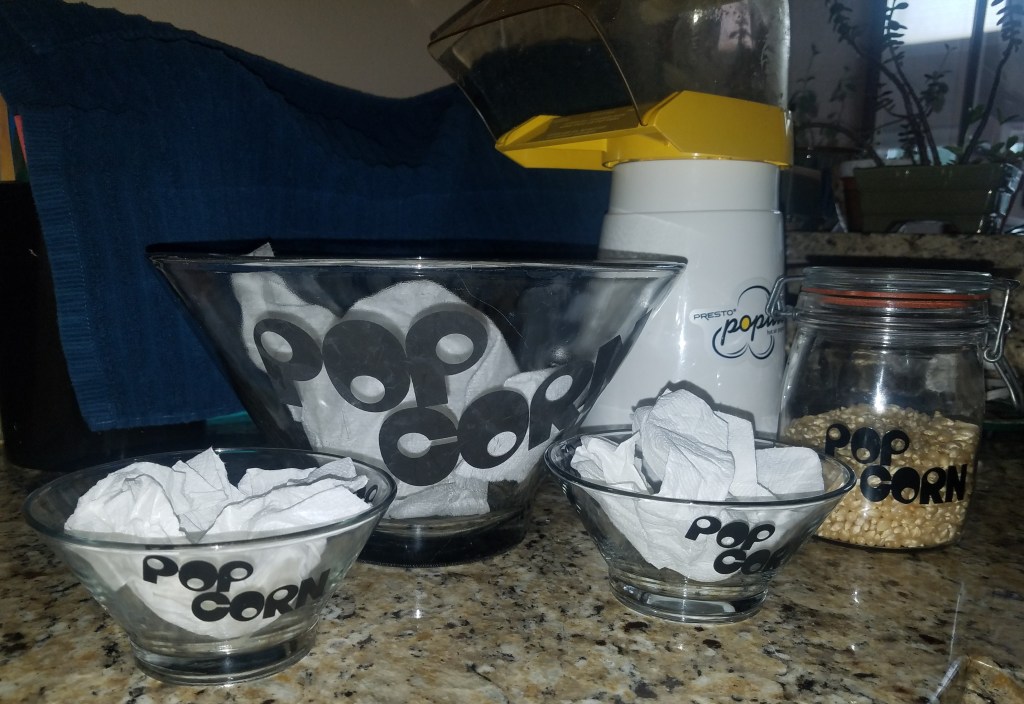
The hubby and I have had this same set of bowls for decades now… and still use them

According to a number of sources on the internet, it was on February 22, 1621, when a Native American by the name of Squanto, at the first Thanksgiving, showed the settlers how to make ‘popcorn’.

Hmmm… wasn’t the first Thanksgiving held in the fall and not February? And did the natives of that region really eat popcorn?

A little refresher. The Pilgrims landed in what is now Plymouth, Massachusetts in November of 1620. For the next year they struggled mightily, enduring hardships and starvation. There was no feast in February 1621. That did not occur until sometime between mid-September and early November 162.

Now on to the second question about the popcorn. According to History.com:

I feel confident that the two groups were not sitting around the campfire enjoying a batch of jiffy pop in February 1621.

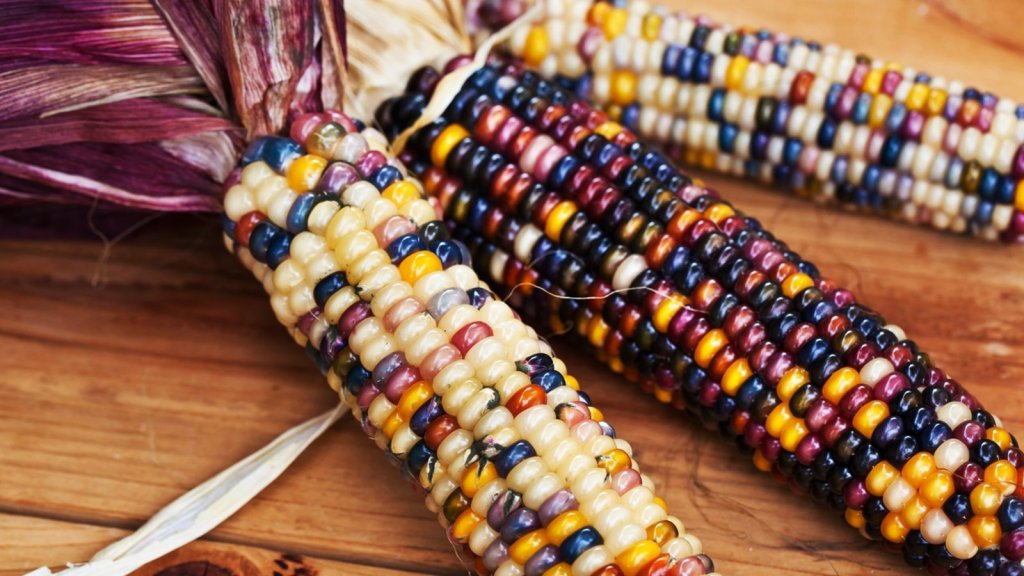
Colorful dried corn

“It’s been said that popcorn was part of the first Thanksgiving feast, in Plymouth Colony in 1621. According to myth, Squanto himself taught the Pilgrims to raise and harvest corn, and pop the kernels for a delicious snack. Unfortunately, this story contains more hot air than a large bag of Jiffy Pop. While the early settlers at Plymouth did indeed grow corn, it was of the Northern Flint variety, with delicate kernels that are unsuitable for popping. No contemporary accounts reference eating or making popcorn in that area, and the first mention of popcorn at Thanksgiving doesn’t appear until a fictional work published in 1889, over 200 years later.”

But, the history of popped corn is interesting. A uniquely western hemisphere food, there is evidence that corn has existed and had been used as food for thousands of years.

While the Infallible Wikipedia was silent on the Pilgrims angle, it does share the following:

“Corn was domesticated about 10,000 years ago in what is now Mexico. Archaeologists discovered that people have known about popcorn for thousands of years. Fossil evidence from Peru suggests that corn was popped as early as 4700 BC.

Through the 19th century, popping of the kernels was achieved by hand on stove tops. Kernels were sold on the East Coast of the United States under names such as Pearls or Nonpareil. The term popped corn first appeared in John Russell Bartlett’s 1848 Dictionary of Americanisms. Popcorn is an ingredient in Cracker Jack and, in the early years of the product, it was popped by hand.

Charles Cretors with one of his popcorn machines

Popcorn’s accessibility increased rapidly in the 1890s with Charles Cretors’ invention of the popcorn maker. Cretors, a Chicago candy store owner, had created a number of steam-powered machines for roasting nuts and applied the technology to the corn kernels.

By the turn of the century, Cretors had created and deployed street carts equipped with steam-powered popcorn makers.”

It was, however, during the Great Depression when popcorn consumption really took off. With sugar in short supply and sweets largely unavailable, American’s discovered they could have an inexpensive salty, buttery snack instead. Soon popcorn was sold in movie theatres and people could pop it at home.

Popcorn popularity surged once again in the 1980’s  with the ability to cook the product in microwave ovens. It’s estimated that Americans today consume more than 17 billion quarts of popcorn annually!

Some of my earliest memories center around popcorn. My dad would pop a pan full on most Saturday nights of my childhood; a once a week treat while the family played cards.

My first popcorn popper was likely a Stir Crazy or similar. You poured a bit of oil on the base and heated it up, then added the popcorn kernels. It was fun to watch the popcorn fill the lid – which you turned over and it became the bowl.

When I went away to college at the University of Puget Sound, I brought with me two ‘appliances.’ One was a small electric kettle and the other was an all in one popcorn popper. Of course I was not the only girl to have one in the sorority, but one could be sure that the smell of the popping corn would be a siren call to others; soon the party would be in my room.

I associate popcorn with the hubby. Not only does he LOVE popcorn, it was the thing we were both eating on the night of our first ever phone call.

The hubby’s older brother, while we were on a waterski trip to Lake Tapps in 1981, decided the hubby was a good ‘target’ for getting popcorned.

In 1979 there were no cell phones. We did not have individual phones in our rooms either. Instead, there was a multi-line phone system in the Alpha Phi sorority where I lived,  and down the hall from my room was ‘the phone room.’ This was a closet size space with a small desk and chair, and the phone for the entire sorority was located there. Additional handsets were located on the second floor and another in the basement. Members took turns being on phone duty in the evenings, answering the calls and then, via intercom, paging those who had a call.

The evening of our first call, I had just finished making a batch of popcorn when the intercom near my room announced, “Call for Barbie D on line 2.” So, with a bowl of popcorn in hand, I made my way to one of the phones. As the conversation got going my new romantic interest and I discovered that we were both enjoying the same snack.

Our mutual love of popcorn has never wavered and we are in agreement that popcorn is best when it has butter drizzled over it and a few turns of the salt grinder on top of that. Sometimes the simplest things are the best.

The links:

https://en.wikipedia.org/wiki/Popcorn

https://www.history.com/news/a-history-of-popcorn

Probably our 4th or 5th popcorn popper. The bowl and popcorn canister we’ve had since the 1980’s. The average American consumes 58 quarts of popcorn a year!

The Teddy Bear

A beloved childhood toy for over 100 years

February 15, 2022

Generations of children, no doubt, think of this toy – one of the first they were likely to have – as a source of comfort. The Teddy Bear was introduced in the United States on February 15, 1903.

The modern day Vermont Teddy Bears can be huge… my dad bought TWO for my Mom when she was in assisted living. The darn things took up alot of space!

Amazingly, two different manufacturers conceived the idea simultaneously. The year before, American President Theodore ‘Teddy’ Roosevelt had been the focus of an incident involving a bear. From the Infallible Wikipedia:

“The name originated from an incident on a bear hunting trip in Mississippi in November 1902, to which Roosevelt was invited by Mississippi Governor Andrew H. Longino. There were several other hunters competing, and most of them had already killed an animal. A suite of Roosevelt’s attendants, led by Holt Collier, cornered, clubbed, and tied an American black bear to a willow tree after a long exhausting chase with hounds.

They called Roosevelt to the site and suggested that he shoot it. He refused to shoot the bear himself, deeming this unsportsmanlike, but instructed that the bear be killed to put it out of its misery, and it became the topic of a political cartoon by Clifford Berryman in The Washington Post on November 16, 1902. While the initial cartoon of an adult black bear lassoed by a handler and a disgusted Roosevelt had symbolic overtones, later issues of that and other Berryman cartoons made the bear smaller and cuter.

Morris Michtom saw the drawing of Roosevelt and was inspired to create a teddy bear. He created a tiny soft bear cub and put it in his candy shop window at 404 Tompkins Avenue in Brooklyn with a sign ‘Teddy’s bear.’ After sending a bear to Roosevelt and receiving permission to use his name, he began to produce them commercially to great demand. The toys were an immediate success and Michtom founded the Ideal Novelty and Toy Co.”

President Theodore Roosevelt and one of Morris Michtom’s “Teddy’ Bears

The Steiff Toy Company in Germany, which had been working on their bear since December 1902, introduced it at a toy show a month later.

It was, perhaps, the first ‘gotta-have-it’ toy for children.

Over the years the style of Teddy Bears has changed. Originally, they were made to look like real bears with long snouts and beady eyes. Modern bears tend to feature large round eyes, stubby noses, and an upturned mouth.

One need only look at culture to really understand the impact this toy made. Since its creation, there have been many children’s books which feature as its main character a bear: Paddington, Winnie-The-Pooh, and Corduroy, for examples.
The song “Teddy Bear’s Picnic” was inspired by the first Teddy Bears and there have been several movies and TV shows about the toy.

Like most products, its popularity waned over time, giving way to flashier toys. Then, in the 1990’s, the Teddy Bear had a revival spurred, no doubt, by the electronic Teddy Ruxpin and the wildly popular “Build-A-Bear” workshops.

The latter took the idea of creating your own bear and opened retail locations in malls everywhere. Now a child could pick and choose the features, give their ‘bear’ a unique name, and watch as it was ‘born.’ There were, of course, adorable clothes which can be purchased for the bear. A little girl might want a ballerina bear. Once you’ve invested in the bear – or other equally adorable stuffed animals –then there were hundreds of adorable outfits available. Today, the dolls start at $14 and go up from there. For $20.50 you can buy the ballerina outfit which includes the glittery tutu and shoes. As you can see, it gets quite spendy.

The machine where each child’s bear is ‘built.’ Part of the allure is getting to see your own ‘bear’ come to life

One of the first toys I remember as a child was my teddy bear. In fact, that bear slept with me every night, my comfort item.

As far as I know it arrived as a Christmas present the year I was two.

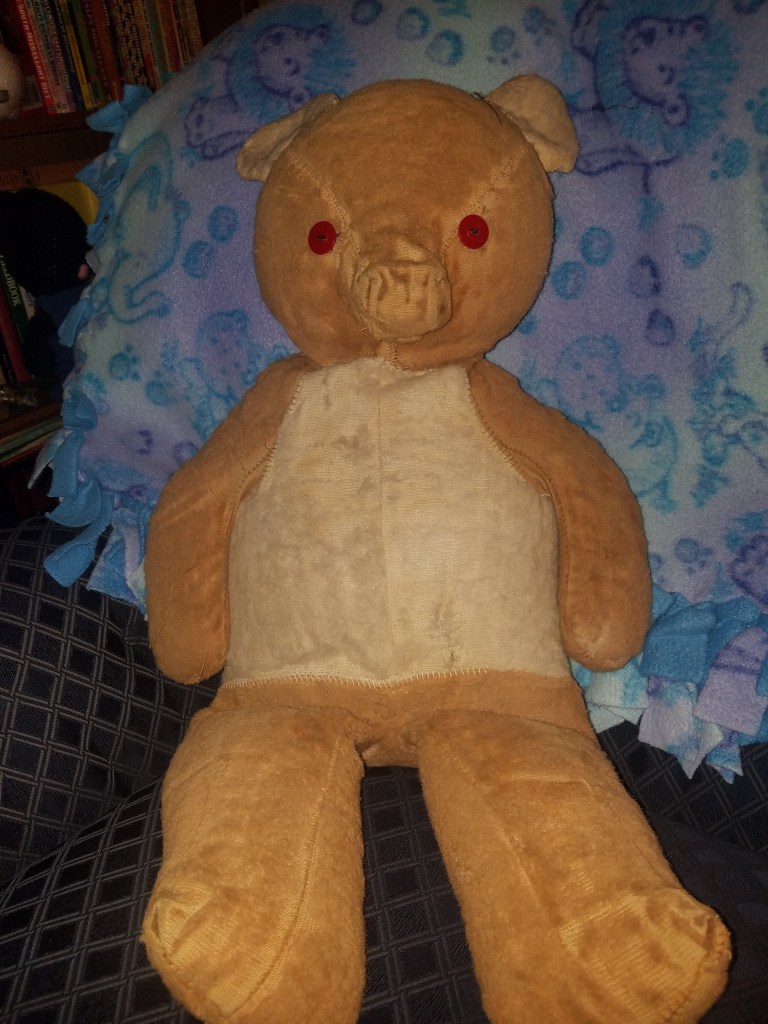
Over the years, his soft fur was worn away – except for one spot under the back of each of his legs – and his original eyes long ago replaced by two matching red buttons from my mother’s collection.

My sister received a similar bear, but hers was pale blue with a light pink tummy while mine was a tawny brown with a beige tummy. I asked her if she still had her bear but she said she did not, unsure when it left her life.

The author’s original ‘Teddy’ – still a source of comfort when one is sick.

Being a couple years older, I don’t think she had the same affinity for her bear that I had for mine. I’m no psychologist, but from a child development standpoint, there is a window of time when a child naturally starts to move away from their parent and when another object – like a stuffed toy, blanket, or baby doll – becomes their comfort. Around age two is about that age.

For me, when there was no one else to play with, Teddy served as a substitute. We had tea parties, I ‘read’ him books, and we colored together.

One of my favorite children’s books is The Velveteen Rabbit. It’s a story about a stuffed rabbit that is so loved by its ‘child’ that he loses his fur, his eyes, everything which makes him ‘beautiful.’ But the message of the story was not lost on me as I could see the parallels to my own Teddy. The book’s author, Margery Williams Bianco, shares this bit of wisdom:

“Generally, by the time you are Real, most of your hair has been loved off, and your eyes drop out and you get loose in the joints and very shabby. But these things don’t matter at all, because once you are Real you can’t be ugly, except to people who don’t understand.”

And, yes, I still have my Teddy. He’s traveled with me through life, always there to offer comfort when needed, a reminder of what’s ‘real’ in life.

A few links:

https://en.wikipedia.org/wiki/Teddy_bear

https://bookroo.com/explore/books/topics/teddy-bears

https://en.wikipedia.org/wiki/The_Velveteen_Rabbit

England Dan

One half of the 1970’s duo with John Ford Coley

February 8, 2022

For years I was never quite sure who, exactly, this artist was. He had an interesting name and together with his partner, topped out at number two on the Billboard Hot 100 charts with their song I’d Really Love To See You Tonight in 1976.

How the pair looked circa 1976. Dan Seals, left, and John Ford Coley, right

England Dan never had a last name in my orbit. But he and John Ford Coley enjoyed a few years riding the wave of soft rock which was so very popular in the era.

The duo met each other in high school and forged their musical reputation in Texas, playing with different cover bands, attracting the attention of record producers, and eventually finding success with Big Tree records.

But who, exactly, was “England” Dan and how did he get that name?

It turns out that he was the younger brother of Jim Seals of, ostensibly, the better known and more commercially successful duo Seals and Croft.

Danny Wayland Seals was born on February 8, 1948. The Infallible Wikipedia tells us of how his name came to be:

“Dan’s childhood nickname, given to him by his brother Jim, was ‘England Dan’ because he was a fan of English rock band The Beatles, and he occasionally adopted an affected English accent. John Colley’s last name was re-spelled ‘Coley’ for ease of pronunciation; ‘Ford’ was added as his middle name for flow purposes, thus England Dan and John Ford Coley.”

While their songs were quite popular on the adult contemporary charts, they did not have enough momentum for an ongoing profession and the duo parted ways in 1980 when Dan moved to Nashville to pursue a solo career.

Now, unless you are a big country fan, the chances are that you’ve never heard a single one of his songs in that genre. I know I have not. From the time they started keeping track of such things, Seals charted 11 number one songs. That’s more than the following ‘big’ names in country music: Trace Adkins (4), Jimmy Buffet (2), Patsy Cline (2), Miranda Lambert (5), and Taylor Swift (9).

In fact, his 11 is tied with Elvis Presley, Hank Williams, and Dierks Bentley. There are only 36 country artists with more number one hits since 1944.

More from the Infallible Wikipedia:

“Throughout the 1980s and into the early 1990s, he released 16 studio albums and charted more than 20 singles on the country charts. Eleven of his singles reached number one: ‘Meet Me in Montana’ (with Marie Osmond), ‘Bop’ (also a No. 42 pop hit), ‘Everything That Glitters (Is Not Gold)’, ‘You Still Move Me’, ‘I Will Be There’, ‘Three Time Loser’, ‘One Friend’, ‘Addicted’, ‘Big Wheels in the Moonlight’, ‘Love on Arrival’, and ‘Good Times’. Five more of his singles also reached top ten on the same chart.”

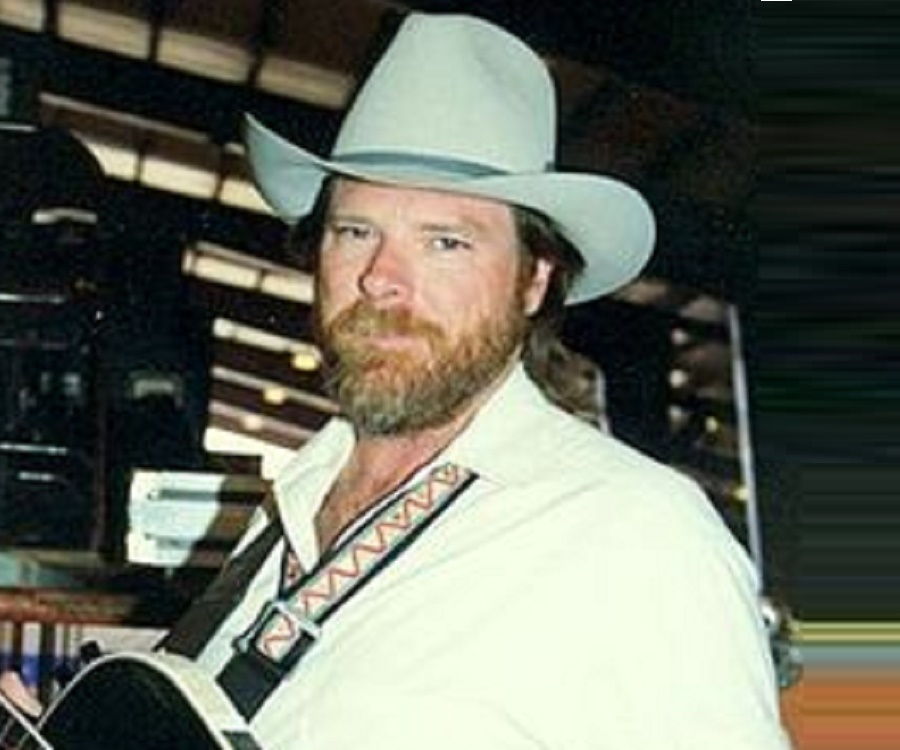
Seals during his years as a Country Music star

Sadly, Seals died of mantle cell lymphoma in 2009. He was only 61 years old.

For me, England Dan and John Ford Coley’s music was a part of the background to my experiences as a 19 year old. The, at times, haunting melodies and wistful longings served to feed the ennui of a time in life when one is trying to find their path. It was, I think, I’d Really Love To See You Tonight, which so eloquently captured young love found and then lost:

Hello, yeah, it’s been a while
Not much, how about you?
I’m not sure why I called
I guess I really just wanted to talk to you

And I was thinking maybe later on
We could get together for a while
It’s been such a long time
And I really do miss your smile

What’s genius about the song is that you never find out if the former lovers ever see each other again.

As a writer, I appreciate how well the musical story was told; it was partially responsible for prompting the question ‘what if’ when I started writing my first novel. “What if” the singer never acted on the thought but then an extraordinary circumstance brings them face to face years later? Well, the possibilities for a fiction writer are endless and the story could end any number of ways.

That song then led to finding and listening to more of their music and my feeling that Seals, especially, was underrated. His voice had a quality which soothed, instantly recognizable. In all he wrote or co-wrote 19 songs, and during his solo career had 36 singles, 13 studio albums, and six compilation albums. Along with John Ford Coley, he produced 10 albums and released 14 singles.

In my travels to Yakima during the 10 years of helping to care for my parents, I added the pair to my “hitchhikers” with their album The Very Best of England Dan and John Ford Coley. It was like discovering them for the first time. How was it I had never heard the wistful Lady, the soulful What Can I Do with This Broken Heart or the haunting Soldier In The Rain?

I discovered that I can listen to them over and over, and never tire of their voices or songs. Which is pretty high praise for any musical artist.

A few links:

https://en.wikipedia.org/wiki/Dan_Seals

https://en.wikipedia.org/wiki/England_Dan_%26_John_Ford_Coley

And links to the two other songs mentioned above:

https://youtu.be/CM8yoUGEWSA (Soldier In The Rain)

https://youtu.be/xdBUqp2a8Ow (What Can I Do with This Broken Heart)

Oxford English Dictionary

The Most Comprehensive Dictionary of the English Language

February 1, 2022

Lord of the Rings. Les Miserables. Gone With The Wind. Harry Potter and the Sorcerer’s Stone. Each of these books took six or more years to be written with the Lord of the Rings trilogy taking JRR Tolkien 16 years.

But in the world of publishing, there was one project which was conceived 23 years before the first pages were published: The Oxford English Dictionary. Also known as OED.

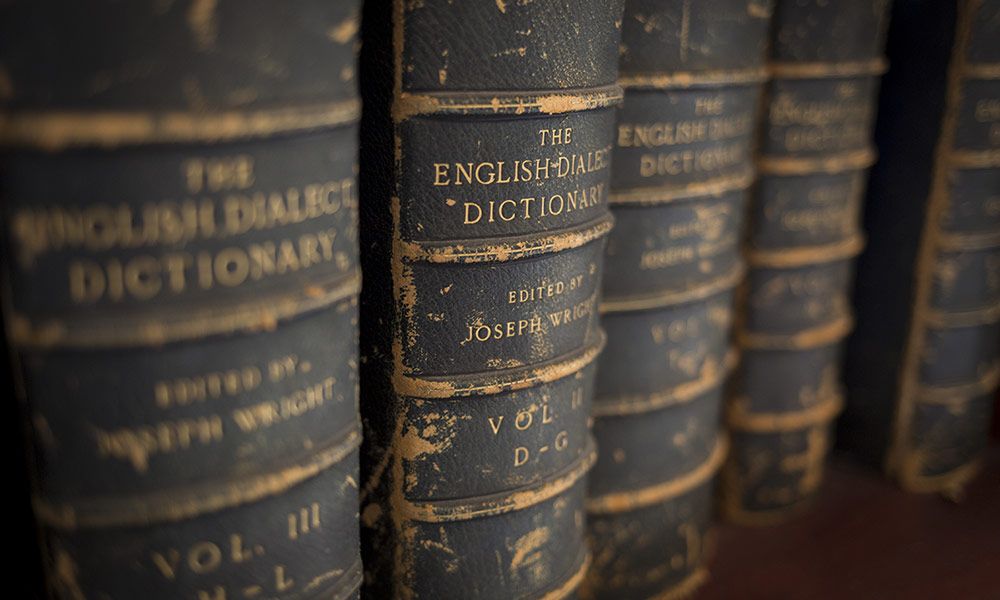
Historical copies of a few of the Oxford English Dictionary

The OED is THE definitive authority on the English language, providing an etymology on the origins of every English word. The idea was conceived in 1857 but the first ‘fascicle’* was not published until February 1, 1884.

The Infallible Wikipedia shares:

“The dictionary began as a Philological Society project of a small group of intellectuals in London (and unconnected to Oxford University): Richard Chenevix Trench, Herbert Coleridge, and Frederick Furnivall, who were dissatisfied with the existing English dictionaries. The society expressed interest in compiling a new dictionary as early as 1844, but it was not until June 1857 that they began by forming an “Unregistered Words Committee” to search for words that were unlisted or poorly defined in current dictionaries. In November, Trench’s report was not a list of unregistered words; instead, it was the study On Some Deficiencies in our English Dictionaries, which identified seven distinct shortcomings in contemporary dictionaries:

·         Incomplete coverage of obsolete words

·         Inconsistent coverage of families of related words

·         Incorrect dates for earliest use of words

·         History of obsolete senses of words often omitted

·         Inadequate distinction among synonyms

·         Insufficient use of good illustrative quotations

·         Space wasted on inappropriate or redundant content.

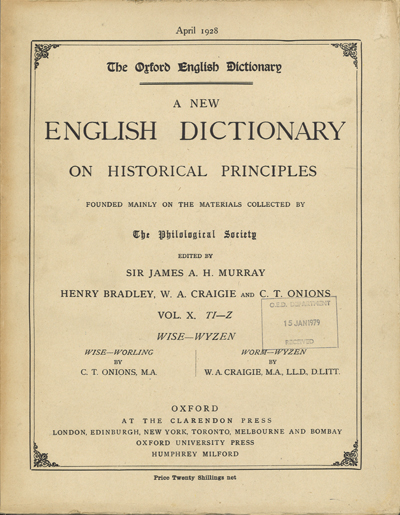
The final fascicle 1928

The society ultimately realized that the number of unlisted words would be far more than the number of words in the English dictionaries of the 19th century, and shifted their idea from covering only words that were not already in English dictionaries to a larger project. Trench suggested that a new, truly comprehensive dictionary was needed. On 7 January 1858, the society formally adopted the idea of a comprehensive new dictionary.”

There is much more to the story and it took another 44 years for the work to be completed. The last fascicle, which ranged from the words Wand to Wise, was the 125th installment. The complete dictionary – in bound volumes – soon followed.

Interestingly, Tolkien worked on the OED  and even wrote a parody based on some of the editors who he called ‘The Four Wise Clerks of Oxenford’ in the story Farmer Giles of Ham.

The OED is not, of course, the only dictionary in the world. But even today it is considered the gold standard.

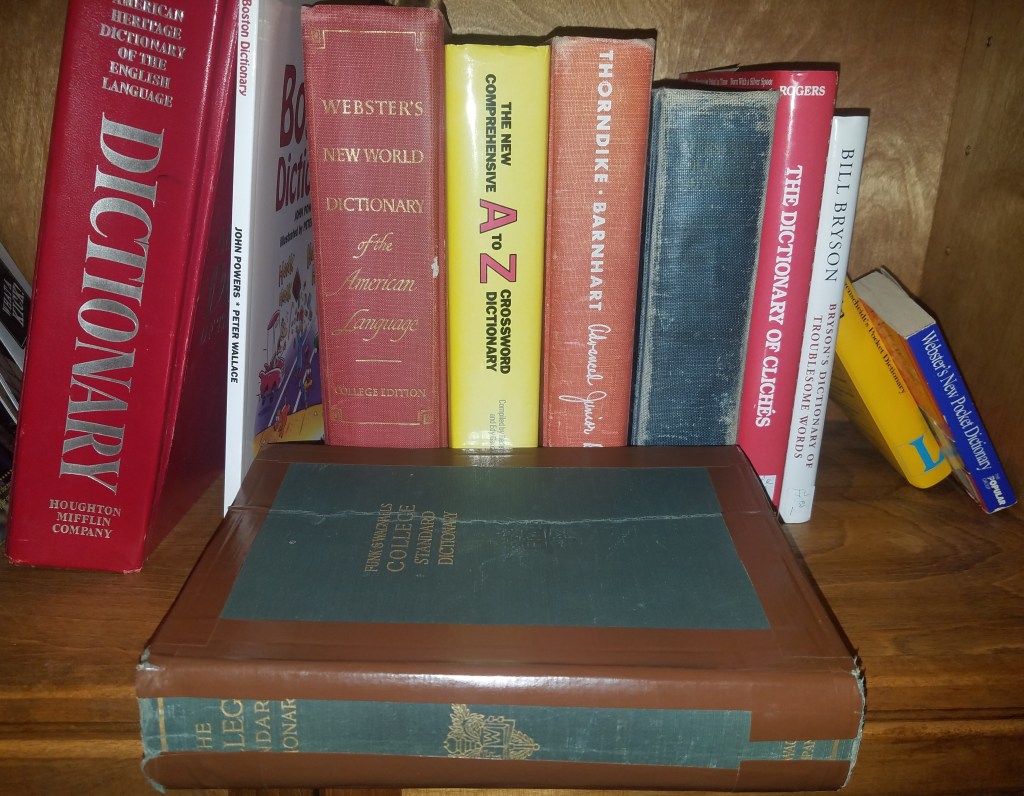
From the time I could read, I have been fascinated with dictionaries. Currently I have 11 books on my shelves with the word ‘dictionary’ in their titles. These include not only standard dictionaries, but also The Boston DictionaryBryson’s Dictionary of Troublesome Words, and The Dictionary of Clichés.

My most prized dictionary, however, is a Funk & Wagnalls College Standard Dictionary. From 1925.

It is still in amazingly good shape, its edges now bound with 1960’s era brown electrical tape. This particular dictionary was a part of my childhood as it belonged to my maternal grandmother and was kept in the family cabin at Rimrock Lake. I suspect it was an early addition to my grandparent’s summer escape place and arrived about the same time as the Scrabble game.

The authors collection. The oldest – from 1925 – is at the front. Also included is my mother’s college dictionary from 1944 (the blue one) and others from the late 1950’s forward.

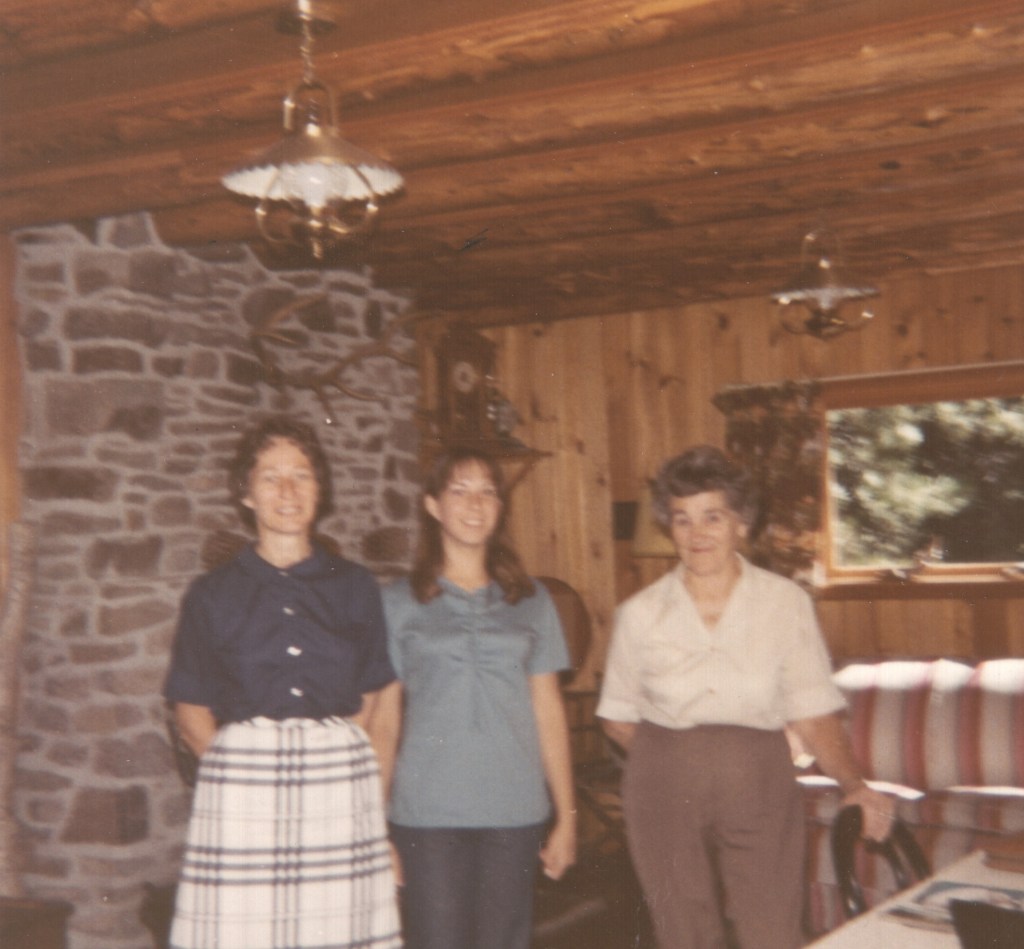
My grandmother and mother loved to play Scrabble together. I can see them, in my mind’s eye, puzzling over their letters to arrive at the word with the most points. But if one or the other challenged the other’s word, the 1925 dictionary would come off the shelf. It was the final authority.

When the cabin was sold two years ago, I was the lucky one who was privileged to add this family heirloom to my collection.

With my mother, sister, and grandmother at the cabin in 1971. You can see the Scrabble board holder behind them.

Every once in a while I will randomly read a page of a dictionary, looking for new and unfamiliar words. But, perhaps the most entertaining thing about perusing an old dictionary is to find words which existed then but have come to mean something different today.

I give you, as an example, the word ‘Computer’.

Dictionary.com provides this as the first definition: a programmable electronic device designed to accept data, perform prescribed mathematical and logical operations at high speed, and display the results of these operations.  Mainframes, desktop and laptop computers, tablets, and smartphones are some of the different types of computers.

But the 1925 F&W dictionary definition is ‘One who computes; particularly one who makes astronomical or other special calculations.’ There was no computer machine to be found in 1925!

I postulate that there is never a reason to be bored. In fact, just now my attention drifted a bit from the task at hand and I found myself reading words from the aforementioned 1925 dictionary. Have you ever heard of a Hackmatack? It sounds like something which would happen to your email if the wrong person found your password.

Hackmatack trees…

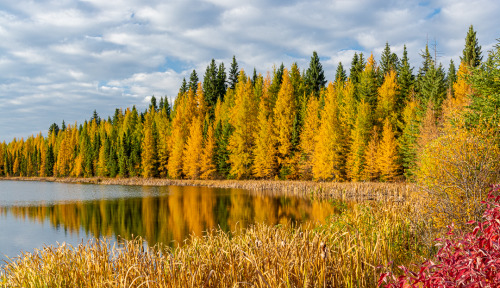
But, no, it is an actual word, a noun, of native American origins which means ‘The American larch; Tamarack.’ From now on I’m calling the Tamarack the Hackmatack. Or perhaps I will incorporate it into my world and use it randomly when the mood strikes. I wonder what other awesome and amazing words I can learn today? 

A couple of links:

https://en.wikipedia.org/wiki/Oxford_English_Dictionary

https://www.oed.com/

*Fascicle: a section of a book or set of books being published in installments as separate pamphlets or volumes.

American Pie

But what does it mean?

January 25, 2022

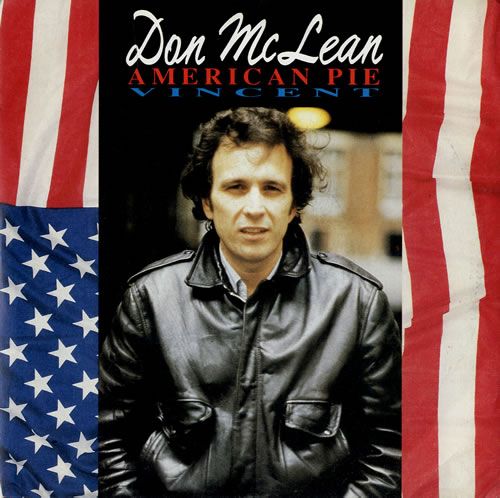
Perhaps no song from the 1970’s has garnered more speculation as to its meaning than Don McLean’s 1972 smash hit American Pie. It was 50 years ago, in January and February 1972, when it sat atop the Billboard charts for four weeks.

From the moment it was released and to this day, no one is entirely certain what the songwriter meant. McLean himself has said this about the song’s lyrics: “They’re beyond analysis. They’re poetry.”

But that declaration has not stopped people from wondering. The memorable tune combined with compelling lyrics imbued the song with staying power. So much so, that the Infallible Wikipedia shares:

“The song was listed as the No. 5 song on the RIAA project Songs of the Century. A truncated version of the song was covered by Madonna in 2000 and reached No. 1 in several countries, including the United Kingdom, Canada, and Australia. At 8 minutes and 42 seconds, McLean’s combined version is the sixth longest song to enter the Billboard Hot 100 (at the time of release it was the longest). The song also held the record for almost 50 years for being the longest song to reach number one before Taylor Swift’s ‘All Too Well (Taylor’s Version)’ broke the record in 2021. Due to its exceptional length, it was initially released as a two-sided 7-inch single. ‘American Pie’ has been described as ‘one of the most successful and debated songs of the 20th century.’”

The song has made seventy six year old McLean wealthy. His net worth estimated at $50 million. If you’re looking to find out what the song means, McLean himself has quipped: “It means I don’t ever have to work again if I don’t want to.” Later, he stated, “You will find many interpretations of my lyrics but none of them by me … Sorry to leave you all on your own like this but long ago I realized that songwriters should make their statements and move on, maintaining a dignified silence.”

When the song became a hit I was 14 years old and – as I’ve written about in other blog posts – a hopelessly romantic, angsty teen. American Pie’s lyrics seemed to speak to my generation on a very personal level. We learned about Buddy Holly, Richie Valance, and The Big Bopper, from the song. There was nothing more tragic than the thought of Holly’s young widow on that fateful February 3, 1959.

But more than that, it was these particular lyrics which seemed to sum up the experience of that time:

Well, I know that you’re in love with him,

 ‘Cause I saw you dancin’ in the gym,

You both kicked off your shoes,

Man, I dig those rhythm and blues

Illustrative of this idea is my diary post of February 11, 1972. The names HAVE been changed to protect the innocent… I think.

“This week went by fast but tonight was awful. I’ve decided that ‘B’ doesn’t like me. We got Yakima’s officers installed. (A reference to a youth group) After, they had a really crudy* dance. We were telling jokes and I was upset. After a while, and ‘B’ was playing the piano, I think he plays it when something is bugging him. But I’ve decided to forget him, for good! Another boy made my day. I think his name is ‘A.’ He said Hi to me but I was crying.”

My 1972 diary entry

Ah, the drama of youth. Eventually, “B” was my boyfriend for a couple of months but, as is true of most such relationships, it was consigned to the dustbin of youthful history. And who knows what caused the tears! Those seemed to be a constant back in the day.

The most ironic thing about American Pie, I think, is the repeated line ‘the day the music died.’ Many have speculated that he was referring to the loss of innocence as well as the death of the three musicians. Perhaps. But ‘the music’ came to life for me in the early 1970’s. I would venture millions of other baby boomers had similar epiphanies in the 60’s and 70’s, thanks to artists like Don McLean and songs like American Pie.

*crudy – derivation of the word ‘crud’ the definition of which, at least how I used it,is: Noun. Slang. ‘something that is worthless, objectionable, or contemptible.’

The links:

https://en.wikipedia.org/wiki/American_Pie_(song)

https://en.wikipedia.org/wiki/Don_McLean

The lyrics are sooooo long, that instead of sharing them in the article, you can read them here

https://www.lyrics.com/lyric/885859/Don+McLean/American+Pie

Long Beach, Washington

A wonderful resort town

January 18, 2022

Although there is no definitive answer as to when something becomes a tradition, I can state unequivocally that my family has a tradition to visit this Washington State city at least once a year; we’ve been doing so for generations now.

My daughter under the World’s Longest Beach sign 2009

The city of Long Beach was incorporated 100 years ago today on January 18, 1922. We go to the Infallible Wikipedia for a bit of history:

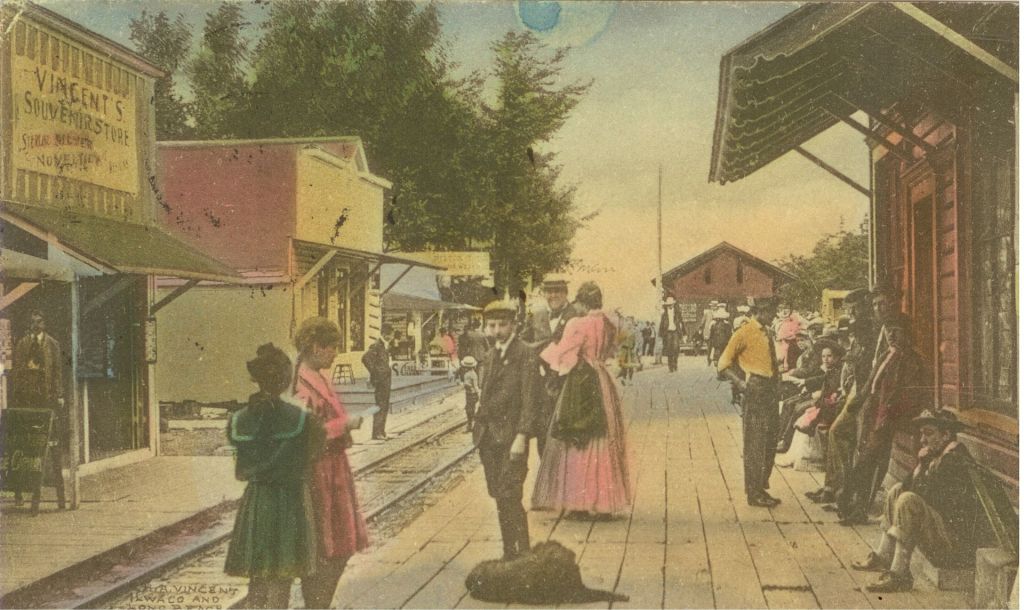
“Long Beach began when Henry Harrison Tinker bought a land claim from Charles E. Reed in 1880. He platted the town and called it ‘Tinkerville.’ (snip) From 1889 to 1930, a narrow gauge railroad called the Ilwaco Railway and Navigation Company ran up the whole peninsula.

The Long Beach depot was built between First and Second Streets on the east side of the track, which ran north along ‘B’ Street. A major destination in Long Beach was Tinker’s Hotel, later renamed the Long Beach Hotel, and built very close to the station. (snip)

Photo from: Unknown author – From old postcard, postmark on back states mailed July 31, 1909
Long Beach, Washington, ca 1909, looking north along the line of the Ilwaco Railway and Navigation Company, at an early tourist area called “Rubberneck Row”.

The boardwalk area near the station was known as ‘Rubberneck Row.’ Businesses existing in August 1911 that can be identified along Rubberneck Row from photographs (see images in this article) include, on the west side of the tracks, an establishment advertising ‘Baths’ (possibly the Crystal Baths, an indoor swimming pool), Milton York Candies, a ‘Postal Shop,’ and a soda fountain just across from the station advertising ‘Milk Shake.’”

This description of Long Beach could, in many ways, fit nearly any small beach resort town throughout the United States. Hotels and eateries were soon joined by shops and activities all designed with the seasonal tourist in mind.

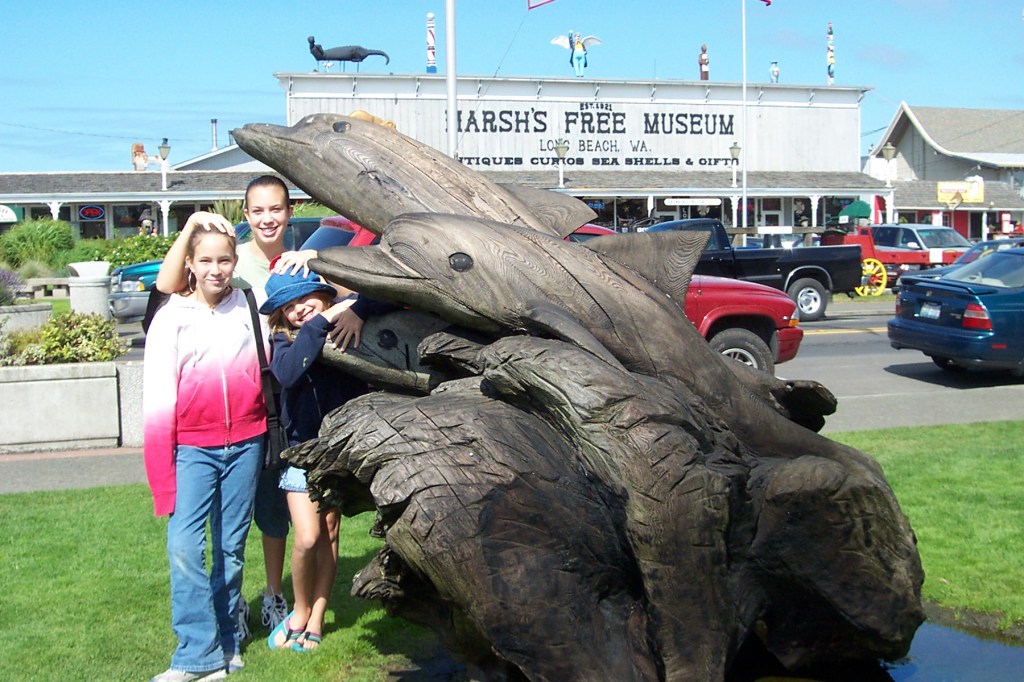
The cousins with Marsh’s Free Museum in the background. 2010

Over the years, attractions in Long Beach have come to include carnival rides, an arcade, museums, go carts, bike and surrey rentals, mini golf, and horseback rides. No doubt I’ve missed an attraction or three.

Riding the mopeds 2005

Driving through downtown Long Beach is one of those traditions which has to be honored upon arrival. In summertime, the main drag through town is a visual feast, awash in brightly colored kites and flags, firmly tethered, usually slapping in the near constant wind. The storefronts display a rainbow of souvenir products: clothes, beach toys, and every knickknack imaginable.

Flower boxes spill over in a confusion of pinks, purples, and green, inviting visitors to sit on the adjacent benches and rest for a moment or two. Tourists stroll along, licking ice cream cones, snacking on elephant ears, or savoring a doughnut from the local bakery.

The main draw for Long Beach is, however, found in its name: beach. At the north end of the business district, a left turn brings into view the large arch which proclaims that you have arrived at The World’s Longest Beach. Ahead of you are sand dunes and, finally, the mighty Pacific Ocean.

Having a sizzling good time visiting some of the sights a few years back

My first trip to Long Beach was 1961… at least that’s the first preserved photographic evidence. There are 8 mm home movies of our family along with my parent’s good friends,Walt and Barbara Lloid, and their family at Long Beach that summer.

While that was the only time we vacationed with the Lloid’s, over the next ten to fifteen years, we went every summer, joining my grandparents, who also stayed at the Klipsan Beach cottages. Every day of those two weeks was an adventure for a child: digging in the sand, playing at the ocean’s edge, beach fires every night.

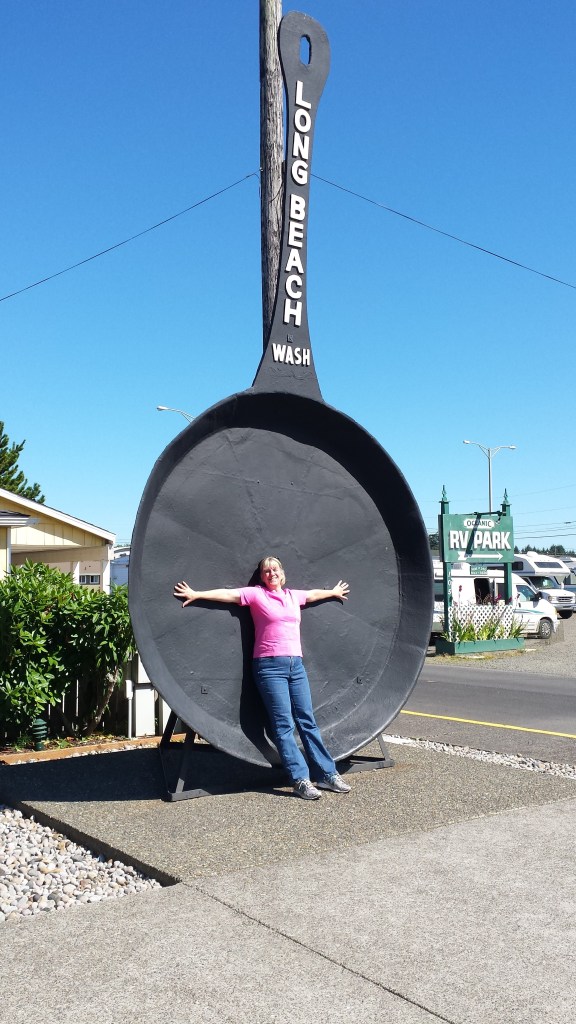
But the special days were those when we drove to downtown Long Beach. We would visit Marsh’s Free Museum, drive the bumper cars and go to the carnival, see the World’s Largest Frying Pan, and buy candy at Milton York. It was a highlight of every visit.

By my own estimation, I’ve been to Long Beach at least once a year for 50 of the last 61 years. My parents gave our family a gift beyond compare when, in 1991, they decided to purchase a condominium at Long Beach. That year, my sister and I took our (then) two children – ages two and one and a half – to the beach and thus brought another generation into our long family tradition.

It would be impossible to encapsulate every single experience at Long Beach in this article. Even as I contemplated what to write, I simply could not pluck the most memorable event from the dozens which floated to the top.

Surry fun with the hubby and kids 2003

As it turned out, I needn’t have worried. When I put Long Beach on my article calendar, I noted that it dovetailed with a planned trip with the hubby and sister. Great, I thought, I can get a current photo. We arrived on Wednesday, January 12, took care of some condo business, walked on the beach, met up with some friends, and then nature said ‘here’s your experience.’ On Friday, January 14,  a mostly underwater volcano in Tonga erupted, it produced tsunami waves which spread across the Pacific Ocean. We heard the news on Friday night just before bed.

The author January 13, 2022

It didn’t take long for the Infallible Wikipedia to share:

“The National Tsunami Warning Center issued a tsunami advisory along the West Coast of the United States and British Columbia, Canada. The advisory contained all U.S. areas along the West Coast from Southern California to Alaska. Beaches were closed, and coastal residents were requested to move to higher grounds. A surfing contest with over 100 participants was cancelled in Santa Cruz, California. Tsunami waves measuring 0.30–0.61 metres (1–2 ft) were expected to hit the shores as early as 7:30 a.m. Pacific Standard Time (UTC−8) along the Central Coast. San Francisco was expected to receive waves at 8:10. The highest tsunami waves are expected one to two hours after the arrival of the first waves. A tsunami advisory was put in place for the entirety of Hawaii. Advisories in Canada were issued along the North and Central coasts of British Columbia, along with the Haida Gwaii archipelago and Vancouver Island. No evacuation order was issued, but people were urged to avoid beaches and marinas. The warning level was low due to the height of reported waves, as they were below the 91 centimetres (36 in) threshold which would warrant an upgrade.

National Weather Service alert from January 15, 2022

Anyone who has been on the west coast has, no doubt seen, the blue tsunami evacuation route signs. I had considered, many times, what my strategy would be IF a tsunami were ever to come ashore while I was at Long Beach. Which is why I was always careful to have my wallet, car keys, shoes, and any other ‘can’t live without’ items next to the bed each night. Even if I was only going for a walk to the beach I always had the car key, ID and a credit card ‘just in case’ safely zipped in a pocket.

As I lay in bed about to go to sleep, I wondered if that would be the night when the sirens would wake us and we’d have to evacuate. Thankfully, that was not the case. We did have to leave fairly early the next morning so we did not get to see any of the impacts.

And, although it wasn’t a full tsunami event, yet another Long Beach experience is added to the already rich storehouse of memories. Thanks Mother Nature, that was enough excitement for 2022.

The links:

https://en.wikipedia.org/wiki/Long_Beach%2C_Washington

https://en.wikipedia.org/wiki/2022_Hunga_Tonga_eruption_and_tsunami#:~:text=After%20being%20relatively%20inactive%20since%202014%2C%20the%20Hunga,about%2070%20km%20%2845%20mi%29%20from%20the%20volcano.