Seasons Of Love

525,600 minutes… How do you measure a year?

January 3, 2023

Five hundred twenty five thousand six hundred minutes… How you measure, measure a year?

In January 1996 the song which these opening lyrics are from – along with dozens of other songs – opened off Broadway in New York in the musical Rent. The production turned out to be a big hit, running for a dozen years. The Infallible Wikipedia tells us:

I added some of the lyrics to a photo I took of Mt Adams, Washington at sunset December 30, 2022

“On Broadway, Rent gained critical acclaim and won several awards, including the Pulitzer Prize for Drama and the Tony Award for Best Musical. The Broadway production closed on September 7, 2008, after 12 years, making it one of the longest-running shows on Broadway. The production grossed over $280 million.

The success of the show led to several national tours and numerous foreign productions. In 2005, it was adapted into a motion picture featuring most of the original cast members.”

The bigger story, I believe, is about the visionary behind the musical. Composer Jonathan Larson was living in New York City, working as a waiter, when he began collaboration with playwright Billy Aronson. Over the course of the next two years, the pair continued to create the musical. Aronson, however, lost interest in the project and Larson made a proposal. The Infallible Wikipedia continues:

“In 1991, he asked Aronson if he could use Aronson’s original concept and make Rent his own. Larson had ambitious expectations for Rent; his ultimate dream was to write a rock opera ‘to bring musical theater to the MTV generation’. Aronson and Larson made an agreement that if the show went to Broadway, Aronson would share in the proceeds and be given credit for ‘original concept & additional lyrics’.

Jonathan Larson focused on composing Rent in the early 1990s, waiting tables at the Moondance Diner to support himself. Over the course of years, Larson wrote hundreds of songs and made many drastic changes to the show, which in its final incarnation contained 42 songs. In the fall of 1992, Larson approached James Nicola, artistic director of New York Theatre Workshop, with a tape and copy of Rent‘s script. When Rent had its first staged reading at New York Theatre Workshop in March 1993, it became evident that, despite its very promising material and moving musical numbers, many structural problems needed to be addressed, including its cumbersome length and overly complex plot.”

After many changes, the show was deemed ready after its final dress rehearsal on January 24, 1996.

Then tragedy struck. Sometime in the early morning of January 25, the show’s creator and composer, Jonathan Larson, died. It was later determined that he had experienced an aortic aneurysm.

Despite this, the show opened and was an immediate hit, made all the more poignant by the tragic death of Larson.

Seasons of Love – the song referenced at the start of the article – became the de facto theme song for the musical. It ended up being given a place of prominence in the production with the entire cast standing in a single line and singing it at the beginning of Act II. A reminder of not only Larson but also of the transient nature of life. Larson had, literally, invested his life into this one project, leaving behind a legacy.

Opening segment from the movie “Rent”

I first became aware of this song in the late 1990’s and ended up using it for a presentation at the Washington Idaho Rainbow Girls convention in the early 2000’s. It seemed fitting as a reminder that each of us has these same number of minutes to use each year, a message I wished to impart to the young women: that each of them had time which they could use to help other people and promote the organization.

For me personally, however, it prompted the question of how to put those 525,600 minutes allotted each year to good use to reach my own goals and achieve my dreams. 

The Jonathan Larson project was formed to bring many of Larson’s never before published works to the public. Link: https://54below.com/events/39697/

Certainly, the sentiment of the song – that we should measure a year in love – is one way. But to do that you must first define love. It can be the love of another person, of family, of friends. But it can also be the love and passion one puts into those things which bring them fulfillment and joy. The thing – or things – I would call someone’s mission in life.

That, ultimately, is what I like to think Larson meant when he wrote the song. Spend your precious minutes doing the things which inspire you and never lose your passion for whatever it is that motivates you. That’s how you should measure a year.

The links:

https://en.wikipedia.org/wiki/Rent_(musical)

https://en.wikipedia.org/wiki/Seasons_of_Love

https://en.wikipedia.org/wiki/Jonathan_Larson

New Year’s Resolutions – Part II

What’s YOUR most Valuable Real Estate?

December 27, 2022

Once Christmas is over, it is nearly impossible to escape the end of the year evaluations and lists of everything which went right – and wrong – during the previous year. It is that moment to step back, look in the proverbial mirror, and decide which ‘resolutions’ to embrace for the next year.

Five years ago I wrote about the tradition of New Year’s Resolutions and how they came into existence. That Tuesday Newsday link is here. https://barbaradevore.com/2018/01/02/new-years-resolutions/

Although the Infallible Wikipedia does not have a page on the most popular resolutions, I did find a list at GoSkills.com. From the article:

“Every year, millions of people make New Year’s resolutions, hoping to spark positive change. The recurring themes each year include a more active approach to health and fitness, improved finances, and learning new things for personal and professional development. Chances are, more than a couple of the top 10 most common resolutions will look familiar to you:

We purchased this extra ‘real estate’ as the kitchen didn’t have quite enough. This is used every single day and is the favorite spot for food prep.

1.     Exercise more

2.     Lose weight

3.     Get organized

4.     Learn a new skill or hobby 

5.     Live life to the fullest

6.     Save more money / spend less money

7.     Quit smoking

8.     Spend more time with family and friends

9.     Travel more

10.  Read more”

For me, it’s almost always #3 which makes it to my list each year. People who know me often say to me “Get organized? But you’re already organized.”

The truth, however, is that it takes effort and constant monitoring to get and stay organized. I was an incredibly messy and disorganized child. But over the years, I have developed some strategies which I follow that help me stay on track.

The biggest thing I do is jealousy guard the Valuable Real Estate (VRE) in my home.

No doubt this phrase is causing more than a few of my readers to scratch their heads and ask “what the heck is she talking about with ‘valuable real estate’?”

I coined the term a few years ago to describe any surface or space which was needed on a daily basis to be used, particularly, by all the members of the household.

In our house, there are several spots which spring to mind.

First, and foremost, are the kitchen counters. I jealously guard the counter space. Now, while there are some decorative items and countertop appliances on them, for the most part, the things which are out include the knife block, the dish drainer, the coffee maker, two ceramic holders with either spatulas or whisks, salt and pepper grinders, a butter dish, a food scale, and an electric tea kettle. While it may sound like a lot, for the most part these things sit at the back of the counter, leaving plenty of space for food preparation.

But, back to figuring out what is, or is not, VRE.

The first thing I ask is:

Is the item used daily?

The corner of the kitchen where small appliances and a few decorative items ‘live.’ This is not the most VRE in the kitchen but I still don’t allow it to become overly cluttered.

The things which meet that criterion remain. Everything else is subject to the next question:

Can the item be easily moved and stored and is there a place other than where it currently is where it can go?

There are some kitchen appliances – like the mixer and the blender – which are too tall/large to be stored in a cupboard, so they live at the back of the counter. Fortunately, we have enough counter space that we can afford to have them where they are.

Of course there are things we have in our homes which we just like. That’s the third question: Does it have sentimental value or bring pleasure?

I do not underestimate the need for a vibrant plant to brighten a winter’s day; or a couple sets of favorite salt and pepper shakers given to me by a friend. We all need things which bring a smile to our face.

And the final question: Do I even NEED the item?

There are things which ultimately don’t even belong in the kitchen or the house as they’ve outlived their usefulness. Unless it has a sentimental value based on question #3, it’s probably time to get rid of it.

These four questions can be applied to any spot in your house. Is your dining room or kitchen table covered with mail and other junk? What about the bathroom counters? Can you park a car in the garage? Do you have a decent work area on your desk?

Let’s apply the VRE model to the dining room table. If yours is covered with stuff which prevents you from using it for eating a meal or other activities, then perhaps it is time to designate it as VRE and send in the excavation crew. The hubby and I both embraced this particular space as VRE early on in our marriage. We simply did not allow things to stay on the table.

I change the table clothes and salt and pepper shakers frequently. Nothing is ever allowed to build up on the table.

For me personally, I enjoy sitting at the table and having a meal with family and friends. Currently there is a small Christmas tree, four sets of salt and pepper shakers, and a holiday table cloth. For the sake of efficiency we will evaluate all items together:

Is the item used daily? The salt and pepper shakers, maybe. The cloth protects the table, so yes. The tree? Just arrived there yesterday as a decoration for Christmas dinner. So, no, it’s not used daily.

Can the item be easily moved and stored and is there a place other than where it currently is where it can go?

Yes. All the items have places in the house where they are stored when not in use.

Does it have sentimental value or bring pleasure?

Yes. Everything on the table brings me pleasure to look at.

Do I even NEED the item(s)?

Nope. But #3 is the deciding answer.

I do not diminish the challenges of daily life. Keeping up with dishes, mail, paperwork, laundry, etc. etc. etc., is not always easy and certainly, not fun.

The other piece of this equation is commitment. I usually clean the kitchen each night before I go to bed. Some days, like on Christmas when we had people over, the cleaning and putting away was not finished that night. But it was all completed in less than 24 hours.

That’s the commitment. Years ago I promised myself – for my own sanity – to make sure that those spots of VRE remained clutter free.

My resolutions for 2023 are pretty much the same as they are every year: spend a bit of time and evaluate how I want to use life’s most valuable commodity: time. And one of the best ways to do that is to make sure that the VRE in my life never gets out of control.

The Magic of Santa Claus Traditions

An icon of Christmas Around the World

December 20th

A Tuesday Newsday Classic

Over the years, Christmas has blended in to a mishmash of traditions with the blurring of the lines between its purely religious meaning and the more secular elements.

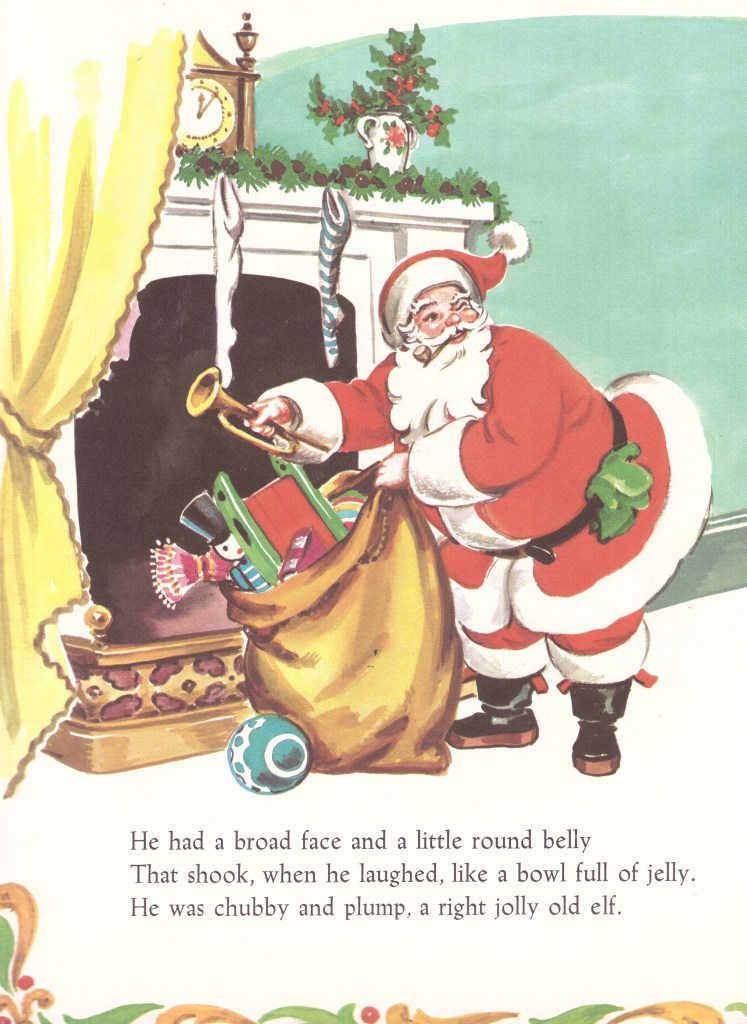
A page from The Night Before Christmas Golden Book, copyright 1955

Take Santa Claus, for example. The idea of the jolly elf who brings presents for children began several hundred years ago. He is based on Nicholas of Myra, the patron saint of children.

The image of Santa Claus as a portly and white bearded man dressed in a red suit trimmed with white fur can be traced back to 1823 with the publication of “A Visit from St. Nicholas.”

The images which that poem conjured up captured the imagination of people everywhere as the story became a favorite to read to children on Christmas Eve.

You will be pleased to know that the Infallible Wikipedia has an extensive and exhaustive article in regards to everyone’s favorite Christmas elf:

“In 1821, the book A New-year’s present, to the little ones from five to twelve was published in New York. It contained ‘Old Santeclaus with Much Delight’, an anonymous poem describing Santeclaus on a reindeer sleigh, bringing rewards to children. Some modern ideas of Santa Claus seemingly became canon after the anonymous publication of the poem A Visit From St. Nicholas (better known today as The Night Before Christmas) in the Troy, New York, Sentinel on 23 December 1823; Clement Clarke Moore later claimed authorship, though some scholars argue that Henry Livingston, Jr. (who died nine years before Moore’s claim) was the author. St. Nick is described as being ‘chubby and plump, a right jolly old elf’ with ‘a little round belly’, that ‘shook when he laughed like a bowlful of jelly’, in spite of which the ‘miniature sleigh’ and ‘tiny reindeer’ still indicate that he is physically diminutive. The reindeer were also named: Dasher, Dancer, Prancer, Vixen, Comet, Cupid, Dunder and Blixem (Dunder and Blixem came from the old Dutch words for thunder and lightning, which were later changed to the more German sounding Donner and Blitzen).

Me and my sister visiting Santa circa 1960

By 1845, ‘Kris Kringle’ was a common variant of Santa in parts of the United States. A magazine article from 1853, describing American Christmas customs to British readers, refers to children hanging up their stockings on Christmas Eve for ‘a fabulous personage’ whose name varies: in Pennsylvania he is usually called ‘Krishkinkle’, but in New York he is ‘St. Nicholas’ or ‘Santa Claus’. The author quotes Moore’s poem in its entirety, saying that its descriptions apply to Krishkinkle too.”

There is so much more in the article which I would encourage all Santa researchers to peruse.

From my perspective, Santa Claus is as integral to Christmas as a tree or a nativity scene and he’s always been a part of the holiday for me. Over the past several days, as I considered this topic, the biggest challenge was deciding what, exactly, to share.

I found early home movies of this author at age four or five, standing on the porch of our house with a three foot tall stiff paper Santa and Mrs. Claus. There was a photo of my sister and me sitting on Santa’s lap as well as one of my older brother and one of our cousins.

On Christmas Eve each year we dutifully hung our stockings only to discover them full of goodies the next morning; evidence that Santa had paid a visit overnight.

But perhaps the best part of the Santa Claus myth was when I became a parent and could share the joy with my own children. Like me, both my son and daughter looked forward to hanging the stockings and anticipating Santa’s visit.

My grandmother designed and created this wooden Santa cutout circa 1950. It’s one of my prized possessions.

I saw the magic happen with my son in 1991. It was a week or two before Christmas and the local fire district had a tradition of Santa riding on the back of a fire truck through the neighborhood.

For a small boy, this was nirvana. On this particular night – well, it was probably no later than six p.m. – my sister and her daughter were visiting and we were eating dinner when I ‘heard’ the fire truck a few blocks over.

What they would do is have the truck’s lights flashing and run the sirens to announce their approach. When we heard the sound, we sprung into action, bundling the children into their coats, arriving out on the street just in time to watch as the big red fire truck, with lights ablaze, roll slowly towards us.

Closer and closer it came, it’s sirens blaring. And then the truck was in front of our house and Santa – riding on the back of the truck – turned and waved at my son and niece – then jumped down and gave each a candy cane.

Three treasured books from my childhood. The Night Before Christmas and Frosty The Snowman were gifts to me and my sister on Christmas circa 1961

A moment later, Santa was back on the truck and spirited away up the street. We waved Santa goodbye and then it was back into the house to finish eating dinner. My son, however, was having none of that. I put him in his high chair but he refused to sit down, instead standing there and repeating over and over and over in a staccato voice: “Santa Claus… Fire Truck!”

His little fist was extended and he pumped it up and down pronouncing each syllable: “San-ta-Claus… Fi-er-Truck!”

This continued for the next half an hour and even after that it was a tough night getting him to settle down and go to sleep.

I think for my sister and me it’s one of our favorite Christmas memories and one we reminisce about every year.

When cleaning out my parents’ home, I came across a copy of the book “The Night Before Christmas.” Picking it up and reading it was like getting together with an old friend: the story and colorful artwork a familiar companion from Christmas’ past. Inside the front cover, it was signed by my grandmother who gave the book as a gift to my sister (I got Frosty the Snowman that year). It seems like my sister said I could keep the book. I include it as part of my holiday decorations each year now.

Truly, it wouldn’t seem like Christmas without Santa Claus. And a fire truck.

The link:

https://en.wikipedia.org/wiki/Santa_Claus

Nutcrackers

A nearly 400 year Christmas tradition

December 13, 2022

An early Nutcracker by Friedrich Fuchtner

I’ve long been fascinated by the thought of how primitive people learned about foods and what was safe to eat. Take nuts, for example. Here were these things encased in shells which grew on trees. I imagine the people watched as animals collected and ate the nuts.

People, being inventive creatures, are always looking for solutions to problems. I suppose they figured out that if they placed the hard shell on a rock and then hit it with another rock that they could get to the seed inside, the nut meat. And nut meats, it turns out, are delicious.

Over the millennia, those ever inventive people devised better ways to get to the nut meats, developing devices which have become known as ‘nutcrackers.’

Some of the earliest ones were forged from metal and became prized items. The Infallible Wikipedia tells us:

“Nuts were historically opened using a hammer and anvil, often made of stone. Some nuts such as walnuts can also be opened by hand, by holding the nut in the palm of the hand and applying pressure with the other palm or thumb, or using another nut.

Manufacturers produce modern functional nutcrackers usually somewhat resembling pliers, but with the pivot point at the end beyond the nut, rather than in the middle. These are also used for cracking the shells of crab and lobster to make the meat inside available for eating. Hinged lever nutcrackers, often called a ‘pair of nutcrackers’, may date back to Ancient Greece. By the 4th century in Europe, nutcrackers were documented in England, including in the Canterbury Tales, and in France. The lever design may derive from blacksmiths’ pincers. Materials included metals such as silver, cast-iron and bronze, and wood including boxwood, especially those from France and Italy. More rarely, porcelain was used. Many of the wooden carved nutcrackers were in the form of people and animals.

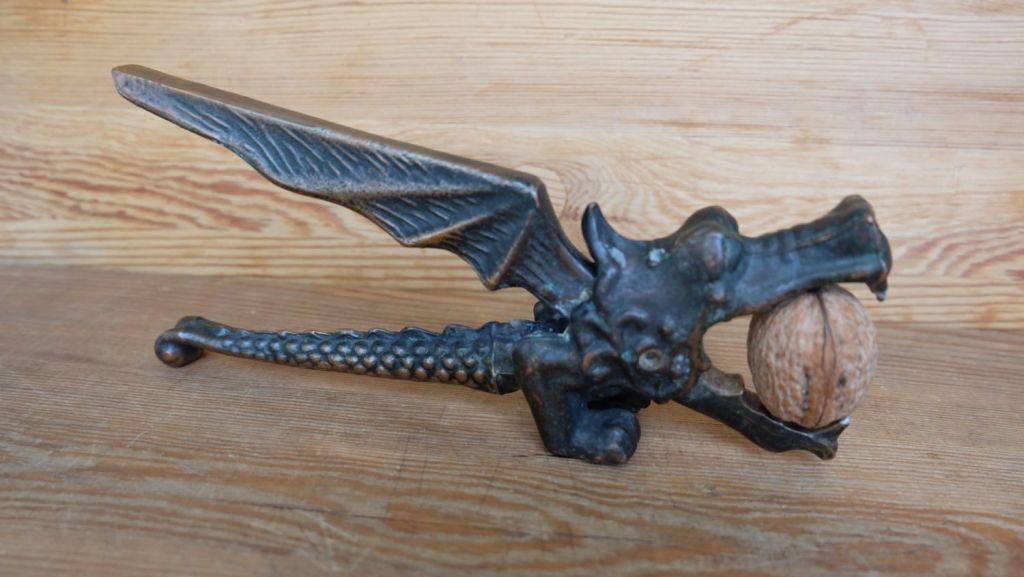
An antique metal dragon nutcracker

During the Victorian era, fruit and nuts were presented at dinner and ornate and often silver-plated nutcrackers were produced to accompany them on the dinner table. Nuts have long been a popular choice for desserts, particularly throughout Europe. The nutcrackers were placed on dining tables to serve as a fun and entertaining center of conversation while diners awaited their final course.”

The wooden nutcrackers we associate with Christmas originated in Germany in the late 17th century in the Ore Mountains. Again, from the Infallible Wikipedia: 

“One origin story attributes the creation of the first nutcracker doll to a craftsman from Seiffen. They were often given as gifts, and at some point they became associated with Christmas season. They grew in popularity around the 19th century and spread to nearby European countries. As the demand grew, nutcracker doll production also began on a mass scale in factories. Friedrich Wilhelm Füchtner  (1844–1923), commonly known in Germany as ‘father of the nutcracker’, began the first mass production of the design (using a lathe) at his workshop in Seiffen in Saxony during 1872.”

As the popularity of the dolls grew, nutcrackers were often given as gifts to children so they could crack the nuts which filled their stockings. Although nowadays stockings are filled with toys and candy, at one time they held nuts and fruits.

Most of the wooden nutcrackers sold today are not equipped to actually crack nuts but are for decorative purposes only. One reason for this is that those always inventive people continued to find better ways to harvest nuts. Today that is done in factories with machines which can crack open large quantity of nuts with efficiency.

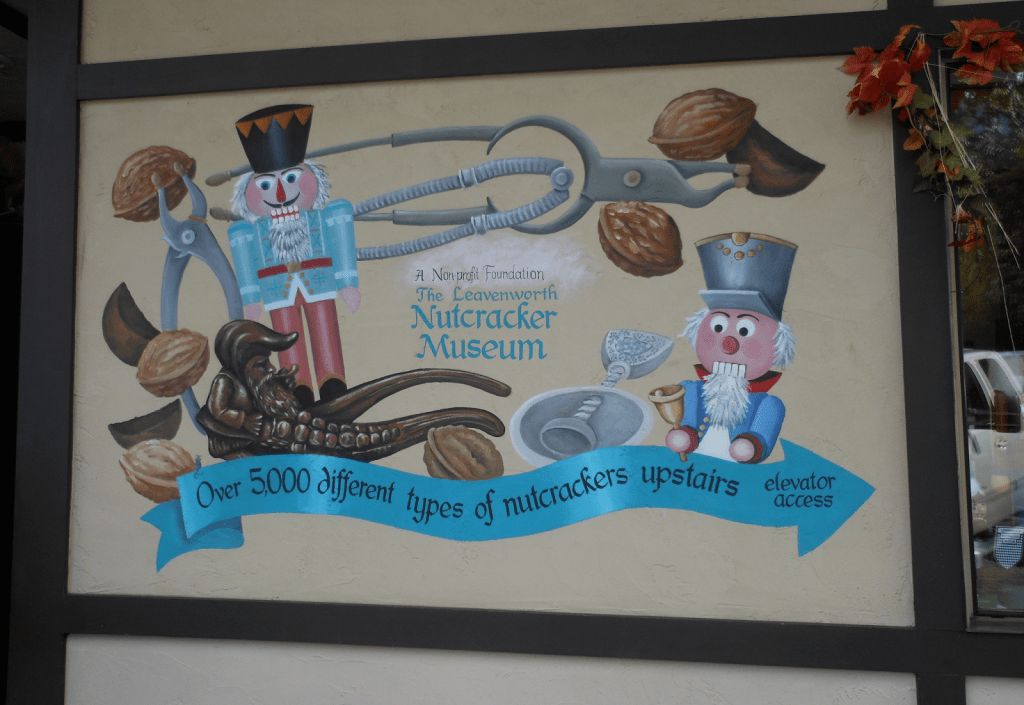
For those who love Nutcrackers a visit to the Leavenworth, Washington, museum is a must see.

I hadn’t much thought about the origin of the soldier nutcrackers until the late 1980’s when the hubby and I lived in the Timberline neighborhood in Sammamish, Washington. (Note – it wasn’t even ‘Sammamish’ at that time, just unincorporated King County!)

As a new development ,Timberline attracted primarily twenty and thirty something professionals who worked in nearby Redmond and Bellevue or commuted to Seattle. Many in the neighborhood were transplants from other states from all over the U.S.

It was never anything official, but Christmas became a big deal in the neighborhood. I suppose that many of us were simply trying to replicate the cozy warmth and hominess of our childhoods by putting up lights and outdoor decorations. Truly, the Timberline neighborhood had more than its share of over the top displays.

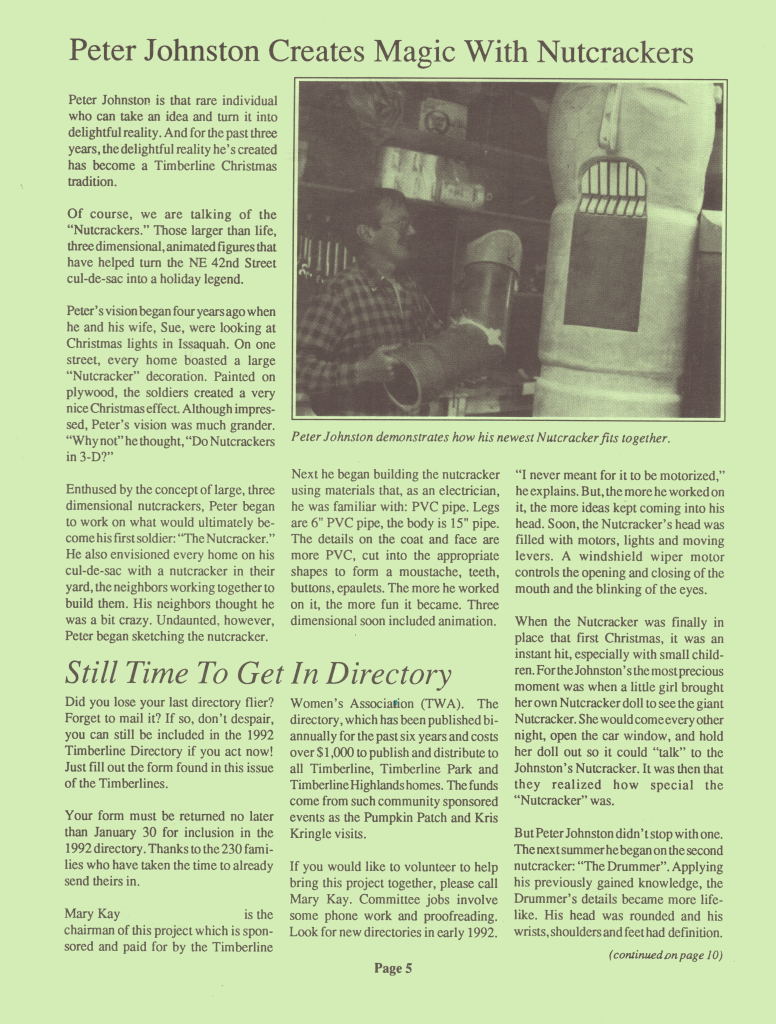
But there was one street in particular which gained a reputation for being ‘THE’ must visit lane due, in large part, to resident Peter Johnston and his giant nutcrackers.

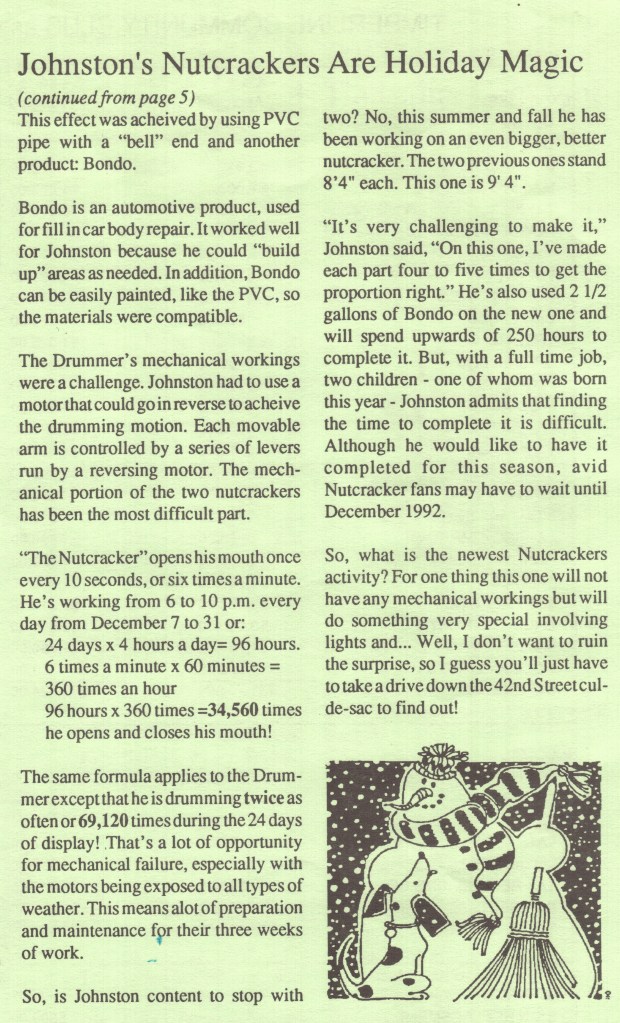
In December 1991, I was the editor of a neighborhood newsletter, The Timberlines, and decided to write a feature story about the Nutcrackers. From my story:

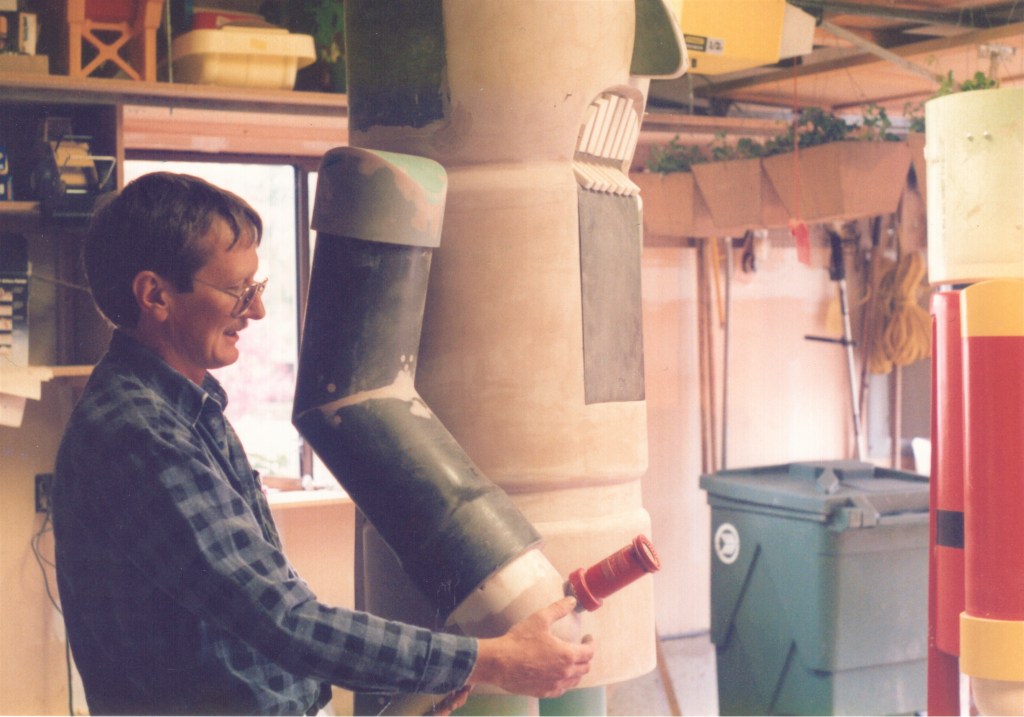
Peter Johnston at work creating his third 3D Nutcracker, the Fireman, in 1991

“Peter’s vision began four years ago when he and his wife, Sue, were looking at Christmas lights in Issaquah. On one street, every home boasted a large ‘Nutcracker’ decoration. Painted on plywood, the soldiers created a very nice Christmas effect. Although impressed, Peter’s vision was much grander. ‘Why not,’ he thought, ‘Do Nutcrackers in 3-D?’”

Peter started creating his 3-D nutcracker using materials he worked with during his day job as an electrician. Soon the ‘Nutcracker’ took on a life of its own and went far beyond simple 3-D. Suffice it to say that when it was finished, the Nutcracker was nearly seven feet tall and its head was filled with motors, lights and moving levers. The mouth opened and closed and the eyes blinked.

Johnston’s original 3D nutcraker how it looked when stored

It was an instant holiday hit. The next year he built a Nutcracker which drummed and the year I wrote the article, he completed a firefighter who held a hose and poured water on a flame.

The article I wrote is far too long to include in its entirety, but I’ve attached it for anyone who wants to read the whole thing.

‘Peak’ Nutcracker was, for us, that Christmas of 1991 when our son was not quite two years old. Every day of December, around five in the late (and dark!) afternoon, we would bundle into the car and he and I would go to see the Nutcrackers. I would have to roll the window down so my son could see them better and talk to them. It was a magical time thanks to the inventiveness of one Nutcracker artist and his vision.

The links:

https://en.wikipedia.org/wiki/Nutcracker

https://en.wikipedia.org/wiki/Nutcracker_doll

Page 1 of the article I wrote in 1991
Page 2 of the 1991 Newsletter article

Fort Clatsop

Retreat from a Dismal Nitch

December 6, 2022

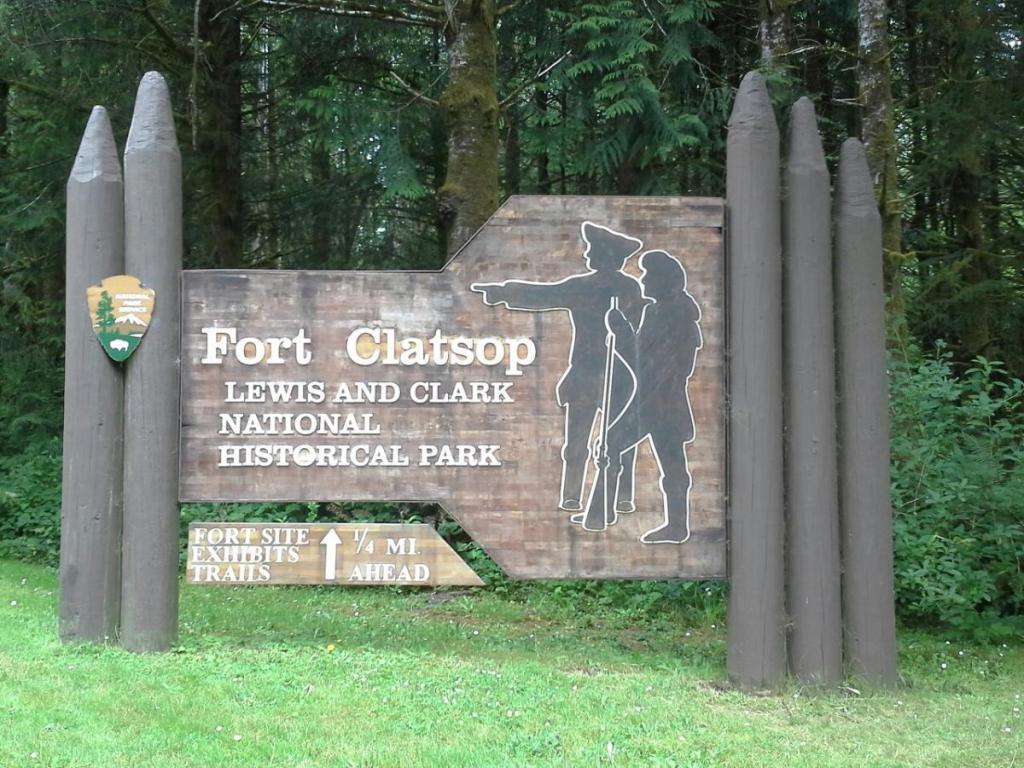
Entry sign to Fort Clatsop

I think I can trace my interest in – and love of – history back to this place which was identified as the location where the Lewis & Clark Expedition would spend the winter of 1805-06. It was on December 6, 1805 when the various scribes for the expedition reported being flooded out by a particularly high tide. The next day, they moved their camp to what would become Fort Clatsop.

For anyone who lives in the Pacific Northwest, you know that winters tend to be wet, miserable, and cold. I often joke (well, sort of) that winter in Seattle is forty degrees and rain.

And so it was for the L&C Expedition. When they arrived at the mouth of the Columbia River in November 1805, they set up camp on the north – in what would become the state of Washington – side of the river in a spot which, according to the Infallible Wikipedia was described as follows:

“On November 10, 1805, a severe winter storm struck the area, forcing them off the river for six days and preventing them from meeting the supply ships. The group landed in a cove on the north bank of the river that Captain William Clark called in his journals ‘that dismal little nitch’. With no more fresh food and their soaked clothes literally rotting away, he wrote that ‘A feeling person would be distressed by our situation’ and was concerned for the Corps safety for just the second time in the expedition, in danger of foundering just a few miles short. Upon the arrival of calm weather, the company left in great haste and moved to Station Camp on the west side of Point Ellice (referred to by Clark as ‘blustering point’, ‘Stormey point’, and ‘Point Distress.’), and camped at that location for 10 days before relocating for the winter to what would become Fort Clatsop.”

View of Fort Clatsop front entry

It is apparent that the explorers were treated to a pretty typical northwest winter. When they arrived at their final destination, they went right to work building the Fort. Also from the Infallible Wikipedia:

“Construction of the fort was slow, due to the incessant precipitation and unyielding wind that made working conditions less than ideal. On December 23, people started to move into the dwelling, even though it didn’t yet have a roof. The next day, Christmas Eve, everyone moved in. On Christmas Day it was named ‘Fort Clatsop’ in reference to the local Indian tribe.”

Firefighters putting out the last of the October 2005 fire which destroyed the 50 year old structure

Now, I don’t know about all of you, but for them to get the fort completed in 15 days doesn’t sound particularly slow what with all the permits they no doubt needed. Or not.

Regardless, it does seem that the weather affected them at every turn. They endured a long and rainy winter. The elk they killed for food would spoil quickly and many in the expedition were dealing with chronic maladies, made worse by the conditions.

Although they originally planned to stay until April 1, 1806, that date was moved up to March 20 and then delayed for three days due… to the weather.

After they departed, the rough hewn fort fell into disrepair and by the middle of the 19th century had rotted away. Then to mark the 150th anniversary of Fort Clatsop’s founding, a replica of the original structure was built using William Clark’s drawings as a guide.

For 50 years that fort stood and then, on October 3, 2005, a fire destroyed it, a mere two months before the planned celebration of the 200th year since Fort Clatsop’s founding.

Yet, in the spirit of the Corps of Discovery, a team of volunteers sprang into action:

“A new replica, more rustic and rough-hewn, was built by about 700 volunteers in 2006; it opened with a dedication ceremony that took place on December 9. The site is currently operated by the National Park Service.”

It speaks volumes to think that the original Corps of Discovery had 36 men who managed to build Fort Clatsop in 15 days and then 200 years later it took 700 to do the same.

My sister and her daughters along with my son and daughter at Fort Clatsop 1999

Now, if you are wondering how it is that Fort Clatsop inspired my love of history, we have to go back to a few short years after the original replica was built. My first trip to Long Beach, Washington, was – from what I have gathered based on home movies – was likely the summer of 1961 or 1962. There is footage of our family along with another family, vacationing on the Washington coast. It is possible we went to Fort Clatsop for the first time that trip.

What I do know is that the ONLY vacation my family took every year was always to the Long Beach Peninsula. And one of the favorite days of the vacation was when we ventured across the Columbia River to explore Astoria and visit Fort Clatsop.

The author with her sister and mother in a dugout canoe at Fort Clatsop. Image taken from home movies circa 1967. My grandmother DeVore is to the left.
The author with her own daughter in a dugout canoe at Fort Clatsop 1997

For a child still in single digits as far as her age, Fort Clatsop inspired the imagination. I was awed by the thought of Lewis and Clark and their adventures; inspired by the young mother, Sacagawea, the only woman in their troop, caring for a baby in the wilderness.

Each summer – and NOT in the rain and wind and certainly warmer than 40 degrees – we would sprint from room to room, examining the wooden bunk beds where the men slept. Looked at the tiny bed where Sacagawea’s son, Jean Baptiste Charbonneau, only 10 months old when Fort Clatsop was built, spent his first year.

My grandmother and our history teacher Dad at Fort Clatsop. Image captured from home movie footage. Circa 1967

We would walk the trail to the stream where they had to go to get water each day. We’d hike down to the Lewis and Clark River (the original name of the river was the Netul River. It was renamed in 1925) and pretend to row in the dugout canoes displayed there. For one afternoon, we’d imagine we were pioneers, living in a wilderness just like Lewis and Clark.

My father went back to school in 1962 to get his education degree and a couple years later became a Washington State History teacher at Franklin Junior High in Yakima.

My siblings and I were, in many ways, his first students as our summer trip to the beach was chock full of historical tidbits mostly about Lewis and Clark. And each year there was ALWAYS the trip to Fort Clatsop.

With the arrival of my own children, the annual trips to the beach resumed and for most of those years the obligatory visit to Fort Clatsop was included.

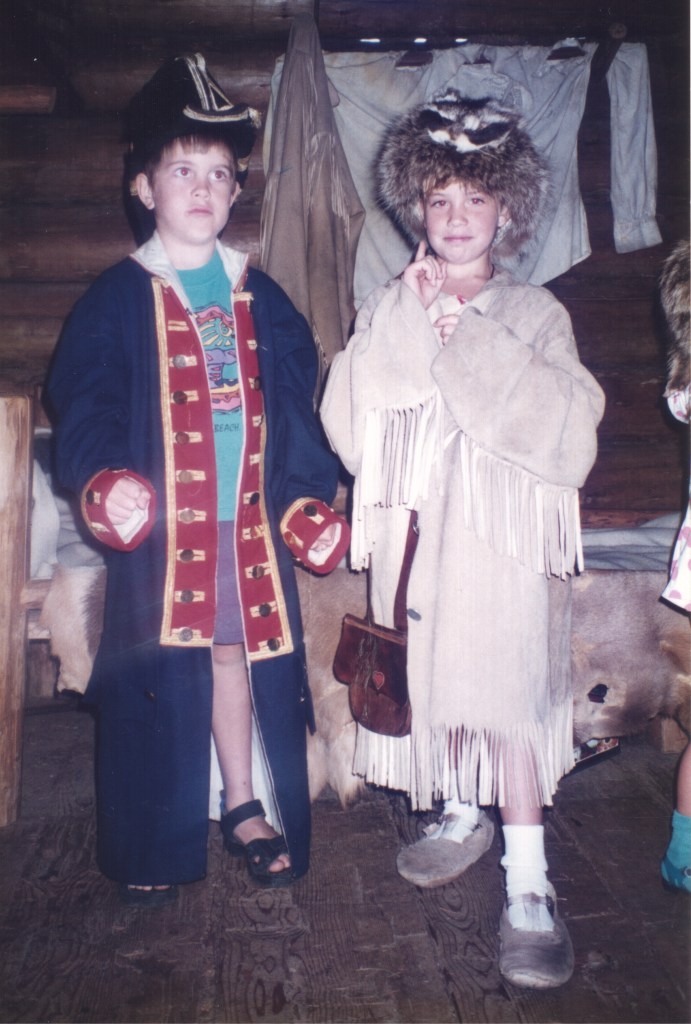
My son and niece dressing up in fun early 19th century style costumes circa 1997

October 2005’s fire left me feeling shocked and sad. Fort Clatsop was gone. And yet it rose again quickly and we visited the next summer. Of course the structure was not exactly the same but in one way it was much better. It felt more historically accurate.

The Fort Clatsop of my day was dank and seemed old. And it smelled musty. In the summer of 2006 I was struck by the aroma of the newly hewn cedar and how bright the wood looked, not yet wet and stinky. This, I thought, was how it must have looked to the Corps of Discovery when they occupied it, perhaps not quite as dark and miserable as the replica of the 1960’s and 70’s portrayed.

I like to think that my children also think about their many visits to Fort Clatsop and remember them as a wonderful family tradition. Just not in the month of December. Although that would be historically accurate.

A few links:

https://en.wikipedia.org/wiki/Fort_Clatsop

https://en.wikipedia.org/wiki/Dismal_Nitch

https://www.nps.gov/lecl/learn/historyculture/fort-clatsop.html

When PONG was King

The original video game

November 29, 2022

Back in the 1970’s life was much simpler. There were no personal computers; no cell phones; no video games. To entertain ourselves, we would tune in to the local radio station and listen to the hits of the day; we might go for a drive – if our parents let us use the car; we’d call our friends on the phone and, perhaps, meet at the local pizza parlor; or we might hang out at the local arcade and drop quarters in a pinball machine.

THIS is what the excitement was all about…

It was on November 29, 1972, when the first hint of the coming electronic age poked its head up out of the ether with the introduction of the earliest of all electronic games: PONG by Atari.

I could attempt to explain to anyone born after 1970 what Pong was, but will let the Infallible Wikipedia do the heavy lifting for me:

“Pong is a two-dimensional sports game that simulates table tennis. The player controls an in-game paddle by moving it vertically across the left or right side of the screen. They can compete against another player controlling a second paddle on the opposing side. Players use the paddles to hit a ball back and forth. The goal is for each player to reach eleven points before the opponent; points are earned when one fails to return the ball to the other.”

Okay, I know, I know. All you Gen-Xers, Millennials, and Gen-Z types are saying: “Really? That’s what you thought was fun back in the 1970’s, Boomer?”

Yes. Yes we did.

The Infallible Wikipedia continues: “The Pong arcade games manufactured by Atari were a great success. The prototype was well received by Andy Capp’s Tavern patrons; people came to the bar solely to play the game. Following its release, Pong consistently earned four times more revenue than other coin-operated machines. (Nolan) Bushnell estimated that the game earned US$35–40 per day (i.e. 140–160 plays daily per console at $0.25 per play), which he described as nothing he’d ever seen before in the coin-operated entertainment industry at the time. The game’s earning power resulted in an increase in the number of orders Atari received. This provided Atari with a steady source of income; the company sold the machines at three times the cost of production. By 1973, the company had filled 2,500 orders, and, at the end of 1974, sold more than 8,000 units.”

1972 Pong Arcade game from pongmuseum.com

I cannot say for sure when Pong first entered my consciousness. My arcade hopping days were a few years later and I can assure you that my mother would not have let me near one anyway. But I did have something which exposed me to the early games: older brothers.

It was likely my eldest brother – nine years my senior – was all agog over Pong. From the earliest days of electronics, he was in to it. Really in to it. No doubt he went to arcades and played Pong, looking to extend a win streak or earn a high score, responsible for giving Nolan Bushnell a bunch of quarters.

When, probably at Christmas 1975, the first home Pong gaming console was released, my brother brought it to the house where we grew up and everyone got a chance to try their hand at the game. All that Christmas there were whoops of joy and cries of dismay as games were won and lost. While I no doubt played Pong, I was never that in to it. I really didn’t get the attraction of moving a little line up and down one side of a screen trying to ‘hit’ a little blinking thing.

By the early 1980’s, the arcade version of Pong became a relic of the past as newer, more involved electronic games like Pac-Man and Donkey Kong took their place. (I wrote about them here: https://barbaradevore.com/2017/10/10/pac-man-fever/)

Similarly, the dedicated ‘at home’ gaming consoles eventually were able to feature multiple games in the form of interchangeable cartridges.

Atari stayed at the top of the heap for a few more years with the introduction of a dedicated gaming console. The Infallible Wikipedia shares:

“The Atari 2600, initially branded as the Atari Video Computer System (Atari VCS) from its release until November 1982, is a home video game console developed and produced by Atari, Inc. Released in September 1977, it popularized microprocessor-based hardware and games stored on swappable ROM cartridges, a format first used with the Fairchild Channel F in 1976. The VCS was bundled with two joystick controllers, a conjoined pair of paddle controllers, and a game cartridge—initially Combat and later Pac-Man.

(snip) The Atari VCS launched in 1977 with nine simple, low-resolution games in 2 KB cartridges. The system’s first killer app was the home conversion of Taito’s arcade game Space Invaders in 1980.”

A ‘gotta have it’ Christmas gift of the 1970’s

My brother, however, did not go with the Atari but invested in the Commodore VIC 20 which was an early home computer system which had a whole bunch of compatible games for it. I have a distinct memory of being at my brother’s  home in Ballard in the early 1980’s and we are all huddled around the TV in their small sitting area, watching as my brother and the hubby battle it out over some game.

I imagine it’s difficult to imagine the thrill of those early games when compared to the sophistication of today’s technology. Yet, it had the power to make us all sit up and notice and be in awe of things we’d never seen before.

As is my custom, I do try to ferret out how I might have been involved with whatever my Tuesday Newsday topic might be. Which led me to my small collection of diary’s from the early to mid-1970’s.  I was rewarded with this gem from December 31, 1973:

The “Upper Valley (DeMolay) New Year’s Eve dance was tonight. It was slow at first. I danced some. Once with Alan, and twice with his friend. Then towards the end Sally and Julie and myself were dancing with Tony, Cory A., and some other guy. It was a fun dance. We went to Pizza Pete’s afterwards but I didn’t eat anything. I played electronic Ping-Pong with Lee L., Kev, Mike K., and beat them. I played Tony and lost.”

Oh, us crazy Boomers. Such wild things! Did we know how to have fun or what!?

Of course, the links:

https://en.wikipedia.org/wiki/Pong

https://en.wikipedia.org/wiki/Atari_2600

https://en.wikipedia.org/wiki/VIC-20

Enchanted

Happily Ever Ever After

November 22, 2022

One of the things that Disney is known for are heartwarming and charming movies aimed at children. Of course we think of the animated classics such as Snow White and the Seven Dwarfs. Peter Pan. Lady and the Tramp. Disney has also done films with actual people such as Mary Poppins and Old Yeller.

It was during the third week of November 2007, when Disney turned their formula on its head and created a truly charming movie which mixed animation and live actors to great effect.

Giselle decked out in her white wedding hoop dress and tiara. Lawyer Robert and Prince Edward behind her and the evil queen, Narissa, at top.

Enchanted is the story of several ‘animated’ characters: Giselle, Edward, Pip, and Narissa who, it would seem, will follow the somewhat predictable storyline of the poor young woman who meets and falls in love with the handsome prince. She is aided by a forest full of adorable animals and the only thing to stand in the way of Giselle and Edward’s happiness is the wicked queen, Narissa.

It is a twist in the story, however, which propelled this movie into a different realm when Giselle, dressed in an over the top, white hooped wedding dress, big hair and a tiara to top it all off, finds herself as a ‘human’ and in the middle of modern day New York City.

Giselle is played by Amy Adams who perfectly encapsulates the naiveté and charm one expects from an animated character made human. The Infallible Wikipedia tells us:

“Disguised as an old hag, Narissa intercepts Giselle on her way to the wedding and pushes her into a well, where Giselle is magically transformed into a live-action version of herself and transported to New York’s Times Square in the real reality. Giselle, frightened and confused, quickly becomes lost and homeless. Meanwhile, Robert, a single father and divorce lawyer, prepares to propose to his girlfriend Nancy. Robert and his young daughter Morgan encounter Giselle on their way home, and Robert begrudgingly allows Giselle to stay the night in their apartment at the insistence of Morgan, who believes Giselle is a princess”

Giselle communicating with her animal friend from the animated world, Pip.

I have to say, the Wikipedia account really does not do the movie justice. It is the on screen chemistry between Adams and the somewhat cynical lawyer Robert – portrayed by Patrick Dempsey – where the real magic happens.

While many of my readers might be tempted to dismiss Enchanted as a children’s film, I would suggest one should not. It’s funny for how the writers and producers take the formulaic Disney film and make fun of themselves in a truly charming and original way, right down to the animals which show up to help Giselle in the middle of the city.

My family saw the movie in the theatre during its original release in November 2007. I truly enjoyed every minute of the movie and it landed at least in the Top 20 list of my personal favorites.

At the time, my children were 14 and 17 and the last Disney movie we saw as a family. In fact, up until the early 2000’s the only movies I had seen were pretty much animated Disney movies.

There are times when someone will ask if I’ve ever seen ‘such and such.’ If it’s not familiar to me I will ask, “When did it come out? Was that in the 90’s?”

It pretty much always is. It’s then I admit that I rarely saw a single film or TV show in the 1990’s which wasn’t Disney or a kid’s program. Except for the month of January 1990, I was fully immersed in babies and little kids for the entire decade.

I have discovered, however, that there are some really terrific movies from the 1990’s which I’ve never seen: Saving Private Ryan, Schindler’s List, and Silence of the Lambs to name a few. It was at least a decade after the release of Forrest Gump that I finally saw that movie. One night about two years ago I happened upon the Shawshank Redemption and was hooked in. I’ve now seen that movie a second time and it landed on my top 20 list also.

One of these days I’ll watch the first three I listed and, no doubt, a whole bunch of others from the 1990’s. It’s kind of nice to have lists of new movies to watch on a late fall or winter evening.

But for today, it’s all about Disney and the enchanting Enchanted and a happily Ever Ever After story.

A couple of links:

https://en.wikipedia.org/wiki/Enchanted_(film)

https://parade.com/1214385/samuelmurrian/best-90s-movies/

Postscript: At long last there is a sequel to the original movie, Disenchanted, which was released this past Friday, November 18. The trailer can be found here: https://youtu.be/DY63dfyn7HQ

Magnificent Frigatebird

A Magical Mexico Moment

November 15, 2022

One of the best things about traveling is the opportunity to experience what is to us, as travelers, exotic plants and animals. As I have, ahem, matured, I spend more time truly looking at the plants and am particularly more aware of unusual birds.

On my recent trip to Puerto Vallarta, Mexico, I was able to channel my inner Crazy Bird Lady. It was glorious.

The first day there I didn’t really focus so much on the birds. After all, birds are just part of the landscape. But then, because our son had rented an AirBnB perched on a steep hill above PV, I started to notice that these birds were not exactly like the robins, sparrows, and crows which populate our corner of the world.

It was a particularly large bird which caught my attention due, in great part, to their sheer size, their unusual tail feathers, and the quantity of them. Of course, having never seen such a bird, I went scurrying to the internet to try to identify it. I was not disappointed. Soon I found a helpful chart with pictures and names of the various birds found in Puerto Vallarta as seen here:

I pored over my chart, eventually settling on the Magnificent Frigate bird as the ones we were seeing soaring above us. According to the Infallible Wikipedia:

“Frigatebirds are a family of seabirds called Fregatidae which are found across all tropical and subtropical oceans. The five extant species are classified in a single genus, Fregata. All have predominantly black plumage, long, deeply forked tails and long hooked bills. Females have white underbellies and males have a distinctive red gular pouch, which they inflate during the breeding season to attract females. Their wings are long and pointed and can span up to 2.3 metres (7.5 ft), the largest wing area to body weight ratio of any bird.

Able to soar for weeks on wind currents, frigatebirds spend most of the day in flight hunting for food, and roost on trees or cliffs at night. Their main prey are fish and squid, caught when chased to the water surface by large predators such as tuna. Frigatebirds are referred to as kleptoparasites as they occasionally rob other seabirds for food, and are known to snatch seabird chicks from the nest. Seasonally monogamous, frigatebirds nest colonially. A rough nest is constructed in low trees or on the ground on remote islands. A single egg is laid each breeding season. The duration of parental care is among the longest of any bird species; frigatebirds are only able to breed every other year.”

I enjoyed looking for the Frigate Birds each morning as they soared high above where we were staying and watched them as they flew out and over the Bay of Banderas. It was on our third day in PV that we secured a boat trip out to the Marietas Islands for an all day tour. As it turned out, the islands are the breeding grounds for the Frigate Birds and we saw dozens of them as we approached.

The author with the Marietas Islands in the distance

The afternoon included snorkeling, an ‘eco-tour’, and my son and I both wanted to swim through a rock arch cave to an area known as the hidden beach (for an extra fee, of course!).

They took us by a smaller boat to the spot where we – only allowed to wear a life jacket over our bathing suits and a helmet – were to swim through the arch to the beach where we would be able to spend 24 minutes.

By now I imagine some of you are asking “Twenty four minutes? That specific?” Yes, that specific. The feature is controlled by the Mexican version of the National Park Service and only a limited number of people are allowed in on any given day.

To get there takes a whole lot of effort. I do not know how far we had to struggle through the rough ocean, but it was difficult. My swimming method was, mostly, backwards and on my back. At one point my son and I linked our right arms with him swimming forward and me backwards, each using our free arm and our legs for propulsion.

When we got to the beach we were tired and it was several minutes before I noticed a large bird just sitting in the sand about 20 feet away. Was it injured?

The archway we had to swim to and through to get to the hidden beach.

None of those who had swum to the beach knew for sure, so we gave the impressive animal its space.

We wandered around the beach and, eventually, the photographer they sent with our group snapped photos of my son and me so we had evidence that we had been there. After our photo shoot was finished I had a thought. Could we get a picture with the bird which I had identified as the Magnificent Frigate Bird?

After we were back on the boat with the larger group, the photographer came by to sell us our photos from the day. It was then that he told us that when he was back out with the next group, the bird – apparently not injured and only resting – had flown away on its own.

For this Crazy Bird Lady it seems as if that incredible creature had been there just for us. It was the most magical moment of the trip thanks to the Magnificent Frigate bird.

My son and me with the Magnificent Frigatebird who welcomed us to the beach. We know it’s a male bird as you can see his bright red gular pouch. The photographer took several photos of us with the bird but I chose this one because I swear the bird is smiling!

A couple of links:

https://en.wikipedia.org/wiki/Frigatebird

https://en.wikipedia.org/wiki/Islas_Marietas_National_Park

Patti Play Pal Dolls

Companion Dolls were all the rage

November 8, 2022

Patti Playpal with her original box

Way back in the early 1960’s, a type of doll – known as Companion Dolls – were all the rage. Little girls everywhere wanted one of these dolls. Ranging in height from 28 to 36 inches, they were about the same size as the child and often wore the same size clothes.

The most famous of these dolls was Patti Playpal, manufactured by Ideal Toy Company from 1959 to 1962.

The Infallible Wikipedia tells us:

“Patti Playpal, also spelled as Patti Play Pal, was an American line of dolls created by both Neil Estern and Vincent DeFilippo (creator of the “baby face” sculpt Patti) both versions were produced by the Ideal Toy Company during the late 1950s to early 1960s. The dolls head, arms, legs and torso are made from vinyl. The process used for the torso and legs is known as blow molding.[1]

A main selling point of the dolls was their size. At 35 inches (89 cm) they were made and marketed as ‘companion dolls’ to children, and thus are able to share clothing and play with its owner as if it were a real child.

Besides the original Patti Playpal doll, several variants were also released (a ‘walking’ version and the non-walking version). The doll line had ‘family members’ which included: 32 inches (81 cm) Penny, 32 inches (81 cm) Saucy Walker who also was sold in a 28 inch version, 28 inches (71 cm) Suzy, 24 inches (61 cm) Bonnie, 24 inches (61 cm) Johnny and the 38 inches (97 cm) Peter. A related line, the 38 inches (97 cm) and 42 inches (110 cm) Daddy’s Girl dolls, were also released around the same time, representing a 12-year old girl. Special editions, including Playpals modeled after child actresses Shirley Temple and Lori Martin, were also produced.

Owing to the popularity of the line, similar companion dolls and counterfeits were made and marketed by other companies under different names, such as those from Allied Eastern, Sayco, Madame Alexander and numerous other manufacturers.”

The year I was four, a companion doll (Not a Playpal brand, but a knock off) arrived for me on Christmas morning. Based on the home movies shot by my dad that year, I was thrilled; footage of me hugging and kissing the doll preserved on celluloid.

The author with ‘Sandy’ on Christmas Day 1961. Photo captured from home movies shot that day.

I’m not sure why but I named the doll ‘Sandy.’ And Sandy was a big part of my life for a time. She became the victim of a murder one afternoon when our cousins were playing at our house. That was the day she lost the middle finger of her left hand when the rope tied around it pulled the digit off.

Like all toys, Sandy eventually was relegated to the back of my closet where she stayed until my parents moved from that house in 1983. A number of years later, when they asked if I would please take my things with me, I obliged and Sandy relocated to our home in Kirkland. It was now the mid-2000’s

Not really having a spot for her, she was a bit of a nomad. She landed in a corner in the guest room where she patiently waited for someone to notice her.

New Year’s Eve 2015… Sandy isn’t quite sure about their beverage choice

That day came December 30, 2015 when my daughter and her boyfriend were in town for a visit. The daughter was reading on her i-phone in bed and happened to notice Sandy standing in the corner… and her eyes were glowing.

The daughter soon arrived at the door of my room demanding that I get that ‘creepy doll’ out of her room. I, of course, thought that it was hilarious that my adult daughter was freaked out by a doll. But I obliged… and moved Sandy into the bathtub of the bathroom my daughter was using. Of course Sandy was concealed behind the shower curtain. Then I went to bed.

The next morning I was rewarded with a scream and some choice words letting me know that my daughter was not pleased with where Sandy now resided. So I transferred the doll down by the Christmas tree. Which is where she remained until later that afternoon.

The daughter and boyfriend had plans to visit friends for New Year’s Eve and had gone to the store to obtain some beer… which they put out in our garage to get cool. Then they left for awhile and, once again, Sandy made her way to the garage to see what beverage they’d chosen and patiently waited for their return. Once again, we were pleased to hear a scream and suggestions as to where Sandy was NOT allowed.

And that’s how Sandy The Creepy Doll became a thing.

Truly, it started as a joke between my son and me as a way to torment his sister. But then a weird thing happened. The doll took on a life of her own. Remember the eyes and how my daughter said they glowed? Well, they do. Since they are made out of glass, a flash from a camera will capture the glow. And I swear that when that glow is recorded you can tell if Sandy is happy… or mad.

Weird things often happen during photo shoots. Not only did I get a cactus spine in my leg, but someone (cough, cough, Sandy) switched the camera to ‘sepia’ instead of color

Now, to really do it right I created a Facebook page for her in April 2016 started chronicling her activities through photos. Sandy has been a true companion doll for a number of years now, traveling around Washington State to places like Yakima, Leavenworth, Blaine, and Long Beach.

In 2018 she tagged along for a two week road trip to the Albuquerque Balloon festival visiting Lassen Peak, Death Valley, Saguaro, Carlsbad, and Arches National Parks along the way.

I have been the recipient of her displeasure. Like that one time at Saguaro National Park when I learned that she’s not a fan of cactus, and was uncooperative during the photo shoot. I backed into a cactus while trying to get the perfect picture, taking a spine in my calf… or the time I tripped over the rock at Lava Beds National Monument…I swear she was judging me as I sprawled on my behind on the hard dirt. She got over it when a woman insisted that Sandy be in a photo with… her dog.

At Lava Beds National Monument with her new best friend.

Sandy doesn’t travel much these days but she is there to greet any houseguests who make their way to the upper floor. I think she kinda freaked out my niece and her boyfriend a couple weeks ago. Sandy was only standing guard outside the room where they were staying. But don’t tell my daughter, okay? One of these days she might come back and stay the night. But I’m not counting on it.

A couple of links:

https://www.facebook.com/SandytheCreepyDoll

https://en.wikipedia.org/wiki/Playpal

https://youtu.be/ybWzkwsgVXQ – A 1960’s commercial for Patti Play Pal

https://youtu.be/W6XEpzilaHI – A video about a man who collects and restores the dolls

.

I added this photo as her expression clearly says “I’m not amused.”

At Area 51 museum in Rowell, New Mexico. I got the impression the lady there had seen it all…Sandy, on the other hand, seems a bit worried about that alien.


National Author’s Day

A day to celebrate our favorite authors

November 1, 2022

For those of us who are compelled to write, it’s nice to know that there is a National Author’s Day. Today, November First, is that day. The event was created by a woman who, as an avid reader, wanted to thank one particular author for writing a book she absolutely loved.

The Infallible Wikipedia, however, snubs this topic so I cite NationalToday.com for the following information:

“In 1928, the president of the Illinois Women’s Club, Nellie Verne Burt McPherson, came up with the idea to create a day that recognized American authors. She was an educator and quite an avid reader. The inspiration for the holiday came while she was in the hospital during the First World War. She had just read Irving Bacheller’s ‘Eben Holden’s Last Day A-Fishing’ and sent a letter to him expressing her love for the book.

After receiving the letter, responded by forwarding a signed copy of another one of his stories to her. McPherson, overwhelmed by his generosity, thought of a way to repay the gesture. She concluded that a National day for authors would do the trick and presented the idea to the Generation Federation of Women’s Clubs. The club approved, and in May 1929, issued an endorsement to celebrate American Authors on National Author’s Day.”

It actually took another 20 years before the US Department of Commerce acknowledged the day. After McPherson died in 1968, her granddaughter – Sue Cole – picked up the torch and encourages people to send notes to their favorite authors to thank them for their contributions which help make life a little bit brighter.

I love hearing the stories from people as to ‘when’ they knew they were – at heart – writers. Each of us comes to it in our own time and our own way but there is a universal thread. Writers are compelled to write. For those who are not compelled to write, perhaps that compunction does not seem obvious.

One of my earliest memories is receiving a ‘desk diary’ from my grandfather for a Christmas present. In reality, it was a marketing give away for his insurance company. For me it was an invitation to unlock the thoughts which coursed through my brain. My seven year old self, of course, did not possess the vocabulary or the skill to produce anything of value. Mostly, I was frustrated by my inabilities.

And yet, I was compelled to write, even if the writing was bad.

It was the fall of 2004 when the journey to author a book really took hold. It had been years in the making as the need to write things down was ever present. While I cannot recall the date of when I knew I needed to compose fiction, I do recall this odd thing which had started to occur.

At night I had the habit of reading to bring my brain ‘down’ before going to sleep. Most nights I would fall asleep with the book still in front of me, only waking up a bit later to set it aside.

One night when I reawakened, I clearly recalled that I was dreaming about the book I had been reading. But instead of my brain following the plot which the author had written, I had ‘rewritten’ one of the scenes in my mind!

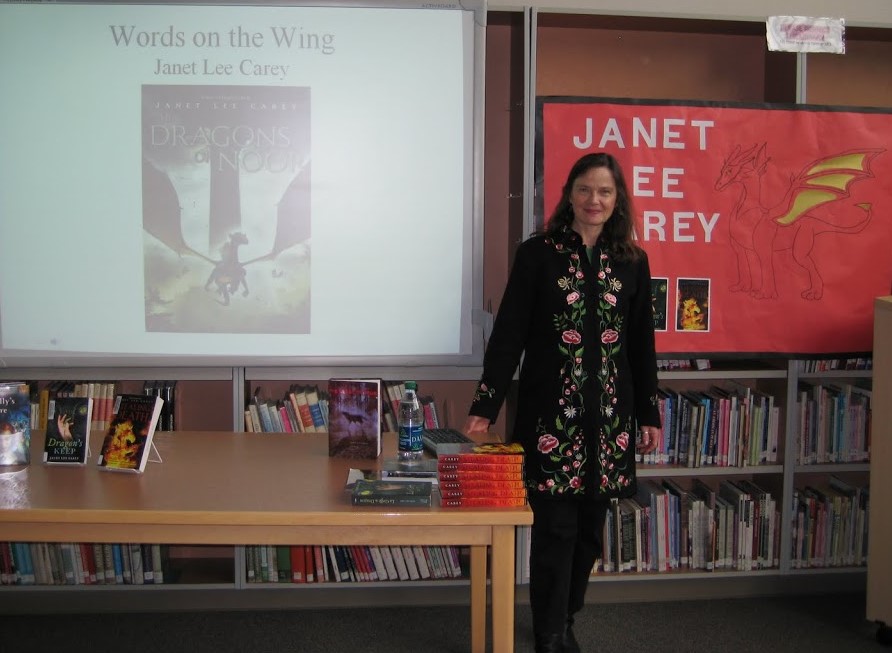
Author Janet Lee Carey – who so generously shared her knowledge with an untold number of fledgling authors

Soon, instead of being engaged by stories others had written, my own imagination began to craft characters and plots.

I enrolled in a novel writing course at Bellevue Community College. It was being taught by author Janet Lee Carey. On October 5, 2004, I walked into that classroom for the first time and took a seat. The first 45 minutes were used by Janet Lee to share information on ‘how’ to write a novel. Over the next eight weeks, she covered everything from character building, to plot development, to types of sentences, grammar, and punctuation. She emphasized how to use dialogue, action, and narrative to move a story along.

And she said something profound which has stuck with me: “If you can write a paragraph, you can write a novel.” A book is, she explained, just many, many paragraphs strung together.

During the second half of each week’s session, the would-be authors in the class were encouraged to share up to six pages of their work-in-progress for Janet Lee and their classmates to critique.

As I listened to – and followed along on the pages the readers provided – I had an epiphany: I could write just as well as anyone in that class!

I went home that afternoon and started to write a novel. It was a heady moment some six months – and 90,000 words – later when I typed the words “The End.” And then I started to write another one. And then another. Each one was a bit better than the previous one. Each time I embarked on a new novel, I learned more about what to do and what not to do.

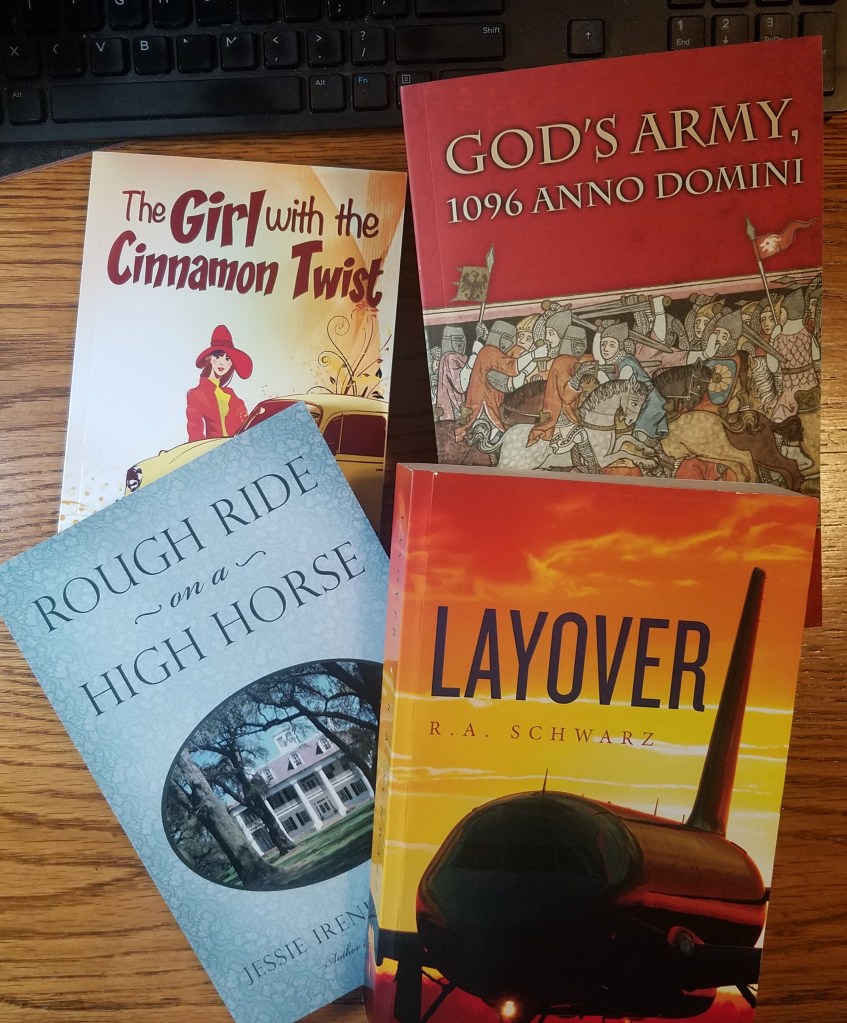
A few of the books published by some of our Anonymous Authors both current and past.

And I found camaraderie among my classmates and a few others we collected along the way. We dubbed our group the “Anonymous Authors” and met weekly to share our musings and make suggestions on one another’s work.

I am truly thankful for their input and, especially, their friendship. Even when our in person meetings came to a crashing halt in March 2020, several of us activated or installed cameras on our computers and we learned to Zoom.

I am currently one of two ‘hold outs’ from our current Zoom crew who has not yet published a novel. But that doesn’t mean I’ve abandoned the idea. Of the seven novels I’ve written, I’m working my way through my editor’s suggestions and corrections on the first one I plan to publish. The particular book is actually the fourth one I’ve written and part of a four book series (Book four in the series is actually a complete rewrite of novel #1)

Editing and rewriting is just another piece of the process essential to the writer’s journey. And, with a bit of luck, on November 1, 2023, I’ll be celebrating National Author’s day having joined the ranks of published authors; who knows, maybe someone will be sending me a note to let me know they loved my book. And maybe I’ll be able to send them an autographed copy back.

A bunch of links:

Novels published by several of the Anonymous Authors who are or, have been, a part of our group:

Layover – RA Schwarz https://smile.amazon.com/Layover-R-Schwarz/dp/1482329190/ref=sr_1_1?crid=2GGTNGKP5I6YS&keywords=ra+schwarz&qid=1666984404&sprefix=ra+schwarz%2Caps%2C198&sr=8-1

Long Time Passing – Jessie Irene Fernandes https://smile.amazon.com/Long-Time-Passing-J-Fernandes/dp/1508665184/ref=sr_1_1?crid=R0T90ONNXEJ0&keywords=fernandes+long+time+passing&qid=1666984909&qu=eyJxc2MiOiIxLjUyIiwicXNhIjoiMC4wMCIsInFzcCI6IjAuMDAifQ%3D%3D&s=books&sprefix=fernandes+long+time+passing%2Cstripbooks%2C148&sr=1-1-catcorr (Irene has published several other novels also)

God’s Army – Ward Harris https://smile.amazon.com/Gods-Army-1096-Anno-Domini/dp/1502508508/ref=sr_1_1?crid=20R0CYGWY2THP&keywords=Ward+harris+God%27+Army&qid=1666985131&s=books&sprefix=ward+harris+god%27+army%2Cstripbooks%2C153&sr=1-1 (Ward has published a number of historial fiction novels)

The Girl with the Cinnamon Twist – Steve Dennis https://smile.amazon.com/Girl-Cinnamon-Twist-Stephen-Dennis/dp/0615887589/ref=sr_1_1?crid=BCSL2AGWWCH0&keywords=The+girl+with+cinnamon+twist&qid=1666985263&s=books&sprefix=the+girl+with+cinnamon+twist%2Cstripbooks%2C156&sr=1-1

Kandu – Joseph Julian https://www.amazon.com/Kandu-Joseph-F-Julian/dp/1495985415/ref=sr_1_2?crid=2PSUL5FUUWDO3&keywords=kandu&qid=1666988042&qu=eyJxc2MiOiIzLjUyIiwicXNhIjoiMy4wOSIsInFzcCI6IjIuMTcifQ%3D%3D&s=books&sprefix=kandu%2Cstripbooks%2C409&sr=1-2

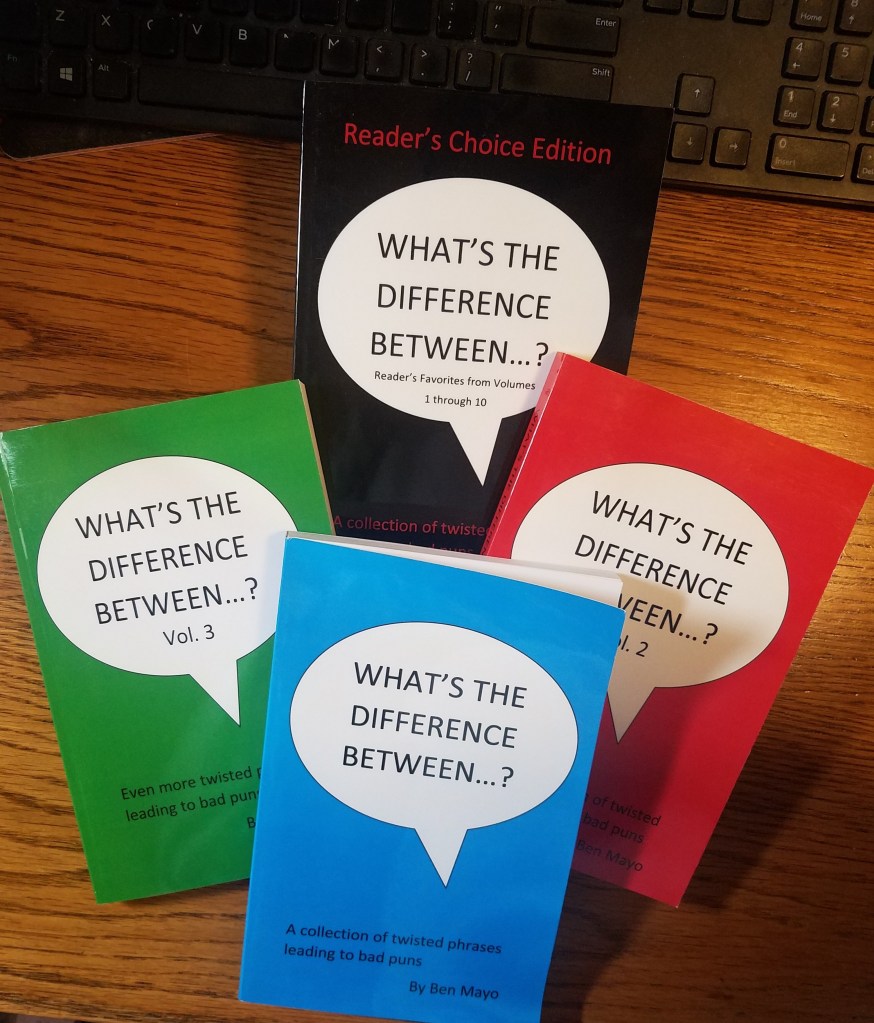
If you love puns and word play, then you might enjoy these books from my high school friend, Ben Mayo. If you’d like to get his books email him at: 27benjo@gmail.com

And a link to Janet Lee Carey’s website: https://janetleecarey.com/