Archives

The Ice Cream Sundae

I Miss the Iconic Farrell’s

July 25, 2023

A Tuesday Newsday Classic Updated

No doubt July 25th is an extremely important day for ice cream lovers everywhere. Yes, it’s the ‘official’ National Hot Fudge Sundae Day!

A hot fudge sundae

You might think something like this would be controversy free. You would be wrong.

According to the Infallible Wikipedia the invention of the Ice Cream Sundae is disputed. The town of Two Rivers, Wisconsin asserted the concoction was created as follows:

“Two Rivers’ claim is based on the story of George Hallauer asking Edward C. Berners, the owner of Berners’ Soda Fountain, to drizzle chocolate syrup over ice cream in 1881. Berners eventually did and wound up selling the treat for a nickel, originally only on Sundays, but later every day. According to this story, the spelling changed when a glass salesman ordered canoe-shaped dishes. When Berners died in 1939, the Chicago Tribune headlined his obituary ‘Man Who Made First Ice Cream Sundae Is Dead’. Two Ithaca High School students, however, claim that Berners would have only been 16 or 17 in 1881, so it is therefore ‘improbable’ that he would have owned an ice cream shop in that year. They also state that the obituary dates Berners’ first sundae to 1899 rather than 1881.

Residents of Two Rivers have contested the claims of other cities to the right to claim the title ‘birthplace of the ice cream sundae’. When Ithaca, New York, mayor Carolyn K. Peterson proclaimed a day to celebrate her city as the birthplace of the sundae, she received postcards from Two Rivers’ citizens reiterating that town’s claim.”

The rival towns who also claim they were first are Buffalo and Ithaca, New York and Evanston and Plainfield, Illinois.

So how did it come to be called an Ice Cream Sundae? Mostly it can be traced back to the “Blue Laws” which were in place in the 1800’s. Carbonated Soda water – like alcohol – was considered inappropriate for consumption on the Sabbath. Because Ice Cream Sodas could not be sold on Sunday in, particularly, Evanston and Plainfield Illinois, the inventive soda fountain owners began selling ice cream with the chocolate syrup poured over it – sans the soda – and thus created the first ice cream sundaes in that state. Rather than call it a ‘Sunday’ which was considered shocking, the spelling was changed to the now instantly recognizable ‘Sundae.’

1970’s era Farrell’s restaurant

I’m not sure who decided to pour hot chocolate over ice cream and create the hot fudge sundae, but it’s a good thing they did. Nothing quite says summer like a couple scoops of ice cream, hot fudge, and whipping cream with a cherry on top!
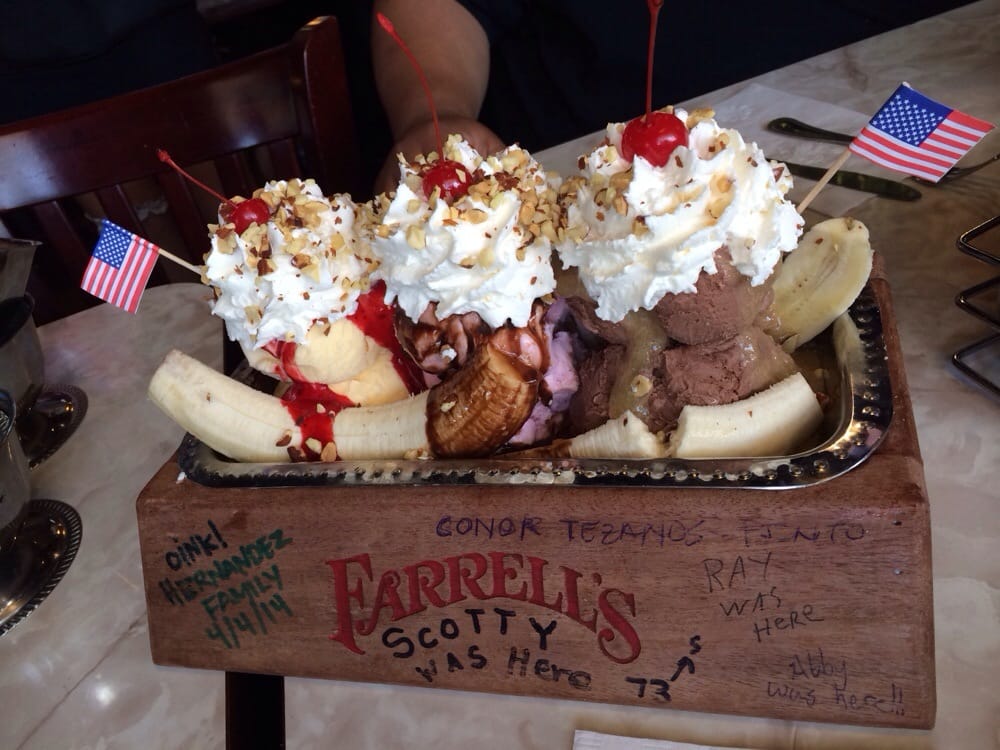
Farrell’s infamous ‘Pig Trough.’

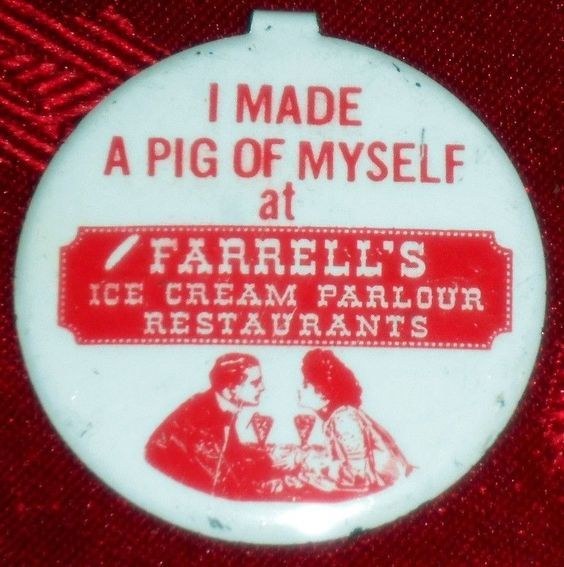
Back in my teen years a real treat was to go to Farrell’s – an ice cream and burgers restaurant which hearkened back to the days of the Soda Fountain. This was a special event for this kid from Yakima. We did not have anything nearly as cool as a Farrell’s. I looked forward to the rare expeditions to Seattle because it often meant gorging on ice cream at Farrell’s. A trip to Farrell’s was more about the experience than the food. The staff would sing happy birthday if you were so lucky to be there on your big day. Heaven help you if you ordered the ‘Pig Trough’. It featured a dozen scoops of ice cream and the rule was that YOU had to eat it all by yourself! Finish it and you were awarded a badge which said “I made of Pig of myself at Farrell’s.” The staff would parade through the restaurant with great fanfare, kazoos playing and drums pounding, to bring the trough to the person who ordered it and then do the repeat parade if that customer was able to finish it.

Mrs. H shows off her fork balancing skills

Going to Farrell’s capped off, a number of times, the annual summer convention where a few thousand Washington and Idaho Rainbow Girls and their chaperones would gather each year. On the last night of the event, literally, hundreds of us would descend upon the Farrell’s in Tukwila Tacoma or Spokane. (I cannot recall the exact locations any longer!) and take over the restaurant. Truly, the staff did not know what hit them.

One of my favorite memories was in 1977 when one of my adult advisors taught us all how to balance a fork on our noses. That was the sort of silliness we enjoyed whether at Farrell’s or, as I think was the case based on the artwork behind her, at Sambo’s in Spokane.

Sadly, the last Farrell’s location closed a number of years ago. I rather doubt any one would open a restaurant like Farrell’s in today’s world. It was sure a lot of fun and I imagine the kids of today would love it as much as we did.

For more information about ice cream Sundaes and their many variations and history click here: https://en.wikipedia.org/wiki/Sundae

Or for a brief history of Farrell’s click here: http://oldlarestaurants.com/Farrell’s/

Fireworks!

A 4th of July tradition since 1777

July 4, 2023

By the time darkness descends on July 4th, the skies of communities across the country will be filled with brilliant bursts of red, white, blue, purple, orange, and green fireworks, a visual feast to behold. Truly, fireworks are the symbol of Independence Day.

The first recorded mention of fireworks for a July 4th celebration was in 1777 to mark the one year anniversary of the signing of the Declaration of Independence.

The Infallible Wikipedia shares this:

“America’s earliest settlers brought their enthusiasm for fireworks to the United States. Fireworks and black ash were used to celebrate important events long before the American Revolutionary War. The very first celebration of Independence Day was in 1777, six years before Americans knew whether or not the new nation would survive the war; fireworks were a part of all festivities.

Fireworks photos from 2018 show in Puyallup

In 1789, George Washington’s inauguration was accompanied by a fireworks display. George Marshall was an American naval hero during the War of 1812 and other campaigns. He was a Master Gunner and pyrotechnics specialist who wrote Marshall’s Practical Marine Gunnery in 1822. The book outlines chemical formulas for the composition of fireworks. This early fascination with fireworks’ noise and color continues today with fireworks displays commonly included in Independence Day celebrations.”

My earliest memories of 4th of July fireworks are from when I was four years old. Actually, it’s my earliest memory of ANYTHING in life. My family lived in Clarkston, Washington, that summer. I can see in my mind’s eye the fireworks exploding overhead as we sit on a picnic blanket in a park, little bits of debris raining down on us. That night I found a star shaped piece of cardboard lying on the ground after the show. Of course I carried it home as a treasure which, undoubtedly, my mother disposed of a short time later after it was forgotten.

Wayne’s rules for safe fireworks

Most years did not involve going to a professional display, but I always went with my Dad to a stand and help pick out those fireworks which our family would set off. My favorites were always the sparklers. There was something exciting and dangerous about holding a metal stick in one’s hand while Dad lit the end and it erupted into tiny exploding sparks. My sister and I would dance around using the sparkler as if it were a colorful pen writing letters across the night sky.

It was in the 1980’s, however, when I was introduced to a completely different level of fireworks mania. My hubby, and his brother Wayne – as kids – were enamored with fireworks, riding their bikes out to the Native American reservations where they would purchase firecrackers and other contraband, often returning with enough to supply every explosion loving kid in their neighborhood.

For Wayne it was a passion he has embraced throughout his life. When I asked him how he got started in the business he did not hesitate: “It would have to be so I could legally play with bigger and better pyrotechnics.”

To do that required him to have pyrotechnics training and certification. The first show he ever helped with, once that certification was obtained, was Salty Sea Days in Everett in 1980.

Organizing the chaos. Puyallup 2018

Wayne has produced 4th of July fireworks shows all over Washington State. He did the City of Yakima show for 15 years in a row; the hubby and son were able to be on site there one year in the late 1990’s for the up close experience, while I stayed with our young daughter and we watched it from a bluff in Selah. Wayne’s shows have taken him all over the state including Blaine, Pasco, Renton, Everett, Omak, and Puyallup.

Wayne and his daughter review the roadmap, aka the schematic, of what shell belongs in which tube.

While most people love seeing the fireworks, few truly understand the time, training, and effort it takes. In 2018, I witnessed what goes in to the set up while the hubby helped Wayne prep the show. The half dozen members of the crew spent hours stringing wires between the tubes where the fireworks were staged; packed sand around the tubes; and had to carefully follow the schematic of what goes where. For my untrained eyes, it all seemed very chaotic for a very meticulous job which requires extreme care so that one does not blow themselves and others up.

Wayne is, perhaps, the most proud of his safety record. In the 44 years in a row doing a 4th of July show, no one on his crew has ever had a fireworks related injury or burn. In fact he made me promise to highlight the dangers of, literally, playing with fire. In the box on the side are his reminders, a defacto Public Service Announcement to all.

It was my understanding that 2023 was the year Wayne was going to retire but when I reached him for this story, he was headed to Yakima with his daughter, my niece. She too has the pyrotechnic bug and had lamented his impending retirement more than once the past few years. But it’s more like a partial retirement. This year he’s going to be on a crew run by one of the women who worked with him on the shows for many years; he’s going as a consultant to, as he said, ‘make sure no one does anything stupid.”

The reward of all the hours setting things up… getting to run the electronic ignition board.

And while there have been some scary moments when something didn’t happen as it should, he waxed poetic about the last year he did the Everett fireworks show in 2017. Everything was set up on a large barge just offshore and the crew, as always, had spent all day getting it organized, making sure all was safe and ready.

Wayne with his daughter at one of the shows. “Generational pyromania’ was the title on this Facebook photo.

That night, when the first ball rocketed into the air, exploding in a shower of sparks, it was the beginning of something special. “The show itself was the most perfect show we’ve ever done,” Wayne said, “Three hundred to four hundred shots and only two shells which did not fire. That’s very rare. It’s not uncommon to have half a dozen or more shells which never fire.” It was also the first show which his daughter, who turned 18 that year, could help with.

So while he’s given up being the guy in charge, he’ll be with a crew all day on the Fourth, embracing his lifelong passion for fireworks and the thrill of getting to play with the bigger and better pyrotechnics. Way cooler than sparklers.

https://en.wikipedia.org/wiki/Fireworks

The Pyromeister in Yakima 2023

Spam. Spam. Spam. SPAM!

So much more than junk email

May 16, 2023

A Tuesday Newsday Classic, updated with a story about the poor man’s version of Spam.

If historians were to pick ONE significant event from each year in history what would the most important from 1891 be? The formation of the US Forest Service? No. The opening of Carnegie Hall? Definitely not. The patent of corkboard? Not even close.

No the most significant event of 1891 was when, on May 16th, George Hormel opened a small butcher shop in Austin, Minnesota and introduced the world to… SPAM!

What was significant about the product is that it took pork and ham and cooked it in its own container thus giving it a rather long shelf life. Oh that innovative George Hormel!

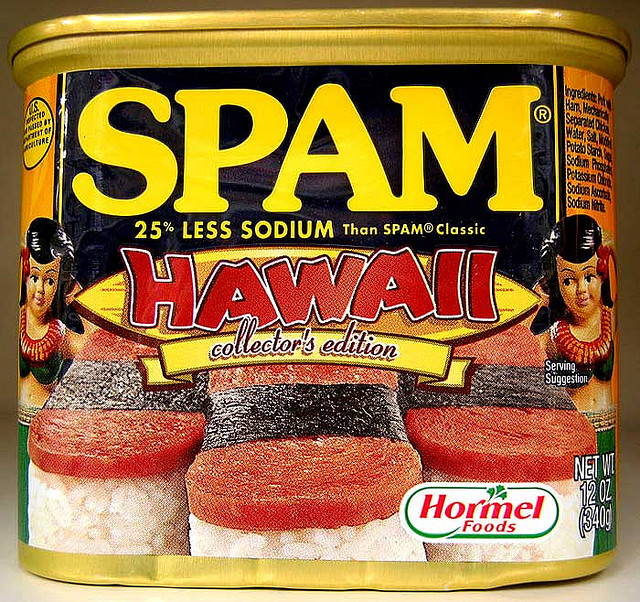
Since its creation Spam has become a ubiquitous part of pop culture and the worldwide psyche. It’s eaten throughout the world but especially in Great Britain and also in the Philippines. In the United States more Spam is eaten in Hawaii than in any other state. From the infallible Wikipedia:

Wildly popular in Hawaii… they make sushi out of it.

“Spam is especially popular in the state of Hawaii, where residents have the highest per capita consumption in the United States. Its perception there is very different from on the mainland.

A popular native sushi dish in Hawaii is Spam musubi, where cooked Spam is placed atop rice and wrapped in a band of nori. Varieties of Spam are found in Hawaii that are unavailable in other markets, including Honey Spam, Spam with Bacon, and Hot and Spicy Spam.

Hawaiian Burger King Restaurants began serving Spam in 2007 to compete with the local McDonald’s chains.  In Hawaii, Spam is so popular that it is sometimes referred to as ‘The Hawaiian Steak’.”

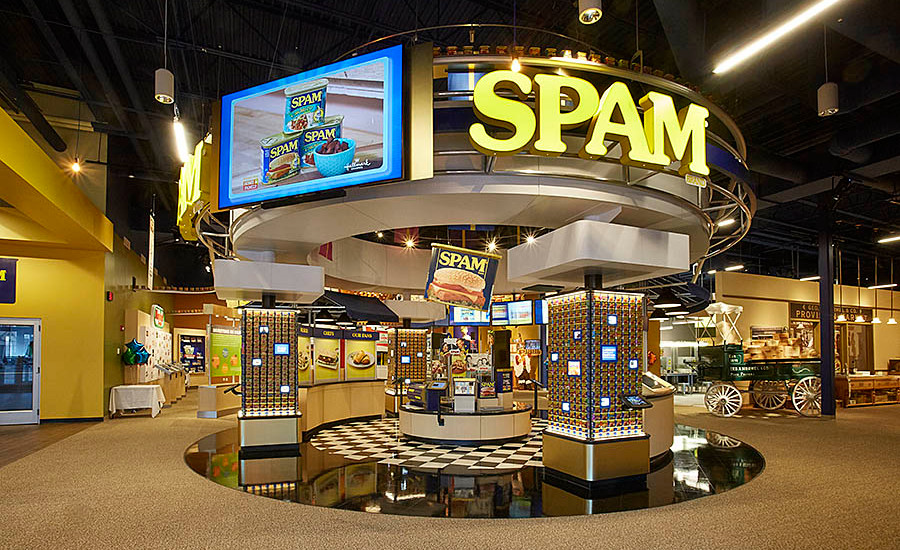
My exhaustive research uncovered the existence of a SPAM museum in Austin, Minnesota. Putting that on my bucket list!

Highlighted in a variety of movies and TV shows, SPAM was immortalized in pop culture by the comedic troupe Monty Python. And, of course, it’s the term which has become synonymous with junk mail. More from Wikipedia:

“Spam was featured in an iconic 1970 Monty Python sketch called ‘Spam’. Set in a café which only served dishes containing Spam, including ‘Spam, Spam, Spam, Spam, Spam, Spam, baked beans, Spam, Spam, Spam and Spam’, the piece also featured a companion song. By the 1990’s, Spam’s perceived ubiquity led to its name being adopted for unsolicited electronic messages, especially spam email.”

Now, I do have a confession to make. To the best of my knowledge, I’ve never eaten Spam. Growing up I was, well, a picky eater. Frankly, I’m surprised I’ve never before shared this story.

When our family moved to Yakima in 1961, my Dad worked for National Cash Register (NCR). NCR had a nasty habit of moving their salesmen frequently and my parents had moved some nine times in less than 15 years.

The Spam Museum opened in Austin, Minnesota in 2016

My mother was happy about the move to Yakima as her sister lived there and their parents resided in Selah. So in the fall of 1961, our family relocated from Clarkston, Washington to Yakima.

We were there for six months when NCR, of course, told my Dad they were transferring him to the Tri-Cities. My long suffering mother put her foot down and said “No more moves.” It was at that point my Dad returned to college to get an Education degree with plans to become a teacher.

This is germane to the story in that for the next two years our family of six had to live off of the savings my parents had. Even after he got a job, I doubt that being a teacher paid as well as being a salesman, but he was happier. In all of the 1960’s we NEVER went out to dinner save for one day each November to celebrate my grandfather’s birthday. I’m pretty sure my Grandpa Freimuth paid for that meal.

Which meant that my mother had to get inventive when it came to food. Most the dinners I recall were of chicken, ham, or beef with mashed potatoes and a vegetable. I did not know until I moved away from home that there were any other spices for cooking chicken or beef than salt and pepper. True story.

But this also meant that all of us who were in school from 1963 to 1967 – that was five people – took lunch in a brown paper sack every day. Once again, Mom had to get creative as she fixed those lunches each evening before she went to bed.

Lunch often consisted of a non-descript yellow cheese on two slices of white bread buttered with margarine. Or some tuna fish which was mixed with miniscule amounts of mayonnaise on two slices of white bread spread with a swipe of mayonnaise, or a bit of peanut butter spread thin on two slices of white bread… well, you get the picture.

My mother had this model, or very similar, and used it to torture her family.

But the most dreaded of all things which my mother would put on a sandwich was this: leftover roast beef or ham, a hunk of the non-descript yellow cheese, and cucumber dill pickles slices… all mixed together by this grinder contraption which was connected by a vice type grip to the cutting board (it was a slide out). My mother would stuff all three things into the top of the grinder, turn the handle, and then out would spew this concoction of brown, orange, and green. This was then spread on two slices of white bread sort of buttered with margarine or mayonnaise*.

My mother used to wonder why I was such a skinny child. Well, it was because of food like this. I would try to eat the thing but usually ended up throwing it away after two bites or less. But I always drank all of the carton of milk (which cost a nickel) and ate the handful of potato chips which were sent.

I suppose had Mom made Spam Sandwiches I might actually have eaten the thing…naw. Who am I kidding?

The good news is that I became an adventurous eater as an adult. I learned about all the herbs and spices and the best one of all: garlic. I wonder if they make garlic Spam? Now that I might eat.

Be sure to check out these two links to learn more about Spam!

https://en.wikipedia.org/wiki/Spam_%28food%29

http://brasscastlearts.blogspot.com/2011/05/hormel-spams-world-may-16-1891.html

*Mayonnaise – my father hated mayonnaise and my mother was not allowed to put mayo on his sandwiches. I think she snuck it in to tuna salad and, possibly, the evil mixture as a way of holding it all together. But she never told him!

Old Spaghetti Factory: A Family Dining Tradition

January 10th

The original Old Spaghetti Factory in Portland, Oregon. From Oregonlive.com

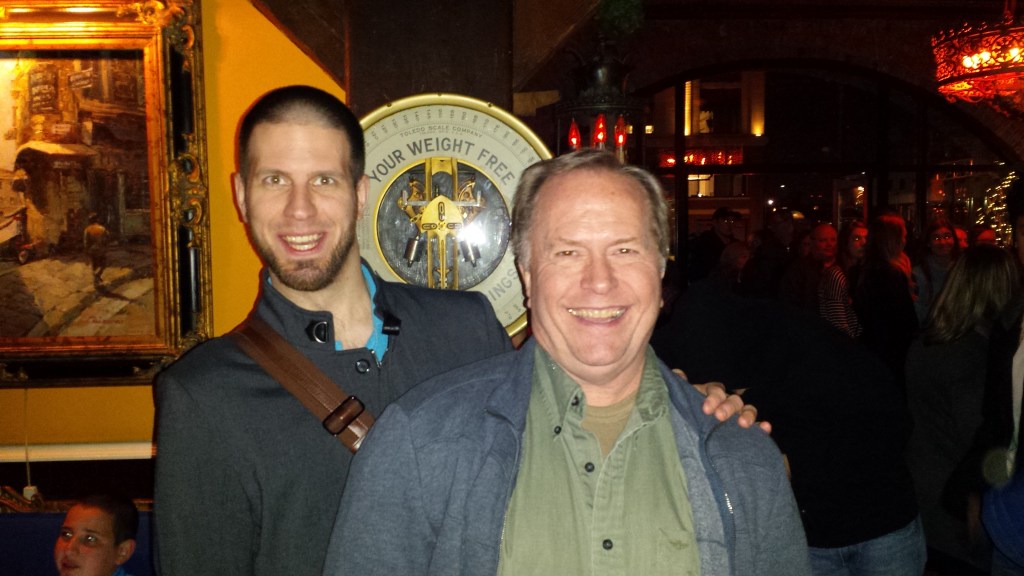
For our family, going to this restaurant was always an event. Perhaps it was due to the unique location. Or perhaps the unusual décor. Or maybe it was because you were encouraged to weigh yourself BEFORE and AFTER your meal.

Whatever that combination, a visit to the Old Spaghetti Factory (OSF) was fun and memorable. The very first OSF opened on January 10, 1970 in Portland, Oregon.

The Infallible Wikipedia tells us:

“The chain was founded in Portland, Oregon, on January 10, 1969, by Guss Dussin. (snip)

Many of the chain’s restaurants are located inside renovated warehouses, train stations, and historic locations. The restaurant decor traditionally features antiques, including chandeliers, brass headboards and footboards as bench backs for booths. Each restaurant’s most prominent feature is a streetcar in the middle of the restaurant with seating inside.”

Not satisfied with the IW description, I took a gander at the OSF official webpage and gleaned additional information.

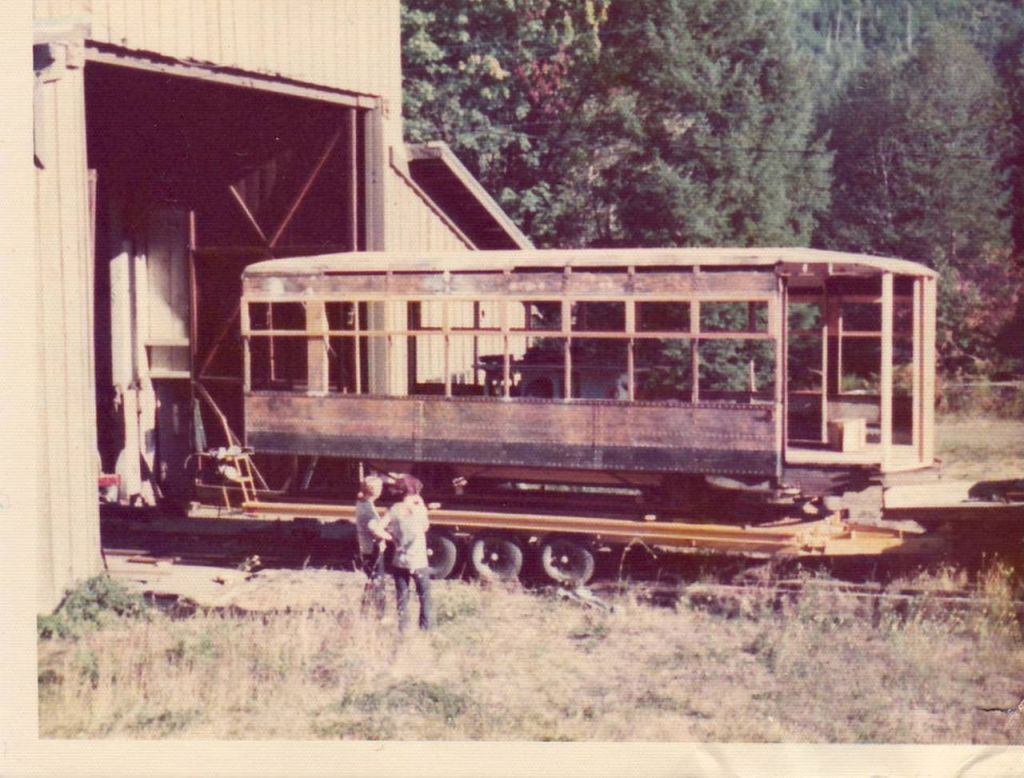
It cost $4,000 to renovate the first Trolley car. Photo from Oregonlive.com

Of course they talked about the original location in Portland, but the snippet I liked best was this:

“The original Old Spaghetti Factory trolley car was found in a field near Reed College in Portland, OR. We refurbished the car and began using it as a unique dining area for guests at our first location. The trolley car has since become a fixture in our locations across the U.S. When our flagship restaurant relocated to its current Portland location, the original car moved with us, of course.”

I cannot specifically recall my first visit to a Spaghetti Factory. All I do know is that it was sometime in the late 1970’s and it was at either the Seattle or Tacoma location.

In researching this article I did learn something which I thought was a bit sad. Neither of those two original locations still exists as OSF restaurants. It was the Seattle location, at the corner of Elliott Avenue and Clay, across from the waterfront, which became the family favorite.

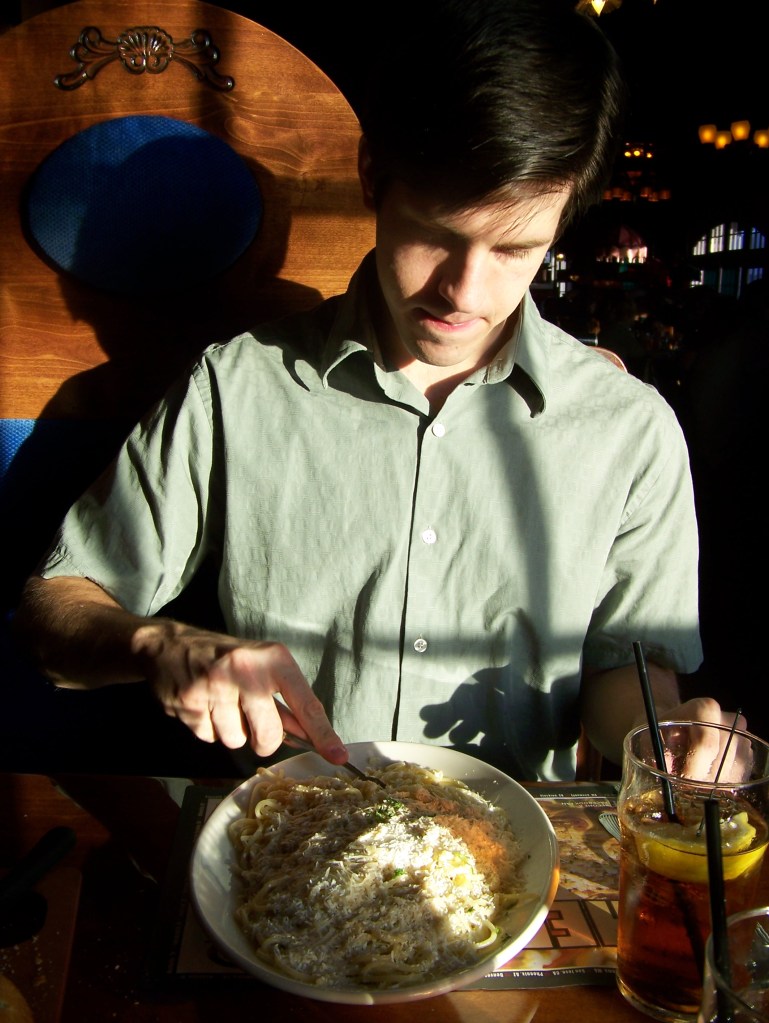
Ah, to be 20 and able to eat as much as you want… from the Anniversary dinner with our kids in 2010.

When my kids were little and a special dinner out was being planned, Spaghetti Factory was often the requested destination. Birthday dinners were celebrated there. Heck, the hubby and I even had an anniversary dinner (with the kids!) there one year.

Once or twice we even sat in the coveted trolley car. But where we sat didn’t matter. The Seattle OSF reeked with ambiance no matter where in the building you were seated.

Due to the popularity of the restaurant, we developed a strategy: arrive as close to when they opened – 4 p.m. – as possible to avoid having to wait too long for a table. Another strategy was to have the driver – usually the hubby – drop us off at the front door. I would get our name on the list and manage the kids while he went in search of often hard to find parking.

The daughter checking out the infamous scale. 2010

But none of that mattered when the warm bread arrived at the table with the two different vats of butter: garlic and plain. By the time our son was around 10, he started ordering the extra large helping of spaghetti with browned butter and myzithra cheese. And would polish off every last morsel. When an older teen his sister’s half eaten spaghetti would usually find its way to his plate to finish.

Despite being full from all those carbs, however, when the spumoni ice cream arrived there would be negotiations as to who got the one with the largest amount of pistachio.

It was not unusual to record a couple of gained pounds on the old fashioned scale in the lobby.

The hubby and me December 21, 2016 – our last time at the OSF in downtown Seattle.
The guys were brave enough to step on the scale in 2016, but not me!

Then the unthinkable occurred in 2016: the Seattle OSF was closing its doors, the building and land (where the parking lot was located) had been sold and the new owners had a different vision for the valuable real estate.

The three of us – hubby, son, and me – hatched a plan to visit one last time. And, as always, we employed a strategy for best results: arrive by five, drop off the mom, go find parking. On December 21, 2016, our trio – along with hundreds of our closest friends – enjoyed one final dinner at the original Old Spaghetti Factory in Seattle. We ate too much bread and too much Spaghetti. We savored one final dish of spumoni ice cream. I refused to weigh myself instead opting to simply enjoy a favorite family tradition.

Yes, we’ve been to the Lynnwood, Washington location and, well, it just isn’t the same. But who knows, maybe the next time our son comes to visit we will make the trek ‘for old times’ sake and to create new memories. And also because he still loves, loves, loves, spaghetti with browned butter and myzithra cheese thanks to the Old Spaghetti Factory.

A few links:

https://en.wikipedia.org/wiki/The_Old_Spaghetti_Factory

https://www.osf.com/about/history/

https://www.oregonlive.com/life-and-culture/g66l-2019/01/f34b9efac39205/portlands-old-spaghetti-factory-turns-50-a-look-back-at-decades-of-delicious-memories.html

https://www.seattletimes.com/life/food-drink/saying-goodbye-to-seattles-old-spaghetti-factory/

A Crow Named Bob

Considered one of the most intelligent species

July 5, 2022

The species Corvus – commonly known as a crows, ravens, and jackdaws – are considered some of the most intelligent creatures on earth. They have been documented to construct ‘tools’ from materials, can recognize specific people and animals of other species, and work cooperatively together to achieve goals.

Crows were frequent visitors to our backyard in Kirkland, often challenging the squirrels for a food source.

For purposes of today’s Tuesday Newsday, we shall refer to this bird simply as ‘crows.’ I chose the first week in July to highlight crows as I propose that the national symbol of the United States could just as easily been a crow rather than an eagle.

Legend has it that Benjamin Franklin suggested the turkey as the national bird but others thought the eagle to be more majestic. In terms of sheer intelligence, cleverness, and persistence, however, it is the crow which dominates. These attributes, to me, more closely encapsulate the nature of Americans.

The Infallible Wikipedia shares the following:

“As a group, crows show remarkable examples of intelligence. Natural history books from the 18th century recount an often-repeated, but unproven anecdote of ‘counting crows’ — specifically a crow whose ability to count to five (or four in some versions) is established through a logic trap set by a farmer. Crows and ravens often score very highly on intelligence tests. Certain species top the avian IQ scale. Wild hooded crows in Israel have learned to use bread crumbs for bait-fishing. Crows engage in a kind of mid-air jousting, or air-“chicken” to establish pecking order. They have been found to engage in activities such as sports, tool use, the ability to hide and store food across seasons, episodic-like memory, and the ability to use individual experience in predicting the behavior of proximal conspecifics. (snip)

A crow seems to find these baby toys irresistible. AvesNoir.com

The western jackdaw and the Eurasian magpie have been found to have a nidopallium about the same relative size as the functionally equivalent neocortex in chimpanzees and humans, and significantly larger than is found in the gibbons.

Crows have demonstrated the ability to distinguish individual humans by recognizing facial features. Evidence also suggests they are one of the few nonhuman animals, along with insects like bees or ants, capable of displacement (communication about things that are not immediately present, spatially or temporally). (snip)

In the past there have been plenty of studies conducted on how ravens and corvids in general learn. Some of these studies have concluded that the brains of ravens and crows compare in relative size to great apes. The encephalization quotient (EQ), helps to expose the similarities between a great ape brain and a crow/raven brain. This includes cognitive ability. Even though the brain differs significantly between mammals and birds we can see larger forebrains in corvids than other birds (except some parrots), especially in areas associated with social learning, planning, decision making in humans and complex cognition in apes. Along with tool use, ravens can recognize themselves in a mirror.”

Here in the Pacific Northwest, crows are everywhere. But that was not always the case. They were rare at the beginning of the 20th century.

Recently, the hubby and I had a crow encounter which we are unable to explain. While strolling down a sidewalk in the Fairhaven neighborhood of Bellingham, a crow swooped low over the hubby’s head, causing both of us to duck. When the crow repeated the action less than a minute later – this time making contact with the hubby’s hair – we knew it was not a random event. We wonder if the hubby’s head, slightly sunburned and shiny on a small spot at the crown, attracted its attention. Regardless, we did not wish to tempt the bird a third time and crossed the street to safety.

Their reputation for collecting shiny objects is based on this behavior. https://kids.britannica.com/

It was another crow encounter, in July of 2005, which became the reason I think the crow should have been our national bird.

I was, along with hundreds of others, at the Sundome in Yakima, Washington, for the Washington/Idaho Rainbow Girls annual convention.

Somehow, a crow had gotten into the building but, apparently, had no way to get out. No worries for the crow, as it swooped and flew around the large space, entertaining the girls, their families, and advisors.

The young woman who was leading the group that year dubbed the crow “Bob” in honor of a group of adult volunteers who had formed a vocal quartet named “The Bob’s” as all the men were named Bob.

For three days Bob flew around the building and was seen alighting on chairs and backdrops – pretty much anywhere. I imagine finding food was not an issue as, no doubt, more than a few snacks were likely consumed – and morsels dropped – by the attendees.

It was on the last day, July 10, when a scenario so perfect occurred that a Hollywood screen writer could not have scripted it better.

The moment had arrived for the Stars and Stripes to be returned from its place of honor on the main stage to the back of the room. This job fell to one of the young women present who – with great reverence – arrived at the flag, bowed to it, and then hoisted it aloft to carry it down a ramp and across the large convention center floor.

Lee Greenwood’s God Bless The USA played over the loud speaker as all eyes watched her procession. Then Bob stole the show.

The crow soared high across the arena, landing on the top of the loudspeaker system just below the ceiling, at the center of the dome. He paused for a moment and then, when the flag bearer was directly underneath him, he flapped his wings and flew in the same direction as she was walking, disturbing confetti which had likely settled on the loudspeaker a week earlier during Fourth of July celebrations.

Tiny red, white, and blue tissue paper glittered in the lights as it filled the air and swirled to the floor.

It was the most awe inspiring patriotic moment I’ve ever experienced.

I was able to confirm that Bob – like the rest of us – departed the Sundome later that evening to go back to his regular life. From the writeup in the Rainbow Girls newsletter:

“Of course, this article would not be complete without mention of Bob the bird. He appeared during set-up and stayed throughout all of the sessions, often coming to visit in the East, taking a bath in the decorations or sitting in the middle of the floor. He enjoyed the sessions and no one will soon forget our special visitor. And for those who may be wondering, Bob did leave the Sundome as the clean up process was coming to an end on Sunday night.”

Well done, Bob, well done. You are a credit to your species and an inspiration to us all.

The Links:

https://en.wikipedia.org/wiki/Corvus

https://en.wikipedia.org/wiki/International_Order_of_the_Rainbow_for_Girls

Washington/Idaho Rainbow Girls webpage: https://www.nwrainbow.org/

Turkey Tomfoolery

Everyone’s favorite Thanksgiving Bird

November 23, 2021

A native to North America, this bird – which takes center stage this week – is, perhaps, the best representative of all that is uniquely American.

The turkey, it turns out, has been around a long time. According to the Infallible Wikipedia:

There’s even a giant turkey statue in Frazee, Minnesota

“The earliest turkeys evolved in North America over 20 million years ago and they share a recent common ancestor with grouse, pheasants, and other fowl. The wild turkey species is the ancestor of the domestic turkey, which was domesticated approximately 2,000 years ago.”

The Aztec culture developed a myriad of recipes for the fowl, many of which are still used in Mexico today. We know that the turkey was known in North America when the Pilgrims arrived in 1620, documented as being served at the first Thanksgiving.

Since then, the turkey has come to be THE meat to serve on the fourth Thursday in November and, for many families, at their Christmas feast also.

Of course there is a good case to be made for cooking a turkey. The size of the fowl, unlike a chicken, make it possible to feed a large group with just one bird. The Guiness Book of World Records tells us:

“The greatest dressed weight recorded for a turkey is 39.09 kg (86 lb) for a stag named Tyson reared by Philip Cook of Leacroft Turkeys Ltd, Peterborough, United Kingdom. It won the last annual `heaviest turkey’ competition, held in London on 12 December 1989, and was auctioned for charity for a record £;4400 (then $6,692).”

That’s a lot of leftovers!

Some of my earliest childhood memories center around Thanksgiving and Christmas dinners both of which featured a large turkey.

An annual tradition is for a pair of turkey’s to get a Presidential Pardon. Pictured at the White House are Peanut Butter and Jelly, the 2021 turkey’s.

Because the family ate ‘dinner’ at noon, that meant my mother (or my aunt if we were going to their house) was up at four a.m. to get the bird in the oven. It was always a treat to awaken to the smell of roasting turkey.

My job, when I was a child, was to set the table with my mother’s china. Oh how I loved the anticipation of that meal.

It was sometime in the mid-1980’s when I cooked my first Thanksgiving meal. After the hubby and I married in 1980, we ping-ponged between our two families, never giving a thought as to the work it took to create the feast.

Our first Thanksgiving as a married couple found us in Blaine with his family. When we walked into his parent’s turn of the century farm house that November 27th, the kitchen was in a state of being updated. The hubby’s dad had recently built an ‘island’ in the middle of the kitchen to house the pride and joy of my mother-in-law’s kitchen: a Jenn-Air cooktop.

For those unfamiliar with the concept, the original Jenn-Air was a cooktop only and featured burners, grills, and griddles which were all a standard shape and size. These cartridges were ‘plugged’ into a power source. The typical Jenn-Air had two cartridge slots on either side with a down draft fan in the center; you mixed and match your elements. It was easy, for example, to remove the two burner cartridge and plug in the grill.

A Jenn-Air cooktop circa 1980

My mother-in-law was VERY excited to use her new cooktop. There was only one problem… it was a cooktop and, at that time, there was not a conventional oven in the kitchen.

Which brings us back to the issue of cooking a turkey. No matter how wonderful the Jenn-Air cooktop might be, it wasn’t going to be able to cook a 12 to 16 pound bird.

But never fear, dear readers, because there was another new – unknown technology – appliance in the house that year: the microwave oven.

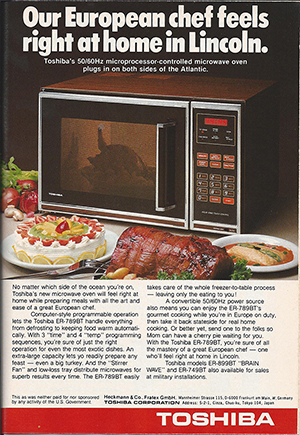
Now, in 1980 hardly anyone understood the advantages or disadvantages of the microwave. In fact, only some 25 percent of U.S. households owned one. The average new microwave cost about $400 which in 2021 dollars is about $1300. Microwave manufacturers were busy touting how great this new ‘oven’ was. We had all been told that the microwave could do everything a traditional oven could do, but would take less time and cook more efficiently.

And that’s how we ended up eating a Turkey cooked entirely in a microwave! That bird got flipped and turned more times than an Olympic Pairs figure skater. And it took much, much longer than anyone could anticipate. For HOURS the microwave was cooking that bird with, it seemed, minimal impact.

Companies advertised microwaves as being able to cook just as well as a conventional oven.

Finally, rather late in the day, the turkey was declared done and dinner was served.

The turkey was nearly inedible.

Rather than a nice roasted brown color, it was gray. There was no crispiness to the skin, no yummy juice coating it.

When the knife cut into the bird for carving, the meat was stringy and tough.

Of course we all made the best of the situation. And it was a rapid learning event in regards to microwaves. They are great for some things, but not for cooking whole turkeys (or other poultry and meats in my opinion).

I also SHOULD have learned that doing kitchen remodels on top of a major holiday is a bad idea. Unfortunately, it was a lesson that I promptly forgot on several occasions in subsequent years. But that’s a story (or two) for another day.

This year I am the one hosting Thanksgiving and am thankful that my in laws will be joining us on Thursday. My turkey will never see the inside of a microwave. Call me a traditionalist, but there are some things which are sacred. A properly cooked Thanksgiving turkey is one of them.

My mother’s china on the table I set for Thanksgiving 2018 – the last one with my Dad.

https://en.wikipedia.org/wiki/Turkey_(bird)

I purposefully didn’t comment on this photo which I posted on Facebook along with the link to this article. Why? This was from Thanksgiving a few years ago when the larger of our two ovens ‘failed’. I was unable to fit a full size Turkey in the smaller oven and had to cut the bird in half and turn it on its side to cook. Now that was quite the chore! That turkey – unlike the one in the microwave – DID come out just fine after I performed my surgery (as pictured)

Hayride!

A fun fall tradition

September 28, 2021

Autumn seems to be a season of traditions which celebrate our rural and agricultural heritage. There’s just something about shuffling through a carpet of red, gold, and orange leaves or sipping a cup of apple cider on a blustery day.

One uniquely North American tradition which has been enjoyed for generations now is a hayride. I turn to the Infallible Wikipedia for a more in depth history:

“Hayrides traditionally have been held as celebratory activities, usually in connection to celebration of the autumn harvest. Hayrides originated with farmhands and working farm children riding loaded hay wagons back to the barn for unloading, which was one of the few times during the day one could stop to rest during the frenetic days of the haying season. By the late 19th century and the spread of the railroads, tourism and summer vacations in the country had become popular with urban families, many of whom had read idealized accounts of hayrides in children’s books.

Red Tail Farm in Leavenworth offers hayrides in the autumn.

To capitalize on the demand, local farmers began offering ‘genuine hayrides’ on wagons loaded with hay, since one could make more cash income selling rides to ‘summer people’ than by selling the same wagon-load of hay (although most farmers did both). During this era, farming was transforming from a subsistence system to a cash system, and there were few options for bringing real money into the average farm.

Over time the hayride became a real tradition, although the original concept of riding on top of a load of hay was gradually replaced with a simple ride in a wagon sitting on a layer of hay intended to cushion the ride. This was considered far safer than (if not as fun as) riding perched 15-20 feet on top of a slippery pile of hay on a moving vehicle.

Laura Ingalls Wilder, in her book The Long Winter, describes the work of loading a hay wagon and her ‘ride’ from the fields back to the barn:

“There Pa walked beside the wagon and drove the horses between the rows of haycocks. At every haycock he stopped the horses and pitched the hay up into the hayrack. It came tumbling loosely over the high edge and Laura trampled it down. Up and down and back and forth she trampled the loose hay with all the might of her legs, while the forkfuls kept coming over and falling, and she went on trampling while the wagon jolted on to the next haycock. Then Pa pitched more hay in from the other side.

Under her feet the hay climbed higher, trampled down as solid as hay can be. Up and down, fast and hard, her legs kept going, the length of the hayrack and back, and across the middle. The sunshine was hotter and the smell of the hay rose up sweet and strong. Under her feet it bounced and over the edges of the hayrack it kept coming.

All the time she was rising higher on the trampled-down hay. Her head rose above the edges of the rack and she could have looked at the prairie, if she could have stopped trampling. Then the rack was full of hay and still more came flying up from Pa’s pitchfork.

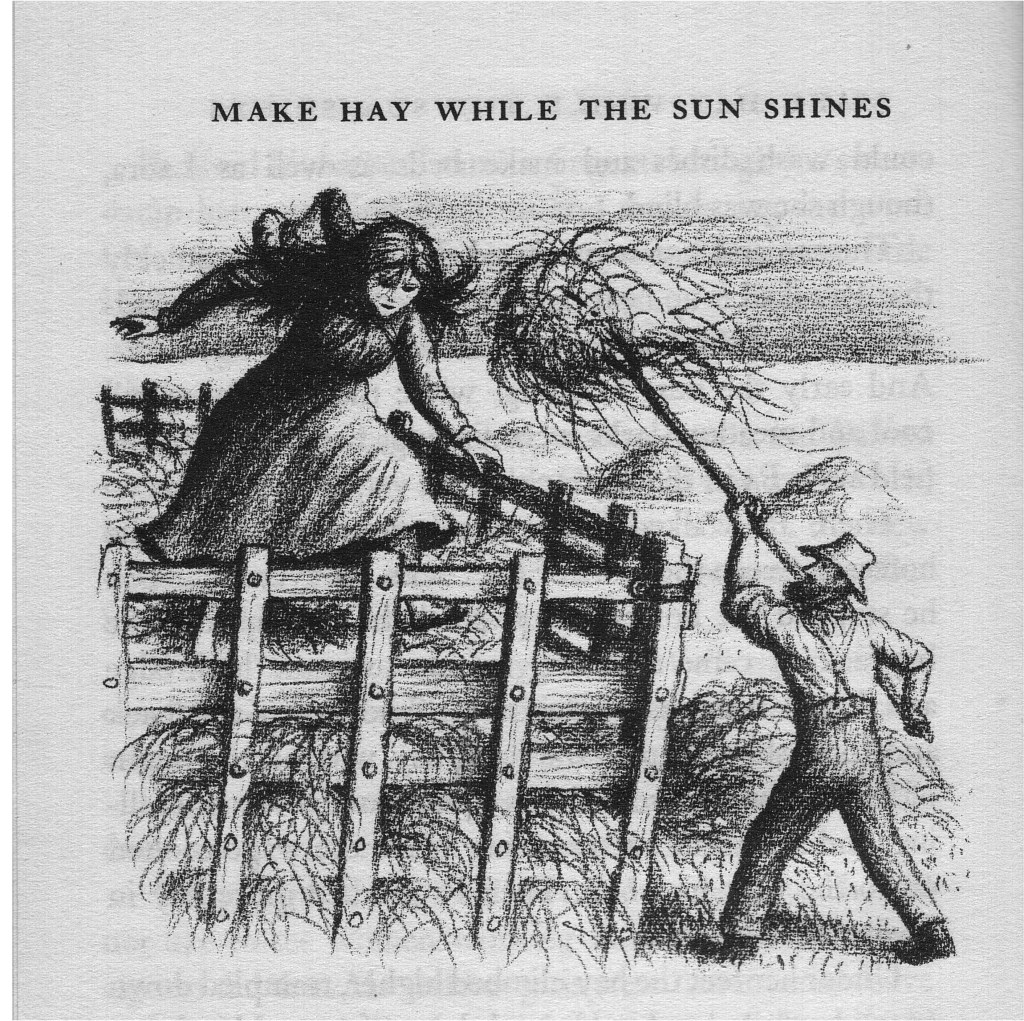
The illustration of Laura in the haywagon from The Long Winter

Laura was very high up now and the slippery hay was sloping downward around her. She went on trampling carefully. Her face and her neck were wet with sweat and sweat trickled down her back. Her sunbonnet hung by its strings and her braids had come undone. Her long brown hair blew loose in the wind.

Then Pa stepped up on the whiffletrees. He rested one foot on David’s broad hip and clambered up onto the load of hay.

‘You’ve done a good job, Laura,’ he said. ‘You tramped the hay down so well that we’ve got a big load on the wagon.’

Laura rested in the prickly warm hay while Pa drove near to the stable. Then she slid down and sat in the shade of the wagon. Pa pitched down some hay, then climbed down and spread it evenly to make the big, round bottom of a stack. He climbed onto the load and pitched more hay, then climbed down and leveled it on the stack and trampled it down.”

For Laura, that ride on top of the hay wagon was a well deserved and needed break from hard physical labor.

Those of us who grew up in urban or suburban settings will never know how difficult life was for farmers.

For me, a hayride conjures up memories from when I was 14 and 15 years old and the Rainbow Girls – along with the members of the boy’s group DeMolay – looked forward to that day each fall when we met at a farm and all piled into the back of a large farm truck for a ‘hayride.’

Unlike Laura Ingalls Wilder’s ‘hayride,’ ours consisted of bales of hay and a layer of straw on which to sit. We were well enclosed by the sides of the truck and squished together as the vehicle lumbered down the dark back roads of the Yakima Valley. By late September or October, the temperatures in the evenings were down into the 40’s – sometime’s the 30’s – and we were all bundled up in coats, hats, and gloves.

Three things which I most remember about the hayrides:

  • Constant jostling
  • Singing
  • The bonfire and hot dog roast when we arrived at our destination

Sadly, despite keeping a diary for several years as a teenager, the only thing I wrote for 1972 about this event was “Tonight was the hayride. It was fun.” A peek at the weather that day informs us that the high was 63 degrees but the overnight temperature was in the low 30’s. So nice and crisp, exactly how I remember. For a young teenager it was the ultimate fall activity.

Nowadays, being jostled about in the bed of a truck and sitting on hay is, perhaps, not the most fun thing to do on a brisk autumn Saturday night. But if you happen to get a hankering to go on a hayride, there’s a helpful website appropriately named hayride.com to fulfill that desire. Enjoy!

The links:

https://en.wikipedia.org/wiki/Hayride

https://www.hayrides.com/

Olympic National Park

Rhode Island has nothing on this place

June 29, 2021

At 922,649 acres – about 1,411 square miles – Olympic National Park (ONP) is roughly the same size as Rhode Island. Comparing something to Rhode Island is, of course, what American’s do.

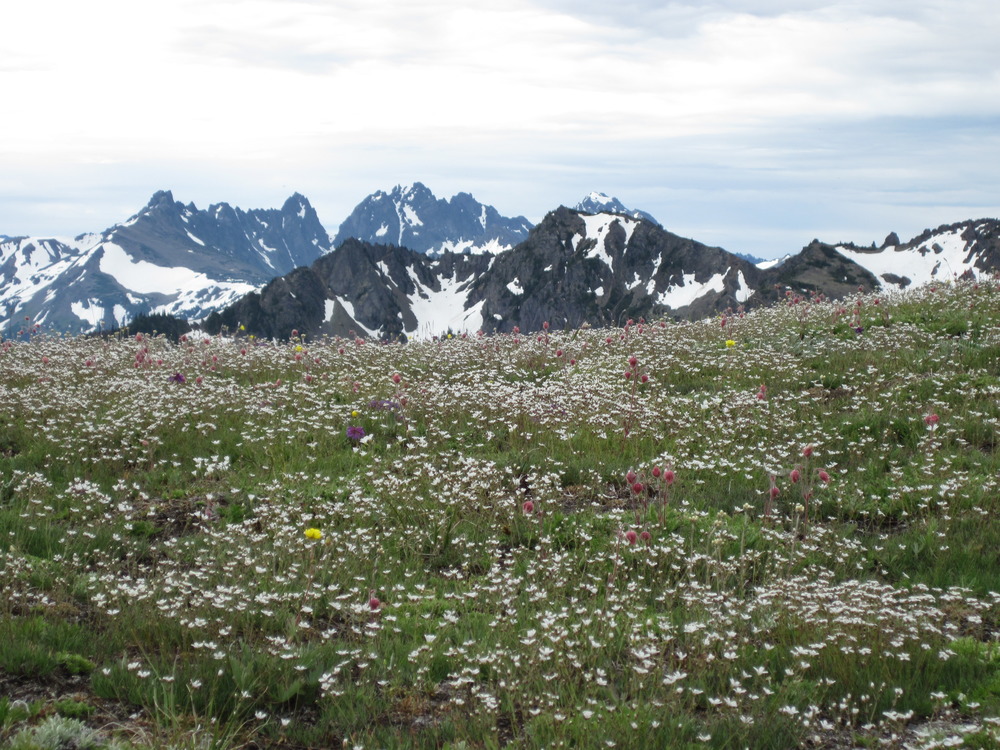
The Olympic mountains dressed up for summer with wildflowers.
Photo from ONP official website

Beyond the fact that Rhode Island borders an ocean, that’s where the similarity ends. Its highest and lowest points range from sea level to just over 800 feet. Olympic National Park, on the other hand, ranges from sea level to just under 8,000 feet with 7,965 foot tall Mount Olympus in the heart of the Olympic Mountains, the center of the park.

While one could traverse all of Rhode Island in a short span of time, to travel around Olympic NP requires planning for a variety of terrains with summer, fall, winter, and spring all possible this time of year.

It was on June 29, 1938 when the area became a National Park, the 13th largest U.S. National Park and the seventh largest in the contiguous US.

The Olympic Marmot

ONP is a true gem in the National Park system. It has a number of distinct animal species found nowhere else in the world including the snow mole, Mazama pocket gopher, Olympic chipmunk, and Olympic marmot. The Hoh River rain forest looks like a scene from a fantasy film with its moss draped trees – the result of receiving 150 inches of rain a year – making it the wettest National Park. The park also features glaciers in the mountains and over 60 miles of pristine beaches.

From the Infallible Wikipedia:

“The beach has unbroken stretches of wilderness ranging from 10 to 20 miles (16 to 32 km). While some beaches are primarily sand, others are covered with heavy rock and very large boulders. Bushy overgrowth, slippery footing, tides and misty rain forest weather all hinder foot travel. The coastal strip is more readily accessible than the interior of the Olympics; due to the difficult terrain, very few backpackers venture beyond casual day-hiking distances.

Tree framed sea stacks.

The most popular piece of the coastal strip is the 9-mile (14 km) Ozette Loop. The Park Service runs a registration and reservation program to control usage levels of this area. From the trailhead at Ozette Lake, a 3-mile (4.8 km) leg of the trail is a boardwalk-enhanced path through near primal coastal cedar swamp. Arriving at the ocean, it is a 3-mile walk supplemented by headland trails for high tides. This area has traditionally been favored by the Makah from Neah Bay. The third 3-mile leg is enabled by a boardwalk which has enhanced the loop’s visitor numbers.”

Unlike its Washington State counterpart, Rainier National Park, Olympic is not overrun with visitors each year. One can visit Olympic and encounter the occasional hiker and a handful of intrepid souls who trek to the beach for its incomparable vistas. One often feels as though they are an explorer from another century, viewing the landscape in much the same way those first settlers saw it.

I first went to ONP as a teenager on a day trip up to Hurricane Ridge. Most of what I recall about that trip was my dad stopping the car in a wide spot so we could get out and visit with a local – that is a deer – who was unafraid of people.

Me and the kids at Heart of the Hills campground in 2004

Although I’ve made the foray into the park a number of times, I still feel as though I don’t really know it. Of the 60 miles of beaches I’ve only ever seen the areas near Klaloch, Ozette, and Rialto. There is a stunning beauty when you stand at the Pacific Ocean’s edge and see the sea stacks, crashing waves, and hundreds of birds soaring overhead.

During a 2004 trip with the kids and hubby, we found ourselves communing with a herd of elk – again the elk were unconcerned at the human’s among them – an event which I’m certain the kids still recall. We marveled at the Hoh river rain forest, and all of us got a little bit fatigued at the driving required to traverse the sheer distance between places.

Even so, we still only experienced a tiny portion of the park.

The hubby and I have had on our bucket list to visit every National Park and although we’ve been to Olympic several times, it definitely deserves another trip or ten.

But don’t tell anyone – us Washingtonians like having Olympic all to ourselves.

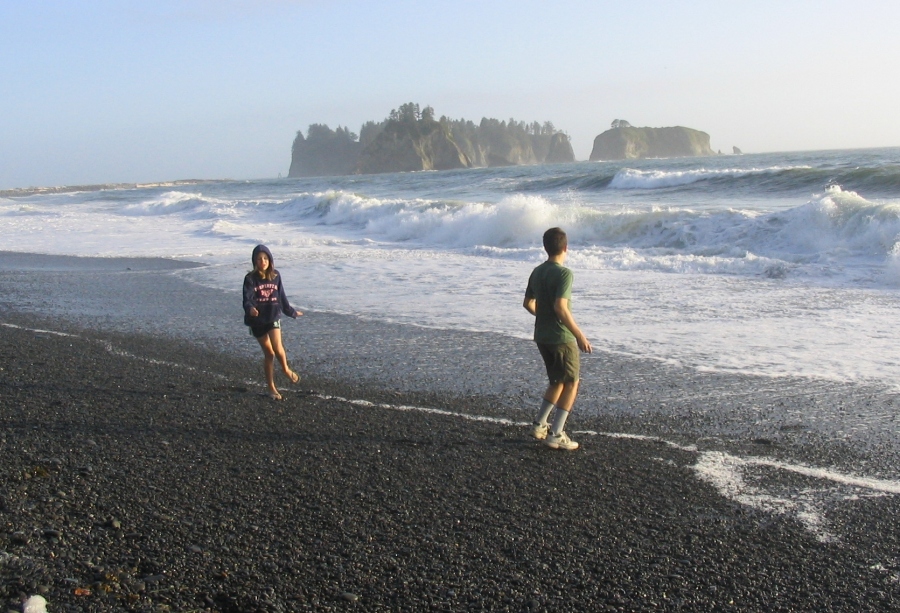
The kid’s on Rialto Beach summer 2004

The links:

https://en.wikipedia.org/wiki/Olympic_National_Park

https://www.nps.gov/olym/index.htm

Dairy Queen Days

A summertime tradition

June 22, 2021

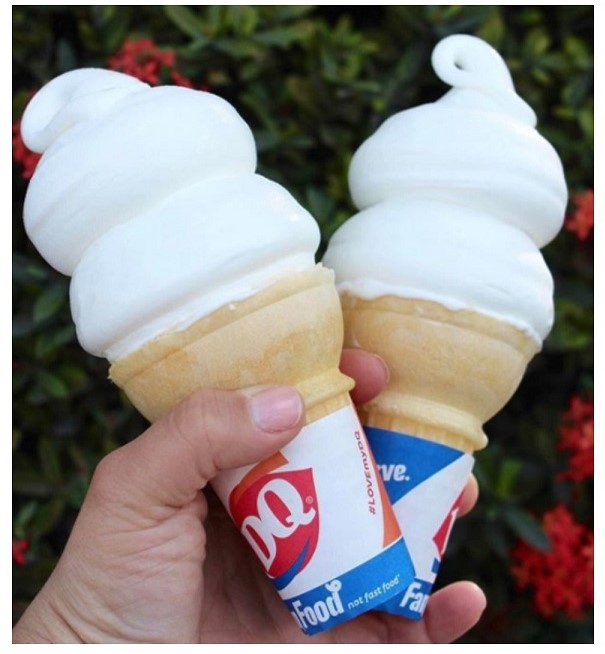
Dairy Queen’s famous soft serve vanilla cone

Nothing says ‘summer’ to me more than a trip to a drive in burger restaurant on a warm afternoon for something cold and frosty. Back in 1960’s Yakima, Washington there were only two places our family went when we wanted an ice cream based treat. The first was the A&W root beer stand for a float. The second was Dairy Queen. McDonald’s didn’t come to Yakima until the 1970’s and I’d never heard of Burger King or Wendy’s during my childhood.

Dairy Queen was the quintessential fast food joint for a hamburger, fries, and a milk shake. But more than that it was the only place one could get a soft serve ice cream cone.

It was the development of soft serve which led to the founding of the first Dairy Queen, in Joliet, Illinois, on June 22, 1940.

The Infallible Wikipedia shares:

“The soft-serve formula was first developed in 1938 by John Fremont ‘J.F.’ ‘Grandpa’ McCullough and his son Alex. They convinced friend and loyal customer Sherb Noble to offer the product in his ice cream store in Kankakee, Illinois. On the first day of sales, Noble dished out more than 1,600 servings of the new dessert within two hours. Noble and the McCulloughs went on to open the first Dairy Queen store in 1940 in Joliet, Illinois. While this Dairy Queen has not been in operation since the 1950s, the building still stands at 501 N Chicago Street as a city-designated landmark.

Since 1940, the chain has used a franchise system to expand its operations globally from ten stores in 1941 to one hundred by 1947, 1,446 in 1950, and 2,600 in 1955.”

On the Dairy Queen website they list 4,421 locations in 49 states. Texas boasts the largest number of restaurants with 594 stores. It continues to be a popular chain throughout the Midwest and the South with between 130 and 260 stores in each state. The only state without a DQ is Vermont. Washington State has the largest number of Dairy Queen restaurants of the Western states with 101 locations. Any way you scoop it, that’s a lot of ice cream.

When I became a teenager my friend Karen and I would sometimes walk to the Dairy Queen which was less than a mile from my house – and only four blocks from hers – just for one of those soft serve cones or, even better, one dipped in chocolate.

The summer my kids were 9 and 6 I dubbed it the Dairy Queen summer. Once a week we’d go through the drive through at the Redmond Way Dairy Queen for those same soft serve cones. In those days I would often just get a Dr. Pepper. What was I thinking?!

In the last year of my Dad’s life his world grew smaller and smaller. But some things never changed. One of those was the joy he got from getting a chocolate chip Blizzard from Dairy Queen. He’d been having increasing difficulties swallowing and the treat seemed to help soothe his throat.

One afternoon in August of 2019, I decided to take him on an outing to Dairy Queen for a Blizzard. This was no small task since getting him to the car, settled into the passenger seat, and then stowing his walker, was always an ordeal.

As we were headed to the restaurant, located out in West Yakima, he grew more and more agitated, questioning where the ‘he**’ I was taking him and proclaiming the adventure as ridiculous. “Dairy Queen,” I answered him, but he was not to be placated. That was NOT the right Dairy Queen.

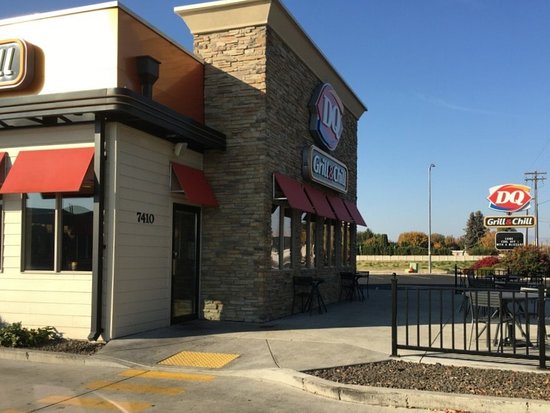
The west Yakima Dairy Queen which caused so much angst

At the time I didn’t realize there were actually a half dozen stores in the town. I only knew of two. One in downtown Yakima and the one where I was heading.

Those were the longest 5.2 miles I’ve ever driven; eventually we arrived and got the treat but he carped about the amount of time it took all the way there and then the 5. 2 miles back again to his adult family home.

A few weeks later I had the chance to redeem myself. Off we headed to Dairy Queen, but this time I was taking no chances. I headed to the one I was sure he wanted; located in downtown Yakima it was a much closer 3.2 miles.

We were stopped by every traffic light in town (it was late afternoon and folks were headed home from work) and the carping started up, with a repeat of the previous trip. When we FINALLY got to the Dairy Queen some 20 minutes later, there was a bit of a line for the drive through. I figured the car ahead of us must have been ordering for a family of 15 based on how long it took. But I was desperate. No way was I exiting that line and driving anywhere else without that Blizzard. Eventually he got the treat and was placated for a few minutes. I needed a nap.

It was only after we were back – nearly an hour later – and he was dozing in his chair that I put Dairy Queen into the map application on my phone. I was dismayed to discover that the nearest store to where he lived was… 1.4 miles away. Next time, I promised, we would go there.

Alas, the weather changed and the Dairy Queen trips were done for the summer. By the end of October he was gone.

One of these warm June or July days I think I will splurge and raise a chocolate dipped cone in a toast to Dairy Queen for its place in our family history. Maybe I’ll even try a chocolate chip Blizzard in honor of Dad.

Naw. I’m a chocolate dipped ice cream cone girl all the way. Some things never change.

The link: https://en.wikipedia.org/wiki/Dairy_Queen

Casey Kasem

“Keep your feet on the ground and keep reaching for the stars.”

April 27, 2021

For anyone who was a teenager in the 1970’s, these words were said by the one person who – each week – united millions of baby boomers.

That person was Kasey Kasem, born April 27, 1932.

Casey Kasem in the early days of American Top 40

For those who are younger than about 40, you can be forgiven for not knowing WHO Kasey Kasem was. But for the rest of us he was the voice of American Top 40, a weekly radio countdown show which began in the summer of 1970.

Kasem began his career in radio, but branched out to pursue acting. He only found limited success in television and movie roles. It was his distinctive voice, however, which catapulted him to fame.

From the ever Infallible Wikipedia:

“Kasem acted in a number of low-budget movies and radio drama. While hosting “dance hops” on local television, he attracted the attention of Dick Clark, who hired him as co-host of a daily teenage music show called Shebang, starting in 1964. Kasem’s roles on network TV series included Hawaii Five-O and Ironside In 1967, he appeared on The Dating Game, and played the role of “Mouth” in the motorcycle gang film The Glory Stompers. In 1969, he played the role of Knife in the film Wild Wheels, and had a small role in another biker movie, The Cycle Savages, starring Bruce Dern and Melody Patterson, and The Incredible 2-Headed Transplant (also with Dern).

Kasem’s voice was the key to his career. In 1964 during the Beatlemania craze, Kasem had a minor hit single called “Letter from Elaina”, a spoken-word recording that told the story of a girl who met George Harrison after a San Francisco Beatles concert. At the end of the 1960s, he began working as a voice actor. In 1969, he started one of his most famous roles, the voice of Shaggy on Scooby-Doo, Where Are You! He also voiced the drummer Groove from The Cattanooga Cats that year.”

The creation of American Top 40 – which he devised in collaboration with three other individuals – is what made him a household name. He was the on-air voice of the program for the next 18 years.

For many Baby Boomers, Kasem was like a friend we’d never met or an older brother. None of us probably realized he was of our parents’ generation. He seemed to ‘get’ us and our music.

When he left AT40 in 1988 it was due to a contract dispute. He then created a competing countdown known as Kasey’s Top 40.

He later regained an ownership interest in AT40, once again doing the countdown for several years. Additionally, he continued his voice acting work well into his late 70’s.

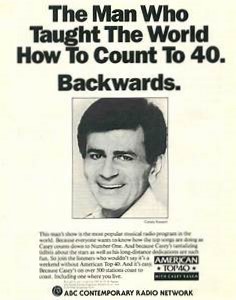
Ad for AT40 in a trade publication

By the fall of 2013, it became known that Kasem was suffering from either Parkinson’s disease or Lewy Body Dementia (it’s unclear which it was). From then until his death in June 2014, a fight over his care erupted between his second wife and his children from his first marriage; the travails of that fight spilled into the pages of the tabloid press for the next six months.

It would have been exactly the sort of story he would have shared on AT40; one filled with conflict and intrigue, definitely tabloid worthy.

I think, perhaps, it was his storytelling ability which was most compelling. He ferreted out interesting facts about the musical artists, the songs, and songwriters and you could tell he was truly interested in what he was sharing. This, to me, is much like writing Tuesday Newsday each week as great part of the enjoyment of writing is in researching and learning new things.

Despite the rather messy situation at the end of his life, I think Kasem filled his years doing what he loved. There is no better way, in my opinion, to live one’s life except to find and pursue the thing which brings you joy and fulfillment. Certainly he faced challenges – just like all of us – but on whole it would seem that his chosen path led him to the top of the charts . We should all be so lucky to live such a life.

The link: https://en.wikipedia.org/wiki/Casey_Kasem

Answer to the Facebook question is for the other three besides the ATF photo, are all voice characters of Casey Kasem: Shaggy, Robin, Cliffjumper